EV Tax Credit Eliminated in 2026: $23 Billion in Red State EV Projects Canceled as US Lags China
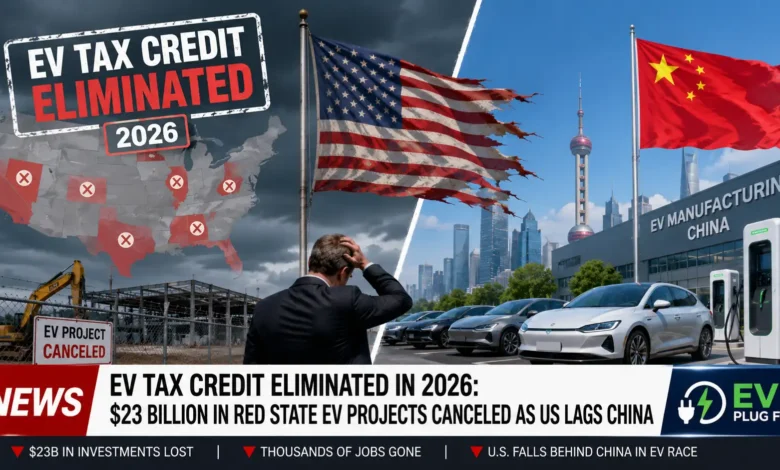
The $7,500 federal EV tax credit that sparked a $188 billion American manufacturing renaissance is officially dead in 2026, and the consequences are already reshaping the U.S. industrial landscape. The elimination of this consumer incentive—part of the Inflation Reduction Act of 2022—has triggered a wave of project cancellations that disproportionately impact Republican congressional districts, even as China extends its global EV dominance to a staggering 75% of worldwide production . Veteran Republican strategist Mike Murphy, founder of the American EV Jobs Alliance, calls the situation “grim,” warning that the political calculus around EVs has shifted so dramatically that Republican lawmakers now face no electoral consequences for dismantling the very incentives that brought jobs to their districts .
The $23 Billion Reckoning: Red State EV Projects Canceled
The numbers paint a stark picture of the policy shift’s impact. According to Atlas Public Policy, nearly $23 billion worth of EV and battery projects have been canceled in 2026 alone, eliminating more than 30,000 promised jobs. Crucially, 76% of these scrapped investments were located in Republican-controlled districts . This isn’t a blue-state problem—it’s a manufacturing crisis unfolding in the heartland of Trump country.
Ford’s massive BlueOval SK battery plant in Kentucky, a $5.8 billion facility hailed as a regional economic game-changer, now faces an uncertain future. U.S. Rep. Brett Guthrie, a Kentucky Republican who once celebrated his district becoming “an EV battery corridor,” voted for the legislation that eliminated the tax credits driving demand for those very batteries . Similar stories play out in Michigan, where the Ford Marshall battery plant—which recently announced it would create 1,700 jobs—now operates under a cloud of policy uncertainty .
The “Policy Penalty Box”: How China Is Winning
The timing couldn’t be worse. While the U.S. retreats from EV incentives, China has accelerated its dominance with surgical precision. Chinese automakers now produce EVs 25-30% cheaper than international rivals, thanks to state subsidies, vertical integration, and a domestic market of 1.4 billion consumers. Chinese brands now account for over 32% of global passenger EV sales, compared to just 5% for America’s Big Three . Even more telling: China produces 80% of the world’s battery cells, and its average battery prices are 30% lower than in the U.S. .
“The choice facing Washington is between letting the Chinese into the US market, going it alone without help, or adopting a new ‘Miracle’ game plan that harnesses America’s innovation strengths.”
— Harry Martin, CEPP Report Lead Author, UC Berkeley
Voter Disconnect: The Knowledge Gap That’s Reshaping Policy
Mike Murphy’s research reveals a troubling disconnect between voter knowledge and policy outcomes. “Most voters are either oblivious to the situation or simply don’t care,” Murphy told Automotive News, noting that the Republican party invested heavily in anti-EV campaigns while Democrats remained largely passive . The consequence? Few voters grasp that China is significantly ahead in the EV industry, thanks to government subsidies that make U.S. incentives look modest by comparison.
However, polling data from February 2025 tells a different story. A survey of 1,016 registered voters found that 85% of Americans—including 76% of Republicans—believe the federal government should support American companies making affordable EVs. A striking 81% of Republicans support federal investments that keep EV manufacturing jobs in the U.S. . Yet this sentiment hasn’t translated into political pressure on lawmakers, largely because EVs have become a “tribal” symbol of environmental activism that triggers reflexive opposition among conservative voters. Understanding Cross-Brand EV Charging Compatibility is essential as the domestic charging infrastructure continues to evolve amid these policy shifts.
State vs. Federal: A Growing Republican Divide
One of the most overlooked dynamics in the EV policy debate is the growing tension between Republican governors and federal Republican lawmakers. Red-state governors have embraced the EV manufacturing boom with enthusiasm. Georgia’s Brian Kemp wants his state to become the “electric mobility capital of the world,” while similar ambitions burn bright in Tennessee and South Carolina .
Yet these same governors are being undercut by their party’s federal leadership. The Trump administration’s Department of Energy recently canceled $7.5 billion in grants for 223 clean energy projects, including EV manufacturing initiatives that would have created thousands of jobs in red states . Republican mayors like Kokomo’s Tyler Moore have personally lobbied Congress to save the EV tax credit—to no avail .
| Metric | 2025 (Before Repeal) | 2026 (Post-Repeal) | Change |
|---|---|---|---|
| EV Projects Canceled | $0 | $23 billion | ▲ Cancellations |
| Jobs Lost/At Risk | 30,000+ projected | 100,000 at risk | ▲ Risk |
| GOP District Impact | 60%+ of new projects | 76% of cancellations | ▲ Disproportionate |
| China Global EV Share | ~30% | 32% (growing) | ▲ Chinese Dominance |
What Comes Next: The Road Ahead for U.S. EV Policy
The end of the EV tax credit doesn’t necessarily spell doom for American EV manufacturing—but it does make the road significantly harder. According to UC Berkeley’s CEPP report, the U.S. could lose 667,000 potential EV manufacturing jobs by 2040 without a new industrial strategy . However, some analysts see an opportunity for Republicans to reframe EV manufacturing as a national security imperative rather than a climate policy.
Murphy has a straightforward message for companies hoping to preserve pro-EV policies: ensure lobbyists reach the White House with visual impact of all the plants under construction. “Strategically, this could be an opportunity for Trump to capitalize on politically, if only he understood the significance,” Murphy noted .
Germany’s Cautionary Tale
History offers a warning from across the Atlantic. When Germany abruptly ended its EV subsidy program in December 2023, monthly EV sales crashed by 50% in January 2024. Battery-electric vehicle market share fell from 18.5% to 13.5% over the following year, allowing the UK to overtake Germany as Europe’s largest EV market .
Princeton University’s Zero Lab estimates that without the $7,500 tax credit, U.S. EV sales could be 40% lower in 2030 than they would have been with the incentive structure intact .
Automakers Respond: The Plan Continues
Despite the policy headwinds, major automakers remain committed to their electrification plans—at least for now. Toyota North America’s David Christ told the Associated Press that “political considerations aren’t a factor in how we approach product development or capital investments” . Ford continues hiring at its Michigan battery plant, with more than 500 employees already on board and production of LFP batteries on track for 2026 .
But the uncertainty is taking its toll. Benchmark Mineral Intelligence has already lowered its forecast for U.S. lithium demand in 2029 by 15% following the policy shifts . And with Elon Musk—who supported ending the tax credit because it would hurt rivals more than Tesla—now serving as a Trump adviser, the policy direction appears locked in for the foreseeable future . For consumers navigating this uncertain landscape, staying informed about EV Charger Error Codes and following a regular EV Charging Maintenance Guide can help protect your investment and ensure reliable performance regardless of policy changes.
The Bottom Line
The elimination of the EV tax credit in 2026 represents a pivotal moment for American manufacturing and global competitiveness. While the policy saves an estimated $168 billion in federal spending over a decade, it comes at the cost of ceding global leadership in the defining technology of the 21st century to China. For Republican lawmakers representing districts hit hardest by the cancellations, the political calculus may soon shift as the reality of lost jobs sets in. As Michigan Governor Gretchen Whitmer noted, the transition to domestic battery manufacturing creates “high-tech jobs” that communities desperately need .
The question isn’t whether EVs are the future—it’s whether America will be part of that future, or whether it will leave the playing field entirely to China.