Car Battery Charger Certifications by Market: EU, UK, US, Japan and Korea

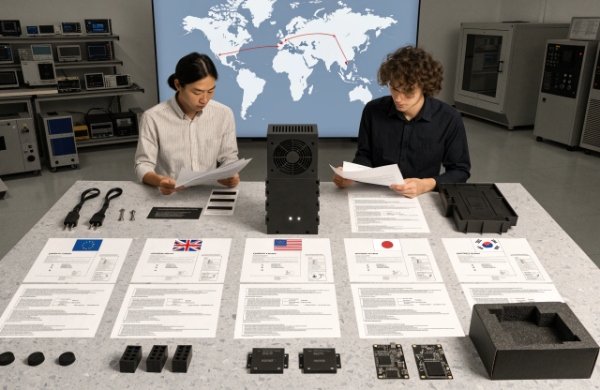
There is no single certification that automatically gives a mains-powered car battery charger access to every major market. The applicable compliance route depends on the destination, product classification, electrical design, intended use and any additional functions built into the charger.
For B2B buyers, the important question is therefore not simply whether a charger carries a CE, UL, PSE or KC mark. The more useful question is whether the compliance documentation covers the exact product, manufacturer, production site, electrical ratings, configuration and destination market.
This distinction matters because the European Union, Great Britain, United States, Japan and South Korea use different regulatory and conformity-assessment systems. A test report prepared for one jurisdiction may provide useful technical evidence in another, but it does not automatically satisfy that market’s legal requirements.
Why One Charger Certification Does Not Cover Every Market
Electrical products can be subject to requirements covering electrical safety, electromagnetic compatibility, hazardous substances, radio equipment and product labeling. The applicable rules vary by jurisdiction and by product classification.
For an international charger project, the compliance process should therefore begin with a destination-market matrix rather than a generic request for a “global certificate.”
| Market | Primary compliance route | What buyers should verify |
|---|---|---|
| European Union | Applicable EU product legislation and CE marking | EU Declaration of Conformity, technical documentation and applicable standards |
| Great Britain | Applicable UK product regulations and the current product-marking framework | Whether CE or UKCA is accepted for the specific product sector and the applicable conformity requirements |
| United States | Applicable product-safety requirements plus FCC requirements where applicable | NRTL certification where required, applicable FCC authorization and relevant market or installation requirements |
| Japan | Electrical Appliances and Materials Safety Act requirements where the product falls within its scope | Product classification, importer responsibilities and PSE requirements where applicable |
| South Korea | Applicable KC safety, electromagnetic compatibility and/or radio conformity routes | Product classification and the specific conformity assessment applicable to the product |
The practical consequence is straightforward: identify the destination markets before the final product design and certification plan are locked.
CE Marking: What It Actually Means for a Car Battery Charger
CE marking is often misunderstood as a standalone third-party certificate. It is better understood as part of the EU conformity framework established by the legislation applicable to the product.
For electrical equipment within the scope of the EU Low Voltage Directive, for example, the manufacturer must complete the applicable conformity-assessment procedure, prepare the required technical documentation and EU Declaration of Conformity, and affix the CE marking when the applicable requirements have been met.
Other EU legislation may also apply depending on the charger’s technical characteristics. A mains-powered charger can be subject to electromagnetic-compatibility requirements, while electrical and electronic equipment may also be subject to restrictions on hazardous substances. The exact combination should be determined from the product’s design and classification rather than assumed from the product name.
The EU Declaration of Conformity should identify the product and the relevant Union legislation and standards or technical specifications used to demonstrate conformity. For products covered by the Low Voltage Directive, the manufacturer must retain the technical documentation and EU Declaration of Conformity for 10 years after the equipment is placed on the market.
What a B2B Buyer Should Request for the EU
- EU Declaration of Conformity for the actual product
- Identification of the applicable EU legislation
- Applicable test reports and standards
- Product model and electrical ratings
- Manufacturer information and product traceability
- Evidence that the production configuration corresponds with the documented configuration
- Applicable technical documentation supporting the conformity assessment
A supplier simply stating “CE certified” is therefore not enough to establish the complete compliance position.
UK Charger Compliance: CE, UKCA and the Difference Between Great Britain and Northern Ireland
The UK should not be treated as one uniform regulatory market. Great Britain covers England, Scotland and Wales, while Northern Ireland follows separate arrangements for product marking in relevant sectors.
As of 2026, Great Britain continues to recognize CE marking for many product sectors alongside UKCA under the current UK product-marking framework. The exact rules depend on the product category and applicable legislation. Northern Ireland has different arrangements that buyers must consider separately.
This distinction is important when a supplier describes a product simply as “UK compliant.” The buyer should first identify whether the destination is Great Britain or Northern Ireland and then verify the product-specific requirements that apply.
For Great Britain, current government guidance covers electrical equipment, electromagnetic compatibility and restrictions on hazardous substances within the broader product-regulation framework. The applicable marking and conformity route should be confirmed for the specific charger and destination.
Questions to Ask a Supplier for the UK
- Is the product intended for Great Britain or Northern Ireland?
- Which UK product regulations apply to the charger?
- Is CE or UKCA being used, and under which conformity route?
- Does the declaration identify the same model being purchased?
- Are the labeling and responsible-economic-operator details appropriate for the destination?
- Has the supplier checked the current requirements rather than relying on an older compliance package?
Because UK requirements can change by product sector, buyers should verify the current government guidance before relying on an existing supplier checklist.
United States: NRTL Safety Certification and FCC Requirements Are Different
The United States does not use a single federal product mark equivalent to CE for all electrical products. Electrical safety and electromagnetic-emissions requirements are separate regulatory questions.
For certain electrical equipment used in workplaces, OSHA requirements can involve approval by an OSHA-recognized Nationally Recognized Testing Laboratory, or NRTL. An NRTL is recognized by OSHA for specific testing and certification scopes, and the applicable certification is tied to the relevant safety standards and the laboratory’s recognized scope.
This does not mean that every consumer car battery charger automatically requires an NRTL certificate under one universal federal rule. The applicable requirements can depend on the product, intended use, installation, applicable codes and requirements imposed by the relevant authority or commercial channel.
FCC compliance is a separate issue. FCC rules address applicable radio-frequency emissions, including requirements for devices classified as unintentional or intentional radiators. The authorization procedure depends on the type of equipment and the applicable FCC rules.
Therefore, a statement such as “FCC approved” should not be presented as proof of electrical-safety certification.
US Compliance Questions for Buyers
- Does the charger require an NRTL-listed or certified construction for its intended application?
- Which safety standard is being used?
- Which NRTL performed or issued the applicable certification?
- Does the certification cover the exact model and production configuration?
- Does the product contain a wireless transmitter that creates additional FCC authorization requirements?
- Are the plug, cord set, power supply and critical components consistent with the documented or certified configuration?
- Are any local, state or installation requirements relevant to the intended application?
Japan: PSE Depends on Product Classification
Japan’s Electrical Appliances and Materials Safety Act regulates the manufacture, import and sale of electrical appliances and materials within its scope. The system applies to designated categories of electrical appliances and materials and assigns obligations to businesses involved in notification, import and sale.
The PSE process is not simply a matter of adding a familiar logo to a charger. The product must first be classified under the Japanese regulatory framework. Depending on the applicable category, the responsible business may have technical-compliance, inspection or conformity-assessment obligations.
AC/DC power supply units are among the types of electrical products regulated under Japan’s framework. Whether a particular car battery charger falls into a regulated category, and which requirements apply, must be determined from its exact construction and classification.
For products covered by the Act, the required PSE labeling and other applicable obligations must be completed before sale. The importer or other responsible business must also meet the statutory requirements associated with the applicable product category.
What to Verify Before Selling a Charger in Japan
- Whether the exact product is covered by the Electrical Appliances and Materials Safety Act
- The applicable product classification
- Whether the product falls into a specified or non-specified category
- Who is acting as the responsible importing or notifying business
- Whether the required conformity assessment and inspection obligations have been completed
- Whether the PSE labeling contains the required information
South Korea: KC Requirements Depend on the Applicable Conformity Route
South Korea uses KC-related conformity systems covering different categories of products and regulatory requirements. Buyers should avoid treating KC as a single generic certificate that automatically covers every electrical or electronic charger.
For broadcasting and communications equipment, South Korea’s National Radio Research Agency describes conformity assessment as covering applicable testing, inspection, certification and marking requirements. The relevant technical framework can include electromagnetic interference, electromagnetic susceptibility, wired and wireless communications requirements.
The exact route for a car battery charger depends on its classification and technical characteristics. A basic mains-powered charger without radio functions should not automatically be treated in the same way as a charger containing Bluetooth, Wi-Fi or another intentional radio function.
For products that fall within South Korea’s communications conformity system, the relevant certification or registration can be checked through the appropriate Korean authority and its certification-status resources.
Questions for a Korean Compliance Review
- What Korean product classification applies to the charger?
- Does the product require electrical-safety conformity, EMC conformity, radio conformity or more than one route?
- Does the documentation identify the exact model?
- If wireless hardware is included, does the conformity documentation cover the actual module and antenna configuration?
- Can the relevant certification or registration be verified through the appropriate Korean authority?
How to Verify a Charger Certificate Before Placing a Bulk Order
The most useful compliance review compares the paperwork with the physical product and the intended sales market. A certificate number by itself does not establish that the document covers the version being purchased.
1. Identify the Exact Product
Record the model number, input voltage, output voltage, output current, power rating, plug type and major configuration options. If the supplier sells several visually similar chargers, make sure the documentation corresponds to the exact model.
2. Check the Manufacturer and Production Site
Review the company named on the certificate or report and compare it with the manufacturer responsible for the production order. If production takes place at more than one factory, confirm that the applicable approval or certification covers the relevant site.
3. Check the Standards and Their Versions
Do not stop at the name of a standard. Record the edition or version referenced in the report and determine whether it is appropriate for the target market and product configuration.
4. Compare the Electrical Ratings
The report should not describe a materially different charger. Compare input range, output voltage, output current, rated power, frequency and other relevant electrical parameters against the production specification.
5. Review Critical Components
Changes to safety-critical components can affect compliance. Depending on the charger design, these can include transformers, fuses, capacitors, insulation systems, power switches, connectors, enclosure materials and other components relevant to the assessed construction.
6. Compare the Physical Construction
Photographs, drawings and construction descriptions in the compliance file can provide useful evidence. Check whether the enclosure, PCB, connectors, cable arrangement and other identifiable features correspond to the production sample.
7. Check Wireless Functions Separately
If the charger includes Bluetooth, Wi-Fi or another radio function, do not assume that the basic electrical-safety documentation covers the radio requirements. The wireless module, antenna configuration and final product integration may require additional regulatory consideration.
8. Record Every Discrepancy
If the certificate lists a different model, factory, rating or construction, ask the supplier or conformity-assessment body to explain the difference before approving the order. Do not assume that a design or component change is automatically acceptable.
Certificate Verification Checklist for B2B Buyers
- Destination country and sales channel identified
- Applicable regulations identified
- Exact product model confirmed
- Manufacturer and production site confirmed
- Electrical ratings match the production specification
- Applicable standards and versions reviewed
- Certificate or authorization status independently checked where a public database is available
- Critical components compared with the approved or assessed configuration
- Plug and cord configuration checked
- Physical sample compared with report photographs or drawings
- Wireless compliance reviewed where applicable
- Battery documentation reviewed if the charger contains an internal battery
- Labeling and required markings checked for the destination market
- Outstanding discrepancies resolved in writing before mass production
Build Compliance Into the Product Before Mass Production
Compliance problems are generally easier to prevent during product development than after finished inventory has been manufactured.
The first step is to define the intended markets before the final PCB, enclosure, power supply, cable and packaging are frozen. A product designed for several markets may require different components, labels or documentation depending on the requirements that apply.
Freeze the Assessed Configuration
Once the relevant testing and conformity work is complete, document the configuration that was assessed. At minimum, this should include the product model and electrical ratings. Where component changes can affect compliance, the controlled configuration should also identify relevant critical parts, PCB revisions and other applicable design details.
Use Formal Change Control
A substitute transformer, fuse, capacitor, enclosure material, power cord, PCB revision or wireless module should not be treated as an ordinary purchasing change when it can affect conformity.
Before approving a substitution, determine whether the change affects applicable test results, certification scope or technical documentation. If necessary, obtain confirmation from the relevant laboratory or conformity-assessment body.
Keep Documentation Under Version Control
Maintain the Declaration of Conformity, test reports, certificates, drawings, product specifications and relevant component information as a controlled product record. This makes it easier to establish which documents belong to a particular production version.
Do Not Leave Labels Until the Last Minute
Marking and labeling requirements should be established before packaging is printed and finished inventory is produced. Correcting labels or packaging after production can create unnecessary cost and delay.
Common Compliance Mistakes to Avoid
Assuming CE Means Globally Certified
CE marking addresses applicable EU conformity requirements. It does not automatically establish compliance with US, Japanese or Korean regulatory systems.
Treating FCC as a Safety Certification
FCC requirements address applicable radio-frequency emissions and equipment authorization. They should not be presented as a replacement for electrical-safety certification where a separate safety requirement applies.
Checking Only the Logo
A mark printed on a product is only one part of the compliance picture. The model, certificate holder, factory, ratings, scope and current status should also be checked.
Using an Old Report for a Changed Product
A report prepared for an earlier design may not cover a revised PCB, different power supply, new enclosure, changed cable or replacement critical component. Product changes should trigger a compliance review.
Calling Every Market “The UK”
Great Britain and Northern Ireland have different product-marking arrangements. A compliance package should identify the actual destination rather than simply stating “UK.”
Assuming an IEC Report Is Automatically a National Approval
International standards and test reports can provide valuable technical evidence, but national regulatory systems determine how that evidence is used. The destination-specific conformity route still needs to be established.
Bottom Line
Car battery charger certifications should be planned by destination market, not by logo. For the EU, buyers should verify the applicable legislation, technical documentation and EU Declaration of Conformity behind the CE marking. For Great Britain, the current CE and UKCA rules should be checked against the relevant product sector, while Northern Ireland requires separate consideration. In the United States, electrical-safety requirements and FCC requirements should be evaluated separately. Japan uses the PSE framework for products within the scope of its Electrical Appliances and Materials Safety Act, while South Korea applies product-specific KC conformity routes.
Before approving an international charger order, compare the certificate or report with the exact model, manufacturer, production site, electrical ratings, critical components and intended market. That verification step is more useful than simply asking a supplier whether a charger is “globally certified.”
FAQ
Is CE certification enough to sell a car battery charger worldwide?
No. CE marking addresses applicable EU conformity requirements. Other markets have their own regulatory frameworks and may require additional conformity assessment, documentation or labeling.
Does a US charger always need UL certification?
Not necessarily. The applicable US requirements depend on the product, intended use, applicable codes and commercial channel. OSHA recognizes multiple NRTLs, so UL is not the only possible NRTL. Where an NRTL requirement applies, the certification should come from an OSHA-recognized NRTL operating within the relevant scope.
Does FCC approval prove that a car battery charger is electrically safe?
No. FCC equipment authorization addresses applicable electromagnetic emissions and radio-frequency requirements. Electrical safety is a separate compliance question.
Does every car battery charger need PSE in Japan?
Not automatically. Japan’s PSE requirements apply according to the scope and classification established under the Electrical Appliances and Materials Safety Act. The exact charger must be assessed against the applicable Japanese product category.
Can one test report be reused in several countries?
Technical test data can sometimes support conformity work in more than one market, but a report does not automatically become a legal approval in every jurisdiction. The applicable national requirements and conformity procedures must be checked separately.
Source Transparency
This article is based on primary regulatory and government information concerning the market-specific compliance frameworks discussed, including European Union legislation, UK government product-marking guidance, US Occupational Safety and Health Administration and Federal Communications Commission information, Japan’s Ministry of Economy, Trade and Industry, and South Korea’s National Radio Research Agency.
- European Union: Low Voltage Directive
- UK Government: CE and UKCA requirements in Great Britain
- OSHA: Nationally Recognized Testing Laboratory Program
- FCC: Equipment Authorization Procedures
- Japan METI: Electrical Appliances and Materials Safety Act
- South Korea RRA: Conformity Assessment System
Regulatory note: Certification requirements can depend on the exact charger design, product classification, intended use and destination. Buyers should confirm the current requirements with the relevant authority or qualified conformity-assessment body before relying on this article for a commercial compliance decision.