EV Charging Adapters Explained: Standards, Speeds and Compatibility

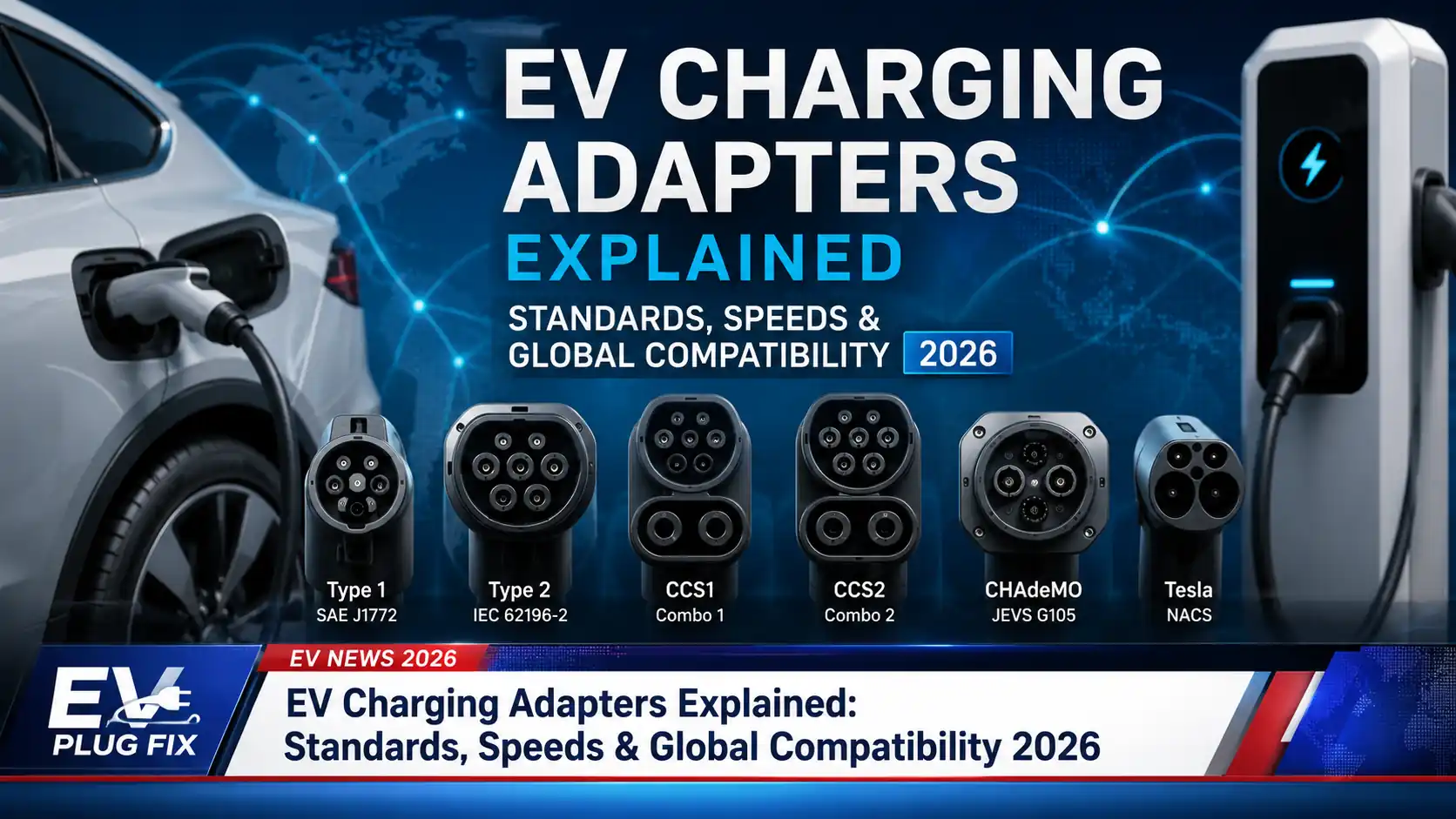
An EV charging adapter can solve a connector mismatch, but matching two plug shapes does not guarantee that a charging session will work. The vehicle and charger must also be compatible electrically and, particularly for DC fast charging, capable of communicating correctly and supporting the required authorization.
This distinction matters as charging standards change. North America is moving toward the SAE J3400 connector commonly associated with Tesla’s North American Charging Standard, while a large number of CCS1 and J1772 vehicles and chargers remain in service. Europe primarily uses Type 2 for AC charging and CCS2 for DC fast charging. CHAdeMO remains relevant in Japan and on compatible vehicles elsewhere, while China has its own GB/T charging standards.
Understanding those differences makes it easier to tell when an adapter is useful, when it can limit charging, and when changing the connector alone cannot make two systems interoperable.
AC and DC Adapters Solve Different Problems
The first question to ask about any EV charging adapter is whether it is intended for AC charging or DC fast charging. The two modes perform different functions inside the vehicle and should not be treated as interchangeable.
How AC Charging Works
An AC charging station supplies alternating current to the vehicle. The EV’s onboard charger handles the AC-to-DC conversion before that electricity reaches the traction battery.
The onboard charger therefore imposes one of the main limits on AC charging speed. If a vehicle can accept a maximum of 7.2 kW AC, connecting it to higher-capacity charging equipment does not make the vehicle consume the charger’s full available output.
The final charging rate is constrained by the relevant limits of the electrical supply, charging equipment, cable, adapter and vehicle.
How DC Fast Charging Is Different
A DC fast charger performs the AC-to-DC conversion outside the vehicle and supplies controlled DC power to the vehicle’s high-voltage charging system. This allows compatible EVs to charge at much higher power than they normally can from AC equipment.
DC adapters consequently have more demanding electrical and communication requirements than ordinary AC connector adapters. They must be designed for the intended voltage and current while maintaining the signaling, safety and control functions required by the vehicle and charger.
A charger’s advertised maximum output is not a promise of the power a particular EV will receive. The vehicle controls how much power it accepts according to its charging capability and operating conditions.
Major EV Charging Connectors
| Connector | Common Market | Charging Type | Key Point |
|---|---|---|---|
| SAE J1772 / Type 1 | North America; also found in Japan | AC | A widely deployed AC interface on North American EVs and plug-in hybrids |
| CCS1 | North America | AC and DC through the combined vehicle inlet | Extends the J1772-style vehicle interface with DC contacts |
| SAE J3400 / NACS-style connector | North America | AC and DC | Supports both charging modes, but network access still depends on the vehicle and charging provider |
| Type 2 | Europe and other markets | AC | Can support single-phase or three-phase AC charging depending on the installation and vehicle |
| CCS2 / Combo 2 | Europe and many other markets | AC and DC through the combined vehicle inlet | The principal interoperable DC interface across European public charging infrastructure |
| CHAdeMO | Japan and legacy installations elsewhere | DC | Remains relevant to compatible vehicles and charging networks, with availability varying by region |
| GB/T | China | AC and DC | Part of China’s separate national EV charging standards framework |
J1772: A Long-Established North American AC Interface
SAE J1772, often called Type 1, has been extensively deployed for AC charging in North America. It remains important even as newer vehicles begin moving to J3400-style inlets because a substantial installed base of vehicles and charging equipment uses J1772.
The interface includes conductors for power and signaling used to establish a safe charging connection and communicate information such as the current available from the charging equipment.
J1772 itself is an AC charging interface. A compatible AC adapter can allow a vehicle with a different supported inlet to connect to J1772 equipment, but it does not bypass the vehicle’s onboard charger or increase its AC charging capability.
CCS1 Adds DC Fast Charging to the Type 1 Interface
CCS1, or Combined Charging System Type 1, builds on the J1772-style vehicle interface by adding two larger contacts for DC charging. A CCS1 vehicle inlet can therefore accommodate the appropriate AC connector as well as a CCS1 DC fast-charging connector.
CCS1 became a major DC fast-charging interface for non-Tesla EVs in North America. The transition toward J3400 does not make existing CCS1 vehicles or charging stations immediately irrelevant; both will remain part of the charging landscape during the transition. For a broader comparison of these regional systems, see how EV charger standards differ between Europe and the US.
Some CCS1 vehicles can also use compatible J3400/NACS DC charging equipment through an appropriate adapter. That capability depends on support from the vehicle manufacturer and charging provider, not merely on whether an adapter physically fits.
SAE J3400, NACS and Supercharger Access
Tesla published its charging connector design as the North American Charging Standard, or NACS, in 2022. SAE International subsequently standardized the interface through its J3400 work, creating an industry standards framework around the connector used in the North American transition.
The J3400-style interface can support both AC and DC charging through the same vehicle inlet, and multiple automakers have announced or begun adopting it in North America.
The terminology can nevertheless cause confusion. A vehicle having a J3400/NACS-style inlet does not automatically mean that it can charge at every Tesla Supercharger.
Tesla provides several forms of access for non-Tesla EVs. Some locations have integrated adapters intended for compatible non-Tesla vehicles, while supported manufacturers can provide access to compatible Superchargers for eligible vehicles using approved adapters or compatible native charging ports.
Vehicle eligibility and charger access can vary by manufacturer, model and charging location. Drivers planning to use Tesla’s network should therefore verify current compatibility through their vehicle manufacturer and Tesla’s Supercharging support information.
The important distinction is that connector compatibility and charging-network access are separate requirements.
Type 2 and CCS2 in Europe
European charging infrastructure developed around Type 2 for AC charging and CCS Combo 2 for interoperable DC fast charging.
Type 2 AC Charging
Type 2 supports AC charging and can accommodate single-phase or three-phase configurations. The connector alone does not establish the charging rate.
For example, a Type 2 charging point may be capable of supplying more AC power than a particular vehicle can accept. The usable rate still depends on the electrical supply, charging equipment, cable and vehicle’s onboard charger.
This is why describing Type 2 itself as a particular charging speed can be misleading.
CCS2 DC Fast Charging
CCS2, also known as Combo 2, combines the Type 2 arrangement with additional DC contacts. It is the principal interoperable DC charging interface used across the European Union.
The EU Alternative Fuels Infrastructure Regulation establishes connector requirements for relevant publicly accessible charging infrastructure, including Type 2 and Combo 2 interfaces under the applicable technical specifications. These requirements set interoperability baselines and do not necessarily prevent charging sites from providing additional interfaces.
The regulatory framework and its current technical requirements are available through the EU Alternative Fuels Infrastructure Regulation.
CHAdeMO Remains Relevant in Specific Markets
CHAdeMO was among the first widely deployed DC fast-charging systems. It remains particularly important in Japan and is still found on compatible vehicles and legacy charging infrastructure in other markets.
The Nissan Leaf is a prominent example of a passenger EV that has used CHAdeMO in multiple markets, although charging configurations can vary by generation and region. Mitsubishi has also sold vehicles using the interface.
For owners, regional availability matters more than broad claims that CHAdeMO is either obsolete or universally supported. A CHAdeMO-equipped vehicle may remain practical where suitable chargers are readily available and considerably harder to road-trip where the network is sparse.
GB/T and Chinese-Market EVs
China uses its own national standards for conductive EV charging, commonly identified through GB/T standards. Vehicles built for the Chinese domestic market can consequently have different charging interfaces and charging-system configurations from versions sold under the same brand elsewhere.
This becomes especially important when importing a vehicle. A model intended for China should not be assumed to charge normally in Europe or North America simply because a physical adapter can connect its inlet to a local charger.
DC fast charging may require compatibility in signaling and higher-level communications as well as voltage and current capability. A passive mechanical adapter cannot solve every difference between regional charging systems.
What an EV Charging Adapter Actually Does
An adapter provides an interface between a charging connector and a different vehicle inlet. In straightforward applications, particularly some AC charging arrangements, that may be enough because the underlying vehicle and charging systems are already compatible. Understanding the main EV charging connector types helps establish which physical interfaces are involved before considering an adapter.
In other situations, especially DC fast charging, successful operation requires much more than a physical connection.
Adapters Do Not Increase a Vehicle’s Charging Limit
If an EV’s onboard charger can accept a maximum of 11 kW AC, connecting it through a suitable adapter to a charging point capable of supplying more power does not raise the vehicle’s limit.
The same principle applies to DC charging. A high-power station makes power available, while the vehicle’s battery-management and charging systems determine how much power the vehicle can request and accept.
Physical Adaptation Is Not Always Protocol Conversion
The vehicle and charging equipment exchange information before and during charging. Depending on the system, communication can be used for charging control, safety functions, authentication and other features.
Some adapter combinations work because the vehicle and charger were specifically designed or updated to interoperate. Other combinations would require communication translation or vehicle support that a simple passive adapter cannot provide.
Product descriptions that mention two connector names therefore provide only part of the information needed. Drivers must also confirm the charging mode, direction, vehicle compatibility and, for public charging, network support.
Network Authorization Can Stop an Otherwise Compatible Session
A mechanically compatible connection does not necessarily provide access to a charging network. Public charging systems can require supported vehicle integration, account authorization, compatible charger hardware or other network-specific conditions.
Tesla Supercharger access for non-Tesla vehicles is a useful example: an adapter alone does not guarantee that an otherwise unsupported vehicle can use every Supercharger.
Adapter Direction Matters
Descriptions such as “NACS-to-CCS” can be ambiguous unless they specify which connector is attached to the charger and which inlet is on the vehicle. An adapter designed for one direction should not be assumed to work in reverse.
| Charging Situation | Required Function |
|---|---|
| CCS1 vehicle using supported J3400/NACS DC equipment | Connect the J3400/NACS charging connector to the CCS1 vehicle inlet |
| J3400/NACS vehicle using supported CCS1 DC equipment | Connect the CCS1 charging connector to the J3400/NACS vehicle inlet |
| J3400/NACS vehicle using J1772 AC equipment | Adapt the J1772 AC connector to the vehicle’s supported AC interface |
| Vehicle using a foreign-market charging system | May require electrical and communication compatibility beyond physical adaptation |
Always follow the documented direction of use. Unless both the adapter manufacturer and vehicle manufacturer explicitly support bidirectional physical use, do not assume that reversing the connection is acceptable.
Will an Adapter Slow Down Charging?
An EV charging adapter is an access device, not a performance upgrade. A properly designed adapter with suitable electrical and thermal capability may allow charging at the rate supported by the rest of the system. An adapter with a lower supported rating can become another limiting component.
Charging power can be constrained by:
- the vehicle’s AC or DC charging capability;
- the charging station’s available output;
- the electrical and thermal limits of the adapter and cable;
- battery temperature;
- battery state of charge;
- the vehicle’s charging curve;
- station power sharing; and
- vehicle or charger protection systems.
This is particularly important when comparing DC fast chargers by their advertised peak power. The station’s maximum rating describes what the equipment can potentially provide, not what every connected EV will continuously receive.
Why DC Charging Power Changes During a Session
An EV normally does not maintain its peak DC charging power from an empty battery all the way to full. The vehicle continually adjusts charging according to battery temperature, state of charge, cell conditions and limits defined by its charging system.
Many EVs can accept higher power at lower or moderate states of charge and then reduce charging power as the battery fills. The shape of this charging curve differs substantially among vehicles.
That is one reason 10% to 80% charging times are frequently used when comparing fast-charging performance. The range is a useful comparison window, not a rule that drivers must always stop charging at 80%.
Charging beyond that point can still be practical when additional range is needed to reach the next reliable charger.
Battery Temperature Can Override Everything Else
Even a completely compatible charger and adapter cannot force an EV to accept high charging power when the battery-management system has imposed a temperature-related limit.
Cold batteries may initially accept less DC fast-charging power. High battery temperatures can also lead the vehicle to reduce charging power to protect the battery system, which is one reason EV battery thermal management has a direct effect on fast-charging performance.
Some EVs can precondition the battery before fast charging. Depending on the vehicle, selecting a compatible fast charger through the built-in navigation system may trigger battery preparation automatically. Owners should consult the vehicle documentation because implementation differs by model.
How to Choose a Safe EV Charging Adapter
An adapter can carry substantial current for extended periods, while DC fast-charging adapters operate as part of a high-voltage system. Choosing one solely by connector shape or an advertised maximum power figure is therefore a poor approach.
Before using an adapter, verify:
- Vehicle compatibility: Check whether the automaker supports the adapter type for the exact model and model year.
- Charging mode: Confirm whether it is designed for AC or DC charging and for the specific intended application.
- Voltage and current ratings: The adapter must be appropriately rated for the charging system in which it will be used.
- Direction: Confirm which side connects to the charging equipment and which side connects to the vehicle.
- Network support: When using public DC charging, verify that the charging provider supports the vehicle and adapter combination.
- Applicable safety certification: Look for a relevant certification or listing from a recognized testing organization for the market where the product is sold. A generic “certified” claim without identifying the applicable standard or organization is not enough.
- Physical condition: Do not use an adapter with damaged contacts, cracked housings, corrosion, contamination or signs of overheating.
Where an automaker supplies or explicitly approves an adapter for the intended charging application, that option provides clearer compatibility guidance than relying on an unverified third-party product. This is especially important for high-power DC fast charging.
Can You Use an EV From Another Country With an Adapter?
Possibly, but connector shape is only the beginning of the compatibility check.
Regional differences can include electrical supply, charging communications, vehicle software, network authentication and the configuration of the vehicle itself.
A European CCS2 vehicle, for example, should not automatically be assumed to work normally with North American CCS1 infrastructure merely because an adapter exists. The same caution applies to Chinese-market vehicles being used outside the GB/T charging ecosystem.
Before importing an EV or relying on it in a region for which it was not originally configured, confirm charging compatibility for the exact vehicle and destination market with the manufacturer or a qualified specialist familiar with that vehicle.
ChaoJi and the Future of High-Power Charging
ChaoJi is a high-power charging project developed through cooperation involving the CHAdeMO Association and the China Electricity Council. It represents a newer technical direction rather than the capabilities of the CHAdeMO connectors fitted to familiar passenger vehicles already on the road.
The CHAdeMO Association’s high-power charging information describes the ChaoJi development and its high-voltage, high-current design goals.
Such specification limits should not be interpreted as charging rates available to today’s typical passenger EVs. The usable power of any charging system depends on compatible charging hardware, cables, connectors, vehicle architecture, battery cells and thermal management.
For the same reason, extremely high charger ratings do not by themselves establish how quickly a particular vehicle can charge. Average charging power across the useful charging window is generally more informative than the highest theoretical figure supported by a connector specification.
A Practical Way to Check Adapter Compatibility
Instead of memorizing every charging standard, start with the vehicle you actually drive and work outward through the charging system.
- Identify the exact vehicle inlet. Check the model year and market because charging configurations can change between regional versions of the same vehicle.
- Separate AC from DC charging. An adapter used at an AC destination charger may have little relevance to the adapter required for DC fast charging.
- Check the vehicle’s charging capabilities. Know the supported AC input and the vehicle’s DC fast-charging compatibility.
- Verify network support. Do this before depending on an adapter for public DC fast charging.
- Check the adapter’s documented ratings and application. Do not infer compatibility from the connector ends alone.
- Verify cross-market compatibility before international use. A physical connection does not guarantee that two regional charging systems can communicate.
- Plan a backup charger on important trips. This is particularly useful when relying on an adapter or a network that is new to your vehicle.
FAQ
Does an EV charging adapter reduce charging speed?
Not necessarily. A suitable adapter can allow charging at the rate supported by the overall system, but it cannot increase the vehicle’s charging capability. If the adapter has a lower electrical or thermal rating than the vehicle or charger, it can become the limiting component.
Can a CCS1 EV use a Tesla Supercharger?
Some CCS1 EVs can use compatible Tesla Superchargers through supported access arrangements and an appropriate adapter. Eligibility depends on the vehicle manufacturer, model and Supercharger location. Owners should check current information from their automaker and Tesla before relying on Supercharger access.
Can a J3400/NACS EV use a CCS1 charger?
It can in supported applications using a suitable CCS1-to-J3400 DC adapter. Whether this works with a particular vehicle depends on manufacturer support and the vehicle’s charging system; physical connector compatibility alone is not sufficient.
Is J3400 the same as NACS?
The terms refer to closely related charging interfaces but have different origins. NACS was Tesla’s name for the connector system it opened to other manufacturers. SAE J3400 is the SAE standards framework developed around the North American interface. In everyday EV discussions the terms are often used together, but J3400 is the appropriate SAE standards reference.
Can I use a CHAdeMO-to-CCS adapter?
Only where the exact vehicle and adapter combination is explicitly supported. CHAdeMO and CCS are different DC charging systems with different communications, so converting between them is not equivalent to using a simple passive AC plug adapter.
Is a 350 kW charger safe for an EV that accepts much less power?
A compatible, standards-compliant DC charging system controls the power delivered during the session. The charger’s maximum rating does not mean that it forces its full rated power into every vehicle. The EV communicates its charging requirements and accepts power within the operating limits of the charging system.
Can I buy any adapter that has the correct connectors?
No. Connector shape is only one compatibility requirement. Check the charging mode, direction, electrical ratings, vehicle support, applicable safety certification and, for public DC charging, network compatibility.
Bottom Line
The most useful rule for understanding EV charging adapters is simple: a matching plug does not necessarily make two charging systems compatible.
For AC charging, check the vehicle inlet, onboard-charger capability, charging equipment and adapter rating. For DC fast charging, communication, vehicle support and charging-network compatibility become equally important.
North America’s move toward SAE J3400 is expanding the number of vehicles using the NACS-style interface, but CCS1 and J1772 equipment remain relevant to a large installed fleet. Europe continues to center its interoperable charging framework on Type 2 and CCS2, while CHAdeMO and GB/T remain important in their respective markets.
Before buying or relying on an adapter, verify three things independently: the exact vehicle, charging mode and charging equipment or network. Those checks provide far more useful information than the connector names printed on an adapter’s packaging.
Source Transparency
This guide separates physical connector compatibility from vehicle and charging-network compatibility because they are not interchangeable. Technical and regulatory details should also be checked against current primary sources when making purchasing or travel decisions.
- SAE J3400: SAE International’s J3400 standards work provides the North American standards framework for the connector interface commonly associated with NACS.
- Non-Tesla Supercharging: Tesla’s official support information provides current guidance on eligible vehicles, adapters and Supercharger access.
- European charging infrastructure: The EU Alternative Fuels Infrastructure Regulation provides the regulatory framework for applicable publicly accessible charging infrastructure.
- ChaoJi: CHAdeMO Association technical information provides background on its high-power charging development.
Vehicle compatibility, charging-network access and approved adapter options can change as manufacturers and charging providers update their systems. Before purchasing an adapter or depending on one during a trip, confirm the latest requirements with the vehicle manufacturer and charging-network operator.