Stationary vs Mobile EV Chargers 2026: Which Wallbox Suits Your Home?
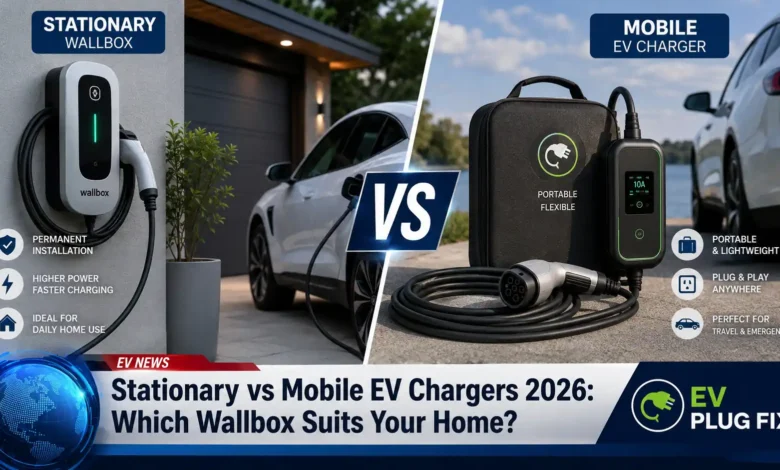
Choosing between a stationary and a mobile EV charger is one of the first and most critical decisions new electric vehicle owners face in 2026. While both serve the same basic purpose—delivering power to your car’s battery—they represent fundamentally different approaches to home charging. One provides the convenience and speed of a dedicated, high-capacity connection; the other offers the ultimate flexibility to plug in almost anywhere. The right choice depends on your driving habits, home electrical setup, budget, and even your eligibility for the latest government grants. For a comprehensive overview of what’s available for your property, consult our complete Home EV Charger Guide.
Understanding the key differences between these two types of EV chargers is the first step toward a seamless transition to electric mobility.
Stationary vs Mobile EV Chargers: Understanding the Core Differences
The primary distinction between stationary and mobile wallboxes lies in their permanence and power delivery.
A stationary charger is a permanently installed unit, hardwired to your home’s electrical system. Think of it as a dedicated appliance, much like an oven or a clothes dryer. It’s mounted on a wall or a pedestal and is designed for daily, high-speed charging. If you’re considering a permanent installation, exploring options like a Level 2 EV Charger Installation can provide the speed and reliability most homeowners desire.
A mobile charger, on the other hand, is a portable device that plugs into standard household outlets. It’s the “Swiss Army knife” of the EV world, offering incredible flexibility for charging at home, at a friend’s house, or while on vacation.
The table below highlights the key specifications that set them apart.
| Feature | Stationary Charger (Wallbox) | Mobile Charger |
|---|---|---|
| Installation | Permanent, requires a licensed electrician | Plug-and-play, no professional installation needed |
| Charging Speed | High (up to 22 kW), significantly faster | Lower (Level 1 or Level 2 via outlets), slower |
| Cost | Higher upfront cost including parts and labor | Lower upfront cost for the unit itself |
| Convenience | Always ready, cable is always available | Must be stored and transported; can be left at home |
| Government Grants | Often eligible for substantial subsidies | Rarely eligible for subsidies |
Important Grant Update for 2026: The German government has launched a €500 million program called “Laden im Mehrparteienhaus” to subsidize charging infrastructure. Owners can now receive up to €2,000 per parking space for installing stationary wallboxes, with applications open until November 2026. This is a significant incentive for stationary charger adoption.
Stationary Chargers: The Pinnacle of Home Charging Convenience
Stationary chargers, or wallboxes, are the gold standard for EV owners who value convenience and speed. Permanently installed by a professional electrician, they are designed for daily use, transforming the charging experience into a simple, seamless part of your routine. Modern wallboxes often include sophisticated energy management features; learning about EV Load Shifting Strategies can help you optimize energy usage and reduce costs.
Why Choose a Stationary Wallbox?
- Speed and Power: A stationary charger can deliver up to 22 kW of power, adding several hundred kilometers of range overnight.
- Professional Installation: It’s hardwired into a dedicated circuit, ensuring a safe, stable, and high-capacity power supply.
- Smart Features: Wallboxes often include advanced features like Wi-Fi, load balancing, and app-based control, allowing you to monitor and optimize your charging sessions. For those interested in maximizing solar energy use, PV Surplus Charging is a game-changing feature available on many modern units.
- Long-Term Value: It adds a permanent amenity to your home that can be attractive to future buyers.
Expert Insight: A top concern with stationary chargers is the condition of your home’s electrical panel. A licensed electrician must assess if your current service can handle the additional load, especially at 11kW or 22kW. Upgrading a panel can add significant cost to the project.
A stationary wallbox transforms EV charging into a simple and invisible gesture that integrates perfectly into your daily routine.
Government Support for Stationary Chargers
In many regions, stationary chargers are heavily subsidized. The rationale is clear: they encourage the rapid build-out of a reliable, high-capacity charging network for residents, particularly in multi-family dwellings.
The UK’s OZEV grant schemes are a prime example. As of April 2026, the home charging grant schemes have funded over 410,000 installations since 2013. In Germany, the new 2026 program specifically targets apartment buildings, offering €1,500 per regular charging point and up to €2,000 for bi-directional ones.
Mobile Chargers: Unmatched Flexibility on the Go
Mobile chargers offer a different kind of freedom. They are self-contained units that you can plug into a standard domestic socket, a reinforced outlet, or even an industrial plug, depending on the model. This makes them the ideal solution for renters, travelers, or anyone without a dedicated parking spot.
When to Choose a Mobile EV Charger
- Renters and Apartment Dwellers: If you can’t make permanent modifications to your home, a mobile charger is your only option.
- Flexibility is Key: They’re perfect for those who visit family and friends in different locations, ensuring you can always top up your battery.
- Emergency Backup: Even owners with a stationary wallbox often keep a mobile charger in their trunk as a safety net for road trips. Understanding EV Charger Error Codes can be invaluable for troubleshooting on the go.
- Lower Upfront Cost: The initial investment is significantly less than a professional installation.
However, the convenience comes with a trade-off. A mobile charger plugged into a standard outlet delivers only about 2.3 kW, which can mean over 30 hours to fully charge a larger battery. Even with a 240V outlet like a dryer plug (using an adapter), the charging speed, while faster, still typically won’t match a dedicated wallbox.
According to the U.S. Department of Energy, approximately 80% of EV charging occurs at home, and a portable charger turns any compatible outlet into a charging station.
It’s also worth noting that many mobile chargers, like the Battery Tender eCharge series, are now “dual-voltage,” capable of plugging into both 120V and 240V outlets. This provides a degree of flexibility that was previously unavailable, allowing you to leverage higher-power outlets when you find them. However, for daily use, many find that comparing options like the Tethered EV Chargers Comparison helps clarify the convenience factor of always having a cable ready.
Making the Right Choice for Your EV Lifestyle
Ultimately, the decision between a stationary and a mobile charger depends on a balance of your driving habits, living situation, and budget.
- Opt for a stationary charger if: You own your home, have access to off-street parking, drive a high daily mileage, and want the fastest, most convenient daily charging experience. Plus, you can take advantage of significant government grants.
- Opt for a mobile charger if: You are a renter, frequently travel to places without dedicated EV infrastructure, want an emergency backup solution, or need a more budget-friendly entry point into EV ownership.
Many EV experts suggest a hybrid approach: install a stationary wallbox for daily use and keep a mobile charger in the car for peace of mind on long journeys. This combination ensures you have a fast, reliable charge at home and the flexibility to handle unexpected situations on the road.
No matter your choice, always consult a qualified electrician to inspect your home’s electrical system before purchasing any high-power charging equipment. This simple step can prevent unexpected costs and ensure a safe, efficient charging setup for years to come. Regular upkeep is also essential; refer to our EV Charging Maintenance Guide to keep your equipment in top condition.