
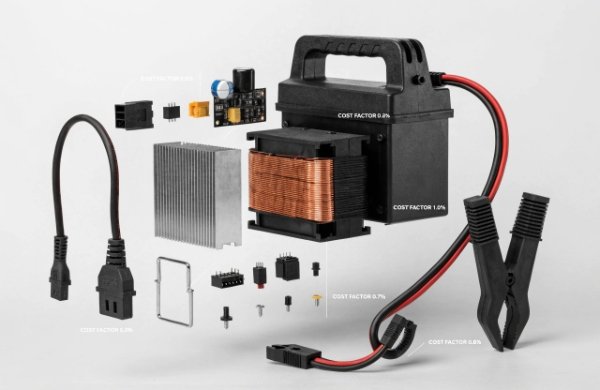
Wholesale car battery charger prices in 2026 are driven less by the advertised amp rating and more by continuous output, power-stage design, battery chemistry support, thermal management, protection hardware, certification, accessories, order volume, and the commercial terms attached to the quotation.
A 12V charger advertised at 20A can cost substantially more than another 20A model because the two units may have different continuous-duty ratings, MOSFETs, capacitors, magnetics, cooling systems, charging algorithms, cable sizes, safety protections, and compliance requirements.
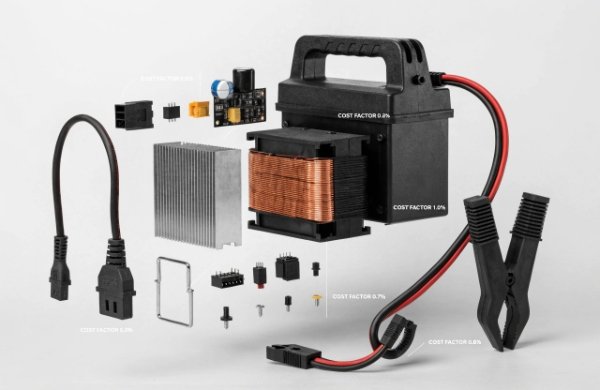
For distributors, automotive accessory wholesalers, importers, fleet suppliers, and private-label brands, the unit price on a supplier quotation is only the starting point. The real purchasing cost depends on what the charger can deliver repeatedly under load, what hardware is included, which markets it can legally enter, and how much support the supplier provides after production.
That distinction matters because battery chargers operate as power electronics, not simply as oversized power adapters. A charger that delivers 14.4V at 10A to a 12V lead-acid battery, for example, must regulate voltage and current while managing heat, sensing battery conditions, protecting against abnormal loads, and transitioning between charging stages. Every one of those functions affects manufacturing cost.
What Determines Car Battery Charger Wholesale Pricing in 2026?
The largest wholesale price differences usually come from nine areas: continuous output capability, charging architecture, supported battery chemistry, component quality, thermal design, protection systems, accessories, regulatory compliance, and commercial volume.
A useful way to compare suppliers is to stop asking only, “How many amps does it produce?” and instead ask, “How many amps can it sustain, at what voltage, for how long, at what ambient temperature, and with which protections enabled?”
Continuous Current Matters More Than the Headline Amp Rating
Peak current and continuous current are not interchangeable.
A charger marketed as 20A may reach 20A only under a narrow operating condition. Another charger may be engineered to maintain 20A continuously with a specified ambient temperature and thermal margin. Those products should not be treated as equivalent simply because “20A” appears on both labels.
Continuous output determines the required size of the switching devices, magnetics, PCB copper, rectification stage, capacitors, heatsinks and cooling system. As sustained power increases, the thermal problem becomes harder and the cost of solving it rises.
For example, a 12V charger operating at approximately 14.4V and 20A is handling roughly 288W at the output during that operating point. A 24V system charging around 28.8V at 20A is closer to 576W. The current rating is identical, but the power stage is not carrying the same electrical load.
This is one reason a 24V charger cannot be priced fairly against a 12V charger simply by comparing amperage.
12V, 24V and Dual-Voltage Designs
12V chargers are common in passenger cars, motorcycles, light commercial vehicles and many automotive accessories. Larger commercial vehicles and certain industrial applications commonly use 24V battery systems.
A dual-voltage charger has to detect or select the correct system and operate safely across both voltage ranges. That can require additional sensing, control logic, power-stage validation and protection testing.
For a fleet operator, dual-voltage capability can simplify purchasing and inventory. For a manufacturer, however, the additional operating modes increase development and validation requirements.
| Specification | Typical Application | Pricing Consideration |
|---|---|---|
| 12V | Passenger cars, motorcycles, light vehicles | Usually simpler power-stage requirements |
| 24V | Trucks, buses, commercial vehicles | Higher output power at comparable current |
| 12V/24V | Mixed vehicle fleets | Additional sensing, control and validation |
Battery Chemistry Changes the Charger Architecture
Battery chemistry is another major pricing factor. A charger designed only for conventional lead-acid batteries does not necessarily have the sensing, firmware and protection strategy required for lithium-based batteries.
Lead-acid, AGM, GEL and LiFePO₄ batteries have different charging requirements. The charger must use appropriate voltage limits, current behavior and charging stages for the selected chemistry.
Lead-Acid, AGM and GEL
Traditional flooded lead-acid batteries typically use a charging sequence involving bulk charging, absorption and, depending on the application and charger design, float maintenance.
AGM batteries can require different voltage targets and temperature considerations compared with conventional flooded batteries. GEL batteries also have their own charging constraints, particularly around avoiding excessive voltage that can damage the battery.
A charger supporting several lead-acid types needs either selectable profiles or an appropriate automatic control strategy. That additional functionality increases firmware and validation requirements.
LiFePO₄ Chargers Require Different Logic
LiFePO₄, or lithium iron phosphate, has a different voltage profile from lead-acid technology. A charger intended for LiFePO₄ should not simply reuse a conventional lead-acid charging algorithm and change the label.
Depending on the product architecture, lithium support may require a dedicated charging profile, different termination behavior, battery-state detection and appropriate protection against abnormal operating conditions.
Some lithium batteries also incorporate their own battery management system, commonly called a BMS. The charger still needs to be compatible with the battery’s expected charging characteristics.
This is why “supports lithium” is not enough information for a wholesale RFQ. Buyers should request the actual charging voltage range, current behavior, supported chemistry and operating conditions.
| Battery Type | Important Charger Considerations | Potential Cost Impact |
|---|---|---|
| Flooded lead-acid | Bulk, absorption and maintenance charging | Baseline |
| AGM | Specific voltage profile and controlled charging | Moderate |
| GEL | Controlled voltage to avoid overcharging | Moderate |
| LiFePO₄ | Dedicated lithium profile and compatible control logic | Higher when fully validated |
Why Power Components Have Such a Large Effect on Wholesale Cost
Inside a charger, the power stage is responsible for converting electrical energy efficiently while controlling voltage and current. Its design has a direct relationship with manufacturing cost.
Power semiconductors such as MOSFETs must operate within their voltage, current and temperature limits. A low-cost design may operate components close to their limits, while a more conservatively engineered product can use higher-rated components with greater thermal and electrical margin.
That margin costs money.
It can also reduce stress on the components during real-world operation.
Capacitors
Capacitors in switching power supplies experience electrical and thermal stress. Their temperature rating, ripple-current capability, lifetime specification and manufacturer can affect both cost and expected service life.
Two chargers may have identical external specifications while using capacitors with very different temperature ratings and endurance characteristics.
Magnetics
Transformers and inductors are especially important as charger power increases. Core material, winding design, copper quantity, insulation system and thermal behavior all influence the cost of the magnetic components.
Undersizing magnetics may reduce the initial bill of materials, but it can increase temperature rise, acoustic noise or saturation risk under demanding conditions.
PCB and Copper Design
High-current paths require appropriate conductor width and copper thickness. Connectors, solder joints, traces and terminals all become part of the current path.
A charger carrying 20A through its output circuit cannot be evaluated only by looking at the semiconductor ratings. The complete current path matters.
Thermal Design Is a Direct Cost Driver
Heat is one of the most important hidden factors in charger pricing.
Electrical efficiency is never exactly 100%. If a charger processes several hundred watts and loses even a small percentage as heat, that loss has to go somewhere.
For example, a 300W power stage operating at 90% efficiency would dissipate roughly 33W internally as heat. At 95% efficiency, the loss falls to about 16W. That difference can change the required heatsink, fan size, enclosure ventilation and component temperature.
Thermal design can include:
- Aluminum heatsinks
- Thermal interface materials
- Forced-air cooling
- Temperature sensors
- Fan control
- Ventilation openings
- Higher-temperature components
- Thermal derating strategies
A fanless charger may look simpler, but achieving reliable continuous output without forced air can require a larger heatsink, better efficiency or more conservative power-stage design.
Ambient temperature also matters. A charger that performs well at 20°C cannot automatically be assumed to deliver the same continuous output at 40°C or 50°C.
Wholesale buyers should therefore request the conditions behind the continuous rating. Understanding how AC to DC conversion works inside the power stage also helps buyers interrogate efficiency claims and thermal derating figures more effectively.
Protection Circuits Add Cost—but Also Prevent Expensive Failures
A professional battery charger normally needs more than a basic fuse.
Depending on the design, protection functions can include reverse-polarity protection, short-circuit protection, overcurrent control, overvoltage protection, overtemperature protection, abnormal-battery detection and input protection.
Reverse Polarity Protection
Automotive batteries are frequently connected in workshops, garages and roadside environments where connection mistakes are possible. Reverse-polarity protection reduces the chance that an incorrect connection will destroy the charger or damage the battery system.
Short-Circuit and Overcurrent Protection
The charger must respond predictably if the output is shorted or an abnormal load is connected. Depending on the architecture, this can involve electronic current limiting, shutdown, foldback or controlled restart behavior.
Overtemperature Protection
Temperature sensors allow the control system to reduce output or shut down when internal temperatures become excessive.
This can protect the power semiconductors, transformer, PCB and other heat-sensitive components.
Abnormal-Battery Detection
Smart chargers may check whether a connected battery is within an expected voltage range before beginning the full charging sequence. The exact detection strategy varies by product.
Each additional protection function requires hardware, firmware, testing and validation. That increases manufacturing cost, but it also changes the risk profile of the finished product.
Cables and Clamps Can Change the Real Cost of a Charger
Accessories are frequently ignored during wholesale price comparisons.
That is a mistake.
At high current, cable resistance creates both voltage drop and heat. A longer cable with an inadequate conductor size can become a significant electrical loss between the charger and battery.
The clamp design matters too. Contact resistance, jaw construction, spring pressure, plating and current rating all affect performance.
| Accessory | What Buyers Should Specify | Why It Matters |
|---|---|---|
| Output cable | Length, conductor size and insulation | Voltage drop, heat and flexibility |
| Battery clamps | Material, size, current rating and cable connection | Contact resistance and durability |
| AC cord | Plug type, length and market specification | Safety and market compatibility |
| Connectors | Current rating and locking method | Electrical reliability |
A quotation for a charger with short 14 AWG leads should not be directly compared with a quotation that includes substantially longer and heavier-gauge cables. Buyers who also procure EV charging hardware will find the same conductor-sizing logic in this EV charging cable guide, where power, length and current rating decide real-world performance.
The supplier may be selling two different configurations.
Certification and Compliance Can Significantly Change the Quotation
Certification is one of the easiest costs to overlook during the initial purchasing discussion.
A charger intended for one market may require a different compliance package from a charger sold in another. Safety, electromagnetic compatibility, electrical construction, plug requirements, labeling and documentation can all affect the final product.
Depending on the destination market and product configuration, buyers may encounter requirements involving CE-related conformity, EMC testing, electrical safety evaluation, or market-specific schemes such as UL-related/NRTL requirements, PSE or KC.
The exact requirements depend on the product, electrical design and destination market. A supplier should therefore not simply write “certified” on an RFQ response. Buyers who also source mains-powered EV equipment should review how EV charger EMC testing is scoped, because the same interference and immunity questions apply to battery chargers with switching power stages.
Ask:
- Which product model was tested?
- Which exact configuration was evaluated?
- Which standards were used?
- Which laboratory performed the testing?
- Is the documentation current?
- Are the certificates applicable to the destination market?
- Are testing and certification costs included in the quoted price?
Testing also has a fixed-cost component. When that cost is distributed across 10,000 units, its per-unit effect can be relatively small. On a 100-unit order, the same fixed cost can have a much larger effect.
Why MOQ and Order Volume Affect Wholesale Pricing
Manufacturers do not price a 100-unit order the same way as a 10,000-unit production run.
Some manufacturing costs are variable. Others are fixed or semi-fixed.
Tooling, engineering preparation, artwork, firmware configuration, test setup, packaging setup and certification can all create costs that must be recovered across the production volume.
A larger order can also improve purchasing efficiency for components, packaging and production scheduling.
| Order Size | Typical Commercial Effect | Buyer Consideration |
|---|---|---|
| Prototype / sample | Highest effective unit cost | Useful for validation, not price benchmarking |
| Small batch | Limited volume leverage | Check setup and packaging charges |
| Medium production order | Better manufacturing efficiency | Compare volume breaks |
| Large annual program | Greater purchasing leverage | Negotiate total program cost |
Buyers should request several quantity breaks instead of asking for a single unit price.
For example, an RFQ could request pricing at 100, 500, 1,000, 5,000 and 10,000 units. This makes the supplier’s volume curve visible and helps identify where the economics change.
The Commercial Terms Can Make a Cheap Charger Expensive
EXW, FOB, CIF and DDP prices do not represent the same commercial responsibility.
An EXW quotation can look dramatically cheaper than a DDP quotation because transportation, export handling, insurance, duties and local delivery may sit outside the quoted unit price.
For that reason, buyers should compare suppliers under the same Incoterm and destination assumptions whenever possible.
Otherwise, the purchasing team may select the supplier with the lowest headline number while actually paying more after freight, import costs and local handling are included.
Common Low-Price Quotation Traps
The cheapest quotation is often not an apples-to-apples comparison. The most common problems are missing specifications and different commercial scope.
| Quotation Trap | What Can Be Missing | How to Compare Correctly |
|---|---|---|
| Peak current | Continuous-duty capability | Require continuous output rating |
| Low EXW price | Freight, duty and delivery | Use identical Incoterms |
| Cheap accessories | Cable and clamp specifications | Specify complete accessory configuration |
| “Certified” claim | Actual test scope and documents | Request applicable documentation |
| Low OEM price | Tooling and development fees | Separate recurring and one-time costs |
| Low unit price | Weak warranty coverage | Compare warranty terms and support |
A supplier quotation should identify anything that is excluded from the unit price.
How to Request a Comparable Car Battery Charger RFQ
The most effective way to compare wholesale suppliers is to give every supplier the same technical and commercial specification.
Do not send one supplier a basic request for “20A 12V charger” and another supplier a detailed specification covering chemistry, accessories and certification. The resulting prices will not be comparable.
1. Define the Electrical Output
- Nominal battery system voltage: 12V, 24V or 12V/24V
- Required continuous charging current
- Maximum output current
- Required charging voltage range
- Input voltage and frequency
- Required duty cycle
Ask the supplier to distinguish clearly between continuous, rated and peak current.
2. Define Battery Chemistry
- Flooded lead-acid
- AGM
- GEL
- LiFePO₄
- Other supported chemistries
For each chemistry, request the applicable charging profile and voltage limits.
3. Define Thermal Conditions
Ask for the continuous output conditions, operating ambient range, cooling method and thermal protection behavior.
A specification that says “20A continuous” without defining the relevant conditions leaves too much room for interpretation.
4. Define the Accessories
- Output cable length
- Conductor size
- Clamp design
- Clamp current rating
- AC cord length
- Plug type
- Replacement accessory availability
5. Define the Compliance Requirements
State the countries where the charger will be sold and identify the compliance documentation required for those markets.
Do not accept a generic “CE available” statement when the project requires a defined safety and EMC documentation package.
6. Define the Packaging
- Retail or bulk packaging
- Box dimensions
- Manual language
- Barcode requirements
- Product labeling
- Outer-carton specifications
- Private-label artwork
7. Define Commercial Conditions
- MOQ
- Quantity-based pricing
- Incoterm
- Payment terms
- Lead time
- Warranty period
- Spare-parts policy
- Tooling charges
- Firmware customization fees
- Packaging or artwork charges
RFQ Checklist for Wholesale Buyers
The following checklist can be copied directly into a purchasing specification:
- System voltage: 12V / 24V / dual voltage
- Continuous current: Specify the required sustained output
- Peak current: State separately from continuous current
- Battery chemistry: Lead-acid, AGM, GEL, LiFePO₄ or other
- Charging profile: Required voltage and charging stages
- Input: Voltage, frequency and plug configuration
- Cable: Length, conductor size and insulation specification
- Clamps: Type, material and current rating
- Protection: Reverse polarity, short circuit, overcurrent and thermal protection
- Cooling: Fan, passive cooling or other method
- Operating temperature: Required ambient range
- Certification: Destination-market requirements
- Packaging: Retail, bulk or private-label
- MOQ: Minimum production quantity
- Price breaks: Multiple volume tiers
- Incoterm: Same term for every supplier
- Warranty: Duration and coverage
- Lead time: Sample and mass-production timing
- Tooling: One-time charges listed separately
- Change control: Approval process for component substitutions
How to Reduce Wholesale Cost Without Creating Warranty Problems
There are safe ways to reduce the cost of a charger. Cutting the wrong component is not one of them.
The best savings usually come from simplifying the commercial configuration rather than weakening the electrical design.
Use a Mature Platform
An existing charger platform that has already completed engineering validation can reduce development, tooling and firmware costs compared with a completely new design.
This is particularly useful for private-label programs where the buyer needs branding changes but does not require a new electrical architecture.
Standardize the Enclosure
Custom molds can become expensive when order volumes are modest. If a standard enclosure meets the required thermal, mechanical and branding requirements, it may reduce both tooling and production cost.
Standardize Accessories
Using common cable lengths, connectors, clamps and AC plugs can simplify procurement and reduce the number of unique components in the supply chain.
Custom accessories should be reserved for applications where they solve a real technical or commercial requirement.
Reduce Packaging Complexity
Heavy retail packaging, multiple printed inserts and special finishes can add cost without changing the charger’s electrical performance.
For industrial distribution, workshop supply or fleet applications, simpler packaging may be appropriate.
Consolidate SKUs
Maintaining separate chargers for every minor variation can increase inventory, packaging and production costs.
Where technically appropriate, a common platform with controlled configuration options can reduce complexity.
Do Not Cut the Wrong Things
Several areas should not be treated as easy cost-saving targets:
- Power semiconductor ratings
- Thermal protection
- Required safety insulation
- Correct cable conductor size
- Output connector ratings
- Protection circuits
- Required certification
- Production testing
- Critical capacitor specifications
- Validated firmware behavior
A small saving on the bill of materials can become a much larger expense if it produces overheating, premature failures, returns or warranty claims.
Why Component Substitution Needs Engineering Approval
One of the most important clauses in an OEM or private-label purchasing agreement is change control.
A supplier may propose replacing a MOSFET, capacitor, fan, transformer, connector or other component because the original part is unavailable or has increased in price.
The replacement may look equivalent on paper.
It may not be equivalent electrically or thermally.
Important parameters can include voltage rating, current rating, RDS(on), switching characteristics, temperature rating, ripple-current capability, insulation class, lifetime and mechanical dimensions.
For this reason, critical substitutions should be documented and evaluated before they are incorporated into production.
Warranty Cost Should Be Part of the Purchasing Calculation
A charger with a lower purchase price can become more expensive when failure rates, returns, replacement units, technical support and logistics are considered.
The correct comparison is therefore not simply:
Unit A = $X
Unit B = $Y
The more useful comparison considers the complete program:
- Purchase price
- Freight and import costs
- Certification expenses
- Tooling and development charges
- Accessory costs
- Warranty exposure
- Replacement-part availability
- Technical support
- Expected field-return cost
This does not mean that a more expensive charger will always have lower warranty costs. The point is that warranty risk should be measured rather than ignored. Operators budgeting for field service should apply the same logic used in this EV charger maintenance cost guide, where total lifecycle expense matters more than sticker price.
Questions Wholesale Buyers Should Ask Before Placing an Order
- Is the advertised current continuous or peak?
- At what ambient temperature is the continuous rating specified?
- What is the actual output voltage range?
- Which battery chemistries are officially supported?
- What charging profile is used for each chemistry?
- Is the product suitable for 12V, 24V or both systems?
- What protection functions are built into the charger?
- What cable length and conductor size are included?
- What current rating do the battery clamps have?
- Which certification documents are available?
- Are testing and certification costs included?
- What is the MOQ?
- What are the prices at different order quantities?
- Which Incoterm applies to the quoted price?
- Are tooling or engineering fees charged separately?
- What is included in the warranty?
- Are spare clamps, cables and other service parts available?
- What is the mass-production lead time?
- How are component substitutions controlled?
- Has the quoted configuration already been validated?
How Buyers Can Compare Three Supplier Quotations
When several quotations arrive, create one comparison sheet and force every supplier into the same specification structure.
| Comparison Item | Supplier A | Supplier B | Supplier C |
|---|---|---|---|
| System voltage | 12V / 24V | 12V / 24V | 12V / 24V |
| Continuous current | Specified value | Specified value | Specified value |
| Battery chemistry | Specified | Specified | Specified |
| Cooling system | Specified | Specified | Specified |
| Cable configuration | Specified | Specified | Specified |
| Protection functions | Specified | Specified | Specified |
| Certification scope | Specified | Specified | Specified |
| MOQ | Specified | Specified | Specified |
| Incoterm | Same basis | Same basis | Same basis |
| Warranty | Specified | Specified | Specified |
| Tooling / development | Separate | Separate | Separate |
| Unit price | Comparable price | Comparable price | Comparable price |
This format exposes the biggest problem with many online wholesale comparisons: the products may have similar names but substantially different specifications.
What Makes a Car Battery Charger More Expensive to Manufacture?
The short answer is not one component. It is the interaction between power capability, thermal margin, control electronics, protection, accessories and compliance.
A higher-output charger needs a stronger power stage. A stronger power stage creates more demanding thermal requirements. More advanced charging profiles require additional sensing and firmware. Wider market coverage can require additional testing and documentation. Higher-quality cables and clamps add material cost. Private-label requirements can introduce tooling, artwork and packaging expenses.
These costs accumulate.
That is why two chargers with the same nominal 12V and 20A label can legitimately have different wholesale prices.
Practical Takeaway
For wholesale buyers in 2026, the most reliable way to control car battery charger costs is to define the technical specification before discussing the unit price.
Start with the battery system voltage and required continuous current. Then define the battery chemistry, charging profile, operating temperature, cooling method, protection functions, cable and clamp configuration, destination market, certification requirements and packaging.
After that, ask every supplier to quote the same configuration under the same Incoterm and quantity assumptions.
Do not compare a 20A peak rating with a 20A continuous rating. Do not compare EXW with DDP. Do not compare a charger with heavy-gauge cables against one with lightweight leads. Do not treat a generic certification statement as equivalent to documented market compliance.
The lowest useful wholesale price is the price attached to a clearly defined product that can deliver the required output, tolerate the expected operating environment, meet the applicable compliance requirements and remain supportable throughout its service life.
For distributors and private-label buyers, that is the number worth negotiating.
Wholesale Car Battery Charger Pricing Checklist
- Confirm 12V, 24V or dual-voltage operation.
- Confirm continuous rather than peak charging current.
- Specify the operating temperature behind the rated output.
- Identify supported battery chemistries.
- Request the charging voltage and charging stages for each chemistry.
- Confirm cooling and thermal-protection methods.
- Specify cable length and conductor size.
- Specify clamp type and current rating.
- List all required protection functions.
- Confirm the exact compliance documentation required for the destination market.
- Compare suppliers using the same Incoterm.
- Request several volume-based price tiers.
- Separate tooling and engineering charges from recurring unit cost.
- Confirm packaging and private-label requirements.
- Document warranty coverage and spare-parts availability.
- Require approval before critical component substitutions.
- Compare landed and warranty-adjusted cost rather than unit price alone.