EV Charger Overcurrent and Overvoltage Protection Explained 2026
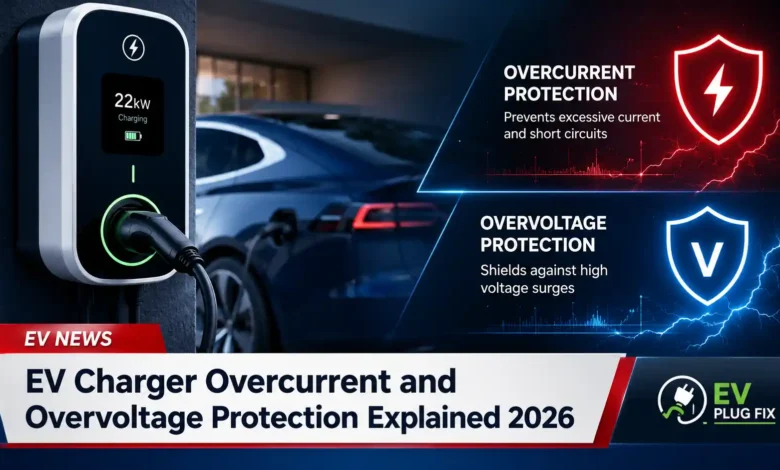
Overcurrent and overvoltage protection serve as the essential safety backbone of every EV charger, preventing catastrophic electrical faults from damaging your vehicle or home. These two distinct but complementary protection mechanisms work silently behind the scenes to ensure every charging session remains safe, reliable, and efficient. Whether you plug into a 22 kW AC charger at home or a 350 kW DC fast charger on the highway, robust overcurrent and overvoltage systems stand guard against the unpredictable nature of electricity.
What Is Overcurrent Protection in EV Charging?
Overcurrent occurs when the electrical current flowing through a circuit exceeds its designed safe limit, creating serious risks of overheating, insulation breakdown, and fire. Every EV charger component, from the internal wiring to the charging cable and the vehicle’s battery management system, operates within carefully defined current thresholds. When those limits are breached, overcurrent protection systems detect the excess flow and interrupt the circuit before damage occurs. Understanding these protection mechanisms is essential for effective Home EV Charger Maintenance and long-term equipment reliability.
Most EV chargers incorporate multiple overcurrent protection devices at different points in their circuitry. AC chargers typically require protection on both input and output sides, while DC fast chargers place special emphasis on protecting the high-power DC output that feeds directly into the vehicle battery. The trip point is generally set between 110% and 150% of the rated current to prevent nuisance interruptions from normal charging fluctuations while responding decisively to genuine faults.
How Overcurrent Protection Devices Work
Modern EV chargers employ a layered approach to overcurrent protection, combining traditional devices with advanced electronic monitoring:
- Fuses: These sacrificial devices contain a metal strip that melts when excessive current passes through, creating a physical break in the circuit. While effective, fuses must be replaced after activation.
- Circuit Breakers: Mechanical switches that trip and open the circuit when detecting overcurrent. Unlike fuses, they can be reset and reused, making them ideal for residential applications where convenience matters.
- Electronic Sensors and Relays: Semiconductor-based protection that detects overcurrent conditions in microseconds and sends signals to interrupt power automatically. These advanced systems offer faster response times than mechanical devices and can integrate with Smart EV Charging Benefits for enhanced grid management.
- Solid-State Circuit Breakers (SSCBs): Emerging technology that enables ultrafast protection for next-generation EV charging applications. Recent research demonstrates overcurrent detection in less than 200 microseconds, far outperforming traditional electromechanical breakers .
Common Overcurrent Conditions in EV Charging
Overcurrent faults in EV charging typically fall into three categories, each requiring specific protection strategies. Overloads occur when sustained current exceeds circuit ratings, often due to multiple chargers operating simultaneously on a limited feeder or misconfigured load management exceeding circuit limits. For commercial facilities with multiple charging stations, implementing EV Peak Shaving strategies can help prevent overload conditions by intelligently managing charging loads. Short circuits represent the most dangerous condition, where unintended low-resistance paths cause currents dramatically higher than normal, creating immediate fire and shock hazards. Ground faults occur when current takes an unintended path to earth, particularly dangerous in outdoor charging environments where water exposure increases shock risks.
Understanding Overvoltage Protection for EV Chargers
Overvoltage refers to voltage spikes or surges that exceed normal operating levels, often occurring in microseconds but capable of destroying sensitive electronics instantly. EV chargers contain sophisticated power electronics, control systems, and communication modules that are extremely sensitive to voltage stress. Without adequate overvoltage protection, a single lightning strike or grid disturbance can render an expensive charging station inoperable and potentially damage the connected vehicle. When selecting a home charging solution, evaluating the Wallbox Installation Costs should include consideration of integrated surge protection features.
Research has shown that without low-voltage surge protective devices (SPDs), overvoltages exceed the rated impulse withstand voltage of both chargers and vehicles during all severe lightning scenarios . Even with distribution board protection, critical overvoltages persist at charger terminals, demonstrating why dedicated SPDs at the charging point are essential. In extreme cases with lightning peak currents exceeding 100 kA and high soil resistivity above 700 Ωm, connected vehicles remain vulnerable even with charger-level protection, highlighting the need for comprehensive protection strategies .
Overvoltage Protection Components and Their Roles
Effective overvoltage protection requires multiple device types working in coordination, each handling different aspects of surge suppression. Surge protective devices incorporate metal oxide varistors (MOVs) that act as voltage clamps, conducting heavy current only when voltage exceeds predetermined limits. Gas discharge tubes (GDTs) rapidly conduct large surge currents to ground when voltage spikes occur, particularly effective for lightning protection. Transient voltage suppressor (TVS) diodes, semiconductor devices that react extremely fast to transients, absorbing surges to protect delicate control circuits. Zener diodes and voltage limiters maintain voltages within safe bounds through electronic regulation. For installations in storm-prone areas, lightning arresters specifically designed to handle direct strike energy direct surges safely to ground.
Residential charging stations face particular overvoltage risks. In a representative three-story residential building with a 22 kW EV charger, studies have demonstrated that surge protective devices at the main distribution board alone are insufficient to fully protect charging equipment. A dedicated SPD at the EV charger successfully limits charger overvoltages to below 4 kV, but connected vehicles remain vulnerable to the most severe lightning events . This finding has significant implications for EV owners and installers, emphasizing the importance of comprehensive surge protection strategies. For homeowners considering renewable integration, go-e PV Surplus Charging systems combine solar energy optimization with robust protection features.
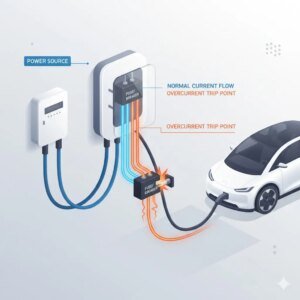
Overcurrent vs. overvoltage protection: two sides of the same safety coin in EV charging
Overcurrent vs. Overvoltage Protection: Key Differences
While both protection types share the goal of preventing electrical damage, they address fundamentally different fault conditions using distinct technologies and response strategies. Understanding these differences helps EV owners appreciate the layered safety approach built into modern charging infrastructure.
| Aspect | Overcurrent Protection | Overvoltage Protection |
|---|---|---|
| What It Protects Against | Excessive current flow causing overheating, fire, and component damage | Voltage spikes and surges that destroy sensitive electronics |
| Primary Causes | Overloads, short circuits, ground faults, multiple chargers on same circuit | Lightning strikes, grid disturbances, switching transients, neutral disconnection |
| Protection Devices | Fuses, circuit breakers, electronic relays, solid-state circuit breakers | Varistors, gas discharge tubes, TVS diodes, Zener diodes, lightning arresters |
| Response Time | Milliseconds to seconds (conventional); under 200 microseconds (solid-state) | Microseconds to milliseconds for semiconductor devices; nanoseconds for TVS diodes |
| In EV Chargers | Prevents cable overheating, battery damage, and fire hazards | Protects sensitive power electronics, controllers, and battery management systems |
Modern EV Charger Safety Integration
Today’s charging systems integrate overcurrent and overvoltage protection with a comprehensive suite of safety features. Ground fault detection protects users by identifying leakage currents, critical for outdoor public charging. Thermal overload protection prevents overheating through continuous temperature monitoring of power electronics, connectors, and cables. Communication protocols such as OCPP and ISO 15118 enable remote monitoring of fault status and protection system health. Smart controls dynamically adjust charging parameters to maintain safe operation even under challenging grid conditions. Enphase Energy’s IQ EV Charger 2 exemplifies this layered approach, incorporating overvoltage protection, overcurrent detection, integrated residual DC detection, relay weld detection, and PEN fault detection in a single weatherproof package . For homeowners seeking a comprehensive setup, understanding Home EV Wallbox Charging options helps ensure proper protection coordination with existing electrical systems.
The shift toward solid-state protection represents a significant advancement in charging safety. Tesla and other major manufacturers increasingly adopt semiconductor-based protection that operates faster and more reliably than mechanical devices. Recent research has demonstrated solid-state circuit breakers achieving overvoltage detection in under 490 microseconds and overcurrent protection in less than 200 microseconds, enabling unprecedented safety margins for ultrafast charging applications .
Practical Benefits for EV Owners and Infrastructure Operators
Investing in well-protected charging infrastructure delivers tangible benefits that extend beyond basic safety compliance. Enhanced safety reduces risks of electrical fires and equipment damage, safeguarding both property and lives while minimizing liability exposure. Equipment longevity improves significantly when chargers are protected from voltage stress and current overloads, maximizing the return on charging infrastructure investment. Regulatory compliance with electrical safety standards ensures legal compliance and insurance validity, while also satisfying utility requirements for grid-connected equipment. User convenience increases through reduced failures and interruptions, meaning fewer frustrating charging session stops and maintenance calls.
“Proper overcurrent and overvoltage protection is not just about meeting safety standards—it’s about ensuring EV charging infrastructure can withstand real-world electrical stresses over decades of service.”
Charging Infrastructure Protection Coordination
As EV adoption accelerates, the integration of thousands of charging stations creates new challenges for distribution system protection. Traditional overcurrent protection schemes must adapt to handle bidirectional power flow from vehicle-to-grid (V2G) applications and the changing fault current characteristics introduced by widespread EV integration . Research indicates that at 100% EV penetration levels, conventional protection systems may exceed thermal limits, requiring advanced coordination strategies that modify charger control systems to limit fault current contributions. Smart charging systems that dynamically adjust output based on grid conditions help maintain protection coordination without expensive hardware upgrades.
The expansion of rooftop solar further complicates overvoltage management in residential areas. Solar PV generation during low-load conditions frequently causes overvoltage that stresses distribution transformers and home electrical systems, potentially damaging connected EV chargers . Smart EV chargers capable of absorbing excess solar energy through optimized charging schedules offer a solution, reducing overvoltage stress while maximizing renewable energy utilization.
Frequently Asked Questions
Frequently Asked Questions
What is the difference between overcurrent and overvoltage protection in EV chargers?
Overcurrent protection prevents excessive current flow that causes overheating and fire hazards, responding to faults like short circuits and overloads using fuses or circuit breakers. Overvoltage protection shields sensitive electronics from damaging voltage spikes caused by lightning or grid disturbances using surge protectors, varistors, or TVS diodes. Both work together to provide comprehensive electrical safety for EV charging.
Do I need surge protection for my home EV charger?
Yes. Research shows that surge protection at the main distribution board alone is insufficient to fully protect residential EV chargers from lightning-induced overvoltages. A dedicated surge protective device at the charger terminal provides critical protection. For homeowners in areas with frequent lightning storms or grid disturbances, investing in a charger with integrated overvoltage protection and a Type 2 SPD is highly recommended.
Can overcurrent damage my EV battery?
Absolutely. Excessive current can cause rapid overheating, insulation breakdown, and thermal runaway in lithium-ion batteries, potentially destroying the battery pack and creating fire risks. Modern EV chargers and vehicle battery management systems include multiple layers of overcurrent protection to ensure charging current never exceeds safe limits. This is particularly important for DC fast charging where currents are highest.
What happens during a lightning strike on an EV charger?
During a direct or nearby lightning strike, voltage spikes can reach the charger and connected vehicle through power lines and the protective earth grounding system. Surge protective devices inside the charger clamp the overvoltage to safe levels (typically under 4 kV) and divert surge current safely to ground. However, extreme lightning events with peak currents above 100 kA may still pose risks to the connected vehicle, highlighting the importance of comprehensive protection strategies.
How do solid-state circuit breakers improve EV charger safety?
Solid-state circuit breakers (SSCBs) use semiconductor technology to detect and interrupt fault currents far faster than conventional electromechanical breakers. Recent developments demonstrate overcurrent detection in under 200 microseconds and overvoltage detection in under 490 microseconds, compared to milliseconds for traditional devices. This ultrafast response protects sensitive power electronics and battery systems more effectively, particularly important for high-power DC fast charging applications where fault currents rise extremely quickly.
Conclusion
Overcurrent and overvoltage protection form the essential safety architecture of EV charging infrastructure, protecting vehicles, homes, and public charging stations from electrical faults that could cause catastrophic damage. From traditional fuses and circuit breakers to advanced solid-state protection systems, these complementary technologies ensure the reliable operation of EV charging as global adoption accelerates. Understanding these protection mechanisms helps EV owners make informed decisions about charger selection and installation, while guiding manufacturers and installers toward best practices for safety and compliance. As charging technology evolves toward higher power levels and bidirectional operation, the sophistication of protection systems will continue advancing, maintaining the invisible safety net that makes electric mobility possible.