EV Leakage Protection Explained: Safety Devices for Charging in 2026
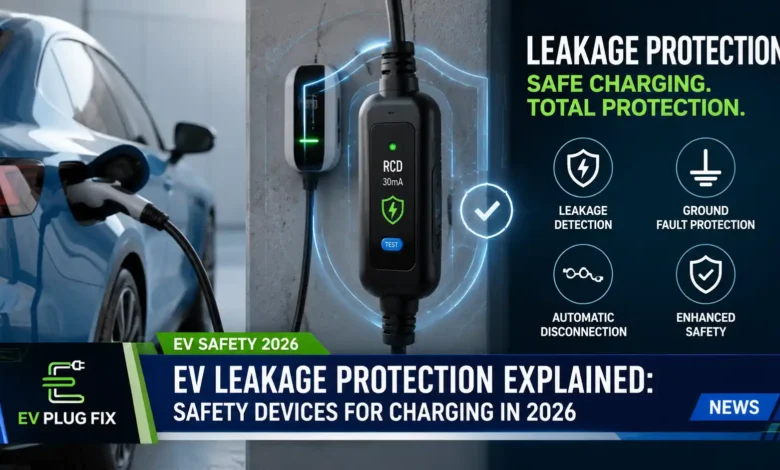
Electric vehicle (EV) leakage protection is a critical safety mechanism designed to prevent electric shock, equipment damage, and fire hazards by detecting and interrupting unintended current flow during charging. As millions of EV drivers plug in at home and in public, understanding this silent guardian is no longer optional—it’s essential for every EV owner. The number of battery electric vehicles in the U.S. alone nearly doubled from 1.1 million to 2.1 million between 2020 and 2022, making widespread safety knowledge more important than ever .
What Is EV Leakage Protection and Why Does It Matter?
Leakage protection, often implemented through Residual Current Devices (RCDs), monitors the balance of electrical current flowing through your EV charger’s live conductors. Under normal operation, the outgoing and returning currents are equal. However, if a fault occurs—such as damaged insulation, water ingress, or a vehicle-side issue—current can “leak” to earth. The RCD detects this imbalance, typically at a threshold of 30 mA for personal protection, and rapidly disconnects the circuit to prevent harm. For comprehensive protection, integrating Smart EV Charging Benefits with proper leakage detection ensures both efficiency and safety.
The Critical Role of Type B RCDs in EV Charging
Not all RCDs are created equal. While older homes might have Type AC or Type A RCDs, these are often insufficient for modern EV charging. The power electronics inside your Tesla, Ford Mustang Mach-E, or Hyundai Ioniq 5, as well as the charger itself, can generate smooth DC residual currents during a fault. These DC components can saturate the sensing core of Type A devices, rendering them unable to trip and creating a severe safety risk. Understanding your EV Charging Time requirements also helps in selecting the right protection level for your specific vehicle and charging habits.
This is where the Type B RCD comes in. Designed for high-power applications with three-phase rectifiers, a Type B RCD is the gold standard for EV charging because it can reliably detect a full range of fault currents:
- AC residual currents (sinusoidal)
- Pulsating DC residual currents
- Smooth DC residual currents (continuous DC leakage)
- Higher-frequency components from power electronics
As noted by industry experts, Type B devices are often mandated for EV charging installations to ensure a “timely tripping and a high degree of safety,” preventing the dangerous oversaturation that can affect less sensitive devices. When planning your installation, considering Wallbox Installation Costs alongside proper RCD selection ensures a budget-friendly yet safe setup.
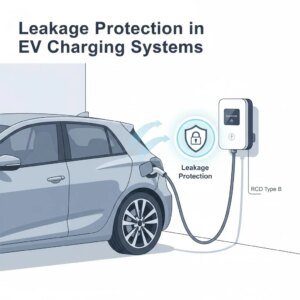
Understanding the flow: How an RCD monitors and interrupts dangerous leakage currents.
How Leakage Protection Works: The Technical Overview
Modern EV charging systems employ a multi-layered approach to safety, combining sensing, detection, and rapid response. Here’s a breakdown of the process:
- Sensing: A current transformer continuously measures the balance between the live and neutral conductors.
- Detection: The device continuously monitors for an imbalance. A difference of 30mA or more is typically considered a dangerous fault .
- Response: The RCD trips a switch, disconnecting power instantly—often within milliseconds—to stop the leakage path.
- Diagnostics: Many modern chargers provide fault indicators or logs, which are critical for troubleshooting and maintenance. Regular Home EV Charger Maintenance helps identify potential leakage issues before they become hazardous.
For high-power Vehicle-to-Grid (V2G) applications, protection becomes even more complex. The bidirectional flow of energy requires a comprehensive multi-layer protection architecture that integrates mandatory DC leakage protection (RCD Type B/RCM) with hybrid circuit breakers (HCB) for ultra-fast DC fault interruption, ensuring compliance with standards like IEEE 1547 and IEEE 519 .
Comparison of RCD Types for EV Chargers
| RCD Type | Detects AC | Detects Pulsating DC | Detects Smooth DC | Recommended for EV? |
|---|---|---|---|---|
| Type AC | ✅ Yes | ❌ No | ❌ No | 🚫 No |
| Type A | ✅ Yes | ✅ Yes | ❌ No | ⚠️ Only with RDC-DD protection |
| Type B | ✅ Yes | ✅ Yes | ✅ Yes | ✅ Yes (Ideal) |
It’s important to note that while Type A RCDs can sometimes be used in conjunction with a Residual Direct Current Detecting Device (RDC-DD) monitoring for DC leakage of 6mA or more, a Type B RCD remains the simplest and most robust choice for full protection. For those using specific vehicle models, understanding the Tesla Model 3 Charging Time can help optimize both charging schedules and protection settings.
Real-World Consequences of Inadequate Leakage Protection
Skipping the correct leakage protection can lead to devastating consequences:
- Electric Shock: Direct contact with a live component due to a leakage fault, especially in wet outdoor environments, can cause severe injury or death.
- Fire Hazards: Leakage current can generate heat, degrading insulation and potentially igniting flammable materials in your garage or vehicle.
- Equipment Damage: Constant low-level leakage can stress insulation and electronics within your EV and charger, leading to premature failure.
- Nuisance Tripping: Using the wrong type of RCD can lead to nuisance trips, leaving you with an uncharged car and a frustrating experience.
Implementing Leakage Protection in Your Home
Ensuring your home EV charging setup is safe involves more than just buying the right charger. It requires a holistic approach to installation and maintenance. Proper Home EV Wallbox Charging practices include selecting the correct RCD type and scheduling regular professional inspections.
1. Consult a Qualified Electrician
This is non-negotiable. A qualified electrician will understand local codes (which often require Type B RCDs) and can assess your existing electrical panel.
2. Choose Integrated or Upstream Protection
Some modern chargers like the MSI Eco Series come with built-in RDC-DD leakage detection and automatic power cut-off . However, even with built-in protection, the circuit feeding the charger often requires an upstream RCD for compliance.
3. Regular Testing
RCDs have a test button. Pressing it monthly ensures the mechanical parts are working correctly. For the full protection system, schedule a professional inspection annually.
4. Consider Advanced Monitoring (RCM)
For fleet operators or those wanting proactive maintenance, Residual Current Monitoring (RCM) can be integrated. RCM measures and trends leakage current, providing early warnings before a fault becomes a safety event, thus reducing downtime .
Frequently Asked Questions
Frequently Asked Questions About EV Leakage Protection
What is the difference between a Type A and Type B RCD for EV charging?
A Type A RCD detects AC and pulsating DC residual currents, while a Type B RCD detects AC, pulsating DC, and smooth DC residual currents. EV chargers can produce smooth DC leakage, which can “blind” a Type A RCD, making it fail to trip. Therefore, a Type B RCD is strongly recommended and often required for EV charging installations.
Can I use a 30mA RCD for my EV charger?
Yes, a 30mA rated residual operating current is the common standard for personal protection in many regions, as per standards like IEC 60364 . However, the type of RCD is just as important as the sensitivity. You need a 30mA Type B RCD, not a 30mA Type A, to ensure it will trip correctly during a DC fault.
My new EV charger has built-in protection. Do I need an RCD in my fuse box too?
Often, yes. While many chargers feature integrated DC leakage detection (like the MSI Eco Series), the wiring regulations in many countries require a residual current device (RCD) at the origin of the circuit (in your fuse box) for protection against AC faults and for electrical safety compliance. Your electrician will advise on the best coordination between the charger’s internal protection and the upstream devices.
What causes nuisance tripping of my EV charger RCD?
Nuisance tripping can be caused by cumulative leakage from multiple devices on the same circuit, moisture ingress in the cable or connector, or using a Type B RCD that is too sensitive or not properly coordinated with the charger’s internal filters. An RCM (Residual Current Monitoring) system can help diagnose the root cause of such issues .
Summary: Stay Safe, Stay Charged
Leakage protection is the unsung hero of the EV revolution, providing a silent but critical safeguard against electrical hazards. Key takeaways for every EV owner:
- Don’t compromise: Ensure your charging installation uses a Type B RCD to cover both AC and smooth DC leakage risks.
- Hire a pro: Always use a qualified electrician for installation and testing.
- Stay current: Keep up with local regulations and standards to ensure your setup is compliant and future-proof.
- Consider RCM: For advanced safety and diagnostics, especially in multi-charger sites, explore Residual Current Monitoring.
By understanding and implementing proper leakage protection, you can enjoy the benefits of electric driving with confidence and peace of mind.