EV Charging Time Explained: How Long to Charge in 2026
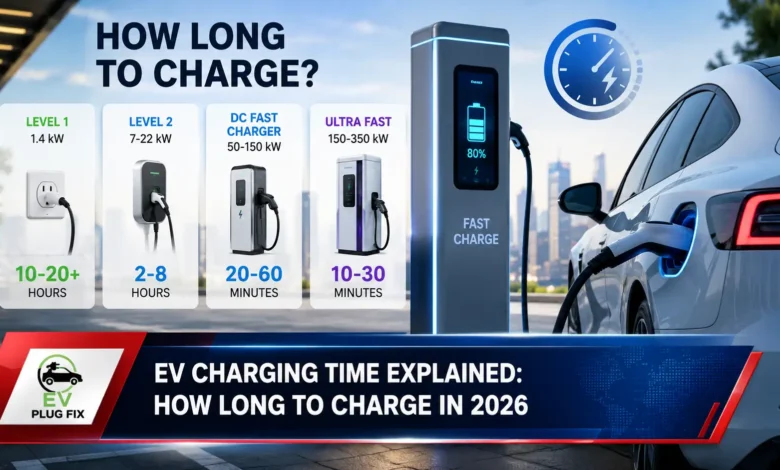
For new and prospective electric vehicle owners, understanding EV charging time is often the biggest source of anxiety and confusion.
The question, “How long to charge an electric car?” doesn’t have a single answer. The duration varies wildly depending on the charger you use, your car’s battery, the weather, and even your driving habits. In this article, we cut through the noise to give you clear, accurate EV charging times for home, work, and public stations, so you can plan your life and road trips with confidence. Let’s demystify the charging process once and for all.
Breaking Down Charging Levels: Level 1, Level 2, and DC Fast Charging
The most significant factor determining your EV charging time is the ChargePoint and other networks categorize charging into three distinct levels. Each one serves a different purpose and drastically impacts charging speed.
- Level 1 (120V): This is the standard household outlet. It’s incredibly slow, adding only about 3 to 5 miles of range per hour. It’s best for plug-in hybrids or as an emergency backup, but not practical for daily use of a full EV.
- Level 2 (240V): This is the most common and recommended home and workplace charging solution. Using a 240-volt outlet, a Level 2 charger adds between 10 to 60 miles of range per hour, depending on the amperage. This is where the bulk of your charging will happen, and understanding proper home EV wallbox charging setup is essential for maximizing efficiency.
- DC Fast Charging (480V+): Found at public stations like Electrify America and EVgo, this is the speed king. It bypasses the car’s onboard charger to pump direct current directly into the battery, capable of adding up to 20 miles of range per minute. This is what makes long-distance EV travel feasible.
Knowing these three levels is the first step to understanding charging times. A Tesla plugged into a Level 1 outlet will take days to charge, whereas the same car connected to a DC fast charger could be ready in under an hour.
Real-World Charging Times by Vehicle and Battery Size
Now, let’s get into the specifics. Here are estimated charging times for popular EVs in 2026. Remember, these are approximations based on optimal conditions. Battery size is measured in kilowatt-hours (kWh), and a larger battery takes longer to fill.
| Vehicle Model | Battery Size | Level 2 (0-100%) | DC Fast (10-80%) |
|---|---|---|---|
| Tesla Model 3 (Long Range) | ~82 kWh | 8-10 Hours | 25-30 Minutes |
| Ford Mustang Mach-E (Extended) | ~91 kWh | 10-12 Hours | 35-45 Minutes |
| Chevrolet Silverado EV | ~200+ kWh | 15-20 Hours | 40-50 Minutes |
| Hyundai Ioniq 6 | ~77 kWh | 7-9 Hours | 18-22 Minutes |
| BMW i4 | ~84 kWh | 9-11 Hours | 30-35 Minutes |
Factors That Affect Your EV Charging Duration
Beyond the charger type and battery size, several other variables can significantly impact how long you’ll be waiting. It’s not always as simple as plugging in and walking away.
Here’s what else is at play:
- State of Charge (SOC): Charging isn’t linear. EVs charge incredibly fast from 10% to 80%, but then the speed Blink Charging and other networks often recommend stopping at 80% on road trips because the last 20% can take as long as the first 70%.
- Battery Temperature: Batteries need to be at an optimal temperature to accept a high charge rate. In extreme heat or cold, the vehicle will use energy to heat or cool the battery, which can slow down the charging process until the ideal temperature is reached.
- Power Output of the Charger: Not all Level 2 or DC fast chargers are created equal. A Level 2 charger can output 6kW to 19kW, and a DC fast charger can range from 50kW to over 350kW. Your car will only pull as much power as the charger provides, so a 150kW charger will be slower than a 350kW unit.
- Vehicle’s Max Acceptance Rate: Even if you connect to a 350kW charger, your car can only take in power at its maximum rate. Many older EVs max out at 100kW, which is a crucial specification to consider when buying a used EV. Proper EV charger protection circuitry also plays a role in maintaining consistent delivery rates and preventing interruptions.
Home Charging vs. Public Fast Charging: The Practical Reality
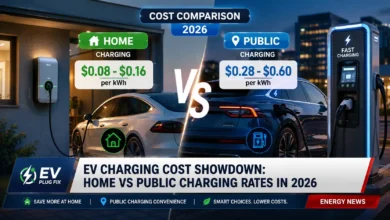
Understanding the difference in EV charging time between home and public charging is key to a stress-free ownership experience. At home, you are playing a long game; in public, it’s all about speed.
For the vast majority of drivers, home charging with a Level 2 unit is more than sufficient. You plug in when you get home and unplug in the morning with a full charge. It becomes a habit, like charging your phone. This is where the convenience of an EV truly shines, and it completely eliminates the need for frequent trips to the gas station. Regular home EV charger maintenance ensures your equipment stays reliable and efficient for years to come.
Public DC fast charging, on the other hand, is for road trips and emergencies. The goal isn’t to get to 100%, but to get enough charge to reach your next destination quickly. This is why you’ll often see EV owners at a Wallbox or other public stations for only 15 to 30 minutes, just enough to grab a coffee and use the restroom before hitting the road again. For businesses looking to manage energy costs, implementing EV peak shaving strategies can help balance demand and optimize charging schedules across multiple stations.