Smart Energy Management for Multi-Charger EV Sites: Cut Costs & Boost Capacity in 2026
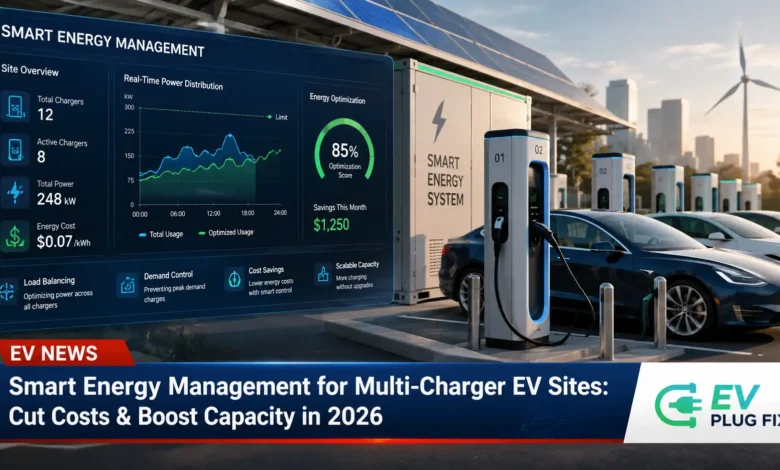
Smart energy management for multi-charger EV sites represents the critical difference between profitable operations and costly, unreliable charging infrastructure in 2026. Multi-charger sites frequently trip breakers and generate enormous electricity bills when multiple vehicles charge simultaneously, severely limiting installation capacity and driving up operating expenses that eat into margins. These challenges have become the primary bottleneck for commercial and fleet operators looking to scale their EV charging networks. Understanding the broader EV Charging Speed Factors that influence site performance is essential when planning your energy management strategy.
Energy management systems intelligently balance power across every connected charger in real-time, preventing overloads, slashing peak demand charges, and enabling more chargers without expensive utility upgrades. For commercial properties, fleet depots, and public charging hubs, this technology has shifted from optional enhancement to essential infrastructure in 2026.
The typical multi-charger installation features several DC fast chargers or Level 2 units sharing a single electrical service. When morning or evening charging peaks hit, total draw routinely exceeds main breaker or transformer ratings. The system trips, or the utility imposes punitive demand charges based on the highest 15-minute consumption interval—penalties that persist throughout the entire billing cycle. For operators concerned about EV Charging Efficiency, smart management ensures that power is distributed optimally to minimize waste and maximize every kilowatt.
| Challenge | Operational Impact | Financial Consequence | Affected Stakeholders |
|---|---|---|---|
| Circuit overload | Breakers trip during peak demand periods | Downtime and lost revenue opportunities | Charge point operators |
| Peak demand charges | Highest 15-minute kW sets monthly utility rate | 20-40% higher electricity bills | Commercial properties and fleets |
| Grid capacity limitations | Unable to install additional chargers | Expensive service panel upgrades | Real estate developers |
| Poor utilization rates | Some chargers sit idle while others max out | Wasted capital investment | All multi-site owners |
| Manual management reliance | Staff must physically turn units on and off | Labor costs and human error | Fleet depot operators |
A site with ten 50kW chargers can easily draw over 500kW at full capacity—far exceeding typical commercial electrical service ratings. Utilities base charges on the highest demand peak, meaning one busy hour can inflate the entire monthly bill. This reality forces operators into impossible choices: underutilize existing chargers, invest six-figure sums in grid upgrades, or accept punishing utility bills. Understanding Germany EV Electricity Prices and their impact on operational costs becomes crucial when evaluating the ROI of energy management investments.
Consider a real-world example from a workplace charging site that Jacky Huang personally consulted on. The operator installed eight chargers but could only safely run four at full power during daytime hours. Drivers complained about lengthy waits, and monthly demand charges consumed significant operating revenue. After implementing basic load management, the site safely powered six chargers simultaneously while cutting peak demand by nearly 30 percent. The system paid for itself within months through utility savings alone.
At Parwatt, we collaborate with charge point operators and fleet managers facing these exact constraints daily. Our 30kW and 40kW power modules deliver precise power control capabilities designed to integrate seamlessly with sophisticated energy management platforms. Without intelligent coordination, these hardware advantages remain underutilized, limiting ROI and operational flexibility.
Fleet depots experience intensified pressure as delivery vehicles typically return and plug in during compressed time windows. Simultaneous charging loads can trip breakers or force expensive infrastructure changes across entire depot facilities. Real estate developers adding chargers to apartment complexes or office buildings encounter the same barriers—residents want charging access, but existing electrical infrastructure cannot handle the additional load. Navigating Home EV Charger Permits and local regulations is an additional consideration for property developers planning multi-charger installations.
Why Multi-Charger Sites Face Overloaded Circuits and High Costs
Multi-charger installations run into trouble when several vehicles charge simultaneously. Circuits overload and trip breakers. Peak demand charges skyrocket. Grid capacity limits charger count. Installation and upgrade costs escalate dramatically. These problems consistently stall commercial project growth and reduce profitability.
Energy management systems solve these core challenges directly. They monitor real-time power consumption and shift loads dynamically to stay within available capacity, preventing trips, lowering peak charges, and enabling more chargers without major grid upgrades. Operators gain both safety and lower operating costs—a winning combination.
The fundamental issue traces back to traditional setups that treat each charger independently without any central brain coordinating power usage. When demand spikes, the system has no intelligent mechanism to share available capacity effectively. This design flaw has made energy management essential as EV numbers and charger power levels continue rising through 2026. Recent EV Charging Data Standards now support better integration between energy management platforms and charging hardware, enabling more sophisticated control strategies.
Common Misconceptions About EV Charging Energy Management
Many site owners and operators still believe they don’t require smart energy management. They assume adding more hardware capacity or using simple timers solves the problem. These outdated assumptions lead to avoidable problems and missed savings opportunities.
Let’s debunk the most persistent myths about energy management for multi-charger sites:
Myth: Total Power Rating Is All That Matters
Reality: Actual power draw fluctuates constantly as vehicles arrive and batteries reach capacity. A site rated for 200kW total can still trip breakers if all units hit peak simultaneously. Static limits waste capacity because they can’t adjust when some chargers slow down.
Myth: Simple Scheduling or Timers Solve the Problem
Reality: Timers provide limited benefit but cannot react to real-time conditions. A sudden rush of vehicles or a car charging slower than expected disrupts even the best schedule. Dynamic systems monitor actual power draw and adjust every few seconds.
Myth: Energy Management Only Matters for Very Large Sites
Reality: Even commercial locations with four to eight chargers benefit significantly. They avoid trips and lower demand charges. Savings accumulate even on modest installations.
Myth: Systems Are Complex and Expensive to Install
Reality: Modern solutions work with existing chargers through open protocols like OCPP. Many integrate with existing power modules and chargers. Properly planned setups typically take days rather than weeks.
“At Parwatt, we repeatedly encounter operators who skipped smart management and later paid for expensive upgrades or faced angry users. Those who added energy management early report smoother operations and significantly better returns.”
These myths persist because early EV charging projects were small and simple. As sites grow and power levels rise, the need for intelligent coordination becomes obvious. In 2026, with more high-power chargers and denser installations, the gap between managed and unmanaged locations is stark.
How Energy Management Systems Work for Multi-Charger Installations
Energy management systems coordinate power across numerous chargers in real-time using sensors, software, and communication protocols to balance load, shift usage to off-peak hours, and protect electrical service infrastructure. These sophisticated platforms have become essential tools for modern charging operations.
Core Functions That Drive Performance
Load balancing serves as the foundation. The system measures total power at the main service panel and at each charger. When total demand approaches the limit, it reduces power to some units or delays new charging sessions. Drivers still receive charge but the site remains operational and safe.
Dynamic power allocation goes further by looking at each vehicle’s specific needs. A car nearly full receives less power, allowing another vehicle requiring a quick top-up to get more. This approach uses available capacity more efficiently than static rules ever could.
Peak shaving shifts load away from expensive high-demand periods. The system can reduce charging speed during utility peak hours or tap on-site storage when available. Advanced setups participate in demand response programs for additional revenue.
Smart monitoring gives operators complete visibility through dashboards showing real-time power consumption, historical trends, alerts for issues, and reports for billing and planning. Most systems send notifications when capacity tightens or chargers encounter problems.
| Management Aspect | Static Approach | Dynamic Energy Management |
|---|---|---|
| Power allocation | Fixed limits per charger | Real-time adjustment based on need |
| Response to changes | Slow or manual intervention | Automatic within seconds |
| Capacity utilization | Often underutilized | Maximizes available power |
| Peak demand control | Limited capabilities | Actively reduces peaks |
| Scalability | Difficult to add chargers | Easy expansion through software |
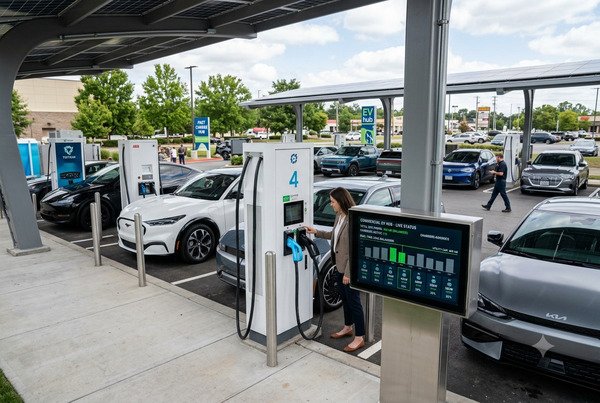
Fleet depot charging operation benefiting from smart energy management to maximize uptime and minimize costs
Communication Protocols and Integration
Most modern EMS solutions utilize open protocols like OCPP to communicate with chargers, power meters, and sometimes directly with utilities. The central controller or cloud platform processes data, makes decisions, and sends commands back to each unit. Drivers typically notice only more reliable service and occasionally shorter wait times.
Well-designed systems can enable a site to run 50 percent more chargers than the electrical service would normally support. The key is intelligent sharing rather than rigid caps. Our FES-D30 DC EV Charger and other Parwatt models respond quickly to these commands thanks to advanced power electronics.
Technology continues advancing rapidly in 2026. Machine learning helps predict usage patterns and pre-adjust power allocation. Integration with building management systems and renewable energy sources grows increasingly seamless. For operators, the result is higher uptime, lower costs, and reduced manual workload.
Key Benefits of Smart Energy Management for Commercial and Fleet Sites
Smart energy management delivers clear, measurable value across commercial and fleet installations. It lowers electricity bills, prevents costly infrastructure upgrades, improves charger utilization, and supports future growth. These benefits transform charging infrastructure from cost center to strategic asset.
Cost Reduction and Financial Performance
Commercial sites save most significantly on demand charges. These charges based on peak kW can represent 30 to 50 percent of total electricity costs. By shaving peaks, the system typically reduces monthly bills by 20 to 40 percent. Savings appear immediately and continue every billing cycle.
Fleet operators gain reliability above all. Trucks and vans can charge immediately upon return without risking tripped breakers that delay subsequent shifts. The system can prioritize specific vehicles or spread load across the depot, improving uptime and reducing stress on drivers and dispatchers.
Higher utilization translates directly to increased revenue or better service. Sites that previously could only run half their chargers during peak times now operate most units safely. Drivers spend less time waiting. Retail and hospitality locations see improved customer satisfaction scores.
Scalability represents a major long-term advantage. When demand grows, sites can add chargers without immediate electrical upgrades—the energy management system simply adjusts its algorithms. This protects initial investment and makes expansion easier and more cost-effective.
| Site Type | Primary Benefit | Secondary Benefit | Measurable Impact |
|---|---|---|---|
| Workplace charging | Lower demand charges | More employee chargers | 25-35% bill reduction |
| Fleet depot | Reliable simultaneous charging | Vehicle prioritization | Fewer operational delays |
| Apartment complex | Tenant satisfaction | Avoids expensive upgrades | Higher occupancy appeal |
| Retail locations | Better customer experience | Higher charger uptime | Increased foot traffic |
| Public charging hubs | Maximum revenue per connection | Future expansion ready | More sessions per day |
“In 2026, these benefits are becoming standard expectations rather than nice-to-have features. More utilities offer incentives for active load management, and insurance requirements favor controlled installations. Early adopters gain both immediate savings and a competitive edge.”
Parwatt helps clients select power modules and chargers compatible with leading energy management platforms. Our META Mobile EV Charger with Battery offers extra flexibility for temporary or growing sites since it already manages its own stored energy independently.
Implementing Energy Management for Your Multi-Charger Site
Getting started with energy management requires a systematic approach starting with clear assessment of current power capacity and usage patterns. From there, operators can select the right system and plan rollout strategically for minimal disruption.
Step-by-Step Implementation Guide
Start with comprehensive data collection. Measure main service capacity in amps or kW. Review utility bills for demand charges and peak times. Log vehicle charging patterns and counts. This baseline reveals exactly where bottlenecks exist.
Evaluate energy management options thoroughly. Look for systems supporting open protocols compatible with existing or planned chargers. Cloud dashboards and mobile alerts improve visibility. Predictive features that learn site patterns add significant value.
Consider integration with on-site storage or solar. Battery-buffered chargers like those Parwatt offers add flexibility layers. The energy management system can decide when to draw from grid, battery, or both based on current conditions and cost structures. For sites planning to integrate renewable energy, Bidirectional EV Charging Benefits can provide additional value through vehicle-to-grid capabilities that complement your energy management strategy.
Practical steps most successful operators follow include:
- Conduct electrical assessment with qualified electrician or engineer
- Review utility rate structures and available incentives for load management
- Select EMS platform matching existing charger brands and expansion plans
- Install necessary meters and communication hardware
- Test system during low-traffic periods before full deployment
- Monitor performance and adjust settings based on real-world data
Future-Proof Your EV Charging Operation
If you manage a fleet or commercial property, now is the time to act. EV adoption continues accelerating and power demands at charging sites keep growing. Equipment from Parwatt including DC chargers and power modules is designed to work seamlessly with advanced energy management from day one.
Advanced energy management delivers immediate savings and long-term scalability that protects your investment. Don’t let power limitations hold back your charging project. A well-designed energy management system transforms potential problems into opportunities for efficient, future-proof EV charging infrastructure that generates returns for years to come. For homeowners and small-scale operators considering Level 2 EV Installation, many of the same principles apply to ensure safe and cost-effective home charging setups.