Bidirectional EV Charging & V2G Technology Benefits in 2026
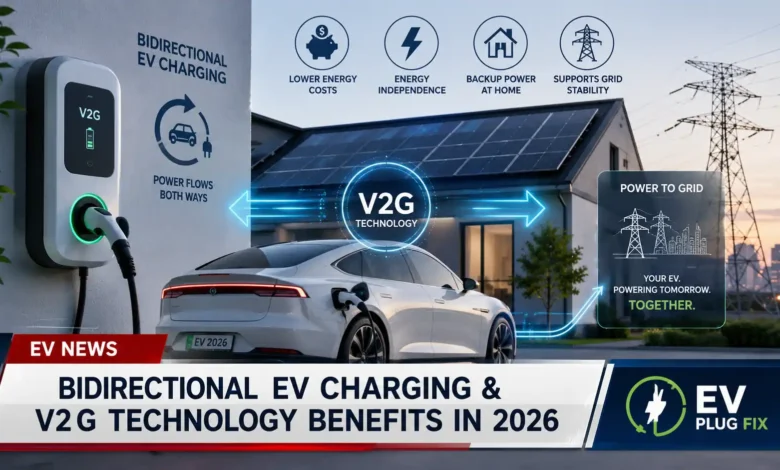
Bidirectional EV charging and Vehicle-to-Grid (V2G) technology are fundamentally reshaping what an electric vehicle can do, transforming it from a simple mode of transport into a mobile energy asset that can power your home, support the electrical grid, and even put money back in your pocket. This is not a distant future concept; it is a practical reality in 2026, with a growing number of vehicles, chargers, and utility programs making two-way power flow accessible for drivers and fleet operators alike.
Imagine this: you charge your EV overnight when electricity is cheap. During the day, when rates spike or a storm knocks out your neighborhood’s power, your car automatically sends that stored energy back to run your home. Or, picture a fleet of delivery vans returning to the depot, their large batteries not just sitting idle but actively earning revenue by feeding energy back into the grid during peak demand hours. This is the promise of bidirectional charging and V2G technology. At Parwatt, we are actively preparing our power solutions to help clients harness this potential, turning their EVs into valuable, two-way energy assets.
The concept is elegantly simple yet technologically profound. Bidirectional charging allows electricity to flow both into and out of your electric vehicle. While V2G (Vehicle-to-Grid) is the most discussed application—sending power back to the wider electrical grid—the technology also enables V2H (Vehicle-to-Home), providing whole-house backup power during outages, and V2L (Vehicle-to-Load), which lets you power tools, appliances, or even another EV directly from your car. This multifunctionality is what makes bidirectional charging a game-changer for energy management. You can learn more about the foundation of this technology in our overview of EV Charging Speed Factors.
Why Traditional One-Way EV Charging Still Wastes Money and Energy
Traditional EV charging is a one-way street. Power flows from the grid into your car’s battery, and that is where the relationship ends. For the vast majority of EV owners, this means the 60 to 100 kWh battery pack sits full and idle for hours or even days at a time. This idle capacity represents a massive missed opportunity, both for the owner and for the stability of the electrical grid.
The limitations are clear when you think about daily routines. You charge your car overnight or during the day, and then it sits parked while you are at work or asleep. That stored energy could be used to power your home during expensive peak-rate periods, or to provide backup power during an outage. Instead, you continue to pay high electricity prices while your car’s valuable battery remains an untapped resource. The grid also suffers, as all these cars plugged in simultaneously in the evening create significant strain, requiring expensive infrastructure upgrades. Understanding Germany EV Electricity Prices can help you see exactly how much you could save with smart charging strategies.
| Issue | What Happens | Money or Energy Lost |
|---|---|---|
| Idle Battery Capacity | EV sits with a full battery for 12+ hours daily | Wasted potential energy storage and value |
| Peak Electricity Pricing | Homes draw power from the grid at high-cost times | Higher utility bills for the owner |
| Grid Strain and Costs | Simultaneous evening charging spikes demand | Increased infrastructure costs passed to consumers |
| Missed Revenue Opportunities | No ability to sell stored energy back to the grid | Zero earnings from the vehicle’s battery |
This one-way flow means your EV remains a cost center. It is an appliance that consumes electricity, rather than an asset that can save or even earn money. At Parwatt, we see this in the feedback from our charge point operator clients. They are increasingly looking for hardware that is future-proof, capable of supporting two-way flow to offer advanced services. Fleet operators, in particular, are keenly aware of the gap; their vehicles frequently return to base with significant charge left, a perfect opportunity to power warehouse operations or even feed the grid for extra income. EV Charging Efficiency is a critical factor to consider when evaluating the overall economics of bidirectional systems.
Debunking 5 Common Myths About Bidirectional Charging and V2G
Despite its clear potential, several persistent myths hold back wider adoption of bidirectional charging. These outdated ideas often create unnecessary hesitation among potential users. Let’s clear them up based on the realities of 2026.
The most common myth is that frequent discharging will quickly ruin the EV battery. In reality, modern Battery Management Systems (BMS) are sophisticated. They strictly control the depth of discharge and keep the state of charge within a healthy range, typically between 20% and 80% for daily cycling. Real-world pilot programs and studies consistently show that managed V2G use results in minimal additional battery degradation over the vehicle’s lifetime. The car remains a reliable daily driver. For more on preserving your battery, check out our guide on EV Battery Lifespan.
Another major concern is safety. People often picture reverse power flow as inherently dangerous. However, certified bidirectional chargers and vehicles use stringent communication standards like ISO 15118 to constantly monitor the system. If any fault is detected, the flow is stopped instantly. The systems are designed with multiple layers of hardware and software safeguards to protect the user, the vehicle, and the grid.
| Common Myth | Current Reality in 2026 |
|---|---|
| Destroys the battery quickly | Managed discharge keeps degradation minimal and within warranty limits. |
| Only for luxury or expensive cars | Ford, GM, and other brands now offer it on trucks and SUVs, with more mainstream models coming. |
| Unsafe for home or grid use | Certified systems include multiple layers of hardware and software safety features. |
| Still an experimental technology | Real-world utility programs and commercially available vehicles exist now. |
| Requires a huge, expensive installation | Many can start with a wallbox upgrade, often supported by utility incentives. |
“The myths around V2G are fading fast as more real-world projects prove the technology’s safety and economic viability. Education is key to unlocking this enormous potential.”
These myths are quickly losing ground as more drivers participate in utility programs and share their positive experiences. They report good savings, reliable backup power, and no noticeable impact on their battery health. The technology has moved past the experimental stage; it is a viable, growing market today.
How Bidirectional Charging and V2G Technology Actually Work
At its core, bidirectional charging requires both hardware and software to enable power to flow in two directions. The process relies on a smart inverter or a specialized bidirectional onboard charger. The vehicle and the charging station, or the home energy management system, communicate constantly using protocols like ISO 15118 to determine when and how much energy to send back. Modern EV Time-of-Use Plans can integrate with these systems to maximize savings through automated discharge scheduling.
V2G
Vehicle-to-Grid: Power flows from the car to the utility grid. You earn money or bill credits by providing services like peak shaving or frequency regulation to the utility.
Hardware Needed: Bidirectional charger + utility program enrollment.
V2H
Vehicle-to-Home: Power flows from the car to your home’s circuits. This provides crucial backup power during grid outages or allows you to run your house on stored energy during peak rates.
Hardware Needed: Bidirectional wallbox + home integration system.
V2L
Vehicle-to-Load: Power flows from the car to any tool, appliance, or device. This is the most portable option, turning your EV into a giant, mobile generator for worksites, camping, or emergencies.
Hardware Needed: Outlets on the car or an external adapter box.
A typical discharge session is automated. You plug in your EV. The system assesses its battery status, your user preferences (like minimum charge level for driving), and price signals from the grid. If conditions are favorable, the car pushes power out. The software acts as a safety net, ensuring the battery never drops below a safe minimum, often around 20-30%. At Parwatt, our expertise in power modules, like our 30kW and 40kW units, gives us a strong foundation to integrate bidirectional capabilities, ensuring our chargers can smoothly manage this complex power flow.
The Key Benefits of Bidirectional Charging in 2026
The benefits of adopting bidirectional charging are extensive and touch every stakeholder, from individual drivers to the grid operators keeping the lights on. In 2026, these advantages are becoming more tangible and accessible.
For drivers, the personal benefits are immediate. You can charge when electricity is cheap—often overnight—and discharge it back to your home during expensive afternoon peaks, significantly lowering your monthly bills. Some utility programs even pay direct credits for participating in V2G, turning your car into a small income stream. The resilience factor is equally important: during storms or grid failures, your EV can power your home for several hours or even days, providing peace of mind. This capability is a major step forward for household energy independence. Pairing V2H with a home solar system and Vehicle-to-Grid Regulations can further enhance your energy independence and grid participation.
Fleets stand to gain even more. A logistics company with a depot of electric trucks can use their massive battery banks to power the warehouse during peak demand, avoiding high charges. In some regions, they can even sell grid services like frequency regulation, creating a new revenue stream from assets that were previously just for transportation. Our META Mobile EV Charger with integrated battery is already helping fleets manage energy flexibly, and integrating bidirectional tech is the next logical step for depot-level energy management.
The broader grid benefits immensely from a distributed network of EV batteries. V2G can absorb excess solar energy during the day and release it in the evening, reducing reliance on expensive and dirty peaker plants. This helps integrate more renewables smoothly and provides fast-response services for grid stability. It is a win-win for utilities and consumers alike. Understanding §14a EnWG Compliance Guide is essential for German EV owners looking to participate in these grid services while staying compliant with local regulations.
| Stakeholder | Main Benefit | Example in 2026 |
|---|---|---|
| Drivers | Energy bill savings & home backup power | Participating in a utility V2G pilot for bill credits. |
| Fleets | Lower operational costs & new revenue | Trucks powering the depot during peak demand events. |
| Grid Operators | Reduced peak demand & better renewables integration | Managing a virtual power plant (VPP) from thousands of EVs. |
| Homeowners with Solar | Maximize self-consumption & energy independence | Storing solar energy in the EV for use at night. |
Your Next Steps: Getting Started with Bidirectional Charging
If you are ready to explore how bidirectional charging can work for you, the path forward is becoming clearer. The first and most important step is to check if your current or planned EV supports this feature.
Start by consulting your vehicle’s manual or contacting your dealer. Major models like the Ford F-150 Lightning are well-known for their V2L and V2H capabilities. General Motors vehicles with the Ultium battery platform are also rolling out these features. This functionality is moving down from premium segments to more affordable models. If you are a fleet manager, you are likely already in contact with manufacturers who can outline their bidirectional roadmap.
Next, investigate programs offered by your local utility company. Many are running pilot programs that include incentives for purchasing a bidirectional charger or bill credits for participation. These programs are the easiest way to get started, as they often handle the technical setup. For home use, you will need a compatible bidirectional wallbox. Your current solar inverter might also be compatible with the right controls.
“Planning now for bidirectional compatibility is an investment in the future of your energy infrastructure. It ensures your charging equipment remains relevant and valuable as the technology and incentives evolve.”
If you are an operator of charging infrastructure, now is the time to ask your suppliers about their bidirectional readiness. Equipment that supports open standards, such as OCPP and ISO 15118, will protect your investment and allow you to offer cutting-edge services to your customers.
Here are practical steps for anyone looking to adopt bidirectional charging:
- Verify Vehicle Support: Confirm your EV’s bidirectional capabilities via the owner’s manual or dealer.
- Contact Your Utility: Ask about available V2G or V2H pilot programs and incentives.
- Select a Charger: Choose a compatible bidirectional charger or wallbox for your needs (home, fleet, or public).
- Set Your Preferences: Configure your system for minimum battery level and optimal discharge times.
- Monitor Performance: Track your energy savings, backup performance, or earnings to see the value in action.
Conclusion: Your EV, The Energy Asset
Bidirectional EV charging and Vehicle-to-Grid (V2G) technology are not just a futuristic concept; they are a rapidly growing reality in 2026 that unlocks immense value for drivers, fleets, and the grid. By allowing power to flow in both directions, your EV transitions from a simple consumer of electricity into a dynamic energy asset that can provide emergency backup, lower your bills, and even create new revenue streams. At Parwatt, we are committed to supporting this shift by developing power solutions and chargers that are ready for the future of energy. The era of the EV as a mobile power plant has arrived.