RCD Protection for go-e Charger: Type A Requirements & Safety 2026
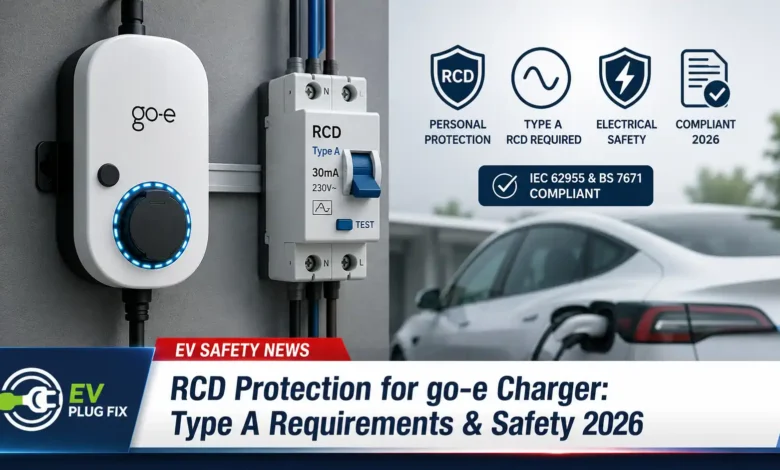
The go-e Charger Gemini and Gemini flex are among the most flexible EV charging solutions on the market, offering both wallbox permanence and mobile convenience with integrated DC and AC fault detection. However, understanding the specific RCD (Residual Current Device) requirements for these chargers is critical for safe operation and regulatory compliance. While the go-e chargers feature advanced internal protection modules that detect DC faults from 6 mA and AC faults from 20 mA, they do not eliminate the need for a building-side RCD. Let’s break down exactly what you need, and why, to keep your EV charging setup safe and up to code in 2026. For a broader comparison of mounting options, check out our guide on Wall-Mounted EV Chargers versus pedestal installations.
🔍 Expert Analysis: The RCD Mandate for go-e Chargers
Despite the go-e Gemini’s sophisticated integrated DC protection module (RCD Type B with DC protection ), the official product specification and independent testing confirm that a Type A RCD must be installed on the building side for the entire charging circuit . This is not a flaw—it’s a layered safety approach mandated by electrical standards to address different types of residual currents. Understanding your Home EV Charger Permits is equally important before any installation begins.
Why a Type A RCD Is Essential for Your go-e Charger
The go-e Charger Gemini flex, while featuring robust internal safety electronics including an RCD protection module that disconnects the unit during DC fault currents , must be backed by a Type A RCD upstream in the building’s electrical distribution board. Here’s why this is non-negotiable for safety and compliance:
- Detecting AC and Pulsating DC Residual Currents: A Type A RCD is designed to detect both sinusoidal AC residual currents and pulsating DC residual currents. This is crucial because EV charging involves power electronics that can generate these specific fault types .
- Preventing ‘Blinding’ of the RCD: A significant risk in EV charging is that smooth DC leakage current from the vehicle’s onboard charger can “blind” a standard AC-only RCD, preventing it from tripping on AC faults . A Type A RCD is designed to mitigate this risk, especially when paired with a charger that has built-in 6 mA DC leakage detection like the go-e Gemini .
- Compliance with Electrical Standards: Electrical safety standards mandate that each AC connecting point for EV charging be protected by an RCD with a rated residual operating current not exceeding 30 mA . The Type A RCD fulfills this requirement, providing personal protection against electric shock . For installations in Germany, also consider §14a EnWG EV Compliance requirements that may affect your setup.
The Critical Role of the Miniature Circuit Breaker (MCB)
Alongside the Type A RCD, your electrician must also incorporate a miniature circuit breaker (MCB) in the electrical system. This device is not optional—it acts as a secondary protective measure against overcurrent and short circuits. While the RCD protects against earth leakage, the MCB provides essential protection against overloads that could cause fire hazards or damage the charging equipment . This dual-layer protection ensures comprehensive safety for your property and your EV.
Understanding RCD Types: Why Type A Is the Baseline
To fully grasp the requirement for a Type A RCD, it’s helpful to understand the different RCD types available in the market:
Type AC
Detects only sinusoidal AC residual currents. Generally not suitable for EV charging applications due to the presence of DC components .
Type A
Detects AC and pulsating DC residual currents. This is the minimum requirement for EV charging installations and is often mandated by local wiring regulations .
Type B
The most advanced type, detecting AC, pulsating DC, and smooth DC residual currents. While ideal, it’s not always mandatory if the EVSE (like the go-e Gemini) incorporates alternative DC leakage detection .
While a Type B RCD is considered the ‘gold standard’ for EV charging due to its ability to detect smooth DC residual currents, the combination of a Type A RCD with a charger that has integrated 6 mA DC leakage detection (like the go-e Gemini) is a widely accepted and compliant approach in many installations. To maximize your charging efficiency, explore EV Time-of-Use Plans that can help you save on electricity costs.
— Adapted from Elinta Charge and EV Engineering & Infrastructure
go-e Charger RCD Specifications: A Closer Look
The go-e Charger Gemini series comes with impressive integrated safety features, but these must be correctly paired with upstream protection. This table summarizes the key RCD-related specifications:
| Feature | go-e Gemini / Gemini flex Specification | Building-Side Requirement |
|---|---|---|
| Integrated DC Protection | Electronic, detects from 6 mA | N/A |
| Integrated AC Detection | Electronic, detects from 20 mA | N/A |
| Required Building-Side RCD | N/A | Type A RCD (30 mA) |
| Secondary Protection | N/A | Miniature Circuit Breaker (MCB) |
Frequently Asked Questions About go-e Charger RCD Requirements
Can I use a Type B RCD instead of a Type A with my go-e Charger?
Yes, using a Type B RCD is absolutely permissible and provides the highest level of protection. However, it is generally more expensive than a Type A RCD. Since the go-e Gemini already contains integrated DC protection, a Type A RCD meets the minimum safety standard, offering a cost-effective and compliant solution . If you’re considering advanced features, learn about Plug and Charge Technology for seamless authentication and billing.
What happens if I don’t install a Type A RCD?
Operating the go-e Charger without a Type A RCD on the building side could violate local electrical codes, invalidate warranties, and pose a significant safety risk. The lack of proper earth leakage protection can lead to severe electric shock or fire hazards .
Who should install the RCD and MCB?
Installation of electrical components like RCDs and MCBs must be performed by a qualified and licensed electrician. This ensures the installation meets all regulatory requirements and safety standards, protecting you and your property .
🚨 Important Safety Notice for 2026 Installations
EV charging safety regulations continue to evolve. Always ensure your installation complies with the latest edition of your country’s electrical standards (e.g., IEC 60364-7-722) . While the requirement for a Type A RCD with 6 mA DC detection remains a common and compliant approach, consulting a local electrician is essential for site-specific requirements. Never attempt DIY installation of the building-side electrical protection for your EV charger. For comprehensive guidance on charger selection, explore our Best Home EV Wallbox Chargers resource to find the perfect solution for your needs.