Car Battery Charger vs Maintainer 2026: Which One Do You Actually Need?
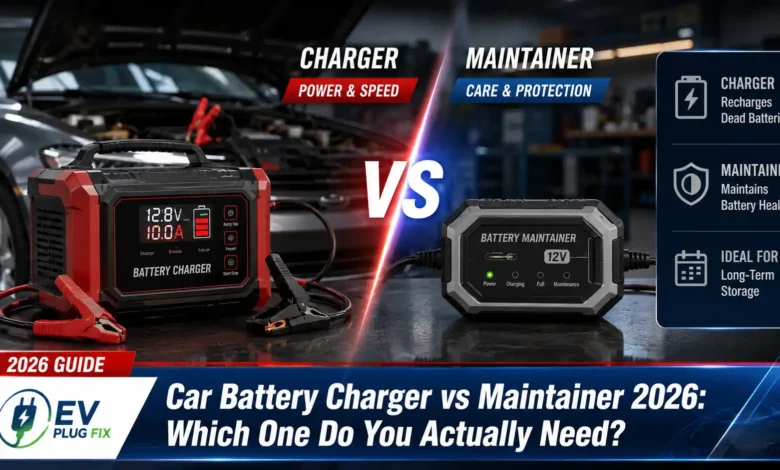
A car battery charger vs maintainer debate often leaves drivers confused, yet choosing the right one is critical for vehicle reliability in 2026. When your battery dies after sitting for just a few weeks, it’s usually not a sudden failure but a slow decline caused by parasitic drain and sulfation.
Modern vehicles, especially those packed with electronics, can drain a 12V battery in as little as 14 days of inactivity according to SAE guidelines . This is why understanding the difference between a battery charger, a trickle charger, and a battery maintainer is no longer optional for car owners.
Let’s settle this debate and help you pick the perfect device for your car, whether it’s a daily driver or a cherished classic sitting in the garage.
The Core Difference: Battery Charger vs Maintainer
While often used interchangeably, these devices serve distinct purposes. A standard battery charger is designed to boost a depleted battery. It delivers a higher current (often 4-20 amps) to quickly restore enough power to start the engine, but it is not designed for indefinite connection . For homeowners considering Level 2 EV Installation, understanding proper power management is equally important for long-term equipment safety.
To understand the distinction, we need to look at how these devices handle the three stages of charging: Bulk, Absorption, and Float. An advanced maintainer uses microprocessors to seamlessly transition through these stages, entering a “float” or “maintenance” mode that delivers small pulses of current to offset natural self-discharge . This microprocessor technology shares similarities with OCPP Charging Protocol systems that intelligently manage EV charging sessions through continuous voltage monitoring.
Here is a clear breakdown of the devices you will encounter in 2026:
| Device Type | Primary Function | Risk of Overcharge | Best Use Case |
|---|---|---|---|
| Battery Charger | Quickly revive a dead battery | High (if left connected) | Emergency jump starts, rapid recovery |
| Trickle Charger | Constant low-current supply | Moderate (manual disconnect often required) | Short-term storage, topping off charge |
| Battery Maintainer | Long-term health and desulfation | Very Low (auto-shutoff/float mode) | Seasonal storage, classic cars, EVs |
Why Modern Cars and EVs Desperately Need a Maintainer
Modern vehicles, including EVs, rely heavily on their 12V auxiliary battery. This small battery powers everything from the door locks to the onboard computer that communicates with the main high-voltage pack. If this 12V battery dies, your EV is nothing more than a paperweight, regardless of the charge in the main battery . When selecting Best Home EV Wallbox Chargers, consider models with integrated auxiliary battery monitoring to prevent this common failure point.
Unlike internal combustion engine (ICE) vehicles, EVs do not have an alternator to recharge the 12V battery. Instead, they use a DC-DC converter that only operates when the car is on or actively charging. If the car sits for a week, the telematics and security systems continue to drain the 12V battery, leading to a critical failure .
A smart maintainer with Infinite Sequential Monitoring (ISM) technology is ideal for this scenario. It keeps the 12V auxiliary battery in top condition, preventing the system failures that lock drivers out of their own EVs . This is particularly relevant for owners of Tesla Battery Lifespan who want to maximize both their main traction battery and auxiliary battery longevity through proper maintenance practices.
Understanding Battery Health: Sulfation and Pulse Repair
The primary enemy of a lead-acid battery is sulfation. This occurs when lead-sulfur deposits build up on the battery plates, creating resistance and reducing the battery’s ability to hold a charge. It often happens when a car is frequently driven on short trips or left idle for weeks .
This is where battery conditioners shine. They use high-frequency pulses to break down these sulfate crystals. Once that resistance is bypassed, the device can apply a higher voltage to regenerate the battery’s full capacity . Advanced chargers like the OptiMate 6 even include a 9-step program that can recover deeply discharged batteries from as low as 0.5V . For EV owners, understanding Bidirectional EV Charging Benefits can help visualize how power flows both ways between vehicle and grid, similar to how maintainers regulate bidirectional current to desulfate batteries.
How to Keep Your Battery Healthy in 2026
Beyond buying the right device, you can extend battery life with a few simple habits:
- Drive Regularly: If possible, take your car for a 15-minute drive weekly to let the alternator (or DC-DC converter in EVs) recharge the battery.
- Clean Terminals: Corrosion creates resistance. Clean the battery posts with a wire brush to ensure a good connection when charging .
- Turn Off Accessories: Ensure all lights, interior electronics, and dashcams are off before parking to reduce parasitic draw.
- Use a Maintainer: For seasonal vehicles, a smart maintainer is the gold standard. It can extend battery life from 2-3 years to 5 years or more .
Compatibility: AGM, EFB, and Standard Batteries
It is not safe to assume a charger works for all battery types. There are three primary types of 12V batteries:
- SLI (Starting, Lighting, Ignition): The standard flooded lead-acid battery.
- AGM (Absorbent Glass Mat): Spill-proof and more durable. Common in modern ICE vehicles and EVs.
- EFB (Enhanced Flooded Battery): A step up from standard, designed for start-stop systems.
Many smart chargers support all three, but you should always check the compatibility. For instance, an AGM battery requires a specific charging profile (often a higher voltage) to charge efficiently and safely . A battery charger designed specifically for standard flooded batteries may damage an AGM battery over time . When installing Wall-Mounted EV Chargers, ensure your charger’s voltage profile matches your vehicle’s battery specifications to avoid compatibility issues.
How to Choose the Right Device for 2026
Selecting the right device depends entirely on your storage and use habits.
If Your Vehicle Sits for Weeks at a Time
This applies to classic cars, RVs, motorcycles, or a backup car. You need a battery maintainer. Look for features like automatic shutoff, float mode, reverse polarity protection, and pulse repair technology. A maintainer in the 1-2 amp range is perfect for long-term care .
If Your Vehicle is a Daily Driver
A maintainer is less critical, but a smart charger with “maintenance mode” is a great backup. If you experience a parasitic drain (like a faulty dashcam or interior light), you can use the charger to top up the battery safely without worrying about overcharging if you forget to disconnect it .
“If you can’t plug in, skip the maintainer and get the battery tested before winter. Weak batteries don’t improve with optimism.” – Yahoo! Autos
For Electric Vehicles (EVs)
As mentioned, EV owners need to maintain the 12V auxiliary battery. A 2-bank charger is a smart investment if you have multiple vehicles. You can maintain the EV’s 12V battery and a classic car simultaneously without buying two separate units .
Safety First: Advanced Protection Features
Leaving a device connected to your battery may feel risky, but modern smart chargers are designed with safety in mind. Look for units with these features:
- Reverse Polarity Protection: Prevents sparks if you connect the clamps incorrectly.
- Overcharge Protection: Prevents battery damage via automatic shut-off.
- Short Circuit Protection: Ensures safety if the clamps touch.
- Temperature Compensation: Adjusts voltage based on ambient temperature, protecting the battery in extreme cold and heat .
Investing in a smart battery maintainer is one of the most cost-effective ways to protect your vehicle investment in 2026. Whether you drive a gas-powered classic or a modern electric vehicle, this simple device ensures your car starts every time and your battery lasts for years.