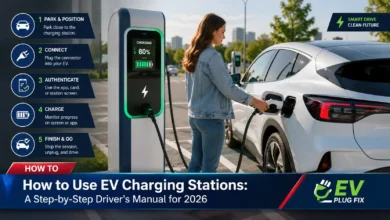
Smart EV Charger vs Standard Charger: Which Is Right for You in 2026?
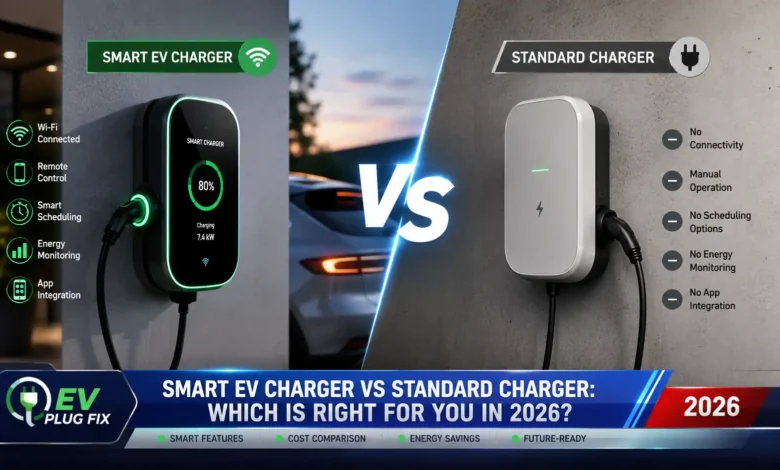
Smart EV charger vs standard charger is a decision that every new electric vehicle owner faces, and with the global EV market projected to surpass 40 million vehicles on the road by the end of 2026, choosing the right home charging equipment has never been more critical for convenience, cost savings, and future-proofing your energy setup. While both types of chargers will safely replenish your car’s battery, the choice between a connected, intelligent system and a straightforward “dumb” unit can dramatically affect your electricity bills, battery health, and overall ownership experience. This long-form investigation by EVPlugFix dives deep into every technical nuance, financial implication, and lifestyle consideration to help you make the most informed decision for your driving habits and home energy ecosystem.
Understanding EV Charger Basics: The Core Difference
At its most fundamental level, both standard and smart EV chargers serve the same primary purpose: delivering electricity to your vehicle’s battery pack through a safe and regulated connection. However, the key difference lies in the level of intelligence, connectivity, and control that each device offers. Before diving deeper, it’s helpful to review our comprehensive EV Charger Selection Guide to understand the full spectrum of available options.
What Is a Standard “Dumb” EV Charger?
A standard EV charger is essentially a sophisticated power outlet for your car. It provides the necessary safety checks, ground fault protection, temperature monitoring, and communication with the vehicle over the standard SAE J1772 or NACS pilot signal, but nothing more. These units lack any form of networking capability, meaning there’s no Wi-Fi, Bluetooth, or app connectivity. Once you plug in your vehicle, it charges at a fixed rate—typically determined by its amperage rating—until the car’s battery management system signals that it’s full or you manually unplug the connector. As one industry analysis notes, “a dumb charger is the EV equivalent of an old-school wall outlet with good manners”. For a detailed breakdown of connector types, see our comparison of NACS vs CCS2 Charging standards.
- No connectivity: No Wi-Fi, Bluetooth, or cellular communication.
- Fixed operation: Charges at a constant amperage until manually stopped or the car reaches full capacity.
- Manual control: All charging sessions are initiated and terminated physically at the unit or the vehicle.
- Lower upfront cost: Generally priced between $300 and $500 for a reliable 32-40 amp unit.
What Is a Smart EV Charger?
A smart charger represents a significant technological leap forward, integrating hardware, software, and connectivity to create an intelligent energy management node for your home. These devices connect to the internet via Wi-Fi, Ethernet, or even cellular networks, allowing for two-way communication with a companion mobile app, cloud services, and increasingly, with the utility grid itself. As defined in the industry, “a smart EV charger adds a layer of brains on top of that basic safety hardware”. This brain allows for features like remote monitoring, dynamic charging schedules, and active power management to optimize energy use and costs. If you’re considering a popular smart option, our go-e Charger Setup guide walks through the installation and configuration process step by step.
- Internet-connected: Enables remote access and control via smartphone apps.
- Intelligent features: Supports scheduling, energy tracking, dynamic load balancing, and integration with renewable energy sources.
- Data-driven: Provides detailed insights into energy consumption, costs, and charging history.
- Higher upfront cost: Typically ranges from $500 to $900 or more, depending on features and power output.
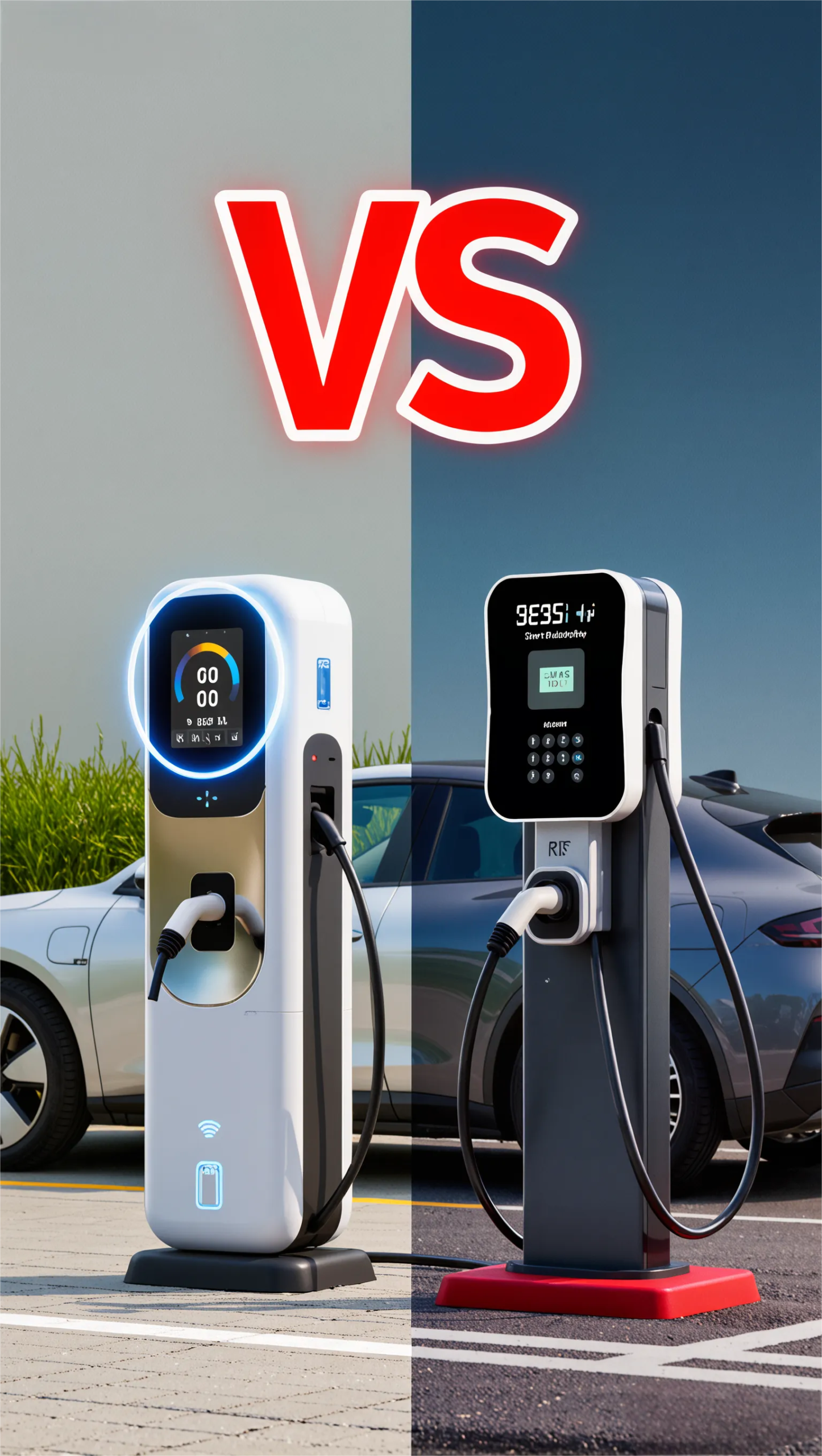
Charging Speed and Efficiency: Does “Smart” Mean Faster?
A common misconception is that a smart charger will inherently charge your EV faster than a standard one. The reality is more nuanced: both smart and standard Level 2 chargers can deliver roughly the same charging speed if they are rated for the same amperage and wired correctly. A 40-amp dumb wallbox and a 40-amp smart wallbox will add essentially the same miles of range per hour. The key difference lies in how that power is managed and optimized. To understand charging metrics in greater detail, explore our EV Charging kWh Guide for monitoring and cost calculations.
Standard Level 2 chargers, typically operating at 7kW to 19kW, can charge a Battery Electric Vehicle (BEV) from empty to 80% in 4 to 10 hours. This is a significant improvement over Level 1 charging, which uses a standard 120V household outlet, delivers about 1kW of power, and can take over 40 hours for a full charge. However, a standard unit provides this power at a fixed rate, regardless of your home’s other electrical demands, your utility’s time-of-use rates, or the current grid load.
Smart chargers excel in efficiency, not necessarily raw speed. They use features like dynamic load balancing and scheduled charging to ensure that the power they deliver is used as cost-effectively and as greenly as possible. For example, a smart charger can automatically delay charging until the middle of the night when electricity rates are lowest, effectively reducing your cost per kilowatt-hour. They can also throttle back their output if your home is using a lot of power from other appliances, preventing an electrical overload and avoiding a tripped breaker. This intelligent energy management transforms the charging process from a blunt instrument into a precision tool for energy savings.
Feature Comparison: The Brains Behind the Charge
The most significant differences between smart and standard EV chargers become apparent when examining their respective feature sets. Standard chargers are limited to a plug-and-charge experience, while smart chargers offer a comprehensive suite of tools to manage, monitor, and monetize your charging sessions. For a complete overview of charger types, visit our Home EV Charger Guide to compare different models and specifications.
- App Control & Remote Monitoring: Smart chargers allow you to monitor charging status, start or stop a session, and view real-time energy usage from anywhere via a smartphone app. Standard chargers offer no remote capabilities.
- Scheduled Charging: You can program a smart charger to automatically begin charging during off-peak hours when electricity is cheaper, a standard feature unavailable on “dumb” units.
- Energy Tracking & Reporting: Smart chargers provide detailed session data, including kWh used, estimated cost, and charging history. This data is invaluable for tracking consumption and managing your household energy budget. Standard units provide no such data.
- Load Management & Dynamic Load Balancing: This feature is critical for homes with limited electrical capacity or multiple EVs. A smart charger can monitor a building’s total power consumption and automatically adjust the power drawn by the charger to avoid overloading the electrical panel.
- Integration with Renewable Energy: Smart chargers can work with home solar PV systems to prioritize charging from self-generated solar power. They can even adjust the charging rate to match the output of your solar panels, maximizing the use of your clean energy and further reducing grid dependency.
- Over-the-Air (OTA) Updates: Like a smartphone, smart chargers can receive firmware updates that add new features, improve performance, and patch security vulnerabilities. Standard chargers are fixed, unchangeable devices.
- Advanced Safety Features: Smart chargers often include more robust safety mechanisms, such as nozzle temperature monitoring, surge protection, and real-time insulation detection, which can proactively shut down the charger to prevent hazards. For additional safety considerations, review our Home EV Charging Safety guide.
Smart EV Charger vs Standard Charger Comparison Table
| Feature | Standard (Dumb) Charger | Smart Charger |
|---|---|---|
| Connectivity | None | Wi-Fi, Bluetooth, Ethernet, or Cellular |
| Remote Control & Monitoring | Not Available | Full control via mobile app |
| Scheduled Charging | Not Available | Automatic off-peak charging to save money |
| Energy Usage Data | Not Available | Detailed kWh cost and session reporting |
| Dynamic Load Management | Not Available | Prevents circuit overloads |
| Solar/Renewable Integration | Not Available | Yes, can prioritize solar generation |
| Over-the-Air Updates | Not Available | Yes, for new features & security |
| Typical Hardware Price | $300 – $500 | $500 – $900+ |
Cost Analysis: Upfront vs. Long-Term Savings
The financial equation is perhaps the most critical factor for many EV buyers. While standard chargers are undeniably cheaper to purchase, the long-term cost advantages of a smart charger can quickly offset the initial price difference. It’s also important to note that the cost of the charger itself is only one part of the overall installation expense. The price of running a 240V circuit from your electrical panel to your garage is largely the same regardless of whether you choose a smart or standard unit, as the amp rating and distance are the primary drivers of labor and material costs. For a complete breakdown of installation considerations, see our EV Charger Installation Guide.
Smart chargers generate savings through several avenues. Their ability to schedule charging during off-peak times, when electricity is often significantly cheaper, leads to direct bill reductions. For instance, if your utility charges $0.20/kWh during the day and $0.05/kWh at night, the savings per session are substantial. Furthermore, by participating in utility demand-response programs, smart chargers can earn you credits or rebates for allowing the grid operator to briefly throttle or pause your charging during peak demand events. Many of these programs require the use of a networked, smart charger to qualify.
- Tip: Installing an EV charging point can increase home value by more than five times the upfront cost of some smart chargers, making it a valuable long-term improvement.
When weighing the costs, consider the total cost of ownership. A standard charger saves you money at the point of purchase, but a smart charger saves you money every time you charge. For high-mileage drivers or those with large battery packs, the savings from time-of-use (TOU) optimization can be significant, often paying for the premium of the smart charger within the first few years of ownership.
Battery Health and Safety: Protection Beyond the Plug
Charging is not just about speed and cost; it’s also about protecting your vehicle’s most valuable and expensive component: its battery. Smart chargers offer a distinct advantage in this area by providing a more intelligent, data-driven charging experience.
Standard chargers function as basic conduits for electricity, with the vehicle’s onboard Battery Management System (BMS) being the primary safeguard. While these BMS systems are highly sophisticated, smart chargers add an extra layer of protection. They can perform a complete “handshake” with the vehicle upon connection, reading critical battery data such as cell temperature, state of charge (SOC), and maximum allowable charging current.
- Dynamic Current Limiting: A smart charger can automatically reduce its power output if the battery is too cold or too hot, protecting it from stress and degradation.
- Real-Time Monitoring: They continuously monitor feedback from the onboard charger. If an anomaly is detected, such as a sudden voltage spike or a communication error, the smart charger can immediately cut off power.
- Diagnostic & Alerting: Smart chargers can detect hardware abnormalities and send alerts to your phone, helping you troubleshoot potential issues before they become major problems.
Standard chargers, lacking this communication, simply provide a fixed amperage and can’t adapt to nuanced battery conditions. While they are safe when used correctly, they don’t offer the same proactive protection or data visibility, which could lead to increased stress on the battery over time.
Future-Proofing: The Smart Grid and Your Home
Making a significant purchase like a home EV charger requires looking ahead. The transportation and energy sectors are evolving rapidly, and buying an outdated piece of technology today could leave you with a depreciating asset that can’t interact with the energy ecosystem of tomorrow.
In this regard, smart chargers are the clear winner. They are designed to be software-upgradeable and integrate with emerging technologies like Vehicle-to-Home (V2H) and Vehicle-to-Grid (V2G), which turn your EV’s battery pack into a power source for your home or a source of energy for the grid. As the energy grid becomes more dynamic, smart EV chargers will react to signals from the grid to optimize power usage based on cost and demand.
When to Choose a Standard Charger
Despite all the advanced features of smart chargers, there are still very valid scenarios where a standard, non-networked charger is the superior choice. The decision ultimately comes down to your personal needs, lifestyle, and tolerance for technology.
- Predictable Schedule: If you plug in your car at a similar time every evening and your utility doesn’t have aggressive time-of-use rates, simple plug-and-charge is sufficient.
- Value Simplicity: If you prefer a “set it and forget it” approach and want to avoid server logins, app setups, or firmware updates, a standard unit is a reliable choice.
- Wary of Cloud Lock-in: Standard chargers don’t rely on cloud servers, ensuring they won’t lose functionality if a company discontinues app support.
- Budget-Conscious: If upfront costs are tight, a safe, quality standard charger is a smart initial choice.
When a Smart Charger Is Worth the Investment
For the growing number of EV owners who view their home’s energy system holistically, a smart EV charger is an indispensable tool. It transforms your electric vehicle from just another appliance into a flexible asset that can save you money, maximize self-generated solar power, and participate in the broader energy grid.
- Time-of-Use (TOU) Utility Rates: Essential for scheduling sessions automatically during the cheapest rate windows.
- Multi-EV Households: Enables dynamic load sharing between multiple vehicles on a single electrical circuit.
- Home Solar Integration: Prioritizes excess solar generation to charge your car directly from clean, free energy.