EV Charging Reimbursement 2026: How to Track Electricity Usage for Company Cars
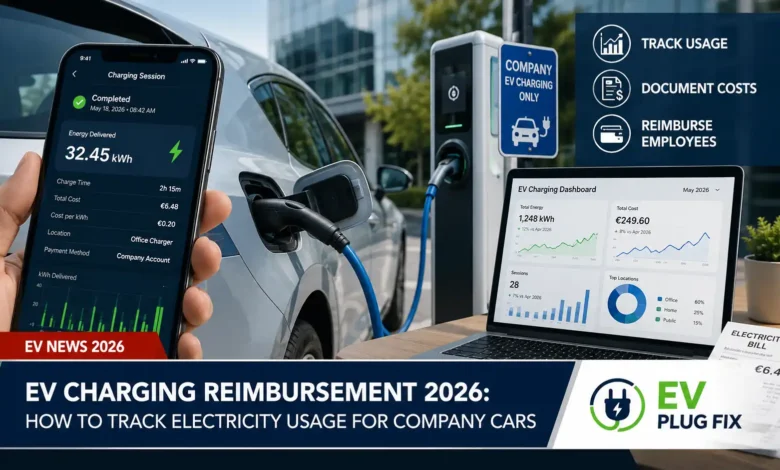
Exact electricity tracking for company car charging is becoming the new standard in 2026, replacing the previous flat-rate reimbursement models that expired on December 31, 2025 .
With the German Federal Ministry of Finance (BMF) introducing new regulations on November 11, 2025, businesses and employees must adapt to a more precise system for billing home charging sessions. The old monthly flat rates of €30 to €70 for EVs and €15 to €35 for plug-in hybrids are officially history .
Whether you’re an employer managing a fleet or an employee charging a company car at home, understanding how to track electricity usage accurately is essential for tax-free reimbursement and legal compliance under the German Measurement and Calibration Act (MessEG). For a broader overview of charging options, check out our EV Charging Levels Guide to understand the different power levels available for home and public charging.
Understanding the New 2026 EV Charging Reimbursement Rules
Starting in 2026, companies can reimburse employees for home charging costs tax-free under two primary options, but both require precise tracking of electricity consumption .
Option A: Tracking Actual Electricity Costs
This method involves billing based on the exact kilowatt-hours charged at home. To implement this approach, you’ll need proper metering equipment and documentation .
The requirements include:
- Proof of charged electricity via a separate meter (stationary, mobile wallbox, or vehicle-integrated)
- Documentation of individual electricity tariff through the energy supplier contract
- Consideration of dynamic tariffs and proportional base fees
Option B: Electricity Price Flat Rate (2026–2030)
To simplify the process, the BMF allows using a flat rate based on the average household electricity price published by the Federal Statistical Office (Destatis). For 2026, the average price is approximately €0.34/kWh. At 3,000 kWh, this equals a tax-free reimbursement of about €1,020 .
Why MID Meters Are Critical for Accurate Electricity Tracking
An MID (Measuring Instruments Directive) meter is a certified power meter that records the energy consumption of your wallbox installation with precision. It provides accurate energy measurements essential for billing or reimbursement purposes .
Wallbox supports two types of MID-certified power meters that can be purchased through their online store :
- Three-phase MID power meter: Suitable for three-phase installations (up to 65A)
- Single-phase MID power meter: Suitable for single-phase installations (up to 100A)
| Meter Type | Installation Type | Maximum Current | Use Case |
|---|---|---|---|
| Three-phase MID Meter | Three-phase | Up to 65A | Commercial properties, high-power charging |
| Single-phase MID Meter | Single-phase | Up to 100A | Residential installations, standard home charging |
MID Meter vs. German Calibration Law: What’s the Difference?
Understanding the distinction between MID conformity and German calibration law (Eichrecht) is crucial for compliance. German calibration law goes beyond the requirements of the MID, laying down specific requirements for measuring instruments used in Germany .
Key differences include :
- MID conformity is accepted for consumption-based billing in other European countries
- German calibration law additionally covers monitoring, maintenance, and repair of measuring instruments
- To be compliant with calibration law, the entire charging station must be tested and approved by a German authority like the Physikalisch-Technische Bundesanstalt (PTB) in Braunschweig
- An MID meter alone is not sufficient for calibration law compliance – the entire charging solution must be approved
“To be in compliance with calibration law, an MID meter alone is not sufficient, as the entire charging station must be tested. Only charging solutions approved under calibration law can be used at public locations where customers pay per kWh.”
Practical Data Transmission Options for Employer Reimbursement
When choosing a wallbox, consider how to send charging data to your employer. Several methods are available, each with different levels of automation and convenience .
Manual Data Transmission
You can email your current electricity report with the kilowatt-hours actually charged to your employer. Records should be submitted for a representative, continuous period, normally around three months. This method works if manual transmission is sufficient for the employer’s requirements .
Step-by-step process for manual reporting:
- Log in to your wallbox portal (e.g., Wallbox Portal at www.my.wallbox.com)
- Navigate to the “Sessions” section
- Select relevant charging processes
- Click on the “Reporting” button to activate sessions reporting or use the “Export” button
- Apply filters to include necessary details
- Download the export file and send to your employer
Automated OCPP Solutions
A private wallbox can be connected directly to your employer’s billing system if the wallbox is internet or mobile-enabled and uses the OCPP (Open Charge Point Protocol) standard .
OCPP is an open communication protocol and the global standard for communication when charging electric vehicles. It enables :
- Precise tracking of charging sessions
- Simple billing processes
- User authentication via RFID roaming cards or NFC
- Integration with backend systems for automation
Special backend systems, such as those offered by Monta or Road, often realize all processes related to charging station management and billing automation .
Self-Generated Solar Power and Reimbursement
Self-generated electricity from PV systems is treated like household electricity for reimbursement purposes .
Key requirements include :
- Proof of charged kWh via suitable metering devices (wallbox, mobile, or vehicle-integrated)
- Reimbursement based on documented purchase price or the electricity price flat rate
- Mandatory documentation of charged electricity amount
Wallbox Compliance: What You Need to Know
To comply with calibration law, charging stations or wallboxes must have special hardware and software solutions for tamper-proof energy recording .
Requirements include :
- Meter data displayed on a screen at the charging station
- Equipment undergone conformity assessment and calibration
- Digital signing capability for measurement data
- Data records containing measured values, time stamps, unique device IDs, and customer identification
- Tamper-proof measurement data storage
- Subsequent verification of measurement data by customers
Mobile and Vehicle-Integrated Tracking Solutions
Recent innovations are making hardware-free tracking possible. In March 2026, Tronity and Mercedes-Benz announced a partnership to simplify and reduce the cost of reimbursing home charging for fleet customers .
Key features of this solution include :
- Use of vehicle data to calculate home charging sessions reliably and automatically
- No additional hardware required
- Seamless integration into existing IT systems like SAP
- Clearly structured, automatically generated reimbursement reports
- Full GDPR compliance
Wallbox also launched the new Pulsar Pro in June 2026, which integrates MID-certified energy metering directly into the charger, eliminating the need for additional external metering hardware . For more information on choosing the right charger for your needs, explore our comparison of Modular EV Charging Systems to see how different architectures can affect your tracking capabilities.
Key Takeaways for Employers and Employees
For Employers
- Establish clear billing processes for home charging
- Implement either actual cost tracking or electricity price flat rate for the entire calendar year
- Require proper documentation from employees
- Consider automated OCPP solutions for larger fleets
For Employees
- Ensure your wallbox has MID certification or calibration law compliance
- Document charging sessions accurately
- Understand whether you’re using Option A or Option B
- Learn to export charging reports from your wallbox portal
- MID meter installed or calibration law compliant solution
- Tamper-proof data recording capabilities
- Method for transmitting data to employer (manual or automated)
- Documentation of electricity tariff and rates
Future Trends in EV Charging Reimbursement
The EV charging reimbursement landscape continues to evolve rapidly. New solutions are emerging that leverage vehicle data, cloud platforms, and advanced metering to simplify the process .
Key developments to watch include :
- Hardware-free tracking solutions using vehicle data
- Integrated MID meters in wallboxes (like Pulsar Pro)
- Enhanced reporting capabilities through employer portals
- Improved compliance automation for fleet managers
With corporate vehicles accounting for approximately 60% of new car registrations across the EU, and about 80% of EV charging happening at home, work, or depot facilities, the importance of accurate, efficient reimbursement systems cannot be overstated .
Conclusion
Tracking exact electricity usage for company car charging in 2026 requires careful attention to metering, documentation, and transmission methods. Whether you opt for MID meters, calibration law compliant solutions, or automated OCPP systems, the key is ensuring accurate, verifiable data that satisfies both tax requirements and employer needs.
The transition from flat-rate reimbursement to exact electricity tracking represents a significant shift, but it also offers greater transparency and fairness in billing. By understanding the available options and compliance requirements, both employers and employees can navigate this change successfully. If you’re considering installing a new wallbox, be sure to review our guide on Austria Wallbox Installation for practical tips, and learn about EV Charger Circuit Breaker requirements to ensure your electrical panel can handle the load. For a deeper dive into the technologies powering your EV, understanding the EV DC-DC Converter can help you appreciate the full system integration.