Modular vs Fixed EV Charging Systems Pros and Cons 2026 Comparison
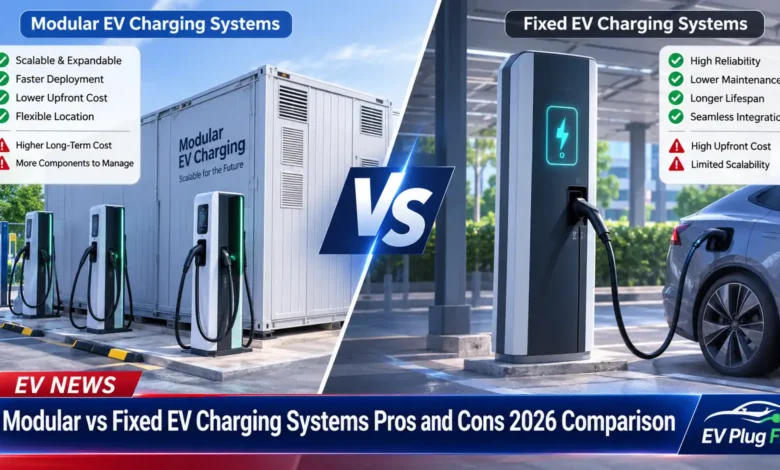
Modular and fixed EV charging systems represent two fundamentally different approaches to electric vehicle infrastructure, each with distinct advantages that directly impact your total cost of ownership, operational flexibility, and long-term scalability. Choosing between these systems in 2026 requires careful analysis of your growth plans, daily usage patterns, and tolerance for maintenance downtime. While modular systems offer unparalleled adaptability and simpler repairs, fixed solutions deliver proven reliability and lower upfront investment for stable, high-volume applications. The right choice ultimately hinges on matching infrastructure capabilities to your specific site requirements and future electric vehicle adoption projections.
Having guided numerous charge point operators and fleet managers through this decision process at Parwatt, I’ve witnessed firsthand how the wrong choice can lead to costly replacements or underutilized equipment. One fleet operator who selected a fixed system for his growing delivery van fleet discovered six months later that his expansion plans required a complete infrastructure overhaul. Conversely, a property developer who initially hesitated at the higher modular price point now enjoys seamless capacity additions as tenant demand grows. This real-world experience informs our comprehensive comparison of modular versus fixed EV charging systems.
Why the Modular vs Fixed EV Charging Decision Creates Confusion for Buyers
The EV charging market bombards buyers with conflicting marketing messages, each emphasizing different benefits while downplaying limitations. This creates significant confusion, particularly for those making infrastructure decisions for the first time. Understanding the root causes of this confusion helps you navigate the selection process more effectively. For a deeper understanding of how different charging capabilities affect daily usage, review our detailed guide on EV Charging Time and its impact on operational planning.
High Investment Risk and Uncertainty
Modular systems typically command a 20-40% premium over fixed alternatives due to additional components and more complex engineering. However, fixed systems that initially appear economical may require complete replacement when charging demands increase. Most buyers cannot accurately predict their EV charging requirements three to five years out, making every equipment quote feel like a gamble with significant financial consequences.
Expansion Capabilities and Limitations
Fixed charging stations generally require new electrical infrastructure and complete unit replacement to accommodate growth. Conversely, modular systems allow power module additions without touching the base installation. Yet even modular designs have practical limitations. Some systems restrict expansion to specific brand components, while others require additional space or cooling infrastructure that site constraints may not accommodate.
Maintenance and Reliability Concerns
Fixed chargers often demonstrate exceptional reliability under consistent operating conditions, but a single component failure can disable the entire unit. Modular systems enable hot-swapping of failed modules, keeping the majority of stations operational during repairs. However, modular designs sometimes demand specialized technicians and readily available spare parts inventory, raising concerns for operators in remote locations. Understanding the EV DC-DC Converter role in modern charging systems can help clarify reliability considerations across different architectures.
Conflicting Vendor Messaging
Manufacturers and resellers often promote the systems they profit from most, rather than what best suits your specific application. Vendors emphasizing modular technology may downplay its complexity, while advocates for fixed systems might ignore legitimate scalability concerns. Without objective data and honest assessment of your specific site requirements, it becomes nearly impossible to evaluate competing claims accurately.
| Buyer Concern | Modular Impact | Fixed Impact | Real-World Consequence |
|---|---|---|---|
| Upfront capital requirements | Higher initial investment (20-40% premium) | Lower purchase and installation cost | Budget allocation challenges vs unexpected replacement costs |
| Future capacity expansion | Add modules without system replacement | Often requires new stations and electrical work | Capital expenditure timing and project disruption |
| Maintenance downtime | Individual module replacement while others operate | Full unit taken offline for repairs | Revenue impact and customer satisfaction issues |
| Technical service requirements | May require specialized training and spare parts | Simpler repair procedures, limited flexibility | Service availability and technician skill requirements |
Additional factors compounding decision complexity include:
- Manufacturer marketing rarely presents honest five-year total cost comparisons
- Local installation contractors may specialize in only one system type
- Utility interconnection rules for power expansion vary significantly by jurisdiction
- Newer EV models sometimes demand power levels exceeding current infrastructure capabilities
Debunking Common Misconceptions About Modular and Fixed EV Chargers
Several persistent myths about EV charging systems continue to influence buyer decisions, often leading to suboptimal choices. These misconceptions stem from oversimplified assumptions that don’t hold up against real-world performance data and operational experience.
Myth: Modular Systems Are Always More Flexible
While modular designs generally offer greater adaptability, flexibility has practical boundaries. Some modular systems restrict module compatibility to specific manufacturers, limiting your ability to source competitive alternatives. Others require substantial physical space or cooling infrastructure for maximum expansion. Fixed systems sometimes support limited upgrades through software updates or external load management features. The actual flexibility depends on specific product engineering, not merely the modular label.
Myth: Fixed Systems Have No Upgrade Path
Many fixed chargers can accommodate some growth through parallel station connections or power-sharing configurations. While they cannot match the granular scalability of modular architectures, they aren’t entirely static. Some modern fixed designs include communication ports and software capabilities that enable expanded functionality without hardware replacement.
Myth: Lower Initial Cost Means Lower Total Cost
The purchase price represents only one component of total ownership costs. When factoring in installation, potential replacement costs, downtime losses, and maintenance expenses, the cost differential between modular and fixed systems narrows significantly. Our project data shows modular installations often recover their premium within three years on high-utilization fleet sites through reduced downtime and avoided replacement costs. Before finalizing any purchase, ensure you understand MID Wallbox Requirements and how metering accuracy affects long-term operational expenses.
Myth: Modular Always Means Less Downtime
Although modular designs allow partial operation during module repairs, they remain vulnerable to control system or cooling infrastructure failures that can disable the entire installation. Fixed systems sometimes prove more resilient for continuous high-power applications due to fewer connection points subject to wear and environmental stress.
| Common Misconception | Reality Check | Smarter Evaluation Approach |
|---|---|---|
| Modular equals unlimited flexibility | Limited by brand compatibility and physical constraints | Verify specific expansion capabilities with documentation |
| Fixed systems offer zero growth potential | Some support software upgrades or parallel configurations | Request detailed upgrade roadmaps from manufacturers |
| Lowest price means best value | Ignores downtime, maintenance, and replacement expenses | Calculate comprehensive five-year total cost of ownership |
| Modular design guarantees uptime | Control or cooling failures can still disable entire system | Analyze complete system failure modes, not just module failures |
Questions that cut through the marketing noise and reveal practical realities:
- What is the maximum capacity this system supports, and how is that achieved?
- Can I install modules from different manufacturers in the same cabinet?
- What is the typical lead time for replacement modules in my region?
- Does the system’s cooling infrastructure support maximum module density?
Modular vs Fixed EV Charging Systems: Comprehensive Analysis
A thorough comparison across key operational dimensions provides the clarity needed for confident decision-making. Each factor carries different weight depending on your specific application and business priorities.
Cost Structure and Financial Impact
Fixed systems generally win on initial capital expenditure, with simpler designs reducing material and installation labor costs. Modular systems command higher upfront investment due to additional components, modular architecture engineering, and more complex electrical planning. However, the long-term financial picture often flips. Modular repairs typically cost less and take less time. Avoiding complete system replacement when capacity needs grow represents substantial savings that accumulate over years of operation.
Scalability and Future-Proofing
This dimension represents the clearest modular advantage. Adding power modules as EV adoption increases eliminates the need for costly system replacement. Fixed systems generally require new charging stations and potentially upgraded electrical service for any meaningful capacity increase. For sites with uncertain growth trajectories, modular architecture provides built-in investment protection. Review our EV Charging Levels Guide to understand how different power levels align with scalability requirements.
Maintenance and Operational Continuity
Modular designs minimize service disruption by allowing technicians to replace individual modules while other stations continue serving vehicles. Fixed systems typically require taking the entire unit offline, extending downtime duration. However, the reduced complexity of fixed designs sometimes translates to fewer potential failure points, potentially improving reliability in harsh environmental conditions.
Reliability Across Different Usage Patterns
Fixed systems often demonstrate superior reliability for steady high-power applications due to their simpler internal connections and fewer components subject to failure. Properly engineered modular systems can match this reliability, but may experience more issues at module connection points over time. Both configurations meet applicable safety standards when properly installed. For a broader perspective on charging standards and compatibility, explore European EV Charging Standards and how they influence system design choices.
Installation Complexity and Site Requirements
Fixed systems generally install more quickly on straightforward sites with minimal constraints. Modular installations require additional planning for module spacing, cooling requirements, and future expansion access. Once the base infrastructure is established, however, modular capacity additions proceed much more efficiently than fixed system upgrades.
| Decision Factor | Modular Systems | Fixed Systems | Recommendation Context |
|---|---|---|---|
| Initial Capital Investment | Higher (20-40% typical premium) | Lower equipment and installation cost | Fixed suits budget-constrained, stable sites |
| Capacity Expansion | Modular addition without system overhaul | Requires new stations and infrastructure work | Modular supports growing operations |
| Maintenance Downtime Impact | Low – single module replacement | Higher – complete unit offline for repairs | Modular benefits high-utilization sites |
| Operational Reliability | Good with proper engineering and installation | Often stronger for continuous high-power loads | Fixed suits harsh, steady-use applications |
| Installation Requirements | Additional planning for modules and cooling | Straightforward installation on most sites | Fixed simplifies simple site deployments |
| Long-Term Investment Value | Superior for uncertain or growing demand | Better for predictable, stable requirements | Decision depends on growth forecast confidence |
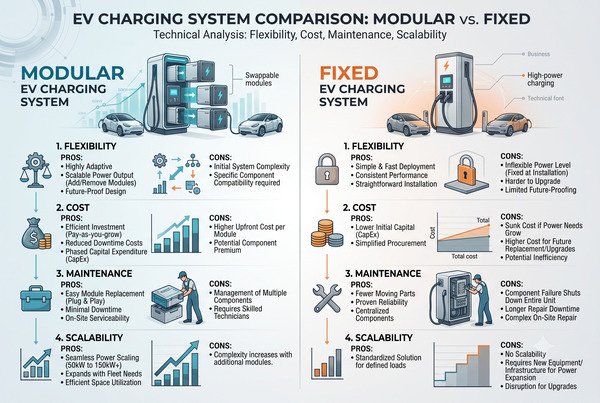
Maintenance and downtime considerations are critical when evaluating fixed and modular EV charger designs.
Critical questions to guide your decision process:
- What is your projected charging demand across one, three, and five years?
- How much downtime can your operation tolerate during maintenance?
- Does your installation site have physical space and power capacity for module additions?
- How critical is maintaining partial operation during service events?
Practical Recommendations: Modular vs Fixed for Specific Applications
Translating general comparisons into specific recommendations requires understanding your site’s unique operational profile. Different use cases naturally favor different architectures.
Residential and Small Business Installations
Most homes and small offices have predictable daily charging requirements and limited installation space. A properly sized fixed Level 2 wall charger typically provides the best value at the lowest cost. If modest future growth seems possible, a basic modular unit with one or two expansion slots offers flexibility without excessive complexity. The EC01 Wall Charger exemplifies the straightforward fixed approach that delivers reliable service for residential and light commercial applications. Ensure your electrical panel can support the chosen system by reviewing EV Charger Circuit Breaker requirements and panel capacity considerations.
Workplace and Retail Charging Locations
These sites often experience moderate growth as EV adoption increases among employees and customers. Modular systems with integrated load management allow operators to add capacity as usage grows. Advanced monitoring and reporting features that many basic fixed units lack can be valuable for administrative oversight. For sites with exceptionally stable usage patterns and limited budgets, high-quality fixed systems with smart features can still deliver excellent results.
Fleet and High-Volume Commercial Operations
For fleet applications, uptime is paramount. Modular systems dramatically reduce downtime by enabling individual module servicing while other stations remain operational. These systems also accommodate power growth as fleets add vehicles or transition to high-power charging requirements. While fixed systems may serve very predictable overnight charging with no anticipated growth, most fleet operators benefit from modular or hybrid architectures for long-term value. The FES-D30 DC EV Charger and power module series provide the durability and expansion capabilities that demanding fleet applications require. For comprehensive understanding of fast charging options, compare EV Fast Charger Types to determine the best fit for your fleet operations.
| Application Type | Recommended Architecture | Key Decision Factors | Parwatt Solution Reference |
|---|---|---|---|
| Residential / Small Business | Fixed or basic modular | Cost efficiency, simplicity, predictable usage | EC01 Wall Charger |
| Workplace / Retail | Modular with smart management | Growth capability, user administration, data reporting | Modular systems with OCPP and load management |
| Fleet / Logistics | Full modular or hybrid architecture | Minimal downtime, easy capacity expansion, high utilization | 30kW/40kW Power Modules + FES-D30 DC EV Charger |
| High-Traffic Commercial | Modular cabinet architecture | Quick repairs, future power increases, revenue protection | Scalable modular charging cabinets |
“The modular versus fixed decision ultimately comes down to this: how confident are you in your charging demand forecast, and how costly would downtime or capacity constraints be to your operation?”
Notable 2026 trends influencing system selection:
- Utility incentive programs increasingly favor modular systems for their flexible load management capabilities
- Fixed systems maintain popularity in new residential construction with limited expansion requirements
- Hybrid configurations combining fixed base cabinets with modular power blocks are gaining market acceptance
- Battery-buffered mobile units offer additional flexibility for temporary installations or remote fleet operations
Your Action Plan for EV Charging System Selection
Armed with comprehensive understanding of the trade-offs, you can now proceed through a structured decision framework that protects your investment and matches infrastructure to your actual requirements.
Step 1: Quantify Your Charging Demand
Document current EV charging requirements and develop projections for one, three, and five years. Record daily energy consumption and peak simultaneous charging periods. This foundational data informs every subsequent decision.
Step 2: Assess Electrical Service Capacity
Have a qualified electrician evaluate your existing electrical service, confirming available capacity and identifying any upgrade requirements. Modular systems often need additional capacity reserved for future modules, while fixed systems may require less now but more during expansion.
Step 3: Calculate Five-Year Total Cost of Ownership
Model complete costs including equipment purchase, installation, expected maintenance, electricity consumption, potential downtime losses, and available utility incentives. The modular option typically proves more cost-effective on growing sites, while fixed systems often win for stable applications.
Step 4: Evaluate Specific Products and Manufacturers
Request detailed specifications and references for both modular and fixed options that meet your requirements. Specifically investigate spare parts availability, software update policies, and actual expansion limitations.
Step 5: Engage Qualified Professional Installers
Work with installation contractors experienced with both system types. Have them model your site with each architecture option. Experienced installers often identify site-specific constraints that you might overlook.
Step 6: Final Decision and Installation Planning
Select the system that best aligns with your growth forecast and operational continuity requirements. Schedule installation during low-activity periods and arrange comprehensive team training on system monitoring and basic maintenance procedures.
Final verification points before committing:
- Warranty coverage for both parts and labor over expected system life
- Availability of local service support within required response times
- System compatibility with required payment, access control, or network management features
- Budget allocation for ancillary electrical work that may emerge during installation
Conclusion: Making the Right EV Charging Infrastructure Investment for 2026 and Beyond
Modular and fixed EV charging systems each offer distinct advantages that make them appropriate for different applications and operational priorities. Modular architectures excel in flexibility, future-proofing, and maintenance efficiency, making them ideal for growing fleets and dynamic commercial environments. Fixed systems deliver superior reliability and lower initial costs for stable, high-volume applications with predictable demand patterns. The optimal choice for 2026 depends entirely on your specific growth expectations, budget considerations, and operational requirements. By thoroughly evaluating your long-term plans and honestly assessing your charging needs, you can make an informed investment that supports your EV journey efficiently for years to come. The right charging infrastructure reduces operational risk, supports business growth, and positions your organization for success in the rapidly evolving electric vehicle landscape.