EV Charging Standards by Region 2026: Global Connector Guide & Market Shifts
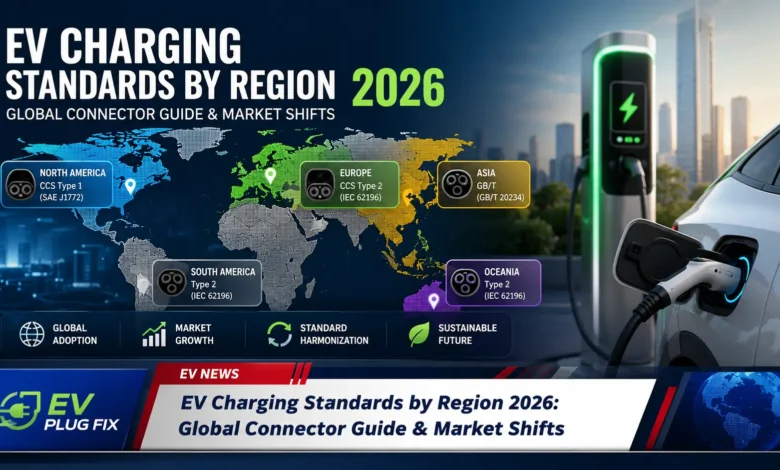
Electric vehicle (EV) charging standards across the globe are not a one-size-fits-all solution but rather a complex tapestry woven from historical decisions, regional market dynamics, and varying electrical infrastructures. As we navigate through 2026, the global landscape of EV connectors is defined by a fascinating divergence: North America is converging on the North American Charging Standard (NACS) after a landmark industry shift, Europe remains steadfast with its unified Combined Charging System Type 2 (CCS2) and Type 2 AC standard, China operates its distinct GB/T national standard, and Japan maintains its legacy CHAdeMO connector for its domestic fleet. This regional fragmentation has a tangible impact on everything from vehicle design and international travel to infrastructure investment and the overall ownership experience for millions of electric car drivers worldwide.
While the ultimate goal for many is a single global EV charging plug, the reality in 2026 is more nuanced. The differences are not merely cosmetic; they involve distinct physical connector shapes, varied communication protocols like ISO 15118 and PWM, differing support for single-phase vs. three-phase power, and varying maximum power outputs. This article delves deep into the major EV charging standards by region, exploring the reasons behind their adoption and what these differences mean for consumers, automakers, and the future of sustainable transportation. We will examine how Tesla’s NACS has transformed from a proprietary system into a North American standard, how Europe’s regulatory framework has solidified CCS2, and why Asia’s landscape remains a diverse mix of influential standards. For those considering home charging solutions, understanding your region’s standard is the first step, and choosing the right Home EV Wallbox Charging setup depends entirely on your local connector type.
North America: The NACS Revolution and Legacy J1772
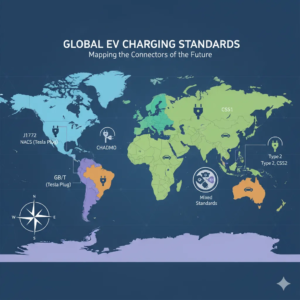
The story of EV charging in North America in 2026 is, without a doubt, the rapid ascent of the North American Charging Standard (NACS). Originally developed by Tesla and introduced with the 2012 Model S, this connector was designed to be a slim, compact, and powerful interface for both AC and DC charging. For years, it was a proprietary system, creating a “walled garden” around Tesla’s extensive Supercharger network. However, in a landmark move in late 2022, Tesla opened the specifications, and by 2024, the Society of Automotive Engineers (SAE) officially codified it as SAE J3400. This formalization paved the way for an unprecedented industry-wide shift. By 2026, virtually every major automaker selling EVs in North America—from Ford and General Motors to Hyundai, Kia, Mercedes-Benz, and BMW—has announced plans to equip their new vehicles with native NACS ports or provide OEM-approved adapters. For Tesla owners, understanding the Tesla Model 3 Charging Time with the new NACS standard has become increasingly relevant as the ecosystem expands.
- Unified Port: A single, small plug for both AC home charging and DC fast charging, eliminating the need for separate bulky connectors.
- Superior Ergonomics: The connector is roughly half the size of the legacy CCS1 combo, making it significantly lighter and easier to handle, a key advantage for drivers with limited mobility.
- Native Plug & Charge: Supports ISO 15118 digital communication for seamless “plug-and-charge” capabilities, where authentication and billing are automatic.
- Future-Proofed Performance: The design is thermodynamically capable of handling up to 1 MW, making it suitable for future heavy-duty applications, while currently supporting 250kW+ DC speeds and 19.2 kW AC.
- Bidirectional Ready: Natively supports Vehicle-to-Grid (V2G) and Vehicle-to-Home (V2H) capabilities through its digital PLC communication protocol, turning your EV into a backup power source. This aligns with the growing interest in Bidirectional EV Charging for home energy management.
The legacy standard in North America is the SAE J1772 connector, often referred to as “Type 1” or the “J-Plug.” This five-pin connector has been the workhorse for AC charging for non-Tesla EVs, including early models like the Nissan Leaf and Chevrolet Bolt, providing Level 1 and Level 2 charging at up to 19.2 kW. For DC fast charging, the industry adopted the Combined Charging System Type 1 (CCS1). This “combo” connector is essentially a J1772 plug with two additional large DC pins attached at the bottom, creating a bulkier, heavier, and more cumbersome interface. When planning your home charging setup, understanding Wallbox Installation Costs will help you decide whether to invest in a NACS-native wallbox or stick with a J1772 solution.
- Market Reality in 2026: While J1772 and CCS1 infrastructure is extensive and still critical for millions of older EVs, their relevance is waning. Drivers often need to carry NACS-to-CCS1 adapters to access the expanding network of NACS-equipped stations. As a result, J1772 is increasingly viewed as a legacy standard that complicates vehicle design and infrastructure planning -2-11.
- The Supercharger Network Factor: Tesla’s Supercharger network is widely regarded as the most reliable and extensive DC fast-charging network in North America. NACS adoption is directly linked to opening up this network to other brands, a major selling point that has accelerated the industry’s decision to abandon CCS1.
Europe: The Unified CCS2 and Type 2 Standard
Across the Atlantic, Europe presents a stark contrast. Driven by proactive regulatory frameworks and a concerted effort by industry and policymakers, the continent has achieved a high degree of standardization, making cross-border EV travel exceptionally seamless. The official European standard for AC charging is the Type 2 connector, also known as the Mennekes plug. This seven-pin connector is distinct from the Type 1 used in North America and offers a critical advantage: it supports both single-phase and three-phase AC power. This allows for much faster AC charging, with typical public stations delivering up to 22 kW, and some installations reaching up to 43 kW. For DC fast charging, the standard is the Combined Charging System Type 2 (CCS2). It builds upon the Type 2 connector by adding two additional DC pins at the bottom, creating a “combo” plug that can handle both AC and high-power DC through a single vehicle inlet.
| Standard | Region | Primary Use | Max Power | Key Feature |
|---|---|---|---|---|
| Type 2 (Mennekes) | Europe / Global | AC Destination Charging | 22-43 kW | Supports 3-phase AC, “socket-only” stations require own cable |
| CCS2 | Europe / Oceania | Universal Fast Charging | 350kW+ | EU/UK/Australia standard, integrates AC & DC |
This unified approach is cemented by the Alternative Fuels Infrastructure Regulation (AFIR), which mandates that all new public DC fast chargers in the EU must include CCS2 connectors. This regulation effectively ensures that the European charging network is universally accessible to all modern EVs sold on the continent. The result is a highly interoperable market where, in practice, almost any EV can charge at almost any public station without the need for bulky adapters. A 2024 Frost & Sullivan report noted that the Type 2 connector dominated the European EV infrastructure sector, accounting for nearly 75% of the market, and CCS2 accounted for the vast majority of new DC installations. For European drivers, having a reliable Type 2 Cable Ratings guide is essential for ensuring compatibility with public charging stations.
Another significant advantage of the European system is the widespread adoption of the ISO 15118 communication protocol. This digital standard enables a feature called “Plug & Charge,” where the vehicle and charging station automatically authenticate and initiate billing without requiring RFID cards or smartphone apps. The system works seamlessly when the car is plugged in. This unified digital and physical infrastructure has made Europe a global leader in both EV adoption and charging network reliability, with over 1 million charge points expected by the end of 2024. The EU EV Charging Network continues to expand at a remarkable pace, setting a benchmark for other regions to follow.
Asia Pacific: A Diverse Landscape of Standards
Unlike the converging standards in North America and the unified system in Europe, the Asia-Pacific region remains fragmented, with distinct players holding sway in their respective markets. The primary standards in play are CHAdeMO in Japan, GB/T in China, and a mix of CCS1 and Type 2 in other countries.
Japan: The Home of CHAdeMO and the “ChaoJi” Future
Japan pioneered DC fast charging with its CHAdeMO standard (short for “CHArge de MOve”). Released in 2010, it was the first globally deployed DC fast-charging standard and remains a significant presence in Japan’s domestic market. While CHAdeMO is being rapidly phased out in Europe and North America in favor of CCS and NACS, it is still supported by legacy infrastructure and vehicles globally, most notably the Nissan Leaf. However, the Japanese automaker is transitioning its new models to adopt the NACS port for its North American market. On the horizon, the CHAdeMO consortium and the China Electricity Council are jointly developing a new global ultra-fast charging standard called “ChaoJi,” which aims to support up to 900 kW and could become a future standard for heavy-duty trucks and next-generation EVs.
- CHAdeMO Specs: Maximum power output of up to 100kW in current deployments, with a future “ChaoJi” iteration targeting up to 900kW -1-5.
- Key Feature: Natively supports V2H (Vehicle-to-Home) bidirectional power flow, a feature that has been integrated since the standard’s inception. This makes it a pioneer in the Bidirectional EV Charging space, a technology that is now gaining traction globally.
China: The GB/T Behemoth
As the world’s largest EV market, China has implemented its own national standard, known as GB/T (Guobiao/T). This standard is unique because it uses two separate physical ports for AC and DC charging, rather than a single “combo” connector. This system has allowed China to deploy a massive charging network to support its domestic EV fleet. The scale of the Chinese market means that GB/T is the most widely used standard globally in terms of number of vehicles and charging points. However, the standard is distinct to China, and EVs exported from China must be adapted to use CCS or other plugs for overseas markets. The government is actively updating the standard, with new versions like GB/T 50966-2024 for charging station design and GB/T 46148-2025 for smart charging and V2G capabilities coming into effect in 2026, showcasing China’s commitment to leading the global EV revolution.
Why Regional Differences Exist: A Deeper Dive
The fragmentation of global EV charging standards is not an accident. It is the result of decades of independent automotive development, distinct grid infrastructures, proactive government policies, and unique market leadership dynamics. Understanding these root causes is key to appreciating the current landscape and predicting future trends.
- Historical Development and First-Mover Advantage: Regions with early EV pioneers developed technologies independently. Japan’s CHAdeMO was designed to solve a specific problem for a new industry, while North America’s J1772 was built upon existing industrial standards for electrical plugs. These early systems became entrenched before any global conversation about harmonization could begin.
- Grid Infrastructure Differences: The fundamental differences in electrical grids have had a profound impact. Europe’s widespread three-phase power grid made the Type 2/CCS2 standard, which supports three-phase AC, an optimal choice. Conversely, North America’s primarily single-phase residential and commercial grids meant that the single-phase J1772/NACS designs were more suitable. NACS’s ability to directly interface with 277V commercial power (a phase of a 480V three-phase system) is a hidden advantage for site hosts -2-3. For homeowners, understanding Dynamic EV Load Balancing becomes crucial when installing high-power chargers that could otherwise overload residential electrical panels.
- Government Policy and Regulation: Government mandates have been the single most powerful force in shaping regional standards. The EU’s AFIR, which mandates CCS2 for all new public fast chargers, has effectively created a unified bloc. California’s zero-emission vehicle mandates have also driven North American innovation. Meanwhile, China’s top-down policy support for GB/T has enabled the country’s massive domestic EV ecosystem to flourish -9-10.
- Market Leadership and Network Effects: Tesla’s dominance in North America is a textbook example of market leadership driving a standard. The company’s extensive Supercharger network created a powerful incentive for other automakers to adopt NACS, leading to the rapid shift away from CCS1. This is a significant divergence from Europe, where Tesla was required to use the local CCS2 standard -2-8. The adoption of smart charging technologies, including Smart EV Charging Benefits, is also influenced by these regional standardizations.
The Future: Convergence, Adapters, and the Next Frontier
Looking ahead, the future of EV charging standards is one of slow convergence, driven by market forces and technological innovation. While a single global plug remains unlikely in the short term, the industry is moving toward more interoperable systems.
In North America, the die is cast: NACS is the future. The rapid adoption by automakers, the standardization by SAE, and the massive expansion of Tesla’s Supercharger network to other brands are all pointing toward a single standard. For drivers of older CCS1 vehicles, the transition will be managed by OEM-approved NACS-to-CCS1 adapters. GM TechLink, for example, lists a number of adapter options for its Bolt, Hummer, and Lyriq models to ensure they can access the growing NACS infrastructure. This adapter-driven approach, while somewhat inconvenient, will be the norm for the next 5-10 years.
Europe will maintain its CCS2 standard, bolstered by AFIR regulations and a mature interoperable market. The focus in Europe will shift to enhancing the user experience with advancements like widespread Plug & Charge, expanding the ultra-fast charging network with chargers exceeding 350 kW, and integrating more V2G capabilities. The recent debut of lightweight CCS2 cables and inlets at major industry events signals a push for improved ergonomics and efficiency.
In Asia, the dynamic is more complex. Japan will continue to see CHAdeMO for a while but will eventually transition to the “ChaoJi” standard alongside China, potentially creating a new unified standard for East Asia. China will continue to develop its GB/T standard to integrate smart charging and V2G, as seen in the new GB/T 46148-2025 standard, while ensuring its domestic industry remains the world leader.
A critical element of the future is the growing importance of bidirectional charging (V2G and V2H). Both NACS and CCS2 support the necessary communication protocols (ISO 15118) to enable this, turning EVs into mobile energy storage units that can stabilize the grid or power homes during outages. As this technology matures, the “charging standard” will no longer just be about the physical plug, but about the intelligent digital communication that enables a fully integrated energy ecosystem.
Frequently Asked Questions
What is the most common EV charging standard in the world?
Will NACS become the global standard for EV charging?
Can I use a CCS1 adapter on a NACS vehicle?
Why is Europe using CCS2 and not NACS?
”What
Final Thoughts: Navigating the Global Charging Ecosystem
The world of EV charging standards in 2026 is a fascinating reflection of the interplay between technological innovation, market forces, and strategic government policy. While regional differences cause complexity, they also showcase diverse, successful strategies to electrify transportation. For consumers, the message is clear: understand the standard in your region and be prepared with the right adapters for travel. For industry, the landscape is an opportunity to innovate, particularly in the realms of Plug & Charge and V2G technology, where digital standards are becoming as important as the physical ones.
- In North America, NACS is the new king, offering a superior, future-proofed user experience.
- In Europe, CCS2 remains the gold standard, ensuring unparalleled interoperability.
- In Asia, the story is one of unique, market-specific standards that are each evolving to meet local needs and global competition.
The conversation is no longer just about where to plug in, but about the smart, digital ecosystem that connects the car, the charger, and the grid. As the industry moves towards this integrated future, the specific physical plug may become less of a barrier, even if a single global standard never materializes.