Type 2 Charging Cable Power Ratings: 22kW, 11kW, and 7.4kW Explained for 2026
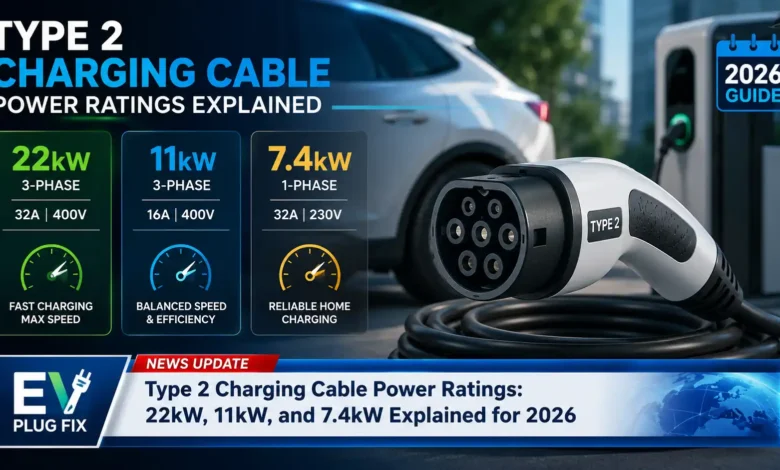
Type 2 charging cables come with different power ratings, from a standard 7.4 kW single-phase cable up to a powerful 22 kW three-phase cable, and the one you choose directly impacts how fast your electric vehicle can charge at home or at a public station.
Understanding these power ratings—and what they mean for your specific EV—is essential for making a smart purchase. This guide breaks down the technical differences, explains what affects charging speed, and helps you pick the right cable for your needs. Let’s dive in.
- Most European EVs support 11 kW three-phase AC charging as standard.
- A 22 kW cable is backward-compatible and will work with any Type 2 vehicle, just at a slower speed if the car cannot accept more power.
- Your EV’s maximum AC charging speed is determined by its onboard charger, not just the cable you use.
Understanding Type 2 Charging Cable Power Ratings: 22kW, 11kW, and 7.4kW
The power rating of a Type 2 cable is determined by its amperage and the number of phases it supports. Here is a breakdown of the most common ratings you will encounter.
| Cable Power Rating | Amperage | Phases | Typical Use Case |
|---|---|---|---|
| 7.4 kW | 32 A | Single-Phase | Standard home charging (UK & some EU homes) |
| 11 kW | 16 A | Three-Phase | Standard public charging, most new EVs |
| 22 kW | 32 A | Three-Phase | High-power public AC stations, fast charging EVs |
These ratings can be a bit confusing at first, but they follow a simple logic. A single-phase cable like a 32A/7.4kW model uses one live wire, while a three-phase cable uses three live wires to deliver more power more efficiently . The higher the kW, the faster the potential charge speed—provided your vehicle and the charging station support it.
“A 3-phase cable ensures you’re ready to plug in anywhere, at maximum possible speed for your car.”
The Golden Rule: Your EV Sets the Limit
Before you shop for a new Type 2 cable, it is crucial to understand the most common mistake buyers make: thinking a higher-rated cable will always charge their car faster.
Every electric vehicle has an onboard charger that converts AC power from the grid into DC power for the battery. The onboard charger determines the maximum AC charging speed your car can handle. As one expert source notes, the maximum charge rate for your specific EV will depend on its make and model . So, if your car has an 11 kW onboard charger, it will never draw more than 11 kW from an AC source, even if you plug it into a 22 kW wallbox with a 22 kW cable . For instance, a Tesla Model 3 will charge at its onboard capacity regardless of the cable’s maximum rating.
Single-Phase vs. Three-Phase Charging
This is perhaps the most critical distinction to make when buying a Type 2 cable. The difference between single-phase and three-phase charging comes down to your location and your vehicle’s capabilities.
Single-Phase Charging (7.4 kW / 32A)
Single-phase is standard for domestic properties in the UK and many other countries. A single-phase Type 2 cable will typically support charging at up to 7.4 kW (32 amps). For many EV owners, this is perfectly adequate for overnight charging at home.
Three-Phase Charging (11 kW / 16A or 22 kW / 32A)
Three-phase charging is more common in commercial buildings and across Europe. It delivers more power more efficiently. A three-phase cable can support charging at 11 kW (16 amps) or 22 kW (32 amps). Nearly all European EVs support three-phase AC charging at 11 kW . A smaller subset of EVs, like the Renault Zoe and Porsche Taycan, can take full advantage of 22 kW triple-phase charging .
If you are unsure whether your EV supports three-phase charging, check the EV Database. Searching for your EV model and scrolling down to Charging > Charge Power will show the maximum charge rate your EV supports, e.g., 7.4kW, 11kW, or 22kW .
Why Buy a 22 kW Cable if My EV is Limited to 11 kW?
This is a common question, and there are several smart reasons to consider a 22 kW three-phase cable even if your current EV only supports 11 kW.
- Backward Compatibility: A 22 kW cable is fully backward-compatible. It will work perfectly with any Type 2 vehicle, and your car will simply draw the maximum power it can handle. There is no risk of “overpowering” your EV .
- Future-Proofing: If you plan to upgrade to a newer EV in the future—especially in Europe, where many new models support 22 kW—you will not need to buy a new cable. It is a one-time investment .
- Public Charging Station Compatibility: Many public AC charging points across Europe are three-phase only. If you turn up with a single-phase cable, it might not work at all, or it will deliver a much slower charge .
Factors That Can Slow Down Your EV Charging Speed
Even with the right cable and a capable EV, charging speed is not always a constant. Several factors can cause your EV to charge slower than the maximum speed you might expect. Understanding these can help you manage expectations and optimize your charging sessions .
The Charging Curve
An EV doesn’t simply charge at its maximum speed from 0% to 100%. The charging process follows a curve. Typically, a car with a low battery initially charges slowly, then the rate increases to either the maximum power of the charger or the maximum charge rate of the EV, whichever is smaller. As the battery becomes fuller, the charging rate slows down. This usually happens around the 80% state of charge to protect the battery and ensure its longevity .
Battery Temperature
Extreme temperatures can affect battery efficiency and charging speed. Your EV will adjust the maximum allowable charging speed depending on its battery temperature. The rated charging curve is typically what to expect at around 25°C. If it is much colder, the speeds the battery can accept will drop .
Onboard Charger and Grid Conditions
The onboard charger is a hard limit on your EV’s charging speed, and other factors like the state of the electric grid and load balancing at a location can also reduce the power available to your charger. Implementing EV peak shaving strategies can help manage grid demand and maintain consistent charging speeds during high-usage periods.
Choosing the Right Type 2 Charging Cable: A Quick Guide
Selecting the right Type 2 charging cable can be straightforward once you know your key requirements. Here is a quick checklist:
- Check Your EV’s Max AC Input: Find your car’s model on the EV Database and note its maximum AC charge power. This is your hard limit.
- Consider Where You’ll Charge Most: Will you be using a single-phase (UK home) or a three-phase (European home/public) supply? Understanding the EU EV charging network can help you decide which cable type is more versatile for your travel needs.
- Think Long-Term: If you might upgrade your EV in the next few years, a 22 kW three-phase cable is a smart, future-proof investment that guarantees compatibility across a wider range of vehicles and charging stations .
- Choose Your Length: Select a cable length that will comfortably reach from your charging point to your car. Cables are available from 2m to 50m .
Frequently Asked Questions
Frequently Asked Questions
Can I use a 22kW cable to charge a car that only supports 11kW?
Yes, absolutely. A 22kW three-phase cable is fully backward-compatible. Your EV’s onboard charger will only draw the maximum power it can handle, so it will not be damaged. The cable will simply work at a slower speed .
What is the difference between a 16A and a 32A Type 2 cable?
The amperage determines the maximum power the cable can deliver. A 16A three-phase cable can support up to 11kW (3 phases x 230V x 16A), while a 32A three-phase cable can support up to 22kW (3 phases x 230V x 32A). For single-phase charging, a 32A cable can deliver up to 7.4kW (230V x 32A) .
Will a single-phase Type 2 cable work on a three-phase charger?
It might, but it will charge very slowly. More importantly, some public three-phase charging stations will not even recognize a single-phase cable, meaning you will not be able to charge at all .
How long should my Type 2 charging cable be?
The ideal length depends on your typical parking situation. For home charging, measure the distance from your wallbox to your car’s charging port, allowing some slack. Cables are available in various lengths, from 2 meters to 50 meters, to suit different needs .
Does a longer charging cable reduce charging speed?
For standard lengths sold for home and public charging (up to 15-20 meters), the voltage drop is negligible and will not noticeably affect your charging speed. Manufacturers use appropriately sized conductors (like 5G6 or 5G2.5mm² cores) to ensure safe and efficient power delivery over the cable’s specified length .