Electric Vehicle Market Share 2026: Global EV Sales Trends & Projections
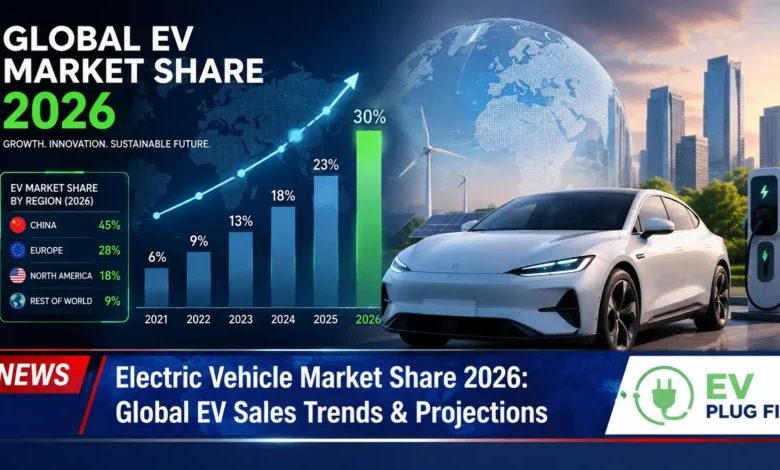
Electric vehicle market share in 2026 is projected to reach a record 29% of global new car sales, signaling an unprecedented acceleration in the world’s transition to sustainable transportation. According to recent data from the International Energy Agency (IEA), this surge comes despite economic pressures and shifting policies in key markets, proving the resilience of the EV sector . While internal combustion engine vehicle sales have faced headwinds, the global fleet of electric cars is expanding at a remarkable pace, with over 20 million units sold in 2025 alone . This analysis delves into the key drivers, regional leaders, and emerging trends defining the electric vehicle market share in this pivotal year. For homeowners looking to join this transition, our comprehensive Home EV Charger Guide provides essential insights into selecting the right charging solution.
Global Electric Vehicle Market Share in 2026
The global electric vehicle market share is on a sharp upward trajectory, with the IEA upgrading its 2026 forecast to 29% following a strong rebound in second-quarter sales . This builds on a landmark 2025, where one in four new cars sold globally was electric, surpassing 20 million units . Despite a broader global light vehicle market experiencing a marginal decline, EV sales are projected to grow by 11% in 2026, reaching an estimated 23.3 million passenger vehicles .
A significant trend reshaping the electric vehicle market share is the growing dominance of battery-electric vehicles (BEVs). While plug-in hybrids (PHEVs) played a crucial transitional role, 2026 is witnessing a shift back towards BEVs, which are expected to see a 17.2% sales improvement, accounting for 18.5% of all light-vehicle sales . This contrasts with a projected decline of over 10% for PHEV deliveries as automakers and consumers increasingly embrace pure electric solutions for their efficiency and lower running costs . Understanding your EV Charging kWh Guide can help you maximize the efficiency benefits of going fully electric.
Global EV Sales Breakdown by Powertrain (2026 Forecast)
| Powertrain Type | Projected Sales Growth | Market Share of Light-Vehicle Sales |
|---|---|---|
| Battery Electric Vehicles (BEVs) | +17.2% | 18.5% |
| Plug-in Hybrid Electric Vehicles (PHEVs) | -10.6% | 7.2% |
| Total EVs | +11% (23.3 million units) | 25.7% |
Regional Electric Vehicle Market Share in 2026
The growth of the electric vehicle market share is distinctly uneven across the globe, driven by varying policy landscapes, manufacturing capabilities, and consumer preferences . While China remains the dominant force, other regions are emerging as key players in the transition.
China: The Unrivaled EV Powerhouse
China continues to be the epicenter of the global electric vehicle market, with its domestic EV sales share expected to approach 60% in 2026 . In 2025, the country sold over 13 million electric cars, accounting for approximately 60% of global sales and cementing its leadership position . The dominance extends to manufacturing, with China responsible for nearly 75% of global EV production, benefiting from integrated supply chains and battery manufacturing costs that are around 35% lower than in advanced economies .
Europe: Policy-Driven Acceleration
The European Union is experiencing renewed momentum in EV adoption, driven by stricter CO2 emissions standards. In 2025, the region’s EV sales share reached 28%, and EV sales are projected to grow by 23% in 2026, potentially reaching nearly five million units . However, the continent remains deeply uneven, with countries like Norway leading with a 97% BEV market share, while southern European nations lag behind . The region’s charging infrastructure has also expanded significantly, with all but one EU country meeting the bloc’s fleet-based targets for public charging capacity, supporting further EV uptake . For European EV owners, understanding Tethered EV Chargers Comparison can help optimize home charging setups in regions with expanding infrastructure.
North America: Challenges and Slow Progress
The United States continues to be a laggard among major markets, with its EV share remaining just below 10% in 2025 . Policy rollbacks, including the withdrawal of federal tax credits and the rollback of fuel-economy targets, have led to a projected 19% decline in U.S. EV sales in 2026, a stark contrast to global trends . This policy uncertainty is slowing progress and contributing to an uneven global electric vehicle market share. Staying informed about 2026 EV Tax Credit developments is crucial for American consumers considering an EV purchase.
Emerging Markets: The Next Growth Frontier
Perhaps the most exciting developments in the global electric vehicle market share are occurring in emerging economies. Southeast Asia has seen EV sales more than double in 2025, with Vietnam reaching nearly 40% EV share and Thailand hitting 27%, driven by the availability of affordable models from Chinese manufacturers like BYD and domestic companies like VinFast . Latin America is also showing dynamic growth, with Brazil doubling sales to 125,000 units [citation:original]. These markets are becoming the new battleground for affordable EVs, reshaping the global landscape .
Next-generation ultra-fast chargers, like BYD’s 1.5 MW “flash charging,” are making EV charging times competitive with gas station refueling.
Technology and Infrastructure: The Pillars of Growth
Battery Technology and Innovation
Continued advancements in battery technology are a primary driver of the expanding electric vehicle market share. Battery costs have fallen by roughly 75% over the past decade, while energy density has increased by around 60% . Innovations like BYD’s 1.5 MW “flash charging” and CATL’s Shenxing batteries are enabling charging times of under 10 minutes, directly addressing “range anxiety” and making EVs more competitive with internal combustion engine vehicles .
Charging Infrastructure Expansion
The expansion of public charging infrastructure is keeping pace with, and in some cases outpacing, EV sales. In 2025, the global stock of public charging connectors reached 6.7 million, a 28% increase year-over-year . Europe, in particular, has seen rapid growth in ultra-fast chargers, which are crucial for long-distance travel, while China continues to account for the bulk of new installations . This growing network is essential for supporting mass EV adoption, especially among drivers without access to home charging. For those who can charge at home, following a proper EV Charger Installation Guide ensures safe and efficient home charging solutions.
“While EV adoption continues to advance globally, the pace of the transition is becoming increasingly uneven across markets… In spite of the unevenness, it is encouraging to see that the longer-term trend towards electrification remains intact.”
Challenges and the Road Ahead for 2026 and Beyond
Despite the positive global outlook, the electric vehicle market share faces several headwinds. Policy uncertainty remains a significant challenge, as demonstrated in the U.S., where the reversal of incentives has dampened demand . Supply chain constraints and the geopolitical risks associated with sourcing raw materials for batteries also pose ongoing threats . Furthermore, while EV sales are growing, the pace of the transition in some regions is slower than anticipated, leading to a downgraded long-term outlook for adoption in major markets like the U.S. and China .
Nevertheless, the long-term fundamentals remain robust. BloombergNEF projects that EVs will surpass 50% of global sales by 2035 and account for 81% by 2040 . The combined impact of falling battery costs, increasing model availability, and a growing charging network will continue to drive global EV adoption. Proper Home EV Charging Safety practices will become increasingly important as more households adopt electric vehicles and install home charging stations.
Expert Analysis: Key Takeaways for 2026
- BEVs are winning the powertrain war: The growth in EV sales is increasingly driven by pure battery-electric vehicles, signaling a shift away from plug-in hybrids as infrastructure improves and range anxiety diminishes .
- Emerging markets are the new battleground: Countries like Vietnam, Thailand, and Brazil are adopting EVs at an astonishing rate, driven by affordable Chinese imports and supportive policies .
- Policy is the deciding factor: Regions with stable, supportive policies and infrastructure targets are leading the transition, while uncertainty in places like the U.S. is slowing progress .
Critical Notice: U.S. Lags in Global EV Shift
📢 While the global EV market charges ahead, the United States is at risk of falling behind. A 19% decline in sales is projected for 2026 due to policy rollbacks. This highlights the fragility of EV adoption when not supported by consistent government incentives and long-term regulatory frameworks .
The electric vehicle market share in 2026 tells a story of unprecedented global momentum, but also one of stark regional divergence. From China’s manufacturing dominance to Europe’s policy-driven growth and the explosive potential of emerging markets, the electrification of transport is accelerating. While challenges around policy and supply chains persist, the technological and economic forces driving this transition are now irreversible, promising a future where electric cars are the undisputed global standard.