Dynamic Load Balancing for EV Charging: Smart Power Management in 2026
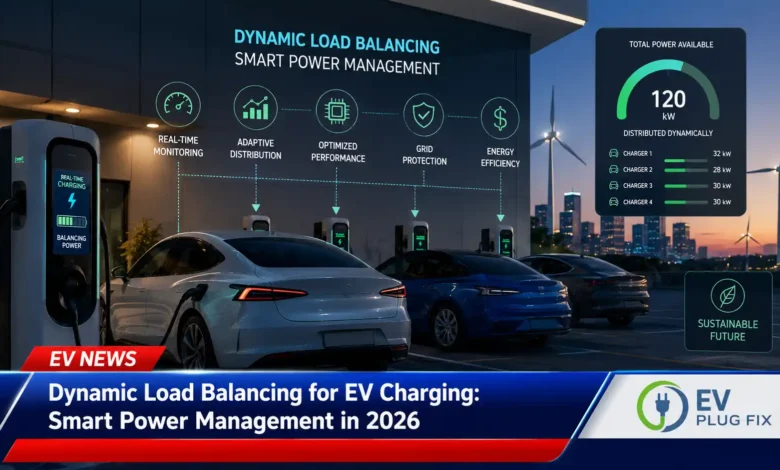
Dynamic load balancing for EV charging has emerged as the cornerstone of modern electric vehicle infrastructure, fundamentally transforming how we manage power distribution across residential, commercial, and fleet charging installations. As electric vehicle adoption accelerates globally, the strain on existing electrical infrastructure has become increasingly apparent, making intelligent power management not just a convenience but an absolute necessity. The concept is elegantly simple yet technologically sophisticated: continuously monitor your building’s total electricity consumption and automatically adjust EV charging power in real-time to prevent circuit overloads while maximizing charging speed whenever possible.
Think of dynamic load balancing as a smart traffic controller for electricity. When your home’s air conditioning kicks in or your oven fires up, the system instantly reduces charging power to stay within safe limits. When those appliances cycle off, it seamlessly ramps charging back up to full speed. This constant, automated dance between your EV charger and household consumption ensures you never blow a fuse while still getting the fastest possible charge. Understanding your specific EV Charging Time requirements can help you better appreciate how this intelligent allocation optimizes your daily routine.
The stakes are higher than ever before. According to recent research, global EV sales surged from 5% of total vehicle sales in 2020 to 14% in 2022, with projections reaching 70% by 2030. This explosive growth has driven a parallel expansion of charging infrastructure, with public charging stations nearly doubling between 2020 and 2022. However, this rapid deployment has created significant stress on power grids, leading to voltage instability, transformer overloads, and reduced reliability of distribution networks. Without intelligent management, multiple EVs charging simultaneously could overwhelm local grid connections, triggering costly infrastructure upgrades or, worse, blackouts.
This is where dynamic load balancing technology becomes a game-changer, enabling property owners to install more chargers than their main fuse theoretically supports by intelligently distributing available power based on real-time demand. The implications for residential homeowners, fleet operators, and commercial property managers are profound, offering a pathway to scalable, cost-effective EV charging infrastructure that works with existing electrical capacity rather than demanding expensive upgrades. For those considering installation, understanding typical Wallbox Installation Costs can help budget for this transformative technology.
Understanding Dynamic vs. Static Load Balancing: The Evolution of EV Power Management
To fully appreciate the sophistication of dynamic load balancing, it’s helpful to understand its predecessor: static load balancing. Imagine splitting a pizza into equal slices regardless of how hungry each person is. Static load balancing works similarly, dividing available power evenly among all connected chargers based on a fixed limit. For example, if your building allocates 100 amps specifically for EV charging, static balancing would split that evenly among all vehicles, never exceeding that arbitrary ceiling.
This approach is simple to implement but profoundly inefficient. If you’re charging a single EV while your building consumes minimal power, static balancing still caps that EV at its predetermined share, wasting precious available capacity. Conversely, if other appliances suddenly demand more power, static balancing has no mechanism to respond, potentially tripping breakers when combined loads exceed safe limits.
Dynamic load balancing, by contrast, represents a quantum leap in intelligence and efficiency. This sophisticated approach continuously monitors your entire building’s real-time power consumption using current transformers (CTs) or smart meters installed in your main electrical panel. The system compares total usage against your contracted power capacity, instantly calculating how much surplus electricity is available for EV charging at any given moment.
[p]The Enphase IQ EV Charger 2 exemplifies this intelligent approach, responding to power changes in under 30 seconds for variations exceeding 200 watts per phase, and under 20 seconds for changes greater than 1000 watts per phase. This real-time responsiveness ensures your EV charging adapts seamlessly to household activities without any manual intervention.- Static Load Balancing: Fixed power allocation, simple setup, inefficient usage of available capacity, no response to building consumption changes.
- Dynamic Load Balancing: Real-time power adjustment based on total building load, maximizes charging speed, prevents overloads, fully automatic operation.
How Dynamic Load Balancing Works: The Technology Behind Smart EV Charging
Understanding the inner workings of dynamic load balancing reveals why it’s considered the gold standard for modern EV charging infrastructure. At its core, the system relies on three essential components working in perfect harmony: sensing hardware, intelligent control logic, and responsive communication protocols.
Current sensors—typically CT clamps—are installed in your main electrical panel to monitor real-time power consumption across all circuits. These sensors continuously feed live current data to the charger’s control system, which calculates the difference between total usage and your grid connection’s safe capacity limit. When this difference shrinks because other appliances have started drawing power, the control system instantly reduces charging output. When the difference grows, the system increases charging power to utilize the newly available capacity.
Modern dynamic load balancing systems support multiple deployment scenarios. Within a single charger, the technology can split power between two connected sockets. Across a group of chargers sharing a common electrical feed, it allocates available capacity based on defined priority rules. At the site level, it accounts for entire building loads including HVAC, lighting, and machinery to ensure the total draw never exceeds safe limits. This flexibility makes dynamic load balancing suitable for everything from single-family homes to multi-tenant residential buildings, commercial parking garages, and fleet depots.
Advanced implementations incorporate sophisticated prioritization schemes. Some systems prioritize based on state of charge (SoC), directing more power to vehicles with lower battery levels. Others use departure time-based scheduling to ensure critical vehicles reach their target SoC before they’re needed. Research has shown that dynamic power-sharing can significantly improve load balancing and grid stability, with multi-agent reinforcement learning algorithms achieving a 7.9% reduction in average station load compared to simpler algorithms.
Critical Benefits of Dynamic Load Balancing for Homeowners and Property Managers
The advantages of implementing dynamic load balancing extend far beyond simply preventing tripped breakers. For homeowners, this technology transforms the EV ownership experience, removing anxiety about charging alongside normal household activities. You no longer need to schedule charging around appliance usage or manually adjust power settings—the system handles everything automatically. Combined with Smart EV Charging Benefits, this creates a seamlessly integrated home energy ecosystem.
- Safe and worry-free charging: Dynamic load balancing continuously monitors your home’s total power consumption, automatically reducing charging output when other appliances demand more power. This eliminates the risk of overloading your electrical system and tripping breakers, giving you complete peace of mind.
- Maximized charging speed: When household demand drops, the system immediately increases charging power to utilize every available watt. You get the fastest possible charge without compromising safety.
- Seamless solar integration: For homeowners with photovoltaic systems, dynamic load balancing can direct excess solar power to your EV, maximizing clean energy consumption and reducing grid dependence.
- Lower installation costs: By intelligently managing existing capacity, dynamic load balancing often eliminates the need for expensive service upgrades. Many installations proceed with existing electrical panels, reducing both upfront costs and installation complexity.
- Future-proof infrastructure: As homes adopt more smart appliances and energy demands evolve, dynamic load balancing ensures EV charging adapts to changing consumption patterns without requiring additional hardware upgrades.
For property managers and developers, dynamic load balancing offers equally compelling benefits. The ability to install more chargers than your main fuse theoretically supports means you can provide EV charging amenities to more residents or tenants without major infrastructure upgrades. This is particularly valuable in multi-tenant residential buildings and commercial properties where parking demand for EV charging continues to grow.
Fleet operators face unique challenges that make dynamic load balancing indispensable. Managing large numbers of EVs charging simultaneously during peak hours can overwhelm even robust electrical systems. Without intelligent load management, fleets risk downtime, increased energy costs, and delayed vehicle availability. Dynamic load balancing enables fleet managers to charge more vehicles with limited grid capacity while maintaining operational readiness. Priority-based balancing ensures critical vehicles receive power first, while site-level balancing prevents costly peak demand charges. For commercial operations, implementing EV Peak Shaving strategies alongside dynamic balancing can further reduce demand charges and optimize energy costs.
Recent research demonstrates that advanced energy management strategies incorporating dynamic load balancing can reduce grid power absorption by up to 79% over 48 hours in hybrid buildings. This level of optimization isn’t just beneficial for individual properties—it’s essential for the broader goal of sustainable urban transportation.
Advanced Applications: Fleet Load Balancing and Multi-Site Management
While residential dynamic load balancing addresses individual home charging challenges, fleet operations require more sophisticated approaches that balance multiple vehicles across potentially multiple depots. Fleet load balancing represents the logical evolution of this technology, applying the same principles at scale with additional layers of complexity and optimization.
In a typical fleet depot, load balancing involves setting a site power cap—for example, 120 kilowatts total available for all chargers—and automatically distributing that power across active charging sessions. The system continuously adjusts as vehicles plug in and out, applying priority rules to ensure critical vehicles receive power first. This might mean prioritizing vehicles with the earliest departure times, lowest state of charge, or those assigned to critical routes.
- Charger-to-charger balancing: A group of chargers shares a fixed maximum power cap, dynamically allocating capacity based on individual vehicle needs and priority rules.
- Site-level balancing: All chargers operate within a site cap that accounts for other building loads, using meters to monitor total consumption and adjust charging output accordingly.
- Phase balancing for AC depots: Ensures L1, L2, and L3 phases are used evenly, preventing phase overload that can occur with many single-phase vehicles.
- Priority-based balancing: Allocates power based on business rules—earliest departure first, lowest SoC first, critical route vehicles first.
- Multi-site balancing: Shifts charging load across depots based on capacity, price, or demand response events, typically requiring a centralized energy management system.
Predictive load balancing takes this further by using data analytics and machine learning to forecast future charging demands and proactively prevent peaks before they occur. By anticipating when and where peak loads will occur, fleet managers can optimize charging schedules to avoid demand spikes, potentially reducing operating costs and improving depot efficiency. While this approach requires extensive data collection and processing, it delivers the highest level of optimization for large-scale, data-driven fleet operations.
The economic impact of proper fleet load balancing is substantial. Key performance indicators show measurable improvements in peak kW reduction, vehicle readiness rates, charger utilization, and cost per kWh. By minimizing or eliminating breaker trips and overload events, fleets maintain operational continuity while reducing both operational expenses and capital expenditure requirements.
The Future of Dynamic Load Balancing: AI, Renewable Energy, and Grid Integration
As dynamic load balancing technology continues to evolve, artificial intelligence and machine learning are playing increasingly important roles. Multi-agent reinforcement learning (MARL) algorithms represent the cutting edge, enabling networks of charging stations to coordinate their behavior for optimal grid performance. These systems treat each charging station as an intelligent agent that learns from its environment and adjusts its behavior based on both local conditions and global network objectives.
The benefits of AI-driven approaches are already measurable. Research has shown that grid-aware algorithms achieve more balanced distribution of visits, reducing power pressure at high-demand stations while improving utilization at less frequented ones. The proposed MARL algorithm with power-sharing demonstrated the lowest average station load, representing a 7.9% reduction compared to simpler algorithms. This translates to real-world improvements in charging network sustainability and financial performance, with moderately profitable stations increasing by 55.6%.
Integration with renewable energy sources adds another dimension to dynamic load balancing. Combining solar, wind, and energy storage with intelligent load management creates charging systems that can reduce grid dependence while maintaining reliability. Research indicates that coordinated EV charging with photovoltaic generation allows solar panels to provide over 71% of charging load during summer. Hybrid optimization algorithms incorporating demand-side management with PV and battery energy storage have shown effective peak load management and electricity cost reduction.
The future likely holds even greater integration between dynamic load balancing, renewable energy forecasting, and energy storage systems. As storage capacity is projected to reach 160 GWh by 2030, the ability to intelligently store and dispatch energy will become increasingly critical. Dynamic load balancing systems that can charge EVs when renewable generation is abundant and draw from storage when needed will maximize clean energy utilization while minimizing grid stress.
Real-time AI-driven solutions are already emerging, with systems that proactively manage EVSE loads based on overall load and phase balance of residential buildings. These solutions promote affordable electrification while ensuring balanced energy loads that reduce losses and contribute to decarbonization.
Installation and Configuration: What You Need to Know
Implementing dynamic load balancing requires careful consideration of your specific needs, existing infrastructure, and technical requirements. The process typically involves installation of current sensors in your main electrical panel, connection to the charger system, parameter setup, and rigorous testing. Due to the high-voltage risks involved, professional installation by a qualified electrician is essential.
Your choice of charging equipment significantly impacts the dynamic load balancing experience. Some chargers have dynamic load balancing built-in, requiring only CT installation, while others need a separate dynamic load balancing module. Compatibility considerations are equally important. Proprietary dynamic load balancing systems work seamlessly with chargers from the same brand, while third-party compatibility typically requires open protocols like Modbus or OCPP.
For homeowners with existing solar PV or energy storage systems, compatibility is typically achieved by monitoring total load at the main input. The dynamic load balancing system adjusts charger power accordingly, provided CTs are correctly installed at the appropriate location. This integration enables solar-aware charging that prioritizes clean energy consumption while maintaining grid safety.
Remote monitoring and control has become standard for modern smart chargers with dynamic load balancing. Most systems offer smartphone apps that provide real-time visibility into total power consumption, current charger output, dynamic load balancing adjustment logs, and historical load curves. Some brands also support web portals or centralized energy management systems for commercial and fleet applications.
It’s important to note that while dynamic load balancing’s core monitoring and adjustment functions operate locally and don’t require internet connectivity, remote features and data access do require a network connection. Similarly, while dynamic load balancing modules themselves are low-failure electronic devices, periodic inspection of current sensors and their connections is recommended for long-term reliability. Following recommended Home EV Charger Maintenance practices will help ensure your system continues to operate safely and efficiently over its lifespan.