Audi Q4 e-tron Charging Times 2026: Mobile AC Adapter Speed Test
Audi Q4 e-tron charging times depend not just on your vehicle’s onboard charger, but also on the mobile AC charging station and adapters you choose. For owners of the 2026 Audi Q4 40 and 50 e-tron, understanding the interplay between different power outputs (11kW vs 22kW) and adapter types (CEE red, CEE blue, household socket) is essential for efficient home and on-the-go charging. This article presents real-world charging time calculations using popular mobile units like the go-eCharger HOME+ and go-e Charger Gemini flex, providing clear data to help you optimize your EV charging routine.
The Audi Q4 e-tron is equipped with an onboard charger that typically supports up to 11 kW of alternating current (AC) power. However, using a 22 kW mobile AC charging station can be advantageous because it often supports more robust adapter configurations, even if the car’s onboard charger limits the final input. The time it takes to replenish your battery is a critical factor in daily usability, and choosing the right mobile charger and adapter can significantly reduce waiting times, whether you are at home or visiting a location with a compatible electrical supply. For a deeper understanding of how your vehicle’s internal systems affect charging speed, check out our comprehensive EV On-Board Charger Guide.
AC charging is the most common method for home and destination charging. Unlike DC fast charging, which bypasses the car’s onboard charger, AC charging relies on this internal component to convert the grid’s alternating current into the direct current needed to charge the high-voltage battery. The efficiency and speed of this process are directly tied to the power rating of the charging station and the capacity of your adapters. To learn more about the differences between these two power types, explore our detailed breakdown of AC vs DC Charging.
Understanding Mobile AC Charging for the Audi Q4 e-tron
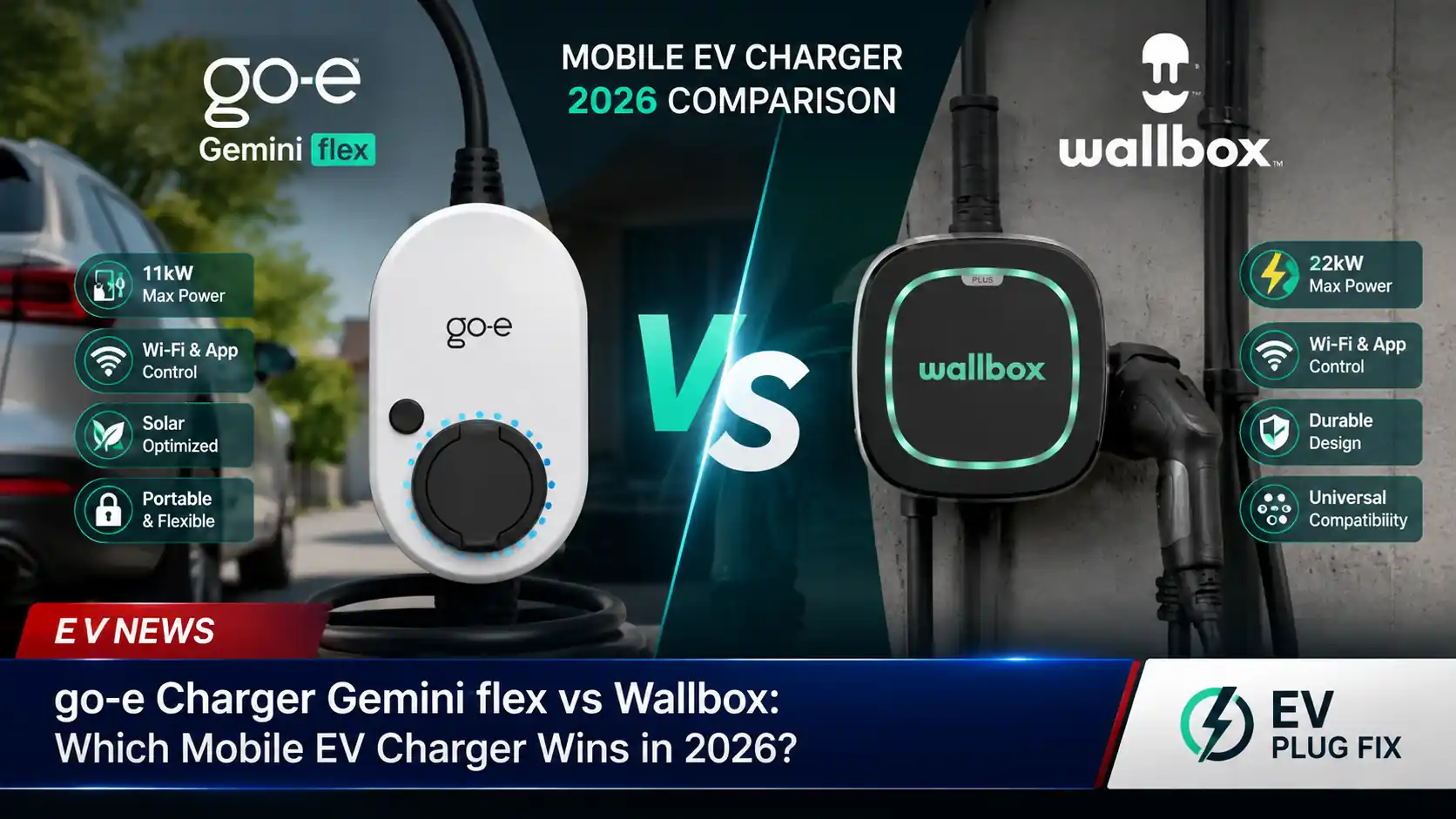
Charging your Audi Q4 e-tron using a mobile AC charging station offers flexibility but introduces variables that affect total charge time. A mobile station like the go-eCharger HOME+ or the more compact go-e Charger Gemini flex acts as a conduit between your power source (wall socket or industrial CEE outlet) and your vehicle’s Type 2 port. The key variable is the adapter used to connect the charger to the mains power.
These adapters are not universal in their capabilities. For example, using a standard household Schuko plug adapter typically limits the current draw to 10 Amps (A) or 16A depending on the circuit, resulting in a slower charging rate. Conversely, industrial CEE adapters are designed for higher power demands. A CEE blue adapter is a 16A single-phase plug, while a CEE red adapter is a 32A three-phase plug. This distinction is crucial because the go-eCharger HOME+ can handle up to 22 kW, but its output is limited by the amperage of the adapter and the electrical supply. When setting up your home charging infrastructure, understanding EV Charging Load Balancing can help you optimize your electrical panel’s capacity.
For the 2026 model year, Audi has focused on improving efficiency, but the fundamentals of AC charging remain. The maximum AC charge rate for the Q4 e-tron is 11 kW, as confirmed by multiple sources. While a 22 kW charging station is capable of higher output, the Audi Q4 e-tron’s onboard charger will cap the incoming power at 11 kW. This means that while a 22 kW station offers headroom, the actual charging curve is still dictated by the vehicle’s internal hardware. If you’re considering a permanent installation, our guide on Home EV Charger Installation provides valuable insights for setting up your wallbox safely and efficiently.
Testing Charging Speeds with go-e Charging Stations and Adapters
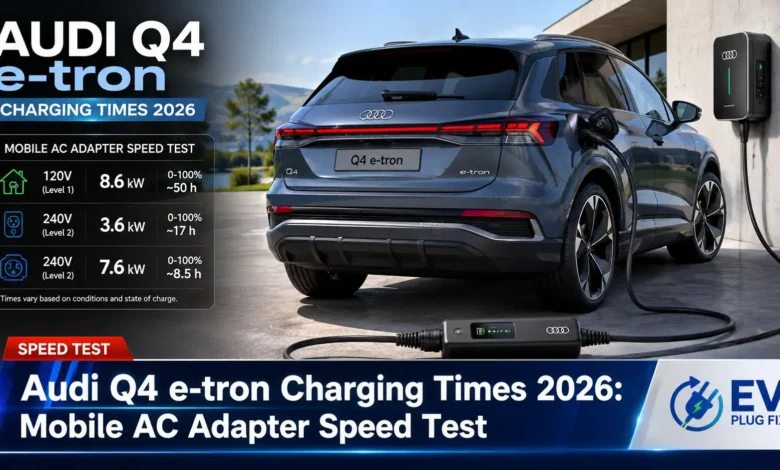
To provide actionable data for Audi Q4 e-tron owners, we calculated charging times using the go-eCharger HOME+ 11 kW and 22 kW, as well as the go-e Charger Gemini flex 11 kW and 22 kW. The calculations utilized three primary adapters: a CEE red 32 A adapter for high-power three-phase connections, a CEE blue 16 A adapter for standard three-phase connections, and a standard household socket adapter set to a 10 A capacity. The results highlight the dramatic difference in efficiency between using a standard wall outlet and a specialized industrial socket.
Charging Times Using Different Adapters
The table below summarizes the estimated charging times for the 2026 Audi Q4 e-tron models. These times are calculated based on the battery capacities and the maximum AC charge rate of 11 kW. While the 22 kW charger is used, the vehicle is the limiting factor. Understanding the EV Charging Curve can help you understand why charging speed tapers off as the battery approaches full capacity.
| Adapter Type | Max Current | Power Output | Time to Full Charge (82 kWh Battery) |
|---|---|---|---|
| Household Schuko | 10 A | ~2.3 kW | ~31 – 35 hours* |
| CEE Blue (1-phase) | 16 A | ~3.7 kW | ~24 hours* |
| CEE Red (3-phase) | 32 A | ~11 kW (limited by car) | ~7 – 8 hours |
It’s important to note that the “Time to Full Charge” for the 22 kW station is identical to the 11 kW station when using the CEE red adapter. This is because the Audi Q4 e-tron is limited to 11 kW AC charging. A 22 kW cable or station does not increase the speed beyond this limit, but it does ensure that the cable is not the bottleneck. As highlighted by EV cable specialists, a 22 kW cable enables charging on 22 kW, 11 kW, 7 kW, and 3 kW chargers, whereas an 11 kW cable is more restrictive. You can also compare different vehicles’ BMW i3 Charging Time to see how other EV models handle similar charging scenarios.
Detailed Charging Times for Audi Q4 40 and 50 Models
The specific variant of the Audi Q4 e-tron plays a role in charging dynamics. The Q4 40 e-tron, which typically utilizes a 63 kWh battery (59 kWh net), will naturally charge faster to full capacity than the Q4 50 e-tron with an 82 kWh battery (77 kWh net). However, the maximum AC charging rate remains 11 kW for all variants, including the 2026 Q4 45 and 55 models.
For the Q4 40 e-tron, a home wallbox (7 kW) can charge from 0% to 100% in roughly 9 hours and 45 minutes. For higher-capacity batteries, such as the one in the Q4 50 e-tron, the time extends to approximately 7 hours and 45 minutes at 11 kW. These figures assume ideal conditions, such as moderate ambient temperatures and the battery not being in an extreme state of charge (too hot or too cold).
The Impact of Onboard Charger Limits
The Audi Q4 e-tron features an onboard charger that is capped at 11 kW for AC input. This is a crucial point for owners considering a mobile charging station. While many public AC chargers are rated at 22 kW, the Q4 will only draw 11 kW. This limitation is standard across the Q4 e-tron lineup and is an important factor in managing expectations when charging at hotels or public parking garages.
Furthermore, modern Audi Q4 e-tron models, particularly those updated for 2024 and later, feature battery conditioning that can improve charging speeds in colder weather, but this primarily benefits DC fast charging. To maximize your battery’s lifespan and performance, review our expert EV Battery Health Tips for optimal charging practices.
Optimizing Your Mobile AC Charging Setup
Choosing the right equipment for your Audi Q4 e-tron is about matching the charger to your most common use case. If you primarily charge at home and have access to a dedicated CEE socket, investing in a robust mobile charger like the go-eCharger Gemini flex 22 kW with a CEE red adapter is the best choice. This setup maximizes the vehicle’s 11 kW capability, allowing for overnight charging without issue.
However, for those who rely heavily on public infrastructure, the Type 2 cable itself is vital. As noted by experts, when selecting an EV cable, a 22 kW cable is generally recommended over an 11 kW cable. This is because a 22 kW cable is backward compatible, providing flexibility to use public chargers at their full potential, even if the vehicle doesn’t require it.
It is also worth noting that the Audi Q4 e-tron supports bidirectional charging (V2L and V2H) for 2026 models, meaning you can not only charge the car but also use its battery to power devices at home or on the go. This exciting feature, available via a domestic socket in the trunk, reflects the evolving role of the EV from transport to energy source. For a comprehensive overview of available equipment, explore our comparisons of the Best Home EV Chargers on the market to find the perfect match for your garage setup.