EV Charging Communication Protocols: How Cars and Chargers Talk in 2026
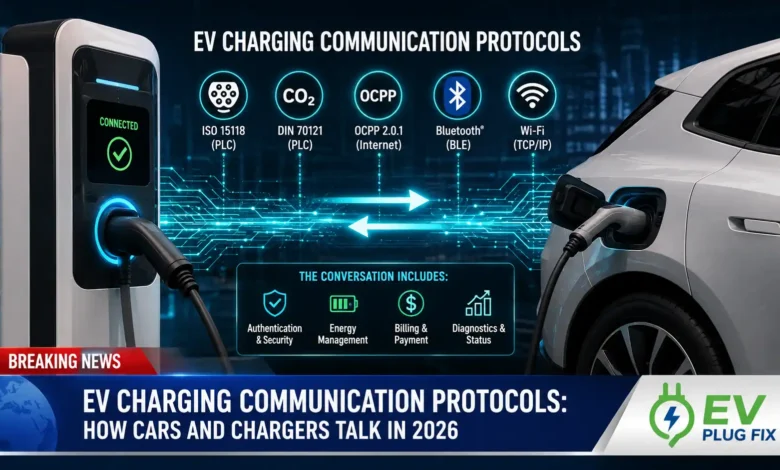
The moment you slide that charging connector into your electric vehicle, something remarkable happens that most drivers never witness. Before a single electron flows into your battery pack, your car and the charger have already engaged in a sophisticated digital conversation – negotiating power levels, verifying safety conditions, exchanging identities, and agreeing on billing arrangements, all within milliseconds. This invisible handshake protocol is the unsung hero of the EV revolution, transforming what could be a dangerous high-voltage connection into a seamless, intelligent energy transfer.
Understanding the intricate communication protocols that govern EV charging doesn’t just satisfy technical curiosity – it empowers you to troubleshoot failed sessions, appreciate why some chargers deliver lightning-fast speeds while others crawl, and glimpse where the technology is heading next. From the elegant simplicity of the Control Pilot signal to the cryptographic complexity of ISO 15118’s Tesla Supercharger network communication, the language of EV charging is far more sophisticated than most people realize.
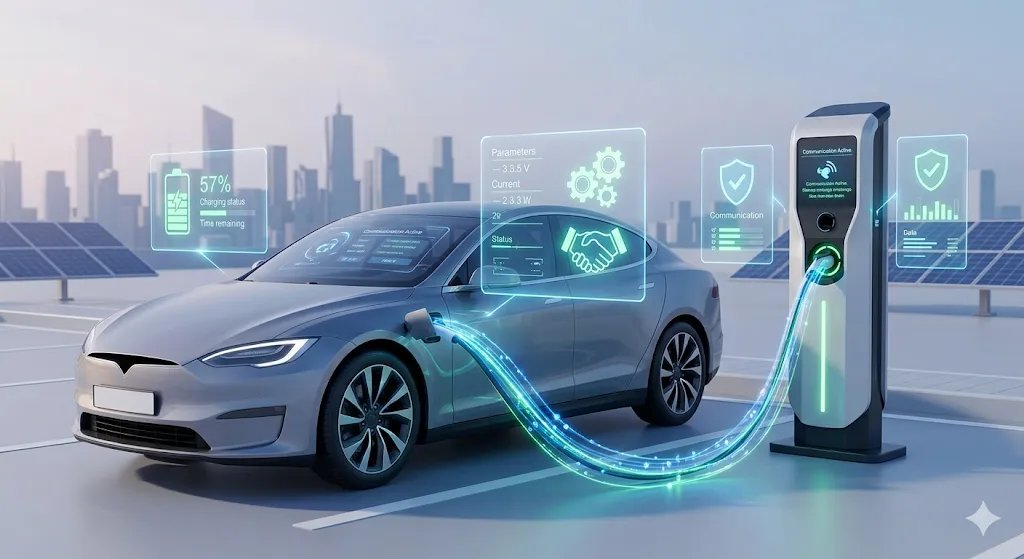
Think about what’s actually happening when you charge an EV. You’re managing a complex electrochemical system with very specific preferences – charge it too aggressively and you risk accelerating battery degradation; charge it too conservatively and you’re wasting precious time and leaving usable range on the table. The charger, on its own, has absolutely no idea what kind of battery is connected, its current state of charge, or how much current it can safely handle. Without robust communication protocols, the charging station would essentially be guessing – and with high-voltage battery packs, guessing wrong is simply not an option. This is why understanding the EV Charging kWh Guide is essential for every EV owner to monitor and optimize their energy consumption effectively.
Every major charging standard in use today incorporates a dedicated communication layer. The charger and vehicle must reach mutual agreement before power flows, continuously monitor conditions throughout the session, and execute a clean, orderly shutdown when charging completes. This isn’t a dumb power pipe – it’s an ongoing, dynamic negotiation that adapts to changing conditions in real-time.
Why Your Car and Charger Need to Talk: The Foundation of Safe EV Charging
The communication between an electric vehicle and charging station serves several critical purposes that go far beyond simply deciding when to start and stop power flow. At its most basic level, the handshake protocol verifies that a proper physical connection has been established and that the cable can safely carry the requested current. This involves checking grounding integrity, ensuring the connector is fully latched, and confirming that no dangerous conditions exist that could lead to arcing or electrical faults. For comprehensive safety practices, refer to our Home EV Charging Safety guide that covers essential precautions for every charging session.
Beyond basic safety, the communication layer enables sophisticated negotiation of charging parameters. The vehicle’s Battery Management System (BMS) must convey its current state of charge, maximum acceptable voltage, temperature limits, and desired charging profile. The charger responds with information about its available power capacity, network status, and any grid constraints that might affect delivery. This two-way exchange ensures that charging occurs at the optimal rate for both the vehicle and the infrastructure.
- Safety verification: Grounding checks, connector locking confirmation, and insulation monitoring
- Parameter negotiation: Voltage, current limits, and power delivery agreements
- Authentication: User identification, billing authorization, and contract validation
- Continuous monitoring: Real-time adjustments based on battery temperature, state of charge, and grid conditions
- Orderly termination: Controlled ramp-down and safe disconnection protocols
The handshake process occurs at the start of every charging session and is a common root cause of start failures. When a charger appears to be “online” but cannot initiate a session, it’s often due to a breakdown in this communication chain – whether from protocol mismatches, hardware issues, or authentication problems. Understanding these fundamentals helps drivers troubleshoot issues and appreciate the complexity behind what appears to be a simple plug-in operation.
The Control Pilot Signal: Simple, Clever, and Ubiquitous
For everyday home charging and public AC stations – encompassing Level 1 (120V) and Level 2 (240V) – the primary communication method is elegantly straightforward. Known as the Control Pilot (CP) signal, this technology has served as the backbone of EV charging communication since the SAE J1772 standard was published in North America and IEC 61851 internationally.
The charger – more properly called an EVSE (Electric Vehicle Supply Equipment) – sends a low-voltage square-wave signal down a dedicated wire in the charging cable. When you plug in, your vehicle detects this signal and responds by slightly modifying the voltage on that same wire. This voltage drop is the car’s way of announcing, “I’m connected and ready to charge.”
The true genius of the Control Pilot signal lies in how it communicates available current capacity. Rather than transmitting complex digital data, the EVSE varies the duty cycle of its signal – the proportion of time the signal remains in its “high” state versus its “low” state. The vehicle reads this duty cycle, configures its onboard charger accordingly, and draws no more than the advertised current. This elegant analog approach requires no microprocessor and works with virtually every EV on the road today.
A second wire, called the Proximity Pilot (PP), provides additional intelligence. It signals to the vehicle that a plug is physically inserted and communicates the current rating of the cable itself. Together, these simple but effective signaling methods create a robust foundation for AC charging that has proven remarkably reliable across millions of vehicles and charging stations worldwide. When selecting equipment for your home, consulting a comprehensive Home EV Charger Guide can help you understand which features matter most for your specific needs.
| Signal Type | Purpose | How It Works |
|---|---|---|
| Control Pilot (CP) | Communicates available current limits and vehicle readiness | Pulse-width modulation varying duty cycle |
| Proximity Pilot (PP) | Detects connector insertion and cable capacity | Resistance-based signaling through separate pin |
The simplicity of this approach has been instrumental in EV adoption. Because the Control Pilot system requires no complex networking or authentication infrastructure, it can be implemented cost-effectively in home charging stations and public AC chargers alike. It also ensures broad interoperability – any J1772-compliant vehicle can charge from any J1772-compliant station using this universal communication language.
Power Line Communication: Talking Through the Power Wires
While the Control Pilot signal handles basic safety and current negotiation admirably, it hits a performance ceiling relatively quickly. The analog approach cannot transmit billing information, support bidirectional energy flow, or handle the complex data exchange required for modern smart charging applications. This is where Power Line Communication (PLC) enters the picture – and it represents one of the most elegant technical solutions in the entire EV ecosystem.
PLC works by superimposing a high-frequency digital signal on top of the existing power conductors within the charging cable. The power flows at the standard 50 or 60 Hz frequency, but the communication signal rides on top at much higher frequencies – typically in the megahertz range – which power electronics effectively ignore. The technology employs HomePlug Green PHY, a low-power variant of the same standard once used for home networking over household electrical wiring.
What this means in practice is transformative: the car and charger can exchange structured digital data at speeds up to 10 Mbps, all without requiring any additional wires or wireless radio links. The charging cable you already possess performs double duty – carrying electricity in one direction while simultaneously transporting data in both directions. This capability unlocks sophisticated features that simply weren’t possible with analog signaling alone. Understanding the differences between Stationary vs Mobile Chargers can help you decide which charging solution best fits your lifestyle and communication needs.
- Plug & Charge: Digital certificates stored in the vehicle enable automatic authentication and billing – simply plug in and walk away
- ISO 15118 compliance: The international standard for V2G communication relies on PLC for secure data exchange
- Smart charging: Real-time grid conditions, electricity pricing, and driver preferences can influence charging schedules
- Bidirectional communication: Enables V2G, V2H, and V2B applications where vehicles send power back to buildings or the grid
PLC serves as the foundation for ISO 15118, the international standard that enables what’s called Plug & Charge. Under this system, when a compatible vehicle connects to a compatible charger, the vehicle presents a digital certificate stored in its secure hardware. The charger’s network verifies this certificate, identifies the vehicle and its associated billing account, and starts the charging session automatically – no RFID card, smartphone app, or payment terminal interaction required.
This technology also makes Vehicle-to-Grid (V2G) communication feasible. With V2G, your EV doesn’t just consume power – it can push electricity back into the grid during peak demand periods. The utility signals through the charger, the vehicle’s BMS responds with available capacity, and the two sides negotiate a discharge session entirely over PLC, requiring no separate communication hardware. This bidirectional capability represents the future of energy management, turning millions of EV batteries into distributed energy storage assets.
DC Fast Charging: Millisecond-by-Millisecond Negotiation
When you move into DC fast charging – the kind that can add 100+ miles of range in 20 minutes – the communication game changes dramatically. At these power levels, bypassing the vehicle’s onboard charger and feeding DC directly to the battery pack requires communication that is simultaneously fast, precise, and fault-tolerant.
The dominant standard in North America and Europe for non-Tesla vehicles is CCS (Combined Charging System). CCS employs ISO 15118 and PLC for its upper communication layer, layered on top of a faster control protocol (DIN 70121) that governs the actual charging loop. Once the initial handshake completes, the vehicle and charger exchange messages every 250 milliseconds – four times per second.
This rapid-fire communication enables precise control of the charging process. The vehicle continuously transmits its target voltage, maximum current request, current state of charge, and battery temperature. The charger responds by adjusting its output in near real-time. This tight control loop is what enables the smooth power taper you observe on fast chargers – and if any sensor detects an abnormal temperature spike, the vehicle sends an immediate stop command, and the charger cuts power within milliseconds. For a deeper understanding of connector standards, explore our NACS vs CCS2 Charging comparison to see how different protocols affect your charging experience.
CHAdeMO, the standard used by Nissan and some other Japanese manufacturers, takes a different technical approach. It uses a dedicated CAN bus (Controller Area Network) running over separate signal pins in the connector, rather than PLC. Meanwhile, NACS – originally Tesla’s proprietary connector now being standardized across North America – combines AC and DC charging in a single compact plug and supports ISO 15118 on newer Superchargers. Tesla’s Supercharger network has long been recognized for its seamless communication and user experience, setting a benchmark for the industry.
The complexity of DC fast charging communication means that handshake failures are more common and more visible to drivers. Protocol mismatches, software version incompatibilities, and PLC signal quality issues can all prevent a session from starting. This is why charging networks invest heavily in interoperability testing and over-the-air updates to ensure their stations work reliably with the growing diversity of EV models on the road.
The Battery Management System: The Car’s Internal Decision-Maker
All of this external communication ultimately serves one master inside the vehicle: the Battery Management System (BMS). The BMS serves as the electronic brain that monitors every cell in the battery pack – voltage, temperature, state of charge, internal resistance, and more – and serves as the final authority on how fast charging can proceed.
The BMS performs several critical functions during charging. It measures individual cell voltages and module temperatures in real-time, calculates the current state of charge, and determines the maximum allowable charging current based on battery chemistry, temperature, and age. During DC fast charging, the BMS directly controls the requested power profile, while for AC charging, the vehicle’s onboard charger works within BMS-prescribed limits.
During the early phase of a fast-charging session – when cells are relatively cool and far from full – the BMS requests maximum current. As the pack fills, it implements what engineers call a CC-CV profile: constant current first, followed by gradual tapering to constant voltage as the pack approaches its maximum voltage threshold. This explains why the last 20% of a charge always takes significantly longer than the first 20%.
The BMS deliberately slows charging near full capacity to avoid stressing cells at their upper voltage limit – the point where battery degradation accelerates most rapidly. It’s protecting your long-term range, not wasting your time.The BMS also acts as a safety shutdown valve. If any cell behaves unexpectedly – a sudden voltage drop, an unusual temperature reading, signs of an internal short – the BMS sends an immediate stop command through the communication link, closes the high-voltage contactors, and terminates the session before any damage can occur. This safety function is why EV batteries rarely experience the kinds of catastrophic failures that plagued early consumer electronics.
Modern BMS systems increasingly incorporate artificial intelligence and cloud-connected analytics to predict potential faults in real-time. Major semiconductor suppliers like Texas Instruments, NXP, and Infineon continue delivering newer BMS chipsets with improved accuracy, speed, and cybersecurity features. Some manufacturers are even developing wireless BMS technology that eliminates wiring harnesses between battery modules, reducing weight and simplifying vehicle design.
- State of Charge (SoC): How full is the battery at this moment?
- State of Health (SoH): How degraded is the battery compared to when it was new?
- State of Power (SoP): How much power can the battery safely deliver right now?
- Remaining Useful Life (RUL): How much longer will the battery function effectively?
OCPP: How Chargers Talk to the Network
Beyond the conversation between vehicle and charger, there exists a second communication layer: between the charger and the wider world. This is handled by OCPP (Open Charge Point Protocol), the de facto industry standard that enables charge point operators to manage their charging networks remotely.
Through OCPP, a charger constantly reports its status – whether available, in use, or faulted – to a central Charging Station Management System (CSMS). Operators can push firmware updates, adjust pricing dynamically, monitor energy usage in real-time, and implement demand response strategies: automatically slowing charging across their network during grid stress events, then ramping back up when demand eases.
For drivers, this network communication is mostly invisible. What it means in practice is that your charging session can be logged, billed, and receipted without you ever interacting with the charger directly. It also means the infrastructure behind the scenes is getting progressively smarter about when and how it delivers power, enabling features like load balancing, peak shaving, and integration with renewable energy sources. This is why many experts recommend a EV Charger Installation Guide to ensure your home setup can leverage these advanced network capabilities.
OCPP’s evolution from a simple two-way communication protocol to a comprehensive device management framework reflects the growing sophistication of EV charging networks. Modern versions support advanced features like smart charging, demand response, and integration with building energy management systems. The protocol’s open nature has been instrumental in fostering competition and innovation in the charging industry, allowing diverse players to participate in the ecosystem without being locked into proprietary solutions.
Frequently Asked Questions About EV Charging Communication
How long does the EV charging handshake typically take?
Can I charge my EV if the communication system fails?
Why do some EVs charge faster than others at the same station?
What's the difference between ISO 15118-2 and ISO 15118-20?
How does Plug & Charge work without an app or RFID card?
”Can
Where EV Charging Communication Is Heading in 2026 and Beyond
The trajectory of EV charging communication is unmistakable: more intelligence, less friction, and deeper integration with the broader energy ecosystem. Plug & Charge is gradually rolling out worldwide, meaning authentication and billing will increasingly require nothing more than the physical act of plugging in. V2G is moving from pilot projects toward commercial deployment, with several automakers and utilities already running real-world programs.
Wireless charging is also creeping into public infrastructure and is already available as an optional feature on some production vehicles. The standardization efforts behind SAE J2954 and ISO 15118 continue to evolve, with newer versions addressing emerging requirements like bidirectional power flow for V2G applications. These developments promise to make charging more convenient, more efficient, and better integrated with the smart grid.
New protocols are also emerging to address specific challenges. ISO/IEC 14543-4-304:2026, published in June 2026, specifies an application-layer protocol for ensuring interoperability among products from various manufacturers regarding communications between EVSE and controllers. This reflects the industry’s ongoing commitment to open standards that prevent vendor lock-in and promote competition.
What’s easy to forget in all this technical complexity is how much of this sophisticated communication already works quietly in the background, every time you charge your vehicle. The next time you plug in, remember that the conversation has already begun – that click of the connector isn’t the end of the process but the beginning of a negotiation that your car and charger have been trained to conduct in milliseconds, without you ever noticing.
The future of EV charging isn’t just about faster speeds or longer range – it’s about smarter, more seamless energy management that turns your vehicle from a simple consumer of electricity into an active participant in the electrical grid. And that future depends entirely on the invisible handshake protocols that make intelligent communication possible.