EV Charging Losses Explained: Why Your Wallbox & Car Display Differ (2026)
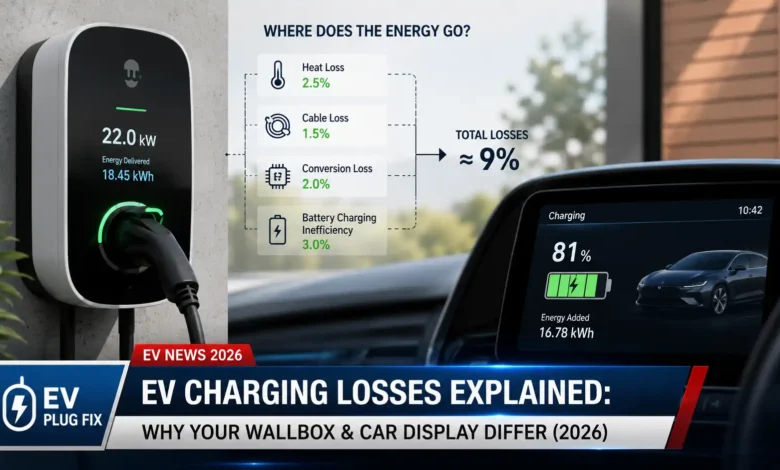
As electric vehicles continue to reshape the automotive landscape, one of the most frequent questions from new and prospective EV owners centers on charging logistics. While public fast-chargers grab headlines, the reality for most drivers is that the majority of charging happens at home, overnight, using a standard wallbox. Understanding the nuances of AC charging, the role of your vehicle’s onboard charger, and how different power levels affect your daily routine is crucial to maximizing both convenience and battery health. This detailed guide breaks down everything you need to know about charging your EV at home with a Level 2 wallbox.
At the heart of home EV charging is the distinction between AC and DC power. Your home supplies alternating current (AC), but your electric car’s battery stores direct current (DC). The conversion happens inside the vehicle via an onboard charger, which is rated at a specific kilowatt (kW) capacity. This onboard unit is the bottleneck for home charging; even if you install a powerful 22kW wallbox, your car will only draw the maximum AC power it can handle. This is why checking your specific model’s specifications is the first step in planning your home charging setup, and our EV Charging Time resource offers a deep dive into these calculations.
Understanding Level 2 Home Charging Speeds: 7kW vs 22kW
Level 2 charging, which operates on a 240-volt circuit (similar to a large household appliance like a dryer), is the standard for home wallboxes. These units typically range from 7kW to 22kW, but the actual charging speed you experience is determined by the lower of either the wallbox’s output or your car’s onboard charger capacity. For example, a vehicle with an 11kW onboard charger connected to a 22kW wallbox will only charge at 11kW. This speed is generally sufficient to replenish a typical EV battery (around 60 kWh) from 20% to 80% in 4 to 8 hours, making it an ideal overnight solution. Choosing the right equipment is essential, and our EV Charger Installation Guide provides expert advice on getting set up safely and efficiently.
Home Level 2 Wallbox Charging Speed Comparison
| Wallbox Output | Required Electrical Supply | Vehicle Onboard Charger | Effective Charge Speed | Typical Charge Time (20-80%) |
|---|---|---|---|---|
| 7.4 kW | Single-Phase (32A) | 7.4 kW – 11 kW | 7.4 kW | 6 – 8 Hours |
| 11 kW | Three-Phase (16A) | 11 kW | 11 kW | 4 – 5 Hours |
| 22 kW | Three-Phase (32A) | 11 kW (Most EVs) | 11 kW (Limited by car) | 4 – 5 Hours |
Key Smart Charger Features and Electrical Safety
When selecting a home charger, you’ll encounter various features that go beyond simple power delivery. Smart chargers offer connectivity via Wi-Fi or Bluetooth, allowing you to schedule charging sessions during off-peak electricity hours, monitor energy consumption, and even integrate with rooftop solar panels. Some advanced models also include dynamic load balancing capabilities, which adjust power output to prevent overloading your home’s main electrical circuit—a critical feature if you own multiple EVs or high-draw home appliances. For a detailed breakdown of features and performance, our Smart EV Charger Comparison can help you decide which unit fits your needs.

Installation of a Level 2 wallbox requires a dedicated circuit breaker and proper wiring, typically involving a 40- to 100-amp breaker depending on the charger’s output. It’s a job that should always be performed by a certified electrician familiar with local codes and EV charging requirements. Safety is paramount, and modern chargers are equipped with multiple protection systems, including RCD (Residual Current Device) protection to prevent electric shock and ground faults. Furthermore, some high-end wallboxes offer DC leakage protection to safeguard against internal faults. You can learn more about this technology in our article on EV Charger RCD Protection.
- Off-Peak Scheduling: Program your wallbox to charge only when electricity rates are lowest overnight.
- Dynamic Load Balancing: Protects main home fuses by throttling charger output when household demand peaks.
- DC Leakage Protection: Integrated 6mA DC protection eliminates the need for expensive external Type B RCDs.
Communication Protocols and Battery Longevity
Beyond hardware, software and communication protocols play an increasingly important role in the charging experience. Modern EVs and wallboxes perform a digital “handshake” using specific communication standards (like ISO 15118) to negotiate charging current, authenticate the vehicle, and handle billing. This bi-directional communication is the foundation for features like Plug & Charge, where the car and charger automatically identify each other and start the session without requiring an RFID card or smartphone app. Our guide on EV Charging Protocols explains these technicalities in detail.
Finally, understanding your specific vehicle’s charging curve is just as important as the wallbox’s specifications. Many cars will taper charging speed as the battery approaches full capacity to protect battery cells from thermal degradation. This means the last 10% of a charge will often take significantly longer than the first 80%. For daily use, most experts recommend charging to 80% for battery longevity and only charging to 100% before long trips. This practice, combined with the convenience of a well-chosen home wallbox, transforms EV ownership from a logistical challenge into a seamless part of daily life.