EV Range Guide 2026: How Far Can Electric Cars Really Go?
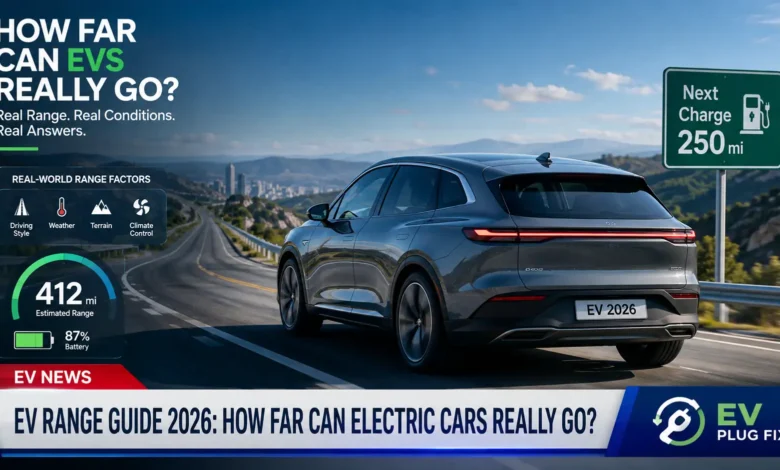
The question of how far an electric vehicle (EV) can travel on a single charge is the single most common inquiry for potential buyers, and for good reason. For over a century, drivers have been accustomed to the quick five-minute stop at a gas station, a habit that is proving hard to break. However, the automotive landscape has shifted dramatically, and the technology behind EV batteries has evolved at a breakneck pace. In 2026, the answer to “How far can an EV go?” is more nuanced than ever, with average ranges reaching new heights and a host of factors influencing the real-world distance you can expect. This detailed guide cuts through the hype to give you a clear, data-driven picture of EV range in 2026, helping you understand what it means for your daily life and driving habits.
For more than a century, the routine of refuelling a traditional combustion engine has been second nature. This ingrained mindset often leads to “range anxiety” – the fear of being stranded with a depleted battery. Yet, as the world pivots towards sustainable transportation, we have a unique opportunity to reshape our refuelling habits. Unlike a gas tank, an EV’s battery is a cost-intensive and heavy component, creating a fundamental trade-off: increased range comes with a higher purchase price, longer charging times, and added vehicle weight. Furthermore, while a traditional car gets lighter as fuel is consumed, an EV’s weight remains constant due to its massive battery pack, impacting efficiency and handling.
Companies like Ford, GM, and Rivian are unveiling heavier electric trucks that necessitate even larger batteries. This highlights the importance of accurately assessing your personal driving requirements. Spending a premium on an 800-kilometer range might be overkill for someone whose workplace is just a short commute away and who rarely exceeds 20 kilometers in a day. The situation is analogous to choosing a laptop: we would all love a battery that lasts for days, but would we be willing to compromise with a heavier and bulkier machine? For many, the extra cost doesn’t justify the marginal gain. To make the right choice, refer to our EV Charger Selection Guide to match your range needs with the ideal home charging solution.
Your living environment also plays a crucial role. Urban dwellers with amenities and workplaces close to home will require less range than those residing in rural communities. Access to home charging is a game-changer. If you can charge your vehicle in your garage overnight, you can start each day with a “full tank,” making range a minor concern. However, if you live in an apartment or a rented property without dedicated charging, finding a reliable, preferably fast, public charging station becomes a necessity. In such cases, a longer range might be more desirable to reduce the frequency of these charging excursions.
The first step in conquering range anxiety is to gauge your daily driving requirements. Track your regular routes using Google Maps or a similar tool to understand the distances you cover routinely. Once you have a rough estimate, it’s wise to add a 10% buffer to account for unforeseen detours, traffic, or errands. This daily kilometer figure will help you estimate how frequently you will need to charge based on the battery capacity of the EV you are considering. If you find you are taking 100-kilometre trips at least once a week, then considering a long-range EV is a prudent choice. Conversely, if your trips are short and predictable, a smaller, more affordable EV with a modest range will be perfectly sufficient and more cost-effective. For a deeper understanding of how battery capacity translates to charging time, check out our guide on 66.5 kWh Charging Time to see real-world calculations.
Understanding EV Range: Averages, Real-World Numbers, and Market Leaders
The landscape of EV range has transformed dramatically over the past decade. From an average of just over 100 kilometers in 2011, the average driving range for a new electric car has more than quadrupled. By 2026, the average battery size across a wide range of models has increased to approximately 75.8 kWh, yielding an average driving range of about 432 kilometers (roughly 270 miles). This represents a staggering 293% increase, effectively erasing the limitations that once defined the first generation of mass-market EVs.
In markets like the UK, the average advertised range for a new electric car is now close to 300 miles (almost 480 kilometers) on the official WLTP cycle. This places most mainstream models in a “sweet spot” of 230 to 320 miles, which is more than enough for daily commutes, school runs, and weekend getaways. However, a key distinction must be made between these official figures and real-world performance. The official WLTP (used in Europe) and EPA (used in the US) ranges are measured in a laboratory, not on the road. On a real highway at 75 mph, in cold weather, or with a heavy load, you can expect the actual range to be 10% to 20% lower than the sticker number. For instance, the Lucid Air Grand Touring, the undisputed champion with an EPA-rated 512 miles, returned about 410 miles in an independent highway test—a haircut of roughly 20%. This is not a flaw in the car, but the simple physics of aerodynamic drag and energy consumption at high speeds.
Despite this gap, the sheer capability of modern EVs is undeniable. The top-tier models are pushing the boundaries of what was thought possible just a few years ago. The 2026 Mercedes-Benz EQS 450+, following its facelift, boasts up to 926 kilometers (575 miles) of WLTP range, a 13% improvement over its predecessor, thanks to a new 122-kWh battery and updated cell chemistry. Meanwhile, the Lucid Air Grand Touring holds the absolute WLTP record in Europe with up to 960 kilometers, though this variant isn’t yet available in all markets. The landscape for long-range SUVs is also heating up. The new BMW iX3, based on the Neue Klasse platform, claims up to 805 km WLTP, while the Volvo EX60 pushes close to 503 miles (EPA). For trucks, the Chevrolet Silverado EV leads the pack with an EPA rating of nearly 493 miles, though this is achieved with a massive battery pack, leading to significant weight and cost. Understanding these range figures is essential when planning your EV Charger Installation Guide at home to ensure your setup meets your daily needs.
How Much EV Range Do You Actually Need? Calculating Your Ideal EV
This is the most critical question a prospective EV buyer must answer, and it is highly personal. While it’s tempting to aim for the maximum range available, doing so often comes with a significant financial and practical penalty. The key is to avoid “range anxiety” by understanding your real needs rather than succumbing to fear.
A simple and effective method is to categorize your driving habits. The first step is to calculate your average daily mileage. For most people, this is well under 50 miles (80 kilometers) a day. The second step is to consider your access to charging. If you have a home charger, you can “fill up” every night, meaning you almost never need a range that covers more than your daily maximum. Conversely, if you rely on public charging, a longer range can reduce the frequency of your charging stops, which may be a significant convenience.
Industry experts suggest considering your driving profile to determine a recommended minimum range:
- Urban Commuter (~8,000 miles/year): If you take mainly short trips and can charge at home or work, a minimum range of 180 miles (WLTP) is more than sufficient. This covers city EVs and smaller hatchbacks.
- Mixed Driver (~10,000 miles/year): For a mix of town and motorway driving with some long journeys, a range of 240 miles (WLTP) is the sweet spot.
- Frequent Motorway / Business Driver (~15,000+ miles/year): For those with regular long routes, a minimum range of 300+ miles (WLTP) is ideal. This is where 800V fast-charging capability becomes just as important as the headline range figure.
If you have a flexible budget, the temptation to buy a car with the highest range or best performance is natural. However, if you are budget-conscious and seeking the most efficient EV, it’s crucial to weigh the benefits against the costs. Charging once every few days is quite reasonable if you have a home charger. The dramatic improvement in charging infrastructure also helps to mitigate the need for extreme range. With fast-charging networks expanding globally, the “desert” of charging stations that once caused range anxiety is quickly disappearing. For those who own multiple EVs, understanding EV Charging Load Balancing becomes essential to optimize your home charging setup without overloading your electrical system.
This brings us to the crucial interplay between range and charging speed. The 2026 Hyundai Ioniq 5, for example, offers a range of 318 miles (EPA) for its long-range RWD version, but its true superpower is its 800-volt architecture, which allows it to charge from 10 to 80% in roughly 18 minutes. In contrast, the Chevy Equinox EV, with a similar 319-mile range, takes about 40 minutes on a 400-volt system. Over a long road trip with multiple stops, the Ioniq 5’s faster charging speed saves significant time, proving that a vehicle’s “road-trip range” is a function of both its battery capacity and its charging speed. The newest Mercedes EQS, also moving to an 800-volt system, can add 320 kilometers of WLTP range in just 10 minutes at a 350 kW charger. When considering charging speed, it’s helpful to understand the underlying technology with our guide on AC vs DC Charging to see how each affects your overall charging experience.
Maximizing Your EV’s Range: Smart Charging, Maintenance, and Driving Habits
Getting the most out of your EV’s battery isn’t just about the number on the spec sheet; it’s about how you treat the battery. Understanding a few key principles can help you preserve battery health and ensure your range remains consistent for years.
Firstly, it is widely recommended to avoid charging your battery to 100% and to not let it run down to 0%. Most EV manufacturers and experts suggest keeping the state of charge between 20% and 80% for daily driving. Charging to 100% is generally reserved for long trips. Many EVs have a built-in function within their Battery Management System (BMS) to limit charging to 80% automatically. The science behind this is simple: lithium-ion batteries are under the most stress at very high and very low states of charge, and avoiding these extremes can significantly prolong their lifespan and slow down degradation.
Environmental factors like temperature also play a massive role in range. A cold battery and the use of cabin heating can cut winter range by 20% to 30%. To mitigate this, look for vehicles equipped with a heat pump, which is far more efficient than resistive heating. Innovations from companies like MAHLE, such as the HeatX Range+ system, can reduce the energy demand of climate control by up to 20%, translating into nearly 10 extra kilometers of range at sub-zero temperatures. To protect your charger and vehicle from electrical faults, ensure your installation includes proper EV Charger RCD Protection, which safeguards against potentially damaging DC leakage currents.
Your driving style is another major factor. Aerodynamic drag increases exponentially with speed, meaning highway cruising is the most energy-intensive activity you can do. Driving at 65 mph instead of 75 mph on a long journey can noticeably extend your range. Similarly, aggressive acceleration and hard braking waste energy, whereas smooth, anticipatory driving and using regenerative braking to its full potential will maximize efficiency.
Finally, regular maintenance is key. Unlike an internal combustion engine, an EV requires relatively little maintenance, but checking tire pressure is crucial. Underinflated tires increase rolling resistance and can significantly reduce range. Using the recommended tire type and ensuring wheel alignment is correct will also help maintain optimal efficiency.
Frequently Asked Questions
What is the average EV range in 2026?
How much range do I really need in an EV?
What is the longest-range EV you can buy in 2026?
What factors reduce an EV's real-world range?
How can I maximize the range of my EV?
Ultimately, the fear of running out of charge, “range anxiety,” is a psychological hurdle that modern EV technology is rapidly dismantling. By focusing on your actual driving habits, the availability of home or public charging, and the growing network of ultra-fast chargers, you can confidently choose an EV that perfectly fits your lifestyle. Your results, of course, will vary, but with today’s EV options, the freedom to drive electric is greater than ever.