Mini Cooper SE Charging Time 2026: 22kW Wallbox Data & Adapter Guide
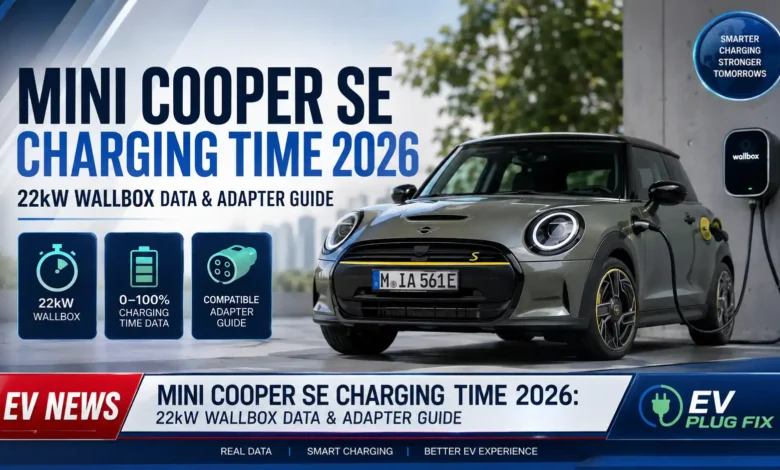
Mini Cooper SE charging time is a critical factor for owners of the 2026 all-electric hatchback, and using a 22kW wallbox with the correct adapter can slash the time spent plugged in by more than 70% compared to a standard domestic socket. While the MINI Cooper SE is capable of accepting up to 11 kW of AC power, the journey from 0-100% can take anywhere from just over three hours to nearly a full day, depending entirely on the connection you use . For a deeper understanding of charging speeds and energy tracking, check out our comprehensive EV Charging kWh Guide to monitor your home energy usage effectively.
The 2026 Mini Cooper SE: Battery and Standard Charging Specs
Before we dive into the adapter data, it’s essential to understand the baseline. The fifth-generation all-electric MINI Cooper SE features a 54.2 kWh battery pack . For home charging, MINI recommends an 11 kW wallbox for a dedicated, fast setup, which can fully replenish the Cooper SE’s battery from 0-100% in about 5 hours and 15 minutes . However, when using more powerful 22 kW public or industrial charging stations, the charging speed is capped by the vehicle’s onboard charger, limiting AC input to 11 kW . The adapter you choose to bridge the charger to your MINI Flexible Fast Charger dictates whether you will achieve that 11 kW maximum. When selecting the right equipment for your garage, our EV Charger Selection Guide can help you make an informed decision.
Charging Time Comparison: 22kW Wallbox vs. Adapters
We analyzed the impact of three distinct adapters on the Mini Cooper SE charging time when connected to a 22 kW wallbox. The differences are staggering. While a 22kW wallbox is capable of delivering 22 kW of power , the Mini Cooper SE on-board charger is limited to 11 kW . This means the bottleneck isn’t the station, but the adapter and cable used.
| Adapter Type | Max. Power Delivery | Charging Time (0-100%) | Best Use Case |
|---|---|---|---|
| CEE Red 16A (3-Phase) | 11 kW | ~3 hours | Industrial sockets (workshops, hotels) |
| CEE Blue 16A (Single-Phase) | 3.7 kW | ~13 hours | Camping sites, some legacy industrial plugs |
| Household Socket (10 A) | ~2.3 kW | ~23 hours+ | Emergency backup, overnight charging at home |
The data confirms that the red CEE 16 A adapter is the clear winner, effectively unlocking the full 11 kW AC charging potential of the Mini Cooper SE and delivering a full charge in just about 3 hours. In contrast, using a single-phase CEE blue adapter drastically extends the process to 13 hours, as it limits the car to a single phase of power . For a complete overview of available home charging solutions, explore our Home EV Charger Guide to find the perfect match for your lifestyle.
“The difference between a 3-phase and a single-phase adapter is not just a matter of hours, but a paradigm shift in convenience. With the right adapter, you can treat a long lunch break as a full ‘tank’ for your MINI.”
Deep Dive: Mini Cooper SE Adapter Options
Your Mini Cooper SE comes with the MINI Flexible Fast Charger 2.0 as standard equipment . This unit itself is a versatile charging cable that can be attached to various adapters, allowing you to plug into almost any outlet in Europe. There are three main adapters to understand:
- MINI CEE 16 A (Red, 3-Phase): This is the gold standard. It is designed to connect your Flexible Fast Charger to red industrial sockets . This type of plug is often found in workshops, hotels, and agricultural buildings. It provides a 400V, 16A, 3-phase connection, delivering up to 11kW of charging power to your MINI .
- MINI CEE 16 A (Blue, Single-Phase): This adapter is for the blue industrial socket (often referred to as “Camping” plugs). It provides a 230V, 16A, single-phase connection, which outputs 3.7 kW . While much slower, it can be a lifesaver in rural areas or campsites where this is the only available outlet.
- Household Socket Adapter: MINI also offers a standard Schuko or Type-G (UK) household plug adapter for its charger, typically rated at 8A or 10A . This is the slowest method, providing a trickle charge of around 1.8-2.3 kW. As per MINI’s official guidance, while possible, this method is “very slow” and not recommended for daily use . Understanding the different cable types available can help you choose the right one for your needs—browse our EV Charging Cable Guide for more details.
Optimizing Your EV Charging Strategy for 2026
With the European EV charging infrastructure growing rapidly, knowing how to optimize your charging time is more important than ever. By the end of March 2026, the EU’s AFIR law requires all member states to have a minimum of 1.3 kW of public charging capacity for each battery-electric vehicle on the road . This means access to public chargers is improving, but it still doesn’t beat the convenience of a fast home setup.
Why You Should Invest in a 22kW Wallbox
While your current Mini Cooper SE may only accept 11 kW, the future is electric and more powerful. A 22kW wallbox (like the Wallbox Pulsar Max) is a future-proof investment for your next EV . For a vehicle with a 60 kWh battery (like a VW ID.3), an 11kW wallbox takes about 5.5 hours to charge, while a 22kW station could do the job in just 3 hours . For expert guidance on installation, check out our EV Charger Installation Guide to ensure a safe and efficient setup.
When to Use Your MINI Flexible Fast Charger
The MINI Flexible Fast Charger is a brilliant travel companion. Carrying a set of adapters for CEE red, blue, and household sockets ensures you can charge almost anywhere . For instance, a 30-minute stop at a public DC fast charger can add 10-80% to your SE battery, but if you are staying overnight at a hotel, the 3-hour red CEE adapter can do the job while you sleep . Always prioritize safety when charging at home—refer to our Home EV Charging Safety guide for best practices.
Conclusion
Understanding the interplay between your Mini Cooper SE, the charging station, and your adapter is the key to minimizing charging time. The choice is clear: to get a near-full charge in just 3 hours, you must use a 3-phase CEE red 16A adapter with a 22kW station. Avoid single-phase connections for anything other than an emergency top-up. By leveraging the correct tools and infrastructure, you can ensure your electric MINI is always ready for the road, reducing downtime and maximizing your driving pleasure.
Frequently Asked Questions
- Can the 2026 Mini Cooper SE charge at 22kW? No, the vehicle’s onboard charger is limited to 11 kW. However, using a 22kW wallbox with the correct 3-phase adapter allows it to draw its maximum 11 kW AC charge, taking approximately 3 hours.
- What is the difference between a red and blue CEE adapter? The red CEE adapter is usually 3-phase (400V) delivering up to 11kW or 22kW, while the blue CEE adapter is typically single-phase (230V) delivering 3.7kW. For the Mini Cooper SE, red equals speed, blue equals a long wait.
- Is it safe to use a household socket for charging my Mini Cooper SE? Yes, but it is the slowest option and is not recommended as a primary charging method . Always ensure the socket and wiring are rated for continuous high-amperage use to avoid overheating.