OCPP Benefits in 2026: Why Open EV Charging Protocols Save Money & Future-Proof Your Network
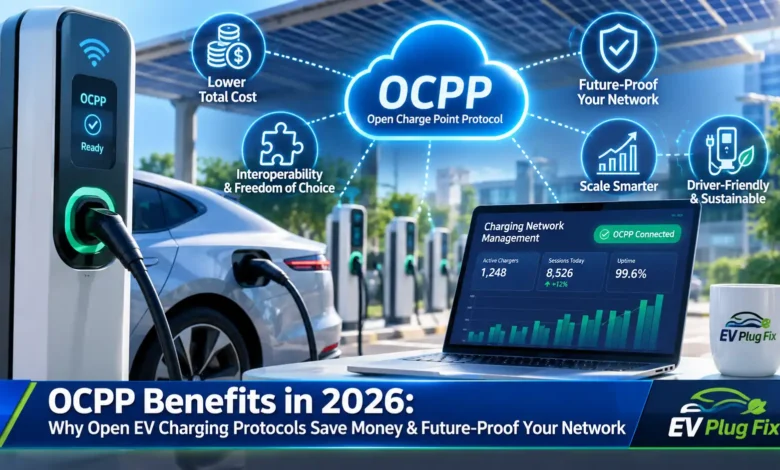
OCPP benefits extend far beyond simple communication between electric vehicle chargers and management software—they represent a fundamental shift in how charging infrastructure is deployed, operated, and scaled in 2026. The Open Charge Point Protocol has evolved from a niche technical standard into the backbone of modern EV ecosystems, delivering unprecedented flexibility, cost savings, and future-proofing capabilities that proprietary solutions simply cannot match.
Imagine investing hundreds of thousands of euros in EV charging stations, only to discover that your software provider has gone bankrupt, your network operator has doubled their fees overnight, or your hardware is locked to a single management system that no longer meets your needs. This nightmare scenario is all too real for operators who choose non-compliant equipment. The Open Charge Alliance, the non-profit consortium behind OCPP, developed this free, royalty-free protocol specifically to solve these challenges by creating a common language that any compliant charger can speak with any compliant back-end.
As the EV market continues its explosive growth—with Germany alone expected to have over 1.7 million EVs on the road by 2028—the importance of OCPP benefits has never been more critical. The protocol decouples hardware from software, giving charge point operators the freedom to choose best-in-class solutions without being held hostage by a single vendor. This fundamental advantage touches every aspect of charging infrastructure management, from installation and maintenance to network migration and advanced smart charging capabilities. Understanding the EV Charger Selection Guide is essential when evaluating OCPP-compliant equipment for your specific needs.
Let’s examine the most compelling OCPP benefits that make this open standard the only rational choice for serious EV infrastructure investments, and explore how both version 1.6 and the more advanced 2.0.1 deliver value across different deployment scenarios.
Freedom from Vendor Lock-in: The Primary OCPP Benefit
The single most transformative OCPP benefit is the elimination of vendor lock-in. In the pre-OCPP era, a network operator that deployed chargers from a specific manufacturer was effectively married to that vendor’s proprietary back-end system. Switching providers meant ripping out perfectly functional hardware and replacing everything—a catastrophic financial blow that could run into millions for large deployments.
PowerFlex, an EDF Renewables company, explains that OCPP software was created specifically because “with people investing significant money into charger software, these chargers would need to be flexible to operate, not tied into a single system that might make them defunct if that company went out of business or changed focus”. This foresight has proven remarkably prescient, as the EV charging industry has seen numerous providers enter and exit the market over the past decade.
The real-world implications of this freedom are substantial. Consider the case of a Spanish hotel in Valencia that invested €18,400 in ten Wallbox Commander 2 chargers in 2023. When they discovered nine months later that switching providers would cost €11,200 in firmware unlocks plus a new commissioning visit, they learned a painful lesson: OCPP-capable on the spec sheet does not mean OCPP-active in the firmware shipped. This distinction between “capable” and “active” represents one of the most critical factors in evaluating OCPP benefits.
The Open Charge Alliance has documented numerous large-scale network migrations that demonstrate OCPP’s value. One notable example is the strategic migration of more than 100,000 EV chargers across Europe following Shell’s divestment from EV charging operations. These chargers were transferred to Last Mile Solutions for 50five—an operation that would have been economically impossible with proprietary systems. OCPP-certified equipment significantly simplified this massive undertaking, proving that the protocol delivers on its promise of genuine interoperability.
- Business Continuity Protection: If your current software provider folds, OCPP-compliant chargers can be migrated to a new provider within days, not months
- Competitive Pricing Leverage: The ability to switch network operators prevents price gouging and ensures you always get competitive rates
- Hardware Investment Protection: Your chargers remain valuable assets regardless of which software providers enter or exit the market
- Technology Choice Freedom: You can select the best hardware for each location without worrying about management system compatibility
As Niklas Hilding, CEO of LaddaTillsammans, puts it: “The worst that can happen if you have a system that follows the OCPP standard is relatively manageable. You can simply switch vendors if something goes wrong and choose from the options available in the market. But if you have a system that doesn’t follow the standard, you could be stuck with higher costs, and in the worst case, you may need to tear up your existing facility and install new systems, which can be a costly lesson”.
OCPP 1.6 vs OCPP 2.0.1: Understanding the Critical Differences for 2026
While OCPP benefits are available in all versions, the differences between OCPP 1.6 and OCPP 2.0.1 are substantial enough to warrant careful consideration. Released in October 2015, OCPP 1.6-J (the JSON-over-WebSocket variant) remains the dominant version in the field, with the Open Charge Alliance reporting in late 2024 that more than 80% of OCPP-connected chargers in Europe still run this version. However, OCPP 2.0.1—released in March 2020—has been steadily gaining ground, driven by its advanced features and long-term strategic advantages. Understanding AC vs DC Charging fundamentals helps contextualize why protocol evolution matters for different charging scenarios.
| Feature | OCPP 1.6-J | OCPP 2.0.1 |
|---|---|---|
| Release Year | 2015 | 2020 |
| Transport Protocol | WebSocket + JSON | WebSocket + JSON |
| Smart Charging | Basic SetChargingProfile | Three variants: Central, Local, External |
| ISO 15118 Plug & Charge | No native support | Native via OCPP-PnC |
| Device Management | Limited | Full firmware, monitoring, variables |
| Security Profile | Profile 0, 1 (basic auth) | Profiles 0 to 3 (TLS 1.3 client cert) |
| Display Messages | No | Yes (push text to charger screen) |
| Transaction Model | Authorize then Start | TransactionEvent (Start, Update, End) |
| V2G Smart Charging | Workarounds only | Native chargingProfileKind extensions |
The headline OCPP benefits in version 2.0.1 include the Transaction-Level Messaging model and an advanced device management framework. These enhancements make large fleets significantly cheaper to operate by reducing the complexity and volume of transmitted data, which is increasingly important for charge point operators managing hundreds or thousands of stations. The device model provides unprecedented visibility into charger status, enabling remote diagnostics and proactive maintenance that dramatically improves uptime.
For residential solar-EV setups in 2026, however, OCPP 1.6-J remains the right call for many applications. It is universally supported, handles solar-following charging profiles adequately through the SetChargingProfile message, and most home energy management systems speak it natively. The protocol runs over WebSocket with TLS encryption when chargers use Security Profile 2 or 3, providing adequate security for most residential and commercial applications.
For commercial operators and large-scale public charging networks, the advanced OCPP benefits of version 2.0.1 are becoming increasingly difficult to ignore. ChargePoint and other major providers are rolling out OCPP 2.0.1 support, enabling features like ISO 15118 Plug & Charge that let drivers simply plug in—no RFID cards, apps, or authorization steps required. The enhanced diagnostics capabilities, secure remote firmware updates, and detailed component monitoring have been shown to reduce maintenance costs and increase network reliability significantly.
Industry experts note that OCPP 1.6 “connects” chargers while OCPP 2.0.1 truly “operates” networks. This distinction captures the essence of what the newer version delivers: not just communication, but intelligent, proactive management that turns charging infrastructure from a passive asset into an actively managed grid resource.
Smart Charging and Energy Management: Unlocking Real OCPP Benefits
The integration of OCPP with solar energy and smart grid management represents one of the most financially significant OCPP benefits for property owners and operators. A study examining a 6 kWp German rooftop solar system powering a Volkswagen ID.3 that charges 40 kWh per session three times weekly found that OCPP-controlled solar-only charging shifted roughly 5,800 kWh per year from grid import at 38 cents/kWh to direct PV self-consumption. Against the German EEG 2023 feed-in tariff of 8.2 cents per kWh, the annual saving was an impressive €1,740—meaning the OCPP integration paid for itself in under six months.
OCPP enables this level of optimization by serving as the communication bridge between renewable energy systems, energy storage, and EV chargers. A home energy management system (HEMS) reads solar production from the inverter, household load from the main meter, battery state of charge, and dynamic tariff data (from providers like Octopus, Tibber, or aWATTar), then computes a target charger limit and pushes it via OCPP SetChargingProfile. The cycle repeats every 10 to 30 seconds, continuously optimizing energy usage based on real-time conditions. Proper EV Charging Load Balancing is crucial when managing multiple chargers in residential or commercial settings.
- Solar Prioritization: OCPP enables chargers to automatically adjust charging power based on available solar surplus, maximizing self-consumption of renewable energy
- Dynamic Load Management: The protocol supports real-time power allocation across multiple chargers, preventing grid overloads and avoiding costly infrastructure upgrades
- Time-of-Use Optimization: Smart charging profiles can shift charging to off-peak hours when electricity is cheaper, reducing operating costs
- Vehicle-to-Grid Readiness: OCPP 2.0.1 and the forthcoming 2.1 support bidirectional power flow, enabling EVs to serve as distributed energy storage assets
Recent research published in IEEE Access demonstrated that AI-driven OCPP frameworks can reduce peak demand by up to 30% and energy costs by approximately 25% without violating grid safety constraints. The study, which evaluated real-world OCPP logs across multiple tariff regimes including flat rate, time-of-use, and real-time pricing, showed that combining established learning methods with rigorous runtime safety enforcement delivers substantial operational benefits while maintaining grid stability.
Large-scale workplace charging deployments benefit even more from OCPP’s smart charging capabilities. A 20-charger workplace with a 200 kWp rooftop solar system can run Local smart charging algorithms that share available solar surplus across active sessions in proportion to vehicle state of charge and required departure time. Without OCPP, this level of sophisticated energy management would require per-charger physical wiring loops into inverter dataloggers—a prohibitively expensive approach. With OCPP, it is simply software configuration. The Smart EV Charger Comparison highlights how OCPP-enabled devices outperform standard alternatives in energy optimization.
Network Migration and Future-Proofing: Long-Term OCPP Benefits
The true measure of OCPP benefits reveals itself during network migration scenarios. The Open Charge Alliance has documented several high-profile migrations that demonstrate the protocol’s value in protecting infrastructure investments. Eneco eMobility successfully migrated approximately 3,500 of its 25,000+ public and semi-public charge points to the GreenFlux Charge Point Management System. Kople, one of Norway’s leading EV charging operators, migrated its entire charging network and driver base to the Driivz platform. These operations, often involving tens of thousands of chargers, would have been economically unviable without OCPP’s interoperability.
As the EV charging industry continues to consolidate and evolve, future-proofing has become an increasingly important consideration. Providers like Switch are now offering platforms that support both OCPP 1.6 and OCPP 2.0.1, ensuring backward compatibility while enabling advanced features like ISO 15118 based Plug & Charge. Switch has achieved the distinction of being the first vendor worldwide to offer an OCPP 2.0.1 (OCA) and Plug & Charge (Hubject) certified system, demonstrating the industry’s commitment to open standards.
The release of OCPP 2.1 in 2025 further reinforces the future-proofing OCPP benefits. This latest version introduces:
- ISO 15118 Support: Enables bidirectional power transfer (V2X) where EVs can return energy to grid, buildings, or homes
- DER Control: Enhanced integration with distributed energy resources including solar and wind for dynamic load management
- Advanced Smart Charging: Improved energy distribution tools for optimizing power allocation across multiple stations in real time
- Battery Swapping Support: Compatibility for battery swap stations, particularly important for two- and three-wheelers
- Local Cost Calculation: Charging stations can determine session costs independently of cloud systems, enabling seamless offline operation
- New Payment Options: Support for prepaid charge cards, ad hoc payment, and secure dynamic QR codes for fraud reduction
The Open Charge Alliance’s commitment to backward compatibility in OCPP 2.1 ensures that investments in OCPP-compliant chargers remain protected as the standard evolves. This stands in stark contrast to proprietary systems, which often leave operators stranded when vendors change direction or exit the market.
Cost Savings and Competitive Advantages: The Business Case for OCPP
Beyond technical capabilities, OCPP benefits translate directly into hard financial savings and competitive advantages for charge point operators. The elimination of vendor lock-in creates genuine market competition, which drives down costs and improves service quality. As PowerFlex notes, when a non-OCPP-compliant charging station is installed, “the incentive to operate well while keeping fees minimal for the network is low”. Operators have already made the investment and face prohibitively high barriers to switching, reducing competitive pressure on network providers.
OCPP-compliant stations, by contrast, are network-flexible. You can stick with the network associated with the branding of the charging station, or easily switch to any other OCPP-compliant network if you want better service, better fees, or a better interface for your customers. This freedom creates a virtuous cycle: providers of OCPP-compliant hardware and software must compete on quality and price, ultimately benefiting the operator and, by extension, the EV driver. For those seeking to maximize their charging investment, understanding EV Charging Time considerations helps optimize usage patterns and ROI.
The financial impact of this competition can be substantial. A Spanish hotel’s experience—paying €18,400 for chargers that cost an additional €11,200 to unlock for network switching—highlights the hidden costs of non-OCPP-active equipment. These “firmware unlock” fees represent pure profit for vendors that have deliberately hobbled their hardware, and they are entirely avoidable by insisting on OCPP-active chargers from the outset.
- OCPP eliminates vendor lock-in, enabling genuine market competition that drives down costs and improves service quality
- Network migration under OCPP can save millions in avoided hardware replacement costs
- Smart charging capabilities reduce energy costs by 25% in real-world deployments
- OCPP 2.0.1’s advanced diagnostics reduce maintenance costs and increase uptime
- Future upgrades and new features are accessible without hardware changes
Moreover, OCPP benefits extend to the broader charging ecosystem through enhanced roaming capabilities. When paired with OCPI (Open Charge Point Interface), OCPP-enabled networks can participate in cross-network roaming, allowing EV drivers to use a single app across multiple providers. This increases utilization rates, generates additional revenue, and creates a seamless user experience that encourages EV adoption.
The Future of OCPP Benefits: What’s Next for 2026 and Beyond
Looking ahead, the trajectory of OCPP benefits suggests the protocol will become even more central to the EV charging ecosystem. ChargeLab’s recent launch of OpenOCPP—a free, open-source embedded software stack supporting OCPP 1.6J and 2.0.1—has dramatically lowered the barrier to OCPP adoption for charger manufacturers. Previously, developing and certifying OCPP firmware took 18 to 24 months and significant investment; OpenOCPP shrinks this timeline to just a few weeks. This democratization of OCPP compliance will accelerate the availability of OCPP-compliant chargers and further expand the benefits for operators.
The release of OCPP 2.1 introduces capabilities that will transform charging infrastructure into active, bidirectional energy assets. Vehicle-to-grid (V2G), vehicle-to-home (V2H), and vehicle-to-building (V2B) charging will enable EV owners to monetize their vehicle batteries, while charge point operators can offer dynamic grid services and turn charging stations into active energy hubs. This evolution represents a fundamental shift from viewing EVs as simple loads to recognizing them as valuable distributed energy resources.
National governments are increasingly recognizing the importance of OCPP benefits in achieving their EV adoption and grid modernization goals. The U.S. National Electric Vehicle Infrastructure Program specifically requires OCPP compliance for funded projects, recognizing that open standards are essential for creating a flexible, scalable, and non-siloed infrastructure. Similarly, India’s Ministry of Power guidelines require public chargers to support OCPP (1.6J or 2.0.1) for charger-backend communication, and state policies increasingly specify that new public DC chargers must be “OCPP 1.6/2.0.1 ready”.
Frequently Asked Questions
Is OCPP mandatory for EV chargers?
What is the difference between OCPP 1.6 and OCPP 2.0.1?
How does OCPP save money for charging operators?
Can OCPP chargers work with solar energy systems?
What is OCPP 2.1 and why does it matter?
How do I know if my chargers are truly OCPP-compliant?
OCPP benefits have evolved from a technical convenience into a strategic necessity for any serious EV infrastructure investment. The protocol delivers freedom from vendor lock-in, substantial cost savings, smart charging capabilities, and genuine future-proofing that proprietary solutions cannot match. Whether you’re deploying residential chargers, workplace facilities, or large-scale public networks, choosing OCPP-compliant, OCPP-active equipment is the only rational path forward in 2026 and beyond.
As the Open Charge Alliance continues to evolve the standard—with OCPP 2.1 now available and future versions on the horizon—the ecosystem of OCPP-compliant hardware, software, and services will only grow. The democratization of OCPP compliance through initiatives like OpenOCPP means even smaller manufacturers can now participate in the open ecosystem. For charge point operators, site owners, and EV drivers alike, the future of charging is open, interoperable, and powered by the Open Charge Point Protocol. Staying informed about EV Charging Protocols ensures you make the most of these evolving standards and capabilities.