Tesla Supercharger Access for Non-Tesla EVs: Full Compatible List 2026
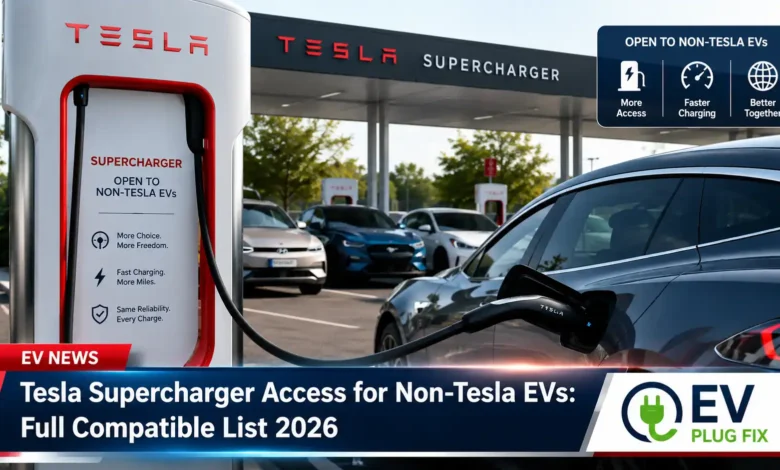
The electric vehicle charging landscape underwent a seismic shift in 2026 as Tesla’s once-exclusive Supercharger network opened its doors to a rapidly expanding roster of non-Tesla electric cars. This landmark transformation is redefining EV road trips, eliminating range anxiety, and consolidating what many industry experts now call the gold standard of fast charging into a shared resource for the mass market. No longer confined to Tesla owners, the vast network of V3 and V4 Superchargers is becoming the backbone of North American EV infrastructure, marking a decisive move toward universal charging compatibility.
For years, Tesla’s Supercharger network was the “walled garden” of the automotive world—a high-speed, ultra-reliable sanctuary reserved exclusively for Tesla drivers. But with the industry-wide adoption of the North American Charging Standard (NACS), now formalized as SAE J3400, these walls have effectively come down. By early 2026, nearly every major automaker—including Ford, General Motors, Rivian, Hyundai, BMW, and the Stellantis group—has either equipped their new models with native NACS ports or provided official adapters for existing CCS1 vehicles. This integration means the “gold standard” of rapid energy delivery is now a shared resource for a vast majority of EVs on the road. For a broader perspective on how this shift fits into the global picture, check out the latest trends in Global EV Market Share.
However, while the network is open, the process of charging a non-Tesla EV at a Supercharger introduces new nuances. Drivers must navigate differences in hardware, software, and even station layouts. This guide provides a complete, up-to-the-minute analysis of which electric cars can use Tesla Superchargers in 2026, the hardware required, and the practical realities of charging outside Tesla’s ecosystem.
The Tesla Supercharger Network Transformation: From Exclusive to Universal
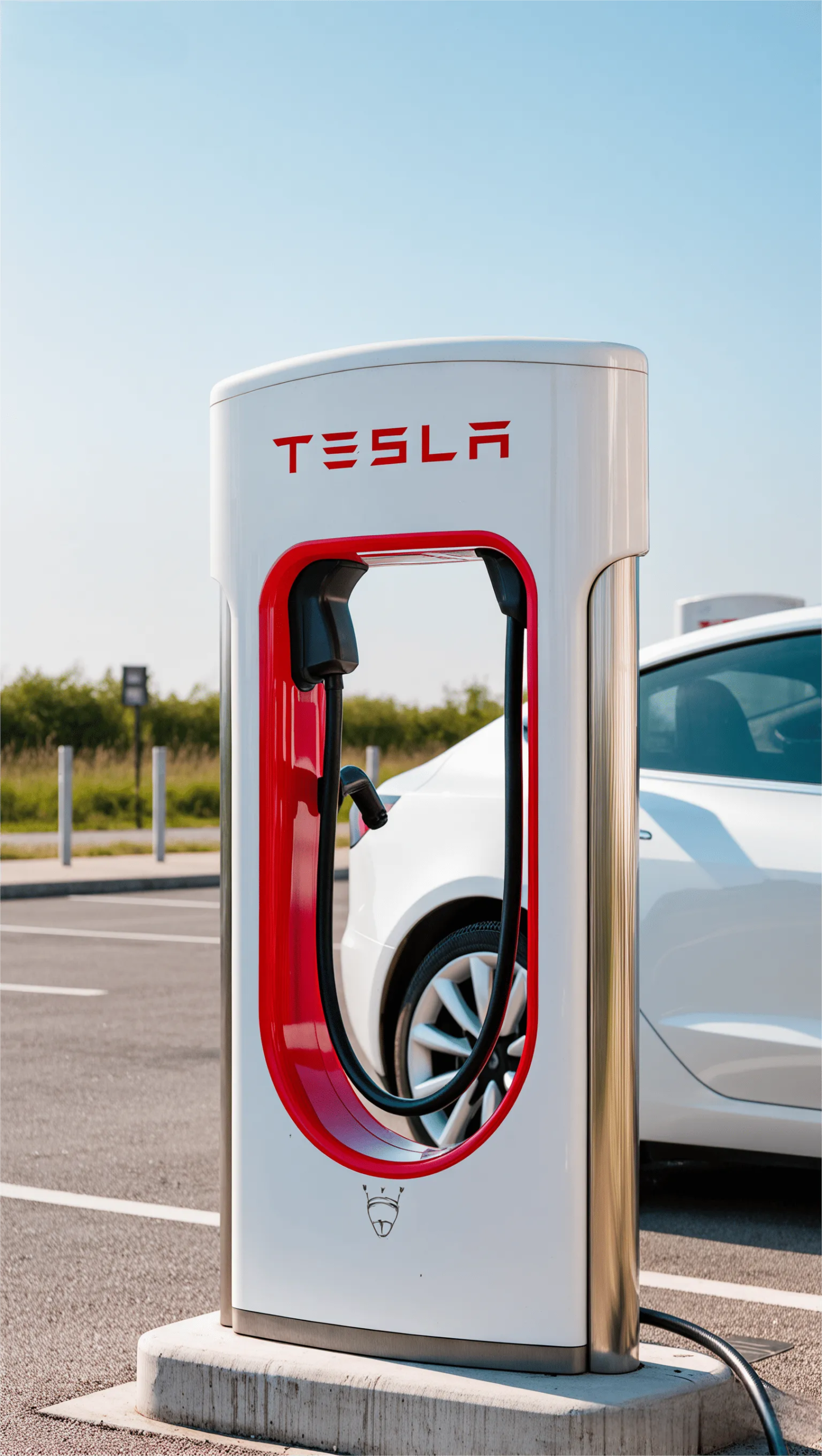
Tesla’s Superchargers were originally designed as a proprietary fast-charging system exclusively for Tesla vehicles, utilizing the unique NACS plug and communication protocol. This design allowed Tesla to offer charging speeds and a user experience that were consistently faster and more reliable than other public options. Meanwhile, electric vehicles from other brands typically relied on the Combined Charging System (CCS) or, less commonly, the CHAdeMO standard, creating two separate charging ecosystems. Understanding these underlying EV Charging Protocols is key to appreciating why the NACS transition is such a game-changer.
This fragmentation began to dissolve when Tesla initiated its “Magic Dock” pilot program, integrating built-in adapters at select stations to allow CCS-equipped vehicles to charge without their own hardware. The real catalyst, however, was the auto industry’s collective pivot to NACS. The transition is not just about plugs; it’s about leveraging Tesla’s superior infrastructure—including reliability, uptime, and streamlined payment—to boost EV adoption across the board.
By 2026, this transformation is complete. Tesla’s Supercharger network now accounts for more than 27,500 charging locations across North America. This is not merely an expansion of access; it is a fundamental shift in how EV infrastructure is built and utilized, paving the way for a future where charging is as seamless as fueling a gas car.
Full List of Non-Tesla EVs Compatible with Tesla Superchargers in 2026
As of 2026, the list of non-Tesla electric vehicles that can access Tesla Superchargers has grown to include 15 major automotive groups, representing nearly every new EV on the market. Below is a comprehensive breakdown of compatible brands, specific model availability, and hardware requirements.
- Over 15 major automakers have signed agreements for Supercharger access.
- New 2025 models often feature native NACS ports; older models require an adapter.
- Access is limited to V3 and V4 Superchargers; V2 stations are generally incompatible with non-Tesla EVs.
Ford
Ford was one of the first legacy automakers to embrace NACS. Models like the Mustang Mach-E and F Lightning can use Tesla Superchargers with an official Ford-approved NACS-to-CCS1 adapter. Owners can also use the FordPass app to manage the session, although the Tesla app remains the primary initiation method.
General Motors (GM)
GM’s electric portfolio, including the Chevrolet Silverado EV, Blazer EV, and Equinox EV, alongside the GMC Hummer EV and Cadillac Lyriq, have been granted access. GM has confirmed that its Ultium-based vehicles will be compatible, with adapter availability for existing owners.
Hyundai and Kia
The Hyundai Motor Group is at the forefront of native NACS adoption. The Hyundai Ioniq 5, Ioniq 6, and Kia EV6 are among the first vehicles to ship with NACS ports, eliminating the need for an adapter. However, some earlier model years or specific trims (like the performance-oriented Ioniq 5 N) may retain the CCS port, requiring an adapter.
BMW Group
BMW owners can now access the network via a software update and an official adapter. Compatible models include the BMW i4 (2022), BMW i5 (2024, with 2026 models requiring a Spring 2026 OTA update), BMW i7 (2023), and the BMW iX (2022, with 2026 requiring an OTA update). For specific details on BMW models, check out the BMW i3 Charging Time guide.
Stellantis (Dodge, Jeep, Ram, FIAT, Maserati)
In a significant move, Stellantis has unlocked access for its North American BEV customers, giving them access to over 27,500 Tesla Supercharger locations. Compatible vehicles using a Free2move Charge NACS-CCS1 DC adapter include:
- Dodge Charger Daytona (2024) – The 2027 model will feature a native NACS port.
- Jeep Wagoneer S (2024) and Jeep Recon (2026).
- Ram ProMaster EV (2024).
- FIAT 500e (2024).
- Maserati GranTurismo Folgore, GranCabrio Folgore (2024), and Grecale Folgore (2025).
Additional Compatible Brands
The list of automakers with Supercharger access includes Audi, Genesis, Honda, Jaguar Land Rover, Lucid Motors, Mercedes-Benz, Nissan (Ariya, not all Leaf models), Polestar, Subaru, Toyota, Volkswagen, and Volvo.
Hardware Requirements: Adapters vs. Native NACS
The primary technical hurdle for non-Tesla EVs is the connector. Tesla uses the NACS plug, while most existing EVs (pre models) use the CCS1 connector. There are three ways to bridge this gap:
1. Manufacturer-Approved Adapters
Most automakers, including Ford, GM, BMW, and Stellantis, are offering official NACS-to-CCS1 DC adapters. For example, Stellantis provides the Free2move Charge adapter for $185, while the Lectron Vortex Plus is a popular aftermarket alternative rated for 500 amps and 1,000V. It is crucial to use automaker-approved adapters to ensure safety and prevent voiding warranties.
2. Native NACS Ports
Newer models, such as the 2025 Hyundai Ioniq 5 and the 2027 Dodge Charger Daytona, are equipped with native NACS inlets. These vehicles can plug directly into any Supercharger cable without an adapter.
3. Tesla Magic Dock
Some Supercharger locations are equipped with a “Magic Dock,” a built-in adapter integrated into the charging pedestal. This allows any CCS-equipped vehicle to charge without bringing their own equipment.
How to Charge a Non-Tesla at a Supercharger: Step-by-Step
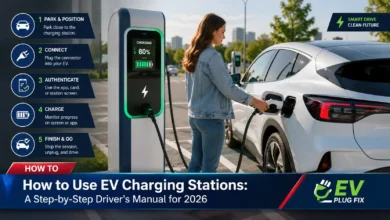
The process for charging a non-Tesla vehicle differs from the plug-and-play experience Tesla owners enjoy. Here is the step-by-step workflow for 2026:
- Download the Tesla App: Non-Tesla users must create an account and set up a payment method in the official Tesla app. This is mandatory as Superchargers lack screens or card readers for non-Tesla transactions. For alternative access management, explore RFID EV Charger Access Control options.
- Find a Compatible Station: Use the app’s “Charge Your Non-Tesla” feature to locate available V3 or V4 Superchargers. Older V2 stations do not support non-Tesla vehicles.
- Connect the Hardware: If your car has a CCS port, attach your NACS-to-CCS1 adapter securely to the charging cable before plugging it into your vehicle.
- Initiate the Session: In the Tesla app, select your stall number and tap “Start Charging.” The car and the charger will authenticate.
- Monitor Your Session: The Tesla app and your vehicle’s dashboard will display charging progress, speed, and estimated completion time. Understanding your vehicle’s charging capabilities can help set expectations; learn more about AC vs DC Charging and how it affects session speeds.
Practical Challenges and Solutions: Cable Length, Parking, and Charging Speeds
While the network is open, it was designed for Teslas. Non-Tesla drivers face a few practical challenges:
Cable Length and Port Location
Tesla’s V3 Superchargers have relatively short cables, designed to reach the rear-left charge port on Tesla models. EVs with ports in different locations (front-right or center-front) may need to park awkwardly or take up two stalls to reach the cable.
However, Tesla is actively deploying V4 Superchargers with significantly longer cables, resolving this issue. The V4 stalls also feature a more user-friendly layout designed to accommodate all EV port locations.
Charging Speed and Curves
Although Tesla Superchargers can output up to 250 kW (V3) and 500 kW (V4), the actual charging speed is limited by the vehicle’s battery management system. Drivers may experience slower-than-expected speeds if their vehicle’s architecture caps input at 150 kW or 100 kW, particularly if the battery is cold or not pre-conditioned. For more insight into optimizing your charging sessions, read about EV Charging Losses and how to minimize them.
The Future of EV Charging: NACS Standardization and Expansion
The opening of the Supercharger network is part of a broader industry trend toward standardization. EVgo, a leading public charging network, announced it will install more than 500 NACS connectors by the end of 2026, serving both Tesla drivers and newer NACS-equipped EV models. The company expects that more than 80% of new EVs sold in North America will be NACS-compatible by 2030.
This standardization promises a future where EV drivers can charge at any station, regardless of brand, using a single plug. The transition reduces manufacturing costs for automakers and simplifies the charging experience for consumers.