EV Charger Safety 2026: Essential Home Protection & Fire Prevention Guide
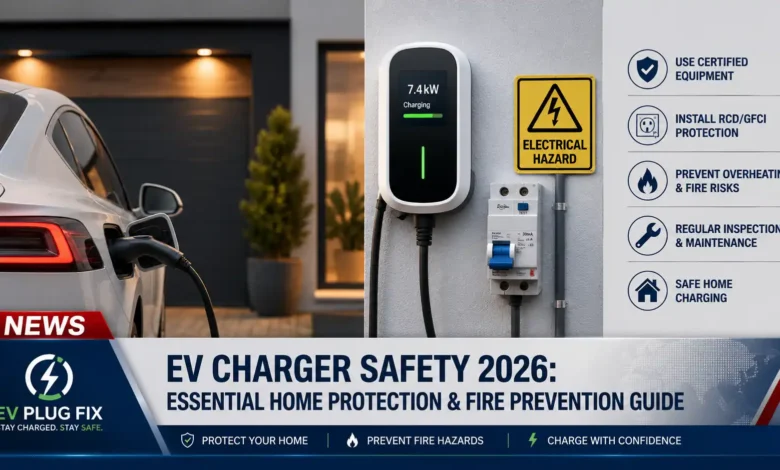
Electric vehicle charger safety represents one of the most critical yet overlooked aspects of modern home ownership in 2026, as millions of new EV adopters install high-voltage charging equipment without fully understanding the potential risks lurking in their garages. The transition from traditional internal combustion vehicles to electric mobility has brought convenience and environmental benefits, but it has also introduced complex electrical systems that demand respect and proper management. Modern smart chargers are no longer simple accessories; they are sophisticated power conversion units that bridge high-voltage mains electricity with sensitive chemical batteries, and a single failure point in this ecosystem—whether a counterfeit component, a frayed cable, or an accessible outlet—can lead to catastrophic outcomes including electrical shock, thermal runaway fires, or severe injury to children.
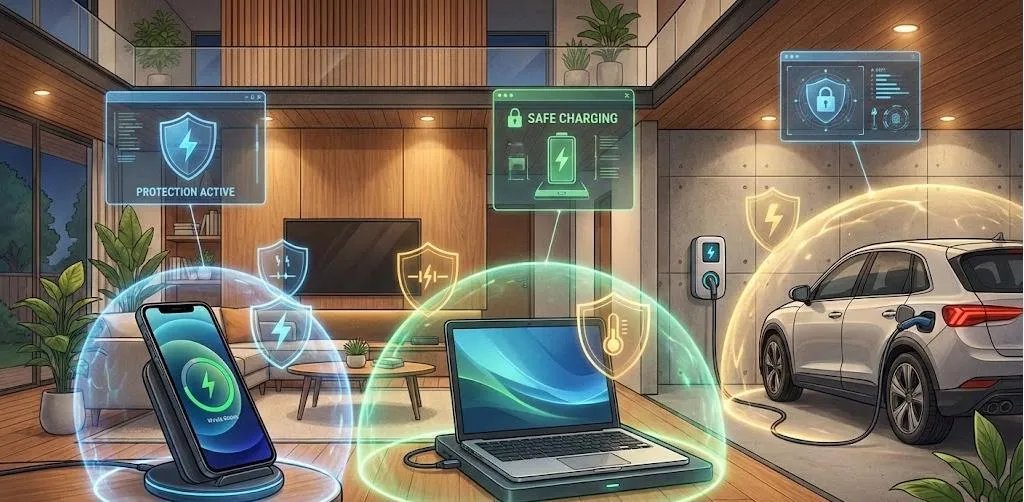
Safety begins long before you plug in your electric vehicle for the first time. The global market is flooded with substandard charging equipment that bypasses critical safety regulations to cut costs, making strategic acquisition and quality assurance your first line of defense. Understanding the anatomy of a safe charger is essential, as high-quality chargers use isolation transformers to physically separate high-voltage grid power from the low-voltage output that touches your device and your hands. Counterfeit or ultra-cheap chargers often compromise this isolation, and if this internal barrier fails in a non-compliant charger, the full mains voltage of 120V or 240V can pass directly through the charging cable into your vehicle and potentially into your body when you handle the connector. When purchasing charging equipment, you are not paying for the plastic shell; you are paying for engineering safeguards that protect lives and property.
Essential Safety Certifications for EV Chargers
Never purchase an EV charger based on price alone, as legitimate equipment must bear the mark of a Nationally Recognized Testing Laboratory (NRTL). These laboratories subject devices to destructive testing to ensure they fail safely rather than catching fire, and understanding the different certification marks can save you from dangerous counterfeits. The UL mark from Underwriters Laboratories in a circle remains the gold standard for North American safety, with standards such as UL 62368 governing audio/video and information technology equipment to ensure the device handles thermal stress and voltage spikes correctly. The ETL Listed mark from Intertek is legally equivalent to UL and indicates the device has been tested to the same stringent safety standards, making it a reliable alternative for consumers. For a comprehensive breakdown of connector types and their respective safety considerations, check out our detailed EV Charging Connectors guide.
| Certification Mark | Meaning | Key Safety Standards |
|---|---|---|
| UL Listed | Tested by Underwriters Laboratories to North American safety standards | UL 62368, UL 2251 |
| ETL Listed | Tested by Intertek to equivalent safety standards | Same as UL standards |
| CE Mark | Self-declared conformity for European market | IEC/EN 61851, IEC/EN 62196 |
| E.V. READY | French certification for EV charging equipment | French national requirements |
While the CE mark is common in Europe, it represents a self-declaration by manufacturers and is less strictly policed for third-party verification than UL or ETL certifications. For high-wattage chargers, prioritizing UL or ETL listings provides greater assurance of safety, as these marks indicate independent testing rather than manufacturer claims. Modern EV chargers like the Enphase IQ EV Charger 2 carry multiple certifications including TÜV Rheinland approval, CE marking, and compliance with IEC/EN 61851, IEC/EN 61851, IEC/EN 62196, and IEC/EN 62955 standards, demonstrating the comprehensive testing required for truly safe equipment.
Identifying Counterfeit EV Charging Equipment
Counterfeiters are adept at mimicking external branding, but they cannot replicate the density of high-quality components or the sophisticated safety features found in genuine charging equipment. When evaluating a new EV charger, verify its weight; a quality charger will feel dense and solid due to the internal transformer and electromagnetic shielding, while fakes often feel hollow or unusually light. Inspect the build quality of the charging connector and cable, as genuine chargers have centered, stable ports with smooth contacts, while low-quality units often have misaligned connectors or rough plastic seams that snag and damage the vehicle’s charging port.
- Weight Test: Quality chargers feel dense and substantial due to internal components and proper heat dissipation materials.
- Connector Quality: Genuine charging plugs have smooth, centered pins with consistent spacing and stable housing.
- Cable Flexibility: Quality cables have proper insulation thickness and appropriate flexibility for the wire gauge.
- Label Verification: Legitimate certification marks include holographic elements or specific font characteristics that counterfeiters cannot replicate accurately.
- Packaging Quality: Genuine products come in professional packaging with clear documentation and warranty information.
Using damaged cables or uncertified EV chargers can expose you and those around you to the dangers of electrical shock or fire, as certified EV chargers come with safeguards to monitor temperature, detect faults, and even cut power when something goes wrong. Paying for a certified option may cost more upfront, but it is far cheaper than dealing with damage to your vehicle or putting your own life at risk. Before plugging any charger into your vehicle, look for cracks, exposed wires, and other signs that indicate the equipment should be replaced immediately.
Professional Installation and Circuit Requirements
Once you have acquired certified charging equipment, the installation environment becomes the primary safety variable, as proper electrical infrastructure is essential for safe operation. Modern fast chargers and EV stations draw significant current, and plugging high-draw devices into an already overloaded power strip creates a fire hazard that can easily go unnoticed until it is too late. Level 2 EV chargers typically require a dedicated 240V circuit installed by a licensed electrician, as using standard household extension cords for EV charging is strictly prohibited by most manufacturers and safety codes because standard cords are not rated for the continuous high-amperage draw of a vehicle. Understanding EV Charger Permit Requirements is a crucial step in this process to ensure your installation meets all local codes and passes mandatory inspections.
- Dedicated Circuit: EV chargers must have their own circuit breaker and wiring, never shared with other high-draw appliances.
- Professional Electrician: Always hire a licensed electrician for Level 2 charger installation to ensure code compliance and safety.
- Permit Requirements: Most jurisdictions require permits for EV charger installation, which ensures proper inspection and documentation.
- Wire Gauge: Use appropriate wire gauge (typically 6 AWG copper for 50-amp circuits) to prevent overheating and voltage drop.
- Torque Specifications: Electrical connections must be torqued to manufacturer specifications using calibrated tools to prevent loose connections.
The NEMA 14 outlet has become the standard for home EV charging, but this outlet was originally designed for electric ranges, dryers, and RV hookups that use power in short bursts rather than the continuous loads of EV charging. EV charging is defined as a continuous load, requiring the 80% rule where you can only safely use 80% of a circuit’s rated capacity, meaning a 50-amp circuit provides 40 amps maximum for EV charging. This distinction matters because of how heat builds up in electrical connections, and the National Electrical Code accounts for this with safety requirements that protect homes from fire hazards. To ensure your system intelligently manages this continuous load without overburdening your home’s electrical panel, consider solutions like Dynamic EV Load Balancing, which automatically adjusts charging power based on real-time household consumption.
Childproofing EV Charging Stations for Home Safety
Households with young children require a defensive strategy for electrical safety, as chargers are uniquely dangerous to toddlers who often explore at eye level and may be attracted to dangling cables that resemble toys. The most critical vulnerability is the wall outlet itself, where small children may attempt to insert metal objects into the slots or pull partially exposed plugs, creating a shock hazard. Modern tamper-resistant receptacles feature internal shutters that block the slots unless two prongs are inserted simultaneously with equal pressure, effectively locking out keys, paper clips, and hairpins that curious children might try to insert.
For outlets where chargers must remain permanently plugged in, standard plastic plugs are insufficient as children can remove them easily. Instead, use box-style outlet covers that snap over the entire outlet faceplate and the charger brick, routing the cord out through a small bottom channel that prevents children from unplugging the charger or touching exposed metal prongs. Advanced childproofing solutions like cable raceways provide the gold standard for concealment, encapsulating wires completely to make it impossible for children to chew on or pull cords while maintaining an organized appearance.
Long charging cables pose strangulation risks to infants and tripping hazards for active toddlers, and a cable left dangling from a table can be pulled, bringing heavy electronics crashing down onto a child. Furniture blocking provides an effective passive safety measure by locating charging stations behind heavy furniture that physically blocks access to the plug point while allowing cables to be routed up to a safer height out of reach. Innovative charging gun designs now include detection components that prevent power output unless the charging interface is completely connected, ensuring that equipment cannot be played with by non-user personnel, especially children in unattended scenarios. For those seeking ultimate portability and flexible placement to optimize child safety, a Mobile Wallbox Charging Guide can offer valuable insights into safe, adaptable charging solutions.
Daily Operational Protocols for EV Charging
Safety is not just about equipment; it is about developing consistent behavioral routines that reduce mechanical wear and electrical stress on your charging system. To minimize electrical arcing—the small spark sometimes visible when plugging in—follow a specific order of operations by connecting the charger to the wall outlet first to allow internal capacitors to stabilize, then connecting the low-voltage connector to your vehicle. If a spark were to occur due to a fault, this sequence ensures it happens at the wall outlet, which is designed to contain it, rather than at the delicate charging port of your vehicle where it could damage pins or ignite battery vapors.
The point where the cable meets the connector, known as the strain relief neck, is the most common failure point in EV charging equipment. Constant bending breaks the internal copper strands while leaving the outer plastic intact, and these broken strands create high electrical resistance that generates intense heat capable of melting insulation. Always disconnect a charger by gripping the hard plastic plug head, never by yanking the cord, and when storing cables, loop them loosely in a circle rather than folding them sharply, which creates kinks and internal wire fatigue that can lead to premature failure.
Smart charging features in modern EV chargers can significantly enhance safety and efficiency, as smart chargers communicate with devices in your home and the grid to charge according to your preferences while providing dynamic load balancing that adjusts power draw based on household consumption. Setting a daily charge limit to around 80% helps preserve battery health while providing ample range for daily driving, reserving 100% charges for road trips or when maximum range is needed. The 20% to 80% rule is widely recommended for daily use, as keeping the State of Charge within that moderate range reduces long-term degradation while still providing sufficient driving distance. To understand how different charging speeds impact your daily routine and safety considerations, you can explore our detailed EV Charger Comparison Guide covering 7kW, 11kW, and 22kW options.
Emergency Recognition and Thermal Runaway Response
Despite taking all precautions, hardware can fail, and recognizing the early warning signs of failure can prevent a minor malfunction from becoming a major emergency. Perform a visual inspection of your charging gear once a month, looking for discoloration on the plastic housing of the charger or the wall outlet that indicates internal overheating. Inspect cables for fraying, especially if the white internal insulation is visible, and listen for buzzing or crackling sounds that indicate electrical arcing requiring immediate disposal of the unit.
Thermal runaway represents one of the most dangerous scenarios in EV charging, where a lithium-ion battery enters a chain reaction of internal heating that sustains continuous combustion at extremely high temperatures. If a device being charged begins to hiss, bulge, or emit a sweet chemical odor, it is likely entering thermal runaway and requires immediate action. Do not touch the device as it may be extremely hot, and do not attempt to unplug it by hand if the port is smoking. Instead, immediately go to your home’s circuit breaker panel and cut the power to that specific room or zone, and only once the power is cut and the device has cooled should you move it, preferably with tongs or fire-resistant gloves, to a non-flammable surface outdoors away from the home.
Fire officials recommend using only manufacturer-approved chargers, avoiding unsupervised overnight charging, and never using damaged cables or overloaded extension boards. Vehicles should be charged in well-ventilated areas away from combustible material, and battery packs that show signs of swelling, overheating, or physical damage should be replaced immediately. The risk of electrical fires in EV charging scenarios has been documented in cases where domestic electrical systems lacked safeguards such as surge protection and thermal cut-offs needed for prolonged high-current charging, especially in densely populated areas where multiple vehicles may be charged from single power points.
Essential Questions & Expert Answers
Is it safe to charge an electric vehicle at home?
What are the most important safety certifications to look for in an EV charger?
What should I do if I notice my EV charger or outlet is warm to the touch?
How often should I charge my EV to 100%?
Can I use an extension cord for EV charging in an emergency?
Conclusion: Building a Safe EV Charging Culture
Charger safety is a discipline of details, requiring continuous attention to equipment quality, installation standards, and daily operational habits. By rigorously vetting the equipment you buy, strictly managing the physical environment where charging occurs, and maintaining vigilance against wear and tear, you can virtually eliminate the risks associated with these essential devices. Treat every charger not as a simple plug, but as an active electrical component that demands respect and proper management, and take the time to educate all household members about safe charging practices.
The transition to electric mobility represents a positive step toward sustainability and energy independence, but it requires responsible adoption of the safety protocols that protect our homes and families. As EV adoption continues to accelerate and charging infrastructure expands, maintaining high safety standards becomes increasingly important for protecting property and preventing the tragedies that can arise from electrical failures. By following the guidelines outlined in this article, EV owners can enjoy the benefits of electric mobility with confidence, knowing they have taken the necessary steps to create a safe charging environment.
Remember that safety is not a one-time investment but an ongoing commitment to inspection, maintenance, and best practices. Stay informed about new safety developments, participate in recall notifications, and never hesitate to consult with qualified professionals when you have questions about your EV charging setup. Your diligence in these matters protects not only your investment in electric vehicle technology but also the safety of everyone who shares your home and community.