EV Charging Curve Explained: Why 150kW Doesn’t Mean the Same Speed in 2026
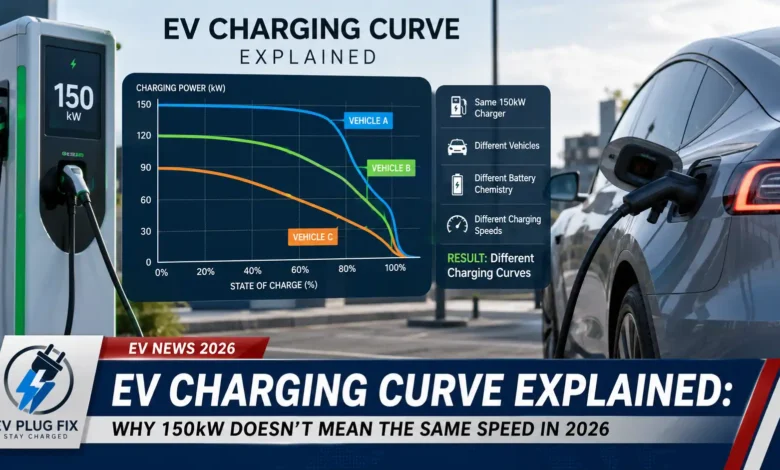
The 2023 Audi E-Tron and 2024 Subaru Solterra each offer a peak DC fast charging rate of 150 kilowatts. The Subaru’s battery is about three-quarters the size of the Audi’s. Logic suggests the smaller battery should charge faster at the same power. But independent testing reveals the opposite: the E-Tron reaches 80% in 30 minutes while the Solterra needs 38 minutes. This discrepancy highlights why understanding the EV charging curve matters more than chasing peak kilowatt numbers.
Before diving into the technical details, it helps to grasp the fundamentals of electric vehicle charging. EV powertrains may appear simpler than internal combustion engines, but the engineering behind them is remarkably sophisticated. Battery cell chemistry, EV Charging Protocols, thermal management systems, and ambient conditions all influence how long you’ll spend plugged in at a station.
Manufacturer specifications often paint an incomplete picture. In the real world, your EV Charging Time may differ significantly from advertised numbers. Worse yet, some specifications can be misleading, setting unrealistic expectations for new EV owners. Understanding these nuances separates informed buyers from disappointed ones.
This investigation aims to clarify why you shouldn’t expect a manufacturer’s peak charging rate to always be reproducible. Like the curve in which an EV charges, there is a learning curve to understanding how this process functions and what affects it.
How Does DC Fast Charging Work?
Imagine arriving at an empty movie theater early. Finding a seat is effortless at first. As people pile in, rows begin filling up. Latecomers struggle to find spots, climbing over others. Eventually, the room is packed and no one else can enter.
This analogy effectively visualizes what happens when charging a battery. Replace people with electrons—negatively charged particles seeking space—and the concept becomes clear. However, like anything involving chemistry and circuits, reality is more complex.
When charging an EV battery, the charger supplies current that drives electrons from the positive side (cathode) to the negative side (anode) of each cell. Since electrons are negatively charged, they naturally “want” to flow to the positive side. During discharge, this process reverses: electrons flow from negative to positive, generating power to move the vehicle.
A battery inherently wants to discharge. When charging to a high state of charge, you’re forcing electrons into a space they don’t naturally occupy. Consequently, the charge rate slows as the battery fills. This explains why your car charges rapidly at low percentages but slows considerably when topping off. But this is merely one of many factors influencing charge rates.
Thermal Management and Charging
While battery chemistry plays a significant role in charge rates, heat transfer exerts equal influence. Every wire has resistance, and electric current flow generates heat. More current means more heat. During DC fast charging, battery cells heat up considerably. Some warmth actually benefits DC charging, but excessive heat accelerates battery degradation.
If battery temperatures become too high, the vehicle must request reduced current from the charger to protect cells. High ambient temperatures force the cooling system to work harder, potentially reducing charge rates. Conversely, cold temperatures also slow charging because colder electrolyte becomes more viscous, impeding particle flow. Temperature extremes on either end inhibit charging performance.
This explains why many EVs feature battery preconditioning features. When navigating to a charger, warming the battery helps it accept maximum current. Not every EV offers this convenience, but regardless, expect reduced charge rates in extreme cold or heat. If you’re charging in desert conditions, the cooling system works overtime and you’ll likely see reduced rates to protect the battery.
Why Is My EV Charging Slowly?
The charger itself often contributes to slow charging experiences. Unless you drive a Tesla or Rivian, the charger was probably manufactured by companies like SK Signet, ABB, or BTC Power, which supply hardware to various charging networks. ChargePoint is one of the few networks building its own chargers in-house. Each option presents attributes that affect your charging time.
The most obvious limitation is using an underpowered charger. If your car accepts 250 kilowatts but the charger outputs only 62.5 kilowatts, you’ll be limited by the charger itself. Your peak rate won’t exceed 62.5 kilowatts regardless of your vehicle’s capabilities.
Another common issue involves power sharing between stations. Charging stations often have maximum power capacities determined by their grid connection via on-site transformers. If a station has 400 kilowatts total capacity and all stalls are empty, your depleted BMW iX could accept up to 195 kilowatts. But if four depleted iXs are plugged in, each receives only 100 kilowatts as power gets shared.
Voltage mismatch between EVSE and vehicle adds further complexity. 800V EVs require special hardware to charge on lower-voltage chargers like 480V Superchargers. To supply energy from a 480V charger to an 800V battery, the EV needs an onboard voltage boost converter to step up voltage and reduce current. This hardware adds expense, weight, and complexity.
Determining charger voltage may require checking the FCC compliance label on the unit. High-output 350-kilowatt chargers typically handle 800V EVs without invoking boost converters. Exercise caution around V3 and older Superchargers and low-output units under 60 kilowatts, though such slow chargers wouldn’t provide fast charging anyway.
Currently, high-powered EVs like the Lucid Air and Hyundai Motor Group’s e-GMP vehicles charge at reduced rates on lower-voltage chargers. Their voltage boosting process delivers around 50 kilowatts to the battery—similar to a Chevrolet Bolt. This constraint significantly affects 800V EV owners.
Manufacturer-Designated Charging Curve
When automakers advertise charging capabilities, they typically share peak charge rates. For instance, when Tesla states the Model 3 charges at 250 kilowatts, it simply means the car can accept up to that amount at some point during a session. These numbers usually reflect ideal conditions, so someone charging in extreme weather might never see that figure.
The extent to which an EV sustains its peak charge rate depends on manufacturer discretion. Some vehicles hit peak rates briefly before massively tapering power. Others sustain peak rates extensively. This variation stems from different engineering priorities and battery management approaches.
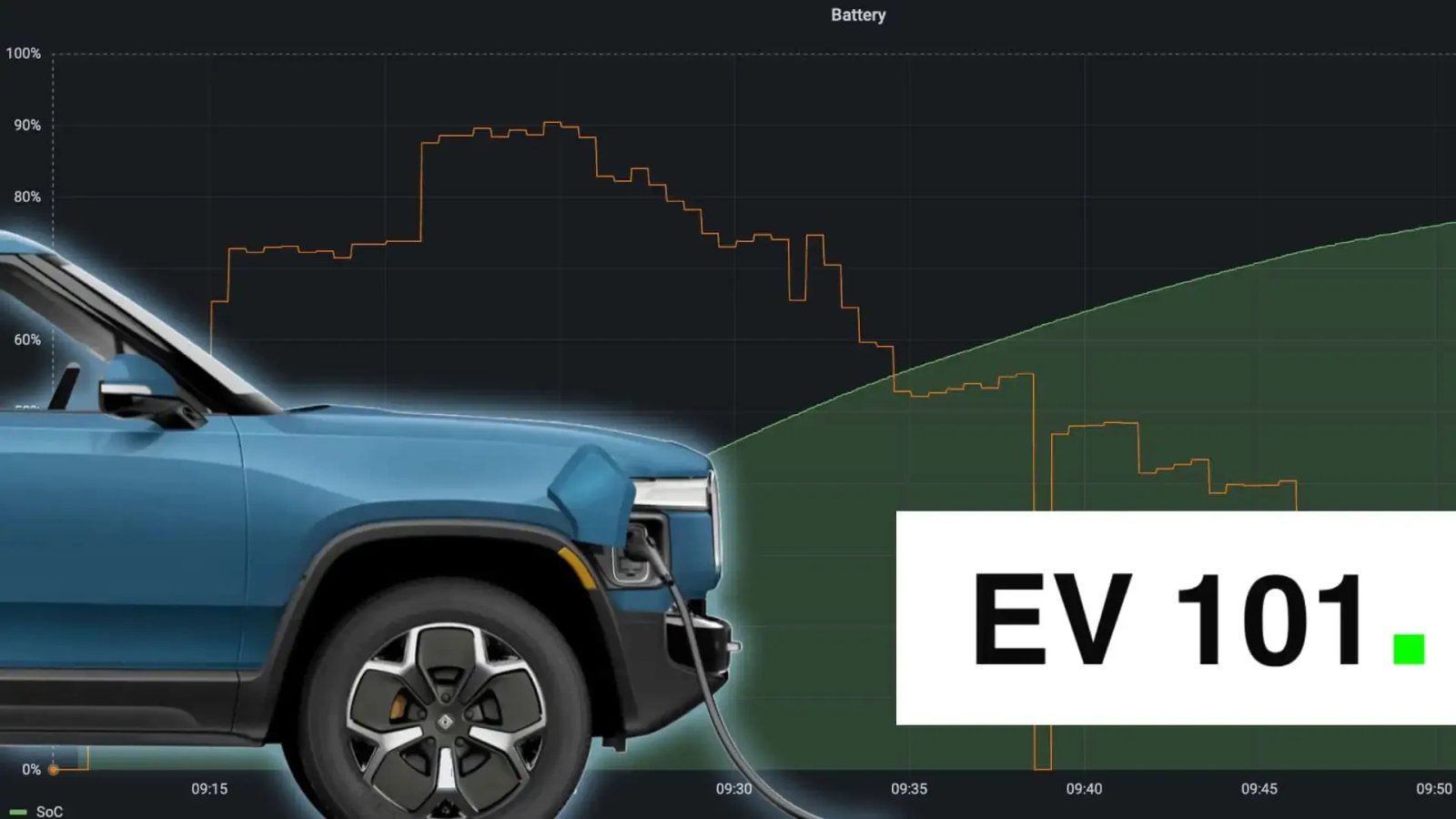
If you’re new to electric vehicles, you’ve likely heard veterans discuss “charging curves.” This refers to how an EV charges faster at low state of charge and slower at high state of charge. Plugging into a fast charger at 60% won’t deliver quick results. Some EVs sustain high rates longer than others.
EV charging curves typically follow one of two trends: steep or flat. A steep charging curve reaches or approaches the manufacturer’s peak number before dropping quickly. If an EV reaches 250 kilowatts but drops to 100 kilowatts by 50% state of charge, it has a steep curve. A flat charging curve maintains a horizontal slope longer. If a car sustains 250 kilowatts to around 50%, it has a flat charging curve.
The reasons for different charge curves vary. Sometimes the battery management system can’t handle thermal loads. Other times, charging is limited by specific components like battery cells or insufficient high-voltage cabling. Poor battery cell insulation causes rapid heating. However, examining the charging curve alone cannot definitively identify the root cause.
E-Tron vs. Solterra: When 150 Doesn’t Equal 150
Returning to the Audi E-Tron and Subaru Solterra charging question, the answer combines multiple factors. The Audi E-Tron maintains a remarkably flat charging curve, averaging 138.9 kilowatts from 10% to 90%. The Subaru Solterra, however, doesn’t share this flatness. Based on data analysis, it averaged just 71.4 kilowatts from 10% to 90%.
The real issue lies in marketing. If two automakers claim their cars accelerate to 60 mph in 5 seconds, you’d expect similar results when testing both. But with charging, it’s the wild west. Pair deception with lack of understanding, and customers face a nightmare.
For the first-generation E-Tron, Audi doesn’t exaggerate about its 150-kilowatt charge rate. The E-Tron charges at or very close to 150 kilowatts up to 80% state of charge. With the Solterra, you might attain 150 kilowatts in ideal conditions, but it likely won’t sustain it long. In fact, by 80%, the Solterra’s charge rate drops to around 30 kilowatts. This isn’t an isolated incident—numerous owners report significantly reduced charging rates on forums.
Through this lens, Subaru and Toyota are being somewhat unclear about their cars’ capabilities. The 2026 Solterra improves charging time from 10% to 80% in less than 35 minutes thanks to improved battery preconditioning and a 74.7-kWh battery, but the fundamental curve characteristics remain relevant.