Home EV Charging With a Wallbox in 2026: Speed, Cost, and Mobile vs Fixed
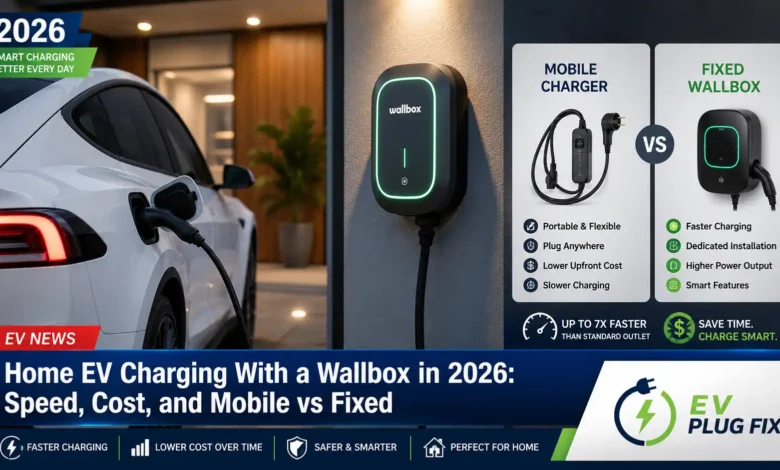
Home EV charging with a wallbox transforms the electric vehicle ownership experience, slashing charge times from over 24 hours to just a few hours while offering significant cost savings compared to public stations. For most EV owners, a dedicated wallbox is the most practical and economical solution for daily charging needs, delivering the convenience of waking up to a “full tank” every morning.
Unlike a standard household socket that delivers a meager 2.3kW and can take up to 30 hours to fully charge a 60kWh battery, a 7kW home wallbox typically adds 25-30 miles of range per hour . This means most EVs can be fully replenished in 6 to 10 hours, fitting perfectly into an overnight charging window . The primary decision for many buyers is choosing between a stationary wallbox or a more flexible mobile unit. Understanding the Smart EV Charging Benefits can help you make a more informed choice for your specific needs.
Mobile Wallbox vs. Fixed Wallbox: Which Is Right for You in 2026?
Choosing between a mobile and fixed wallbox depends on your lifestyle, living situation, and charging habits. Both have distinct advantages and trade-offs.
Mobile Wallbox: Flexibility on the Go
A mobile wallbox, like the go-e Charger Gemini flex, is a portable charging unit designed for maximum flexibility. As the name suggests, you can use it as a stationary device at home, but you can also take it with you when you travel, allowing you to charge at a friend’s house, family member’s home, or even at work . For those interested in maximizing this flexibility, the go-e PV Surplus Charging guide provides detailed insights into optimizing this portable solution with solar energy.
One of the biggest advantages of a mobile wallbox is the ease of installation. For example, with the go-e Gemini flex, you don’t need an electrician; you can easily install it yourself by simply connecting it to an existing CEE 16 A three-phase socket (Plug & Play) . However, it’s crucial to note that while this is simple, a licensed electrician is typically required for hardwiring a fixed wallbox to your home’s electrical panel.
Fixed Wallbox: Maximum Power and Convenience
A fixed wallbox is a permanent installation that is hardwired to your home’s electrical supply. This type of charger is designed for daily use and offers maximum power and convenience. Most dedicated EV chargers deliver 7kW on a single‑phase supply, which is roughly three times faster than a 3‑pin socket .
Fixed wallboxes are generally more powerful and can be integrated with smart home energy management systems. Brands like ChargePoint, Electrify America, and Wallbox offer smart features that sync with your energy tariff, automatically charging during cheaper off‑peak hours to save money . To understand the investment required for these permanent solutions, reviewing Wallbox Installation Costs is an essential step in your planning process.
Wallbox Charging Speeds and Installation Costs
Understanding charging speeds and installation costs is essential for planning your home EV charging setup.
Charging Speed: How Long Does It Take?
Charging speed depends on the wallbox’s power output and your EV’s onboard charger capacity. A mobile wallbox can be an excellent choice for many, but a fixed wallbox often provides the highest possible power for the fastest charging. For a real-world example, you can check the Tesla Model 3 Charging Time to see how these speeds translate to actual driving range.
| Charger Type | Power Output | Charging Time (0-100% for 60kWh EV) | Typical Use Case |
|---|---|---|---|
| Standard 3-Pin Socket | ~2.3 kW | 24-30 hours | Emergency, very slow charging |
| Mobile Wallbox (e.g., go-e Gemini flex) | 11 kW | ~6 hours | Flexible charging at home and on the go |
| Fixed Wallbox (7kW) | 7 kW | 6-10 hours | Overnight home charging |
| Fixed Wallbox (11kW-22kW) | 11-22 kW | 2-6 hours | Fast home charging (requires 3-phase power) |
Installation and Upfront Costs
Mobile wallboxes generally have lower upfront costs because they don’t require professional installation. You can simply plug them into a compatible socket. In contrast, a fixed wallbox requires a licensed electrician for installation, with costs typically ranging from $700 to over $3,000, depending on your home’s electrical setup .
Cost Savings: Home Charging vs. Public Charging
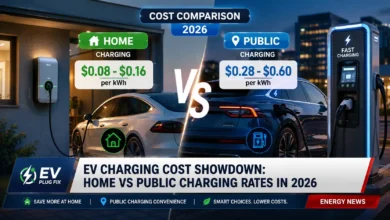
Charging your EV at home with a wallbox is significantly cheaper than using public charging stations. On average, home electricity costs about 17 cents per kilowatt-hour (kWh) in the US, while public stations average around 37 cents per kWh .
For a typical EV driver covering 12,200 miles per year, charging at home costs roughly $732 annually—just $61 a month. Using public stations for the same distance would push that to about $132 per month . Off-peak EV tariffs can reduce costs even further, making a full charge cost as little as $5-$9 depending on your battery size . The expanding EU EV Charging Network offers more public options, but home charging remains the most cost-effective choice for daily use.
Key Advantages of Owning a Wallbox
Beyond the speed and cost benefits, a wallbox offers several other compelling advantages for EV owners. Regular inspection and maintenance can further enhance these benefits, so be sure to review our Home EV Charger Maintenance guide to keep your equipment in top condition.
- Unmatched Convenience: You can easily charge your electric car at home while comfortably sitting on the couch, watching a movie, or sleeping. No more detours to gas stations.
- Superior Speed: Charging with a wallbox is much faster than from a regular socket. Instead of charging your electric car for almost a whole day, you usually only charge for 2-6 hours.
- Enhanced Safety: Charging with a private AC wallbox allows for two-way communication with the electric car, ensuring a safe and optimized charge every time.
- Maximized Savings: You save money compared to charging at a public charging station, which can be two to three times more expensive.
Frequently Asked Questions
Frequently Asked Questions
What is the best home EV charger in 2026?
The “best” charger depends on your needs. For flexibility, the go-e Gemini flex mobile wallbox is a top choice. For a permanent, high-power solution, a 7kW or 11kW fixed wallbox from brands like ChargePoint, Electrify America, or Wallbox are excellent options .
Can I install a wallbox myself?
You can install a mobile wallbox yourself if you have a compatible socket (Plug & Play). However, a fixed wallbox generally requires a licensed electrician for safe and legal installation .
Is it cheaper to charge an EV at home or at a public station?
It is significantly cheaper to charge at home. Home charging costs roughly 17 cents per kWh, while public charging averages 37 cents per kWh, making home charging roughly half the price .
How many miles of range does a wallbox add per hour?
A standard 7kW home wallbox typically adds 25-30 miles of range per hour . An 11kW charger can add even more, depending on your vehicle’s onboard charger limits.
What is the charging time for a mobile wallbox vs a fixed wallbox?
A mobile wallbox like the go-e Gemini flex (11kW) can fully charge a typical EV in about 6 hours. A fixed 7kW wallbox will fully charge the same vehicle in 6-10 hours. Both are vastly faster than a standard 3-pin plug, which can take over 24 hours .
Conclusion: Is a Wallbox Worth It in 2026?
Investing in a wallbox for home EV charging is one of the smartest decisions an EV owner can make. The combination of faster charging speeds, substantial cost savings, and the sheer convenience of charging at home makes it an essential upgrade. Whether you opt for a flexible mobile solution like the go-e Gemini flex or a permanent fixed wallbox, you’ll unlock the full potential of your electric vehicle and never look back.