7kW vs 11kW vs 22kW EV Charger Comparison 2026: Speed, Cost & Installation Guide
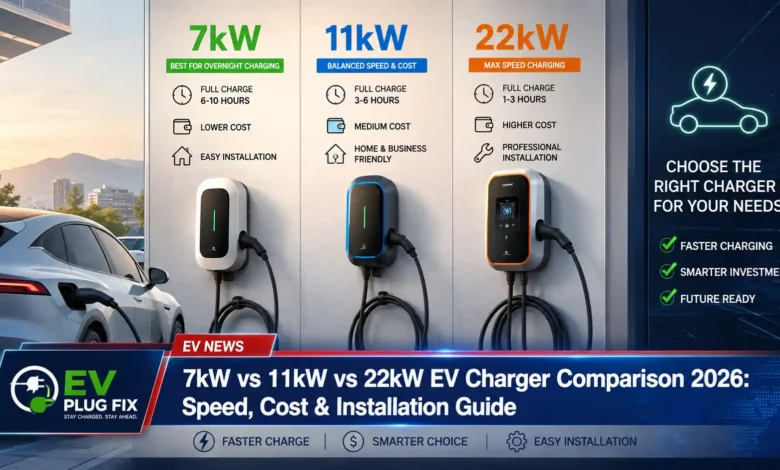
The decision between a 7kW, 11kW, or 22kW home EV charger can significantly impact your electric vehicle ownership experience—affecting everything from daily convenience to installation costs and long-term electrical capacity. With electric vehicles becoming increasingly mainstream in 2026, homeowners face a crucial infrastructure decision that determines how efficiently they can replenish their EV’s battery, whether they can future-proof their setup for multiple vehicles, and how much they’ll spend on electrical upgrades. Understanding the technical differences, real-world charging speeds, and practical applications of each power rating is essential for making an informed investment that balances performance with budget considerations.
Home EV charger installation represents the most convenient and cost-effective method for powering your electric vehicle, with most charging sessions occurring where you park overnight. A properly installed home charger eliminates range anxiety and allows you to start each day with a full battery. However, not all chargers are created equal—and the power rating you choose directly affects charging speed, installation requirements, and compatibility with your vehicle’s onboard charging system.
The three most common residential Level 2 charger options in 2026—7kW, 11kW, and 22kW—differ substantially in their electrical demands, installation complexity, and suitability for various living situations. A 7kW charger works well for most homes with single-phase power, providing overnight charging that meets the needs of daily commuters. Meanwhile, 11kW and 22kW chargers offer faster replenishment but require three-phase electrical supplies that aren’t universally available in residential settings. This comprehensive comparison examines each option’s technical specifications, real-world charging performance, installation considerations, and regional adoption patterns to help you determine the right choice for your specific circumstances.
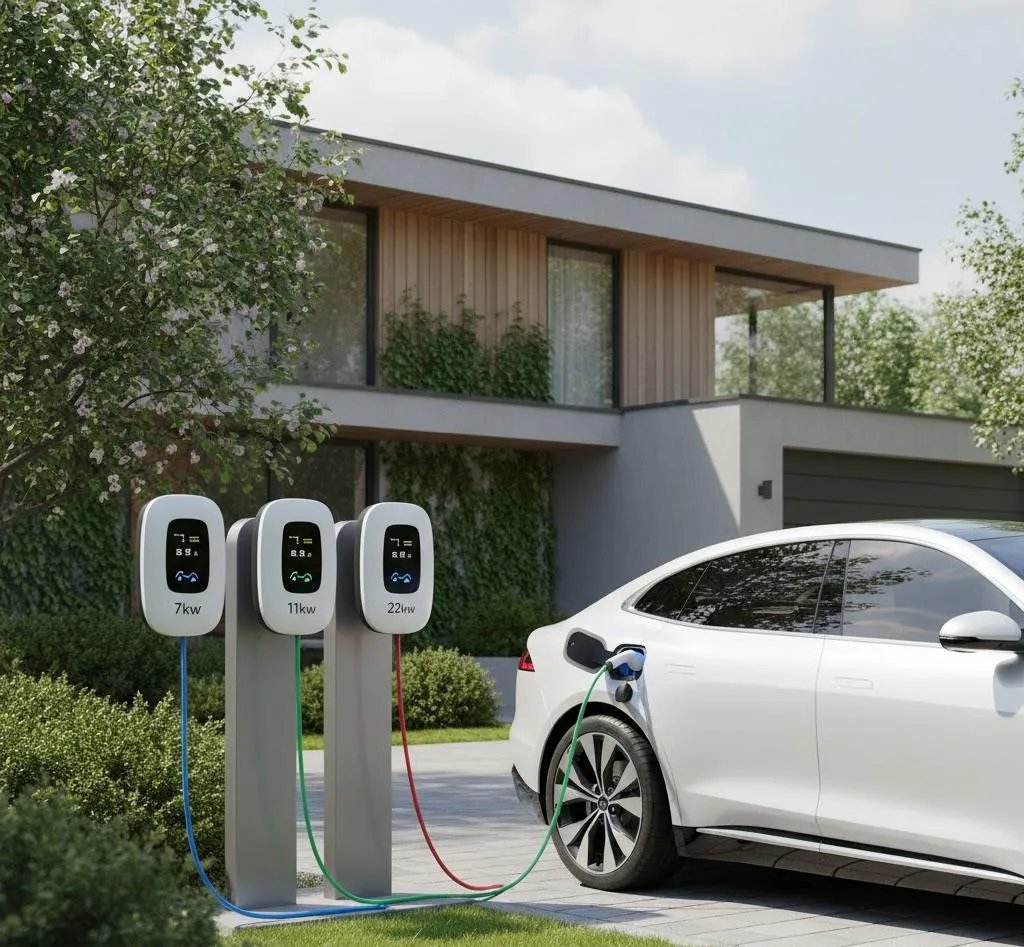
Before diving into the comparison, it’s helpful to understand the fundamental relationship between power, voltage, and current in EV charging. The basic formula P = V × I (Power equals Voltage multiplied by Current) determines a charger’s maximum power output, though actual charging speeds are also influenced by your vehicle’s onboard charger capacity and the home’s electrical system configuration.
Understanding Charging Power: The Technical Foundation
Electric vehicle chargers operate at different power levels based on their voltage and current capabilities. A 7kW charger running on single-phase 230V supply draws approximately 32A of current, while a 22kW charger on three-phase 400V supply draws 32A per phase. The three-phase configuration delivers significantly more power through the √3 factor (approximately 1.732) in the three-phase power calculation. This technical distinction has profound implications for charging speed and installation requirements.
Most European homes feature three-phase power supplies capable of supporting 11kW or 22kW charging, whereas North American and Chinese residences typically rely on single-phase systems that limit them to 7kW charging. This regional difference explains why 7kW chargers dominate residential markets in the United States and Canada, while 11kW and 22kW options are more prevalent in European households. For homeowners with three-phase power available, faster charging speeds become accessible, though vehicle onboard charger limitations must also be considered.
Your EV’s onboard charger (OBC) plays a crucial role in determining actual charging speed, regardless of your wallbox’s maximum power rating. The OBC converts the AC power from the grid into DC power for the battery, and its capacity imposes a hard limit on how much power your vehicle can accept. If you own a vehicle with an 11kW onboard charger, installing a 22kW wallbox won’t yield faster charging—the vehicle simply cannot accept more than 11kW from an AC source. This critical limitation means that investing in a higher-power charger often doesn’t provide benefits unless your vehicle can actually use the additional capacity.
| Charger Power | Voltage/Phase Type | Current | Estimated Miles per Hour | 0% Charge Time (75kWh Battery) |
|---|---|---|---|---|
| 7kW | Single-Phase 230V | 32A | ~25 miles | 10 hours |
| 11kW | Three-Phase 400V | 16A per phase | ~35 miles | 6 hours |
| 22kW | Three-Phase 400V | 32A per phase | ~70 miles | 3 hours |
Breaking Down Each Power Level: Practical Performance Analysis
7kW Chargers: The Residential Standard
For the vast majority of homeowners, a 7kW charger represents the practical sweet spot between charging speed and installation cost. These chargers operate on standard single-phase 230V power supplies found in most North American and many European homes, requiring minimal electrical modifications for installation. The 7kW power level provides approximately 25 miles of driving range per hour of charging, making it ideal for overnight replenishment of daily commuting distances.
Most daily commuters drive fewer than 30 miles round-trip, meaning a 7kW charger can fully replenish typical daily usage in just one to two hours. Even with a depleted 75kWh battery, a 7kW charger will achieve a full charge in approximately 10 hours—well within a typical overnight window. This makes the 7kW charger extremely practical for drivers who park at home for 8+ hours each night. Installation costs are reasonable, typically ranging from €200 to €400 in Europe, and electrical panel upgrades are rarely required unless your home’s service is particularly limited.
For first-time EV owners or those with smaller batteries (under 60kWh), a 7kW charger frequently provides more than enough charging capacity to meet daily needs. The technology is proven, widely compatible with virtually every EV equipped with a J1772 or Type 2 connector, and available at competitive price points from manufacturers like ChargePoint, Wallbox, and Grizzl-E.
11kW Chargers: The Performance Upgrade
An 11kW charger delivers approximately 57% faster charging than a 7kW unit, reducing a full charge from 10 hours to 6 hours for a 75kWh battery. This significant speed improvement provides greater flexibility for drivers with long commutes, large battery vehicles, or situations where overnight charging windows are shorter. However, the benefits come with higher electrical requirements—11kW charging demands a three-phase 400V supply, which may not be available in all homes.
For European homeowners with existing three-phase power, upgrading from 7kW to 11kW generally requires minimal additional electrical work. The installation cost is moderately higher, typically ranging from €400 to €700, but the faster charging speeds can be worthwhile for households with multiple EVs or drivers with heavy daily mileage. Additionally, many modern EVs—including those from Tesla, Audi, and Porsche—feature 11kW onboard chargers, making them fully compatible with this power level.
One important consideration: installing an 11kW charger when your home lacks three-phase power requires a costly electrical upgrade that makes the decision financially unattractive. For North American homeowners, where three-phase power is uncommon in residential settings, 11kW charging is generally impractical without significant electrical modifications. The cost-benefit analysis typically favors 7kW for most single-phase homes unless you’re planning extensive electrical renovations.
22kW Chargers: Commercial Speed, Residential Potential
A 22kW charger represents the fastest possible AC home charging option, providing approximately 70 miles of range per hour and completing a full charge in 3 hours for most vehicles. This speed approaches the performance of some public DC fast chargers, making 22kW appealing for drivers who need rapid replenishment during shorter parking periods. However, the reality is more nuanced—most EVs cannot accept 22kW AC charging due to onboard charger limitations.
Only a minority of vehicles, primarily premium models from manufacturers like Porsche and certain Tesla configurations, include 22kW onboard chargers. For the vast majority of EV owners, a 22kW wallbox will simply provide the same 11kW charging speed that their vehicle can accept, making the additional investment largely wasted. Before committing to a 22kW charger, it’s essential to verify your vehicle’s maximum AC charging rate to avoid unnecessary expenses.
Even when your vehicle supports 22kW charging, the installation requirements are substantial. A 22kW charger requires a three-phase 400V supply with 32A per phase, larger cable sizes (5×6-10mm²), and more robust circuit breakers (32A three-phase RCBO). Installation costs in Europe typically range from €500 to €1,000+, and professional installation is mandatory. The higher electrical load also generates more heat, requiring more frequent maintenance checks—ideally every 6 months rather than the annual inspection sufficient for lower-power units.
For residential settings, 22kW chargers are generally overkill unless you own a compatible vehicle and have an urgent need for extremely fast home charging. The sweet spot for most drivers remains 7kW or 11kW, depending on electrical availability. Commercial settings, fleet operations, and workplaces with high vehicle turnover benefit most from 22kW installations, where the speed justifies the cost.
Installation Requirements and Electrical Considerations
Choosing the right charger involves more than just power ratings—your home’s existing electrical infrastructure determines what’s realistically possible. Before purchasing any charger, consult a qualified electrician to perform a load calculation that determines whether your current electrical panel can handle the additional demands. For homes with 200-amp service and available circuit breaker slots, Level 2 charger installation is typically feasible, though older homes with 100-amp service may require panel upgrades or load management solutions.
- 7kW Installation: Requires single-phase 230V supply with 32A current capacity. Uses 3×6mm² cable and a 32A RCBO circuit breaker. Installation is relatively straightforward with costs ranging from €200-€400 in Europe. Most homes with existing 100-amp service can accommodate a 7kW charger without major upgrades.
- 11kW Installation: Demands three-phase 400V supply with 16A per phase. Uses 5×2.5-4mm² cable and a 16A three-phase RCBO. Moderate complexity installation with costs from €400-€700. If your home already has three-phase power, the upgrade is manageable; otherwise, expect significant electrical modifications.
- 22kW Installation: Requires three-phase 400V supply with 32A per phase. Uses 5×6-10mm² cable and a 32A three-phase RCBO. High complexity installation requiring professional expertise, costing €500-€1,000+. May necessitate main panel upgrades and is rarely cost-effective for residential use.
For homes with limited electrical capacity, dynamic load management (DLM) systems offer an alternative to costly panel upgrades. DLM automatically adjusts charging power based on your home’s total electrical draw, ensuring the charger never overloads the system. This technology can save thousands of dollars in electrical panel upgrades while still providing adequate charging speeds. Manufacturers like Emporia offer integrated load management solutions that monitor home energy usage and throttle charging when necessary to keep the lights on without tripping circuit breakers.
Safety certification is paramount when selecting any EV charger. Look for units certified by nationally recognized testing laboratories such as UL, Intertek ETL, or CSA. ENERGY STAR certification also indicates the charger meets safety standards and operates efficiently. Avoid uncertified units from unauthorized sellers, as these may pose fire or electrical hazards.
Use Cases: Matching Charger Power to Your Lifestyle
Different living situations and driving patterns demand different charging solutions. Understanding your specific use case helps narrow down the appropriate power level, avoiding both overinvestment and insufficient charging capacity. Consider your daily mileage, home parking situation, electrical availability, and future plans when evaluating options.
Residential Single-Family Homes
Single-family homes represent the most common scenario for EV charger installation. In this setting, a 7kW charger generally provides adequate overnight charging for most daily commuters, while 11kW offers faster replenishment if three-phase power is available. The choice depends primarily on your vehicle’s charging capacity and home’s electrical supply. For homes with 200-amp service and single-phase power, the 7kW charger is the logical default, balancing cost with performance.
If you own a vehicle with an 11kW onboard charger and have three-phase power available, upgrading to an 11kW unit can be worthwhile for faster charging and greater flexibility. However, for homeowners with existing single-phase systems, the cost of converting to three-phase (potentially thousands of euros/dollars) rarely justifies the speed improvement unless you have a long-term plan for multiple EVs or high daily mileage.
Multi-Unit Residential Buildings
Apartments and condominiums face unique charging challenges, including limited electrical capacity and shared parking arrangements. In these settings, 7kW or 11kW chargers are typically recommended, with load management systems balancing usage across multiple residents. Many multi-unit buildings implement timed charging schedules or smart sharing to optimize energy distribution and prevent circuit overloads.
For apartment dwellers, the installation decision often involves building management and may require coordination with other residents. Singapore’s Land Transport Authority requires registration and periodic inspection of EV chargers in non-restricted access locations every 6 months, highlighting the regulatory considerations that may affect multi-unit installations.
Workplaces and Commercial Offices
Workplace charging serves employees who need to replenish their EVs during limited parking hours, making faster charging beneficial. 11kW or 22kW chargers are often appropriate for commercial settings, where higher vehicle turnover demands quicker turnaround. Smart management systems can optimize usage, track consumption, and prevent circuit overloading while providing employee convenience as a benefit.
For businesses installing chargers, Open Charge Point Protocol (OCPP) compatibility enables remote monitoring, payment processing, and integration with existing building management systems. This standardization ensures that chargers can be centrally managed and scaled as demand grows.
Fleet Operations and Public Charging
Commercial fleet operations and public charging stations benefit most from 22kW chargers, where rapid turnaround supports multiple vehicles throughout the day. These installations often incorporate advanced features like user authentication, payment processing, and usage tracking. For fleet managers, faster charging translates directly to operational efficiency, making the higher installation cost worthwhile.
However, even in commercial settings, the vehicle’s onboard charger remains the limiting factor. Fleet operators should verify that their vehicles can accept higher AC power before investing in 22kW infrastructure.
Regional Differences: Europe vs. North America vs. Asia
Charger preferences vary significantly by region due to differences in electrical systems and regulatory frameworks. Understanding your region’s typical configurations helps contextualize which power levels are practical and accessible.
Europe
European homes commonly feature three-phase power supplies (400V), making 11kW and 22kW chargers feasible options for many households. This electrical infrastructure advantage, combined with larger EV batteries and higher charging speed expectations, has made faster chargers more common in European residential settings. Government incentives in countries like Germany and France further reduce installation costs, encouraging adoption of higher-power chargers.
Many European EV owners choose 11kW chargers as a future-proof investment, anticipating that their next vehicle may support faster charging. The widespread availability of three-phase power makes the upgrade from 7kW to 11kW relatively straightforward compared to North American homes where three-phase is uncommon.
North America
North American homes predominantly use single-phase 240V power, making 7kW chargers the most practical and common choice. While some high-end homes and commercial buildings have three-phase power, residential installations of 11kW or 22kW chargers are rare and expensive. The cost of electrical system upgrades typically outweighs the benefits unless you’re planning a comprehensive renovation.
For North American EV owners, 7kW chargers offer the best balance of affordability, compatibility, and performance. The Tesla Wall Connector ($450) and Emporia Pro ($599) represent popular choices that deliver reliable 75kW charging with app connectivity and smart features. For households with two EVs or high daily mileage, installing two 7kW chargers often proves more practical than upgrading to a single higher-power unit.
Asia and China
Similar to North America, most Asian homes use single-phase power, favoring 7kW chargers as the residential standard. In China, where EV adoption is rapidly accelerating, 7kW wallboxes dominate home installations due to accessibility and cost-effectiveness. Higher-power chargers are typically found only in high-end residential developments, commercial buildings, or public charging infrastructure.
Government regulations, such as Singapore’s EV charger registration requirements, emphasize safety and proper installation rather than power level. Inspections vary by location—restricted access locations (landed homes) require inspection every 24 months, while non-restricted access sites require inspections every 6 months.
Real-World Usage Examples
- Daily commuter: A 7kW charger provides sufficient overnight replenishment, low installation cost, and minimal maintenance. Perfect for drivers with typical 30 mile daily commutes and 8+ hours of home parking.
- Large battery EV owner: An 11kW charger cuts charging time significantly, offering faster top-ups for vehicles with 80kWh+ batteries. Ideal if three-phase power is available and your vehicle supports 11kW AC charging.
- Multiple-vehicle household: Installing two 7kW chargers often proves more practical than a single 22kW unit, especially if load management systems balance usage. Alternately, one 11kW charger can serve two vehicles through sharing or scheduled charging.
- Commercial fleet: 22kW chargers combined with smart systems deliver efficient charging for multiple vehicles, maximizing uptime and supporting fleet expansion.
Even with a 22kW charger installed, many EVs remain limited by their onboard charger, making 11kW the practical maximum in numerous cases. Always check your vehicle’s specifications before committing to higher power levels.
Future Trends in Home EV Charging
The EV charging landscape continues evolving, with several trends shaping residential installations in 2026 and beyond. Smart charging and energy management are becoming standard features rather than premium add-ons, enabling homeowners to optimize costs and energy usage automatically.
Vehicle-to-Grid (V2G) technology represents one of the most promising developments, allowing EVs to supply power back to the home or grid as backup energy. This capability transforms the vehicle from a mere transportation tool into an energy storage asset, potentially offsetting electricity costs and providing emergency power. While still emerging, V2G compatibility will influence charger selection as the technology matures.
Smart charging features have become increasingly sophisticated, with modern chargers offering:
- Remote control via smartphone apps
- Scheduling to leverage off-peak electricity rates
- Integration with solar panel systems for 100% renewable charging
- Dynamic load management to prevent circuit overloads
- Energy usage tracking and cost analysis
- Power sharing among multiple chargers
For environmentally conscious homeowners, solar compatibility has become a key differentiator, enabling 100% green energy charging when paired with photovoltaic systems. This integration reduces carbon footprint and long-term operating costs, making it increasingly attractive as solar adoption grows.
High-power charger adoption is expected to increase in Europe as three-phase supply and large battery EVs become more common. However, the practical ceiling for most residential installations remains 11kW given vehicle limitations. 22kW chargers will likely remain niche residential products, primarily serving commercial and fleet applications where rapid turnaround justifies the cost.
Essential Questions & Expert Answers
Is a 22kW charger worth installing at home in 2026?
Can my home support an 11kW or 22kW EV charger?
How do I know what power level my EV can accept?
What are the ongoing maintenance requirements for different charger power levels?
Should I choose a tethered or untethered charger?
Making Your Final Decision
Choosing the right home EV charger requires weighing your specific needs against available electrical capacity and vehicle capabilities. The decision matrix below summarizes recommendations based on typical use cases:
| User Type | Recommended Power | Key Considerations |
|---|---|---|
| Daily commuters, first-time EV owners | 7kW | Easy installation, overnight charging sufficient, lowest cost |
| Homes with existing three-phase power | 11kW | Faster charging, balanced cost vs. performance, future-proof |
| High-end homes, fleets, commercial use | 22kW | Rapid charging, supports multiple vehicles, requires compatible EVs |
For most residential users, the 7kW charger represents the practical sweet spot—offering ample overnight charging for daily needs while minimizing installation costs and electrical requirements. The 11kW charger provides meaningful speed improvements for those with three-phase power and compatible vehicles, while 22kW chargers are best reserved for commercial applications or owners with specific high-speed requirements.
Before making any purchase, consult a professional electrician to assess your home’s electrical system and confirm your EV’s onboard charger capacity. Smart wallbox EV chargers with dynamic load management and solar integration can further enhance efficiency and convenience while ensuring safe operation. By matching charger power to your actual needs and electrical infrastructure, you’ll maximize value while avoiding unnecessary expenses on capabilities you can’t use.
Best home EV chargers are designed for typical residential use, providing reliable, fast, and safe charging for personal electric vehicles. However, they are not intended for commercial or fleet use. For businesses, public charging stations, or multi-vehicle fleets, higher-capacity, commercially certified chargers would be required. Feyree chargers excel in single-family homes or apartments where convenience, safety, and smart home integration are the priority.