European EV Charging Connectors & Outlet Types 2026: Complete Travel Guide
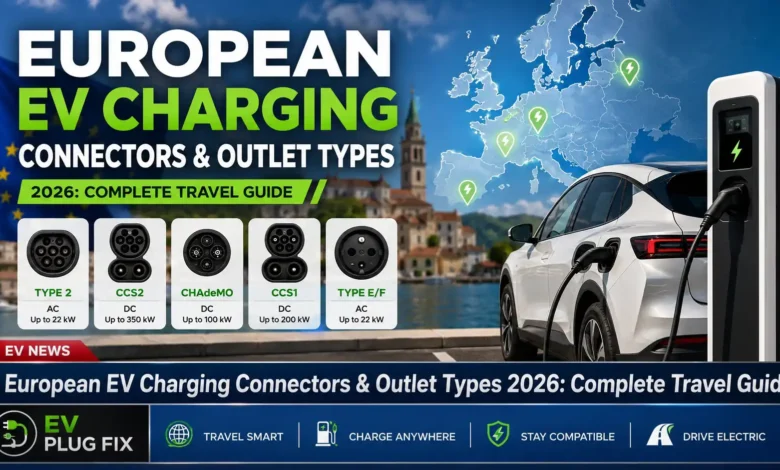
European EV charging connectors and power outlet types present a unique challenge for electric vehicle drivers and travelers navigating the continent’s diverse electrical landscape in 2026. Unlike the unified North American Charging Standard (NACS) that has gained momentum across the Atlantic, Europe’s electrical infrastructure remains a fascinating tapestry of historical standards, regional preferences, and, remarkably, a unified approach to EV charging that actually works better than the domestic outlet situation.
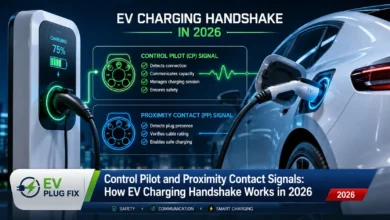
The reality of charging an electric vehicle or simply plugging in a phone charger across Europe requires understanding a complex ecosystem of plug shapes, voltage specifications, and safety features. For EV owners, the situation is both simpler and more complex than for traditional appliance users. While domestic outlets vary dramatically from Germany’s Schuko to the UK’s chunky Type G, the European Union has successfully mandated standardized EV charging connectors that give drivers a consistent experience from Portugal to Poland. Understanding the EV Charging Handshake between your vehicle and the charging station is essential for a smooth experience at any public charging point.
Why European Outlet Types Remain Diverse
The patchwork of European power outlets stems from independent electrical infrastructure development during the late 19th and early 20th centuries. Each nation adopted plug configurations based on available technology and commercial dominance at the time, creating a system where neighboring countries often use incompatible sockets. Germany developed the Schutzkontakt (Schuko) system with its distinctive side-grounding clips, while France opted for a protruding earth pin design, and the United Kingdom created arguably the world’s safest plug with built-in fuses.
Voltage across Europe consistently operates at 220-240V at 50Hz, significantly higher than North America’s 110-120V system. This means North American travelers must check device voltage ratings before plugging in, though most modern electronics like laptops and phones are dual-voltage capable and only need simple plug adapters.
European EV Charging Connectors: The Success Story
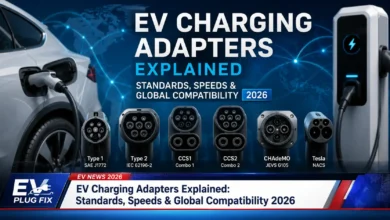
While domestic outlet standardization failed, Europe’s EV charging connector landscape tells a remarkably different story. The European Union’s decisive action in 2014 mandated Type 2 (Mennekes) as the standard AC connector for all new Public EV Fast Charging points, creating a unified infrastructure that domestic outlets never achieved.
Type 2 (Mennekes) – AC Standard
- Power: Up to 22 kW (three-phase)
- Pins: 7-pin design with communication capability
- Usage: Public AC stations, home wall boxes, workplace charging
- EU Mandate: Required at all public AC points since 2014
CCS2 – DC Fast Charging Standard
- Power: 50-350 kW rapid charging
- Design: Type 2 with two additional DC pins
- Speed: 10-80% charge in 15-30 minutes
- Future-proof: Mandatory at all new DC stations
The Type 2 connector’s seven-pin configuration supports both single-phase and three-phase AC charging, making it exceptionally versatile for European conditions where three-phase power is more common in residential and commercial buildings than in North America. Understanding EV Phase Balancing helps optimize three-phase charging efficiency and prevents grid instability issues. A three-phase Type 2 wall box at 22 kW can fully charge a typical EV in approximately 2-4 hours, making it ideal for overnight home charging or workplace installations.
Domestic Outlet Types Across Europe
| Outlet Type | Countries | Key Features | EV Charging Use |
|---|---|---|---|
| Type C (Europlug) | Most continental Europe | Two round pins, 2.5A max, ungrounded | Slow emergency charging only |
| Type F (Schuko) | Germany, Spain, Netherlands, Scandinavia | Side grounding clips, 16A, non-polarized | Common for Mode 2 granny charging |
| Type E (French) | France, Belgium, Poland | Protruding earth pin, 16A | Limited EV charging compatibility |
| Type G (UK) | UK, Ireland, Malta | 3 rectangular pins, 13A fuse, polarized | Requires specific EVSE equipment |
| Type L (Italian) | Italy, Chile | 3 round pins inline, 10A/16A versions | Incompatible with Schuko/Type F |
Mode 2 Charging: Using Domestic Sockets
The simplest EV charging method across Europe is Mode 2, which uses a standard domestic outlet via an In-Cable Control Box (ICCB). Often called EV Granny Charger charging, this method delivers 1.4-2.3 kW through a standard Schuko or Type G socket, taking 24-40 hours to fully charge a 60 kWh EV battery.
The ICCB contains protective electronics that monitor the connection, prevent overheating, and negotiate safe current draw with the vehicle. While legal and widely practiced, European electrical authorities generally recommend Dedicated EV Circuits for regular home charging due to the sustained load placed on household wiring not designed for continuous high-current draw.
CCS2: Europe’s DC Fast Charging Backbone
The Combined Charging System Type 2 (CCS2) represents Europe’s commitment to unified fast-charging infrastructure. By adding two large DC power pins below the standard Type 2 AC socket, CCS2 creates a combined connector capable of handling both AC and DC charging through a single vehicle port.
CCS2 stations are rapidly expanding across Europe, with networks like Ionity, Allego, and motorway service areas deploying high-power chargers along major travel corridors. The EU’s AFIR regulation mandates minimum 150 kW charging power at CCS2 stations along core TEN-T routes from 2025 onward, ensuring EV drivers can travel across borders without range anxiety. For drivers concerned about battery preservation, understanding EV Charging Battery Health helps optimize charging habits during long-distance trips.
CHAdeMO and Tesla: The Exceptions
CHAdeMO, the Japanese DC fast-charging standard, is declining rapidly in Europe as manufacturers transition to CCS2. Nissan, Honda, and other former CHAdeMO proponents have announced plans for CCS2 adoption in future European models, and many charging networks have begun removing CHAdeMO connectors to make room for additional CCS2 points.
Tesla’s European vehicles uniquely use the standard Type 2 connector for AC charging, fully compatible with all EU public charging points. Tesla Superchargers in Europe use CCS2, and since late 2022, Tesla has opened its Supercharger network to non-Tesla vehicles across Europe through the Tesla app, significantly expanding charging options for all EV drivers. Tesla owners can also take advantage of Tesla Free Supercharging promotions and the extensive Supercharger network coverage across the continent.
Practical Travel Tips for EV Drivers and Travelers
“The standardization of Type 2 and CCS2 across the EU represents a remarkable success in electrical harmonization that domestic outlet standardization never achieved. For EV owners, ensure your vehicle supports CCS2 for DC fast charging, and you’ll access virtually all public rapid charging infrastructure on the continent.”
- Check your vehicle’s connector type before traveling. Most modern European EVs use Type 2 for AC and CCS2 for DC fast charging.
- Download charging network apps like PlugShare, Ionity, or Tesla’s app to locate compatible chargers and check real-time availability.
- Carry a Mode 2 charging cable with Schuko or Type G plugs as a backup for emergency charging at campsites or accommodations without dedicated EV charging.
- Understand voltage requirements for non-EV devices: most modern electronics are dual-voltage (100-240V), but hairdryers, irons, and older appliances may need voltage converters.
- Pack a universal travel adapter covering Type C, E, F, G, and L for non-EV devices. Look for models with USB-C charging ports built in.
- In Italy, check socket compatibility as many older locations accept only the 10A Type L plug. Modern multi-standard sockets are becoming more common, particularly in hotels.
“The diversity of European power outlets reflects a century of independent development, but the EV charging landscape shows what harmonization can achieve. Type 2 and CCS2 now form a unified charging backbone across the EU, giving drivers a consistent experience whether at home, at work, or on the motorway.”
Future Outlook: Smart Charging and Vehicle-to-Grid
Europe’s standardized EV charging infrastructure positions the continent for advanced Smart EV Charging Europe and vehicle-to-grid (V2G) integration. The communication pins built into Type 2 connectors enable bidirectional power flow, load management, and dynamic pricing integration. As renewable energy penetration increases across European grids, V2G technology will allow EV batteries to store excess solar and wind power, feeding it back to the grid during peak demand periods.
The EU’s regulatory framework, combined with standardized connectors, creates ideal conditions for smart charging deployment. EV owners can expect increasingly sophisticated charging experiences with dynamic electricity pricing, grid-friendly charging schedules, and potentially revenue-generating V2G services in the coming years. Taking advantage of EV Off-Peak Charging strategies can significantly reduce charging costs while supporting grid stability during high renewable energy production periods.