EV On-Board Charger Limits: Why Your 22kW Wallbox Only Delivers 7.4kW in 2026
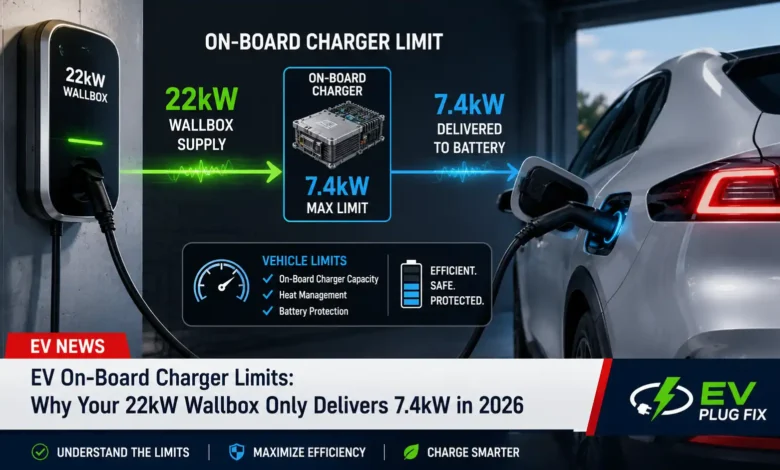
The 22kW wallbox installed in your garage represents a significant investment in your electric vehicle charging infrastructure, yet you consistently see charging speeds capped at just 7.4kW. This frustrating discrepancy is one of the most common misunderstandings in EV ownership, and it stems from a critical component that many drivers overlook: the on-board charger (OBC). This vital piece of power electronics, physically mounted inside your electric vehicle, is the true gatekeeper of AC charging speeds. While your wallbox may be capable of delivering impressive power, the OBC determines how much of that power can actually be converted and stored in your battery. Understanding this relationship between your EV’s on-board charger and your charging equipment is essential for maximizing efficiency, planning your charging routine, and avoiding unnecessary expenses.
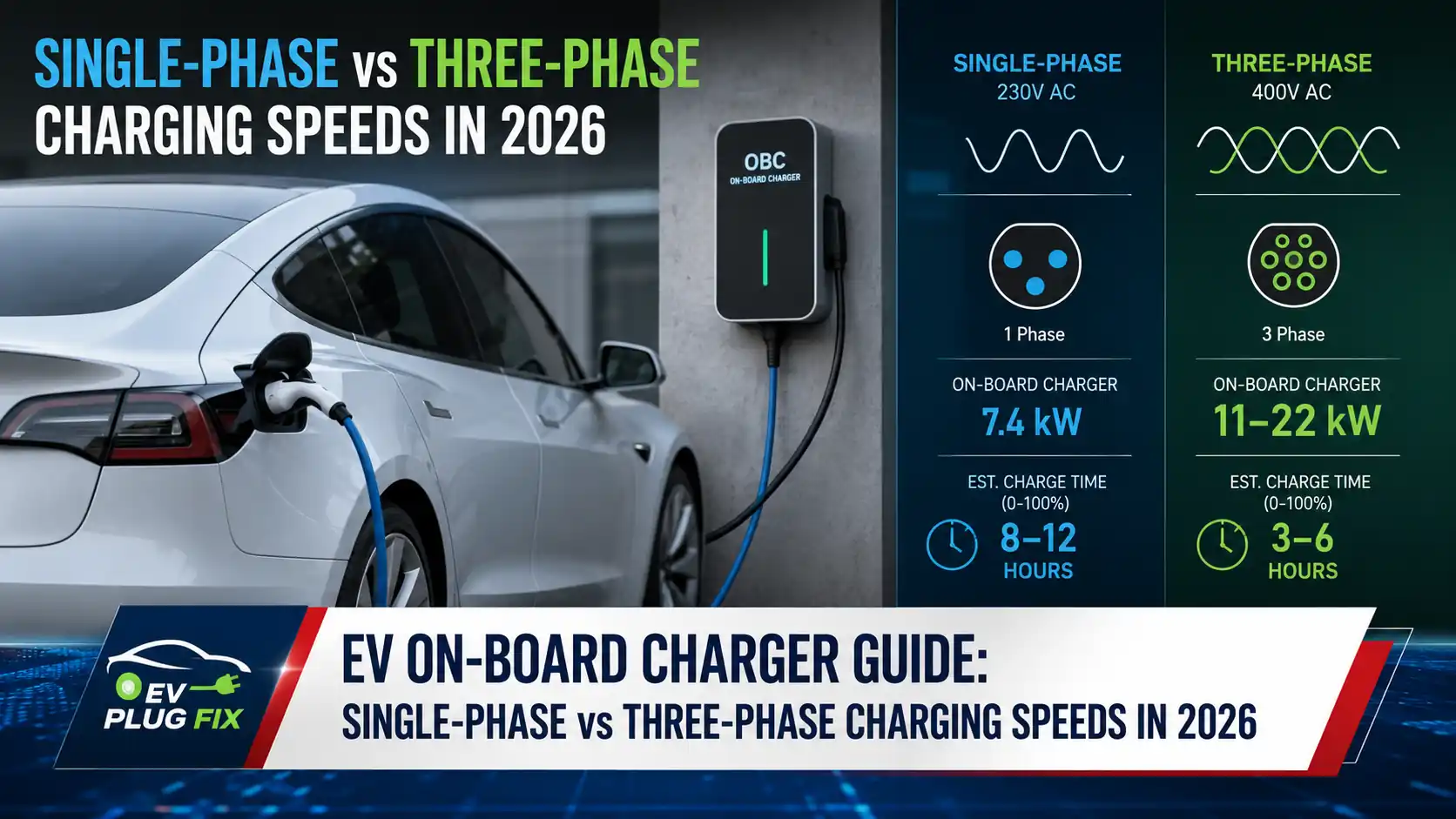
For EV owners who have recently upgraded to a high-capacity wallbox or are shopping for a new electric vehicle, the technical distinction between single-phase and three-phase charging creates significant confusion. A wallbox rated at 22kW sounds impressive, but without compatible on-board charging hardware, you’ll never see those speeds. In fact, installing a more powerful wallbox than your vehicle can accept is often a wasted investment. This guide will demystify EV on-board charger technology, explain exactly why your charging speed may be limited, and help you understand what to look for when purchasing your next electric vehicle or charging equipment in 2026. Before upgrading your wallbox, it’s wise to review our EV Charger Comparison Guide to understand which power level truly matches your vehicle’s capabilities.
What Is an On-Board Charger and Why Does It Matter
The on-board charger, often abbreviated as OBC, is a crucial power electronics unit integrated into every electric vehicle. Its primary function is to convert the alternating current (AC) supplied by your home wallbox, workplace charger, or public AC charging station into the direct current (DC) required to charge your vehicle’s high-voltage battery pack. This conversion process is fundamental to AC charging, which represents the vast majority of charging events for EV owners, particularly those charging at home or work. For many drivers, the Home EV Charger Guide provides essential context on how the OBC interacts with your home installation.
Unlike DC fast charging, where the AC-to-DC conversion happens within the charging station itself, AC charging relies entirely on the vehicle’s internal hardware. When you plug your EV into a 22kW wallbox, the AC power flows through the cable and into your vehicle’s charging port, where the on-board charger converts it to DC at the appropriate voltage and current for your battery. The OBC also handles communication with the charging station, negotiating available power and managing the charging profile to protect battery health. This sophisticated process involves power factor correction (PFC) stages and isolated DC-DC converters that together ensure efficient, safe charging.
The maximum AC charging speed you can achieve is therefore fundamentally limited by your OBC’s rated capacity. Even if you connect your vehicle to a 350kW DC fast charger, the charging power will be limited by the battery’s acceptance curve and thermal management systems. However, for everyday AC charging, the OBC is often the primary bottleneck that determines whether you’ll see 3.7kW, 7.4kW, 11kW, or 22kW from a given wallbox.
Recent advances in OBC technology are changing the landscape. The Fraunhofer Institute for Reliability and Microintegration (IZM) has developed innovative smart packaging solutions that enable on-board chargers with twice the performance at half the size, featuring bidirectional capabilities that support vehicle-to-grid (V2G) applications. These next-generation OBCs promise to significantly enhance charging efficiency and grid integration. However, for most vehicles currently on the road, OBC specifications remain firmly rooted in established single-phase and three-phase architectures, with clear limitations that every EV owner should understand.
The Weakest Link Principle: How Your OBC Caps Charging Speed
To understand why your 22kW wallbox may only deliver 7.4kW, you need to grasp the fundamental concept of the “weakest link” in the EV charging chain. This principle applies across all AC charging scenarios and explains why investing in a more powerful wallbox doesn’t always translate to faster charging. The charging chain consists of three main links: the power supply grid and household installation, the wallbox or charging station, and finally, the vehicle’s on-board charger. Each link has a maximum power capacity, and the charging speed is always limited by the weakest link in this chain.
For example, if your home’s electrical installation can only deliver 3.3kW, you’ll never see higher charging speeds regardless of your wallbox or EV specifications. Similarly, if you install a 22kW wallbox but your vehicle is equipped with a single-phase on-board charger rated at 7.4kW, the wallbox’s capacity becomes irrelevant. The OBC is the weakest link and caps the charging speed at 7.4kW. This relationship holds true across all charging scenarios, from domestic wallboxes to public AC charging stations. To ensure your installation isn’t introducing unnecessary limitations, consult our guide on Dynamic EV Load Balancing to optimize your home’s power distribution.
According to the Wallbox support team, “one of the common questions when buying an electric or plug-in hybrid is: How long does it take to charge my vehicle? To answer that question, it should be noted that the charger is not the only player in the charging process, and the limitations that can affect both the domestic electric facility available, such as electric or plug-in hybrid vehicle charging capacity itself, must also be known”. This highlights why a holistic understanding of the entire charging ecosystem is essential for optimizing your charging experience.
Drivers often assume that installing a more powerful wallbox automatically improves charging speeds. In reality, if your EV’s OBC is the limiting factor, upgrading your wallbox will have absolutely no effect on charging speed. This is a critical consideration that can save EV owners from spending thousands on unnecessary equipment upgrades. Instead, the focus should be on understanding your vehicle’s OBC specifications and ensuring your charging equipment matches your actual needs rather than chasing maximum power ratings that your vehicle cannot utilize.
- Always check your EV’s OBC rating before purchasing a wallbox or signing up for charging services
- Match your wallbox capacity to your vehicle’s OBC capacity for optimal cost-effectiveness
- Consider future-proofing if you plan to upgrade to a vehicle with higher OBC capacity
- Consult an electrician to understand your home’s actual power delivery capabilities
Single-Phase vs Three-Phase EV Charging: The Technical Breakdown
The distinction between single-phase and three-phase charging lies at the heart of understanding OBC limitations. Single-phase power is the standard for most residential installations worldwide, particularly in North America and Australia, where homes typically have single-phase connections delivering up to 7.2kW or 7.4kW. This system uses two wires (one live phase and one neutral) to deliver alternating current at 230V, with typical amperage of 16A or 32A. Single-phase wallboxes are simpler to install, less expensive, and perfectly adequate for overnight charging, particularly for drivers with modest daily ranges.
Three-phase power, by contrast, utilizes four wires (three live phases and one neutral) to deliver a smoother, denser flow of electricity at 400V. This infrastructure enables significantly higher power delivery, with three-phase wallboxes capable of reaching 11kW (at 16A per phase) or 22kW (at 32A per phase). Three-phase charging is the standard for industrial and commercial sites, as well as many residential installations in Europe where electrical grids were developed later and designed for higher capacity. The difference in charging speed is dramatic: a 22kW three-phase charger can deliver energy up to three times faster than a standard 7.4kW single-phase unit.
However, the vehicle’s OBC must support three-phase charging to benefit from these faster speeds. A single-phase OBC will only draw power from one phase, limiting charging speed to the capacity of that single phase regardless of the wallbox’s total power rating. This is why many mainstream EVs equipped with single-phase 7.4kW OBCs cannot take advantage of three-phase wallboxes, even if the wallbox’s label suggests higher capacity. The distinction is crucial for both residential and commercial charging infrastructure planning. If your EV supports three-phase charging, pairing it with an advanced charger like the go-e Gemini with flexible tariffs can maximize your charging efficiency and cost savings.
Common OBC Ratings and What They Mean for Your EV
Electric vehicles on the market today feature a range of OBC power ratings that directly impact charging speeds. At the lower end, some budget or older models come equipped with 3.7kW OBCs, which are typically single-phase and slow even by residential charging standards. The most common configuration for mainstream EVs is a single-phase 7.4kW OBC, found in vehicles like the Tesla Model Y, BYD Atto 3, MG ZS EV, and GWM Ora. These vehicles will accept a maximum of 7.4kW from any AC source, regardless of whether the wallbox is rated for 11kW or 22kW.
For more rapid AC charging, many premium and newer models feature three-phase OBCs with capacities of 11kW or 22kW. The Tesla Model 3, for instance, is equipped with a three-phase OBC but is limited to 11kW. This is a common configuration among mid-to-upper-tier EVs and represents a significant upgrade over single-phase 7.4kW systems. At the top end, the Renault Zoe stands out with its 22kW three-phase OBC, enabling rapid AC charging from compatible wallboxes. For vehicles equipped with advanced three-phase OBCs, exploring PV surplus charging can further optimize your energy usage. Learn more about PV Surplus Charging Modes to make the most of solar energy for your EV.
- 3.7kW single-phase: Budget/older models, slowest AC charging
- 7.4kW single-phase: Most mainstream EVs (Tesla Model Y, BYD Atto 3, MG ZS EV)
- 11kW three-phase: Premium models (Tesla Model 3, IONIQ 6, BYD Seal)
- 22kW three-phase: High-end models (Renault Zoe, some Mercedes EQ, Porsche Taycan)
What makes this distinction particularly important is that manufacturers often offer OBC upgrades as optional equipment. For example, many electric car makers offer an optional upgrade from 11kW to 22kW, either by fitting a second OBC or using a larger module, though both options come at a premium in terms of cost and space. When purchasing a new EV or a used vehicle, it’s essential to verify the OBC specification rather than assuming the vehicle can charge at maximum AC speeds. This specification is often buried in the technical details but has significant implications for your daily charging experience.
In the United States, home power is nearly always single-phase, which means a 7.4kW wallbox is the practical maximum for the vast majority of residential installations. Even if you purchase a vehicle with an 11kW or 22kW OBC, you won’t be able to use its full capacity at home without a three-phase power supply, which requires significant electrical upgrades. This regional variation in electrical infrastructure is another crucial factor that EV buyers must consider when evaluating charging speeds and equipment costs. Our EV Charger Permit Requirements guide can help you navigate the necessary electrical upgrades and inspections for your home installation.
Real-World Examples: Renault Zoe vs Tesla Model 3
To illustrate the practical implications of OBC limitations, consider the comparison between the Renault Zoe and Tesla Model 3, two popular electric vehicles with very different charging capabilities. The Renault Zoe is equipped with a 22kW three-phase on-board charger, enabling it to accept the full power from a 22kW wallbox. This means that if you plug a Renault Zoe into a 22kW three-phase wallbox, you’ll actually achieve charging speeds close to 22kW, significantly reducing charging times compared to vehicles with lower OBC ratings.
By contrast, the Tesla Model 3, despite being a premium EV with impressive overall performance, features a 22kW three-phase OBC that is actually limited to 11kW maximum charging power. Plug the same Tesla Model 3 into that identical 22kW wallbox, and you’ll only receive 11kW charging power. The wallbox could deliver more, but the Tesla’s OBC won’t accept it, creating a bottleneck that frustrates owners who expected faster charging. This illustrates perfectly why OBC specifications matter more than wallbox capacity when evaluating charging speed.
- Renault Zoe: 22kW three-phase OBC, fully utilizes 22kW wallbox
- Tesla Model 3: 11kW three-phase OBC, caps at 11kW even on 22kW wallbox
- Single-phase vehicles: 7.4kW max regardless of wallbox capacity
- Both vehicles have three-phase OBCs, but different maximum power ratings
This difference has real-world consequences for charging times and convenience. For a Renault Zoe owner with a 22kW wallbox, a typical charging session from 20% to 80% might take around two hours. The same session for a Tesla Model 3 owner would take approximately four hours with the same wallbox, not because the wallbox is different, but because the OBC cannot process more than 11kW. This is a crucial consideration when evaluating charging infrastructure needs and vehicle purchase decisions.
It’s worth noting that Renault has historically positioned itself as a leader in AC charging capability, with the “chameleon” charger in earlier Zoe models using the motor winding for power conversion. However, the market has largely moved toward standardization around 11kW as the default three-phase OBC capacity, with 22kW often offered as an option. This shift reflects the changing nature of EV charging, where DC fast charging has become the preferred solution for rapid charging, while AC charging focuses on overnight and workplace convenience.
The Inefficiency Factor: Why Faster Charging Is Often Greener
Beyond the obvious time savings, charging speed has a significant impact on energy efficiency and cost. The German automobile club ADAC conducted extensive testing on charging losses in electric vehicles, measuring the difference between energy drawn from the grid and energy actually stored in the battery. Their findings revealed that slower charging, particularly from household sockets, results in substantially higher energy losses, sometimes up to 30% in extreme cases.
For the Renault Zoe, ADAC measured charging losses of 24.2% at a 2.3kW household socket, compared to just 14.3% at an 11kW wallbox. This means that charging at home on a slow domestic outlet wastes significantly more electricity as heat and parasitic losses compared to using a wallbox. The reason lies in the increased efficiency of the on-board charger when operating at higher power levels, combined with the reduced time that vehicle electronics and battery management systems remain active.
Charging at a wallbox reduced total losses to between five and ten percent across all tested vehicles, including the Renault Zoe, VW ID.3, Tesla Model 3, and Fiat 500e. The Fiat 500e achieved the highest efficiency with only 6.3% loss at an 11kW wallbox, demonstrating that modern OBCs can be remarkably efficient when matched with appropriate charging equipment. In contrast, charging at a 2.3kW household socket resulted in losses between ten and thirty percent, with the Renault Zoe performing particularly poorly at 24.2% loss.
Charging Losses and Your Electricity Bill
The financial impact of these charging losses can be significant. ADAC calculated that for a Renault Zoe owner driving 10,000 kilometers per year, consistently charging at a wallbox rather than a household socket could save approximately 120 euros annually. This saving comes from the reduced energy waste during the charging process, highlighting that the investment in proper charging infrastructure pays off not only in convenience but also in direct energy savings.
The primary causes of charging losses include the AC-to-DC conversion process in the on-board charger, which generates heat and represents a fundamental inefficiency in the power conversion process. Additionally, vehicle electronics and control units remain active during charging, drawing 100 to 300 watts for components that manage the charging process. The longer the vehicle remains plugged in, the more energy these systems consume. Faster charging reduces this parasitic drain by shortening the overall charging session duration, making higher-power wallboxes more efficient per unit of energy stored.
Furthermore, ADAC noted that household socket wiring can contribute up to four percent additional losses due to voltage drop over longer cable runs. Wallboxes, installed by qualified electricians with appropriately sized wiring, typically have much lower cable losses. For EV owners, this means that upgrading to a proper wallbox installation not only provides faster charging speeds but can also substantially reduce electricity costs over time, particularly for drivers with high annual mileage.
Charging Speed Comparison Table
The table below provides a clear comparison of typical charging speeds achievable under different configurations. Understanding these relationships can help you make informed decisions about your EV and charging infrastructure.
| Vehicle | OBC Type | Max OBC Power | Wallbox Type | Actual Charging Speed |
|---|---|---|---|---|
| Renault Zoe | Three-phase | 22kW | 22kW three-phase | 22kW |
| Tesla Model 3 | Three-phase | 11kW | 22kW three-phase | 11kW |
| Most mainstream EVs | Single-phase | 7.4kW | 11kW or 22kW wallbox | 7.4kW |
| Any EV | Any type | Any rating | Household socket (2.3kW) | Limited by socket |
This table illustrates the importance of matching wallbox capacity to OBC capacity. Installing a higher-capacity wallbox than your vehicle can accept may be a poor investment, as the actual charging speed will always be capped by the OBC’s maximum rating. For most mainstream EVs with 7.4kW single-phase OBCs, a 7.4kW wallbox is the most cost-effective solution, providing the maximum possible charging speed without unnecessary additional expense.
The Future of OBC Technology: What’s Coming in 2026 and Beyond
The next generation of on-board charger technology promises significant improvements in power density, efficiency, and functionality. Researchers at the Fraunhofer Institute for Reliability and Microintegration (IZM) are developing innovative smart packaging solutions that enable OBCs with twice the performance at half the size. These advanced OBCs feature bidirectional capabilities, allowing electric vehicles to not only charge but also feed stored power back into the grid or serve as a buffer for domestic solar power systems.
Wide-bandgap semiconductor integration, modular multi-level converters, and intelligent thermal management are among the emerging technologies expected to transform OBC capabilities. These advancements will enable higher efficiency, reduced size and weight, and improved thermal performance, addressing many of the current limitations of OBC design. However, for most EV owners today, the existing single-phase and three-phase OBC architectures remain the norm, with clear limitations that must be understood when making purchasing decisions.
Bidirectional charging, which allows energy to flow both into and out of the vehicle battery, represents a particularly significant development. This capability enables vehicle-to-grid (V2G) applications, where EVs can help stabilize the electrical grid by providing stored energy during peak demand periods. Vehicle-to-home (V2H) and vehicle-to-load (V2L) applications are also emerging, allowing EVs to power homes or tools during outages. These advanced OBCs may require higher power ratings to support effective energy export, further emphasizing the importance of understanding OBC capabilities.
Onboard charger technology is evolving rapidly, with researchers exploring integrated charger-drive systems that could share power electronics between traction and charging functions. This integration could reduce weight and cost while enabling new vehicle designs. However, such advances are likely several years from mass-market deployment, meaning current OBC limitations will continue to shape EV charging decisions for the foreseeable future. To stay informed about emerging trends, including bidirectional charging, explore our analysis of Bidirectional EV Charging technology and its implications for future OBC designs.