EV Emissions vs Gas Cars: Lifecycle Analysis & Real Savings 2026
Electric vehicles have faced persistent scrutiny regarding their environmental impact, with critics arguing that emissions from battery manufacturing and electricity generation offset their tailpipe advantages. The reality, however, is far more nuanced. A comprehensive lifecycle assessment (LCA) of EVs compared to internal combustion engine vehicles (ICEVs) reveals that electric cars consistently produce fewer greenhouse gas emissions over their lifetime. The key lies in understanding how and where these emissions occur, and how regional factors influence the final environmental footprint. This analysis delves deep into the data, breaking down the emissions from battery production, vehicle manufacturing, fuel or electricity generation, and in-use operation to provide a clear picture of the pollution comparison between electric and gas-powered vehicles.
While EVs produce zero tailpipe emissions, the electricity used to charge them must be generated somewhere, and the batteries require energy-intensive manufacturing processes. This has led to an ongoing debate about whether EVs are truly cleaner than gas-powered cars. A growing body of research confirms that the answer is a resounding yes, though the degree of benefit varies significantly by location and driving habits. In most locations across the U.S., for example, EVs save between 40% and 60% in greenhouse gas emissions compared to combustion vehicles. However, this advantage can range from as low as 0% to as high as 82%, depending on how the local electricity is generated and the driving patterns of the owner.
The research underscores a crucial point: the electricity production mix is the most significant factor in determining an EV’s emissions savings. Cleaner power production translates directly to a more substantial environmental benefit. In regions with a high penetration of renewable energy sources like solar, wind, and hydro, an EV’s lifecycle emissions can be a fraction of those of a comparable gasoline car. However, in areas where the grid relies heavily on coal, the emissions benefit is less pronounced, though EVs still do not raise lifecycle emissions compared to ICEVs, even with the most carbon-intensive electricity mix. This is a critical finding that dispels the myth that EVs can be dirtier than gas cars. Understanding your EV Charging Curve can also help you optimize charging efficiency and further reduce your environmental footprint.
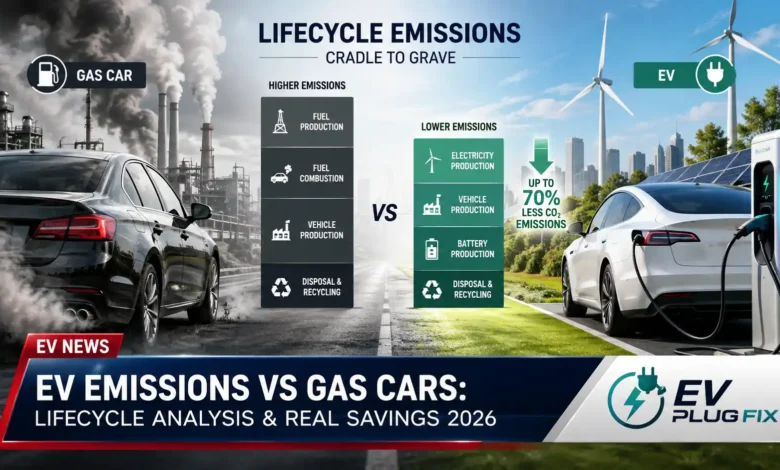
A detailed breakdown of the lifecycle emissions for an EV versus an ICE vehicle reveals the specific sources of pollution at each stage. The four primary categories are:
- Battery: The production of the battery pack, especially the extraction and processing of raw materials like lithium, cobalt, and nickel, accounts for a significant portion of an EV’s manufacturing emissions. This stage is often the most cited source of pollution for EVs, with research indicating it can contribute a substantial percentage of the vehicle’s total cradle-to-gate footprint.
- Feedstock and Fuel: This category encompasses the emissions from producing and delivering the fuel, whether it is gasoline for an ICEV or electricity for an EV. For an EV, this includes the emissions from power plants, which can vary drastically based on the energy mix. Charging with solar or other renewable sources eliminates emissions at this stage.
- Other Manufacturing and End of Life: The emissions from extracting and manufacturing materials for the vehicle body, assembly, and eventual disposal or recycling. For this stage, the two types of cars do not differ much in pollution levels, as both require similar industrial processes.
- Vehicle In-Use: The emissions produced while the vehicle is driven. This is the most significant distinction between an EV and an ICEV. An EV produces zero emissions from the tailpipe, whereas a gas-powered vehicle continuously emits CO2 and other pollutants while in operation.
The Battery Burden: Understanding EV Manufacturing Emissions
It is true that manufacturing an electric vehicle, particularly its battery, is more carbon-intensive than producing a traditional gas-powered car. The extraction of raw materials like lithium, cobalt, and nickel, and the energy-intensive processes required to synthesize battery materials and assemble cells, create a significant “carbon debt” at the outset of an EV’s life. For a typical 80 kWh lithium-ion battery, such as the one in a Tesla Model 3, CO2 emissions for manufacturing can range from 2,400 kg to 16,000 kg, depending on where and how the battery is produced. Much of this variability is due to the energy source used in manufacturing; around 77% of the world’s lithium-ion batteries are produced in China, where coal is a primary energy source.
The type of battery chemistry also plays a critical role in its environmental footprint. A comparative lifecycle assessment of Lithium Iron Phosphate (LFP) and Nickel Manganese Cobalt (NMC) batteries in India found significant differences in their environmental impacts. The study revealed that NMC batteries had nearly double the global warming potential during the manufacturing phase (1,208 kg CO2-eq) compared to LFP batteries (573 kg CO2-eq). Furthermore, NMC batteries exhibited higher use-phase emissions and consumed six times more water in manufacturing than LFP batteries. This indicates that LFP batteries, which are increasingly used in popular EV models like the Tesla Model 3 RWD, offer a more environmentally sustainable option, particularly in regions with coal-dominated electricity grids and water scarcity issues. For more insights on battery longevity, check out these EV Battery Health Tips to maximize your battery’s lifespan and efficiency.
Despite the higher upfront manufacturing emissions, research consistently shows that EVs make up for this initial carbon debt during the use phase. One study found that while the CO2 emissions associated with BEVs are 30% higher than ICEVs during the first two years, after the second year, BEVs result in a cumulative reduction in CO2 emissions. The economic value of the climate and air pollution damage attributable to ICEVs over their lifetime is currently two to three and a half times that of BEVs, and this ratio is expected to increase as the electricity sector continues to decarbonize. This demonstrates that the long-term operational benefits of EVs far outweigh the environmental burden of their production.
The Grid Factor: How Electricity Generation Impacts EV Emissions
One of the most significant factors determining the overall environmental impact of an EV is the source of the electricity used to charge it. In regions where the electricity grid is powered by a high proportion of fossil fuels, the emissions associated with an EV’s use phase are higher. However, in areas with a cleaner grid, the benefits are substantial. The MIT study highlighted that the regional variation in emissions savings is most pronounced along the coasts of the United States, particularly in California and the Pacific Northwest, where the electricity mix includes a large share of renewables. Conversely, the emissions savings are far less pronounced in states like Colorado, Nebraska, Montana, and Wyoming, which rely more heavily on coal.
The widespread adoption of solar EV charging stations offers a promising solution to this challenge. By generating electricity from solar panels, EV owners can effectively eliminate the emissions associated with charging their vehicles, making the use phase 100% free of toxic emissions. The environmental and economic advantages of this approach are compelling. Research on grid-connected highway solar EV charging stations shows that enabling the sale of excess solar energy back to the grid can reduce the net present cost (NPC) by up to 40% and significantly lower CO2 emissions. Under policy scenarios that allow grid sales, CO2 emissions from EV operation are projected to be only 3% of 2022 levels by 2050. This highlights the immense potential of integrating renewable energy sources with EV charging infrastructure to maximize the environmental benefits of electric vehicles. Learning about Germany EV Charging Subsidies can provide valuable insights into how policy support accelerates this transition.
Looking forward, the decarbonization of national electricity grids will make the emissions benefits of EVs even more pronounced and uniform across regions. As coal-fired power plants are retired and replaced by renewable energy sources, the grid will become cleaner, directly improving the lifecycle emissions of all EVs, regardless of where they are charged. A global perspective shows this is a trend shared across the world. In Europe, for example, EVs sold today have 73% lower lifetime emissions compared to combustion cars, thanks in part to a relatively cleaner energy mix. In China, however, a single BEV generated 37.4 tons of carbon emissions in 2021, with the manufacturing phase accounting for 53% and the driving phase for 37%, largely due to the country’s heavy reliance on coal. This illustrates the critical importance of a comprehensive, region-specific approach to assessing EV emissions.
Driving Efficiency: The In-Use Advantage of EVs
The most significant advantage of electric vehicles is their efficiency and lack of tailpipe emissions during operation. The Department of Energy (DOE) data shows that gas-powered vehicles use only 14% of the fuel’s energy to move the car in stop-and-go city driving, with the rest lost in the engine and to idling. In contrast, EVs convert up to 66% of the electrical energy from the grid to power at the wheels, with even greater efficiency in city driving due to regenerative braking. This fundamental difference in how the two types of vehicles use energy makes EVs inherently cleaner to operate, even before considering the source of the electricity.
City driving is where EVs save the most emissions. Internal combustion engines are inefficient in stop-start traffic, cold starts, and idling. EVs, on the other hand, do not idle in the traditional sense, and regenerative braking helps recover energy that would otherwise be wasted. This means that drivers who frequently drive in urban environments, have a high annual travel distance, or operate larger vehicles will see a larger absolute reduction in emissions by switching to an EV. Conversely, those who replace a fuel-efficient compact car used infrequently for short trips will see a more modest emissions benefit, though it will still be positive. To maximize your EV’s efficiency, consider implementing EV Charging Load Balancing to optimize energy distribution and reduce waste.
The in-use advantage of EVs is also evident in their performance across various environmental impact categories. A systematic review comparing EVs and ICEVs found that battery electric vehicles are superior in terms of greenhouse gas emissions (182.9 g CO2-eq/km vs. 258.5 g CO2-eq/km), cumulative energy demand (3.2 MJ/km vs. 4.1 MJ/km), and fossil depletion. This demonstrates that across the vast majority of environmental metrics, the operational benefits of EVs make them a more sustainable choice. This advantage is expected to grow as battery and energy production technologies continue to improve. For a deeper understanding of improving your EV’s performance, explore EV Range Boosting Technology for innovative ways to extend your driving range.
To provide a clear, at-a-glance comparison of the emissions across different vehicle types and life cycle stages, the following table summarizes the key findings from recent lifecycle assessment studies:
| Vehicle Type | Lifecycle GHG Emissions (g CO2-eq/km) | Manufacturing Emissions | Use Phase Advantage |
|---|---|---|---|
| Gasoline (ICEV) | 258.5 | Lower than EV | Baseline |
| Battery Electric (BEV) | 182.9 | Higher due to battery | Zero tailpipe emissions, 40% lower lifecycle emissions in the U.S. |
| Plug-in Hybrid (PHEV) | Varies by use | Moderate | Can achieve 80% of BEV savings in urban areas with regular charging |
The Lifecycle Verdict: Putting EV Emissions into Perspective
The evidence from a multitude of lifecycle assessment studies provides a clear and unequivocal verdict: electric vehicles are cleaner than gas-powered cars over their entire lifespan. While they carry a higher manufacturing burden, this is more than offset by their operational efficiency and lack of tailpipe emissions. Even when accounting for the full supply chain, from raw material extraction to end-of-life recycling, EVs produce substantially lower greenhouse gas emissions. The International Council on Clean Transportation found that EVs sold in Europe had 73% lower lifetime emissions compared to combustion cars, and research using the R&D GREET Life Cycle Assessment Model found that EVs have 46% lower lifecycle emissions than gas vehicles. Understanding EV Charging Losses can help you minimize energy waste and further enhance your vehicle’s environmental performance.
A key consideration for policymakers and consumers is how to maximize the environmental benefits of EVs. The research points to several strategies:
- Decarbonize the electricity grid: The most impactful step is to shift electricity generation from fossil fuels to renewable sources. This will directly improve the emissions profile of every EV on the road.
- Invest in solar charging infrastructure: Encouraging the deployment of solar EV charging stations, especially on highways, can significantly reduce the reliance on grid electricity and lower the carbon footprint of EV charging.
- Adopt cleaner battery chemistries: Policies and incentives should promote the use of battery technologies like LFP, which have a lower environmental impact than NMC batteries, especially in regions with less sustainable manufacturing.
- Extend vehicle lifespans: Encouraging the use of EVs for longer and promoting a market for second-hand EVs ensures that the manufacturing emissions are amortized over more miles, maximizing the environmental return.
Furthermore, the shift to electric vehicles is not just about reducing greenhouse gases; it also has a significant local impact. By eliminating tailpipe emissions, EVs improve air quality in cities, reducing particulate matter and other pollutants that are harmful to human health. As Electrify America and other networks expand their charging infrastructure, the transition to electric will bring these benefits to more communities.