EV Charging Cost with Solar Panels in 2026: Save Thousands with Home PV
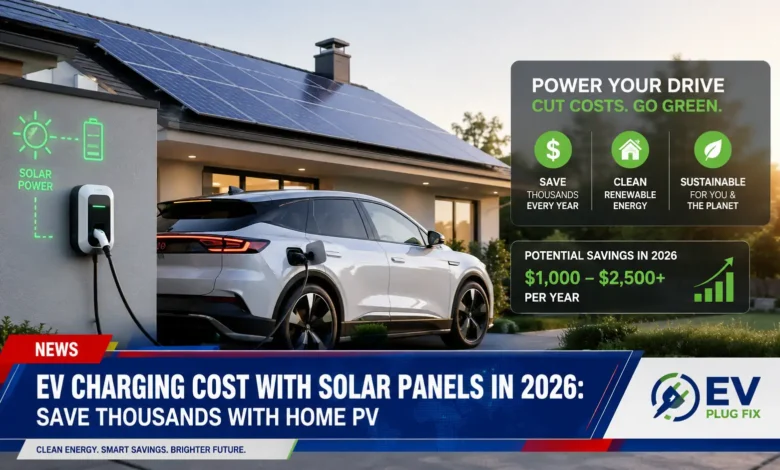
Electric vehicle charging with solar panels represents the most cost-effective and environmentally friendly way to power your car, yet many EV owners remain uncertain about the true expenses involved.
The concept is simple, but the financial reality of installing a photovoltaic system for your electric vehicle involves careful consideration of hardware costs, energy production, and long-term savings. The rule of thumb remains that driving an electric car is significantly cheaper than operating a gas-powered vehicle, whether you use solar energy or grid power. For homeowners considering this transition, understanding Home EV Wallbox Charging options provides a solid foundation for evaluating your overall investment.
When you harness natural energy specifically for charging, the primary expense is the solar panels themselves. A standard 300W photovoltaic panel typically ranges from €150 to €400, with costs increasing alongside capacity. However, this represents only the beginning of the investment.
To effectively utilize this energy, you require additional essential components: a charge controller, a solar inverter, and a separate battery if you want to store energy for nighttime or cloudy day charging. These upfront costs can be relatively high, and buying all this equipment solely for charging your car often proves less profitable than integrating it into a comprehensive home energy system. Implementing EV Charger Protection measures ensures your valuable equipment remains safe from electrical faults while maximizing your system’s longevity.
The smarter approach involves installing enough panels to power other home appliances alongside your EV. A washing machine, oven, heating system, and dishwasher all benefit from solar power, making the additional investment in inverters and charge controllers entirely reasonable. This strategy maximizes your return on investment and accelerates the payback period for your solar installation. A Home EV Wallbox Installation performed by qualified professionals ensures your system integrates seamlessly with both your solar array and household electrical infrastructure.
Understanding the True Cost Components of Solar EV Charging
Before diving into savings calculations, it’s essential to understand the comprehensive cost structure of a solar EV charging system. This involves more than just purchasing panels and calling it a day.
Equipment Expenses
The hardware required for a functional solar EV charging setup includes:
- Photovoltaic Panels: A residential system typically requires 15-25 panels, depending on your driving habits. A 6 kWp system costs roughly $14,200 in 2026.
- Inverter: Converts DC power from solar panels into AC power for your home and EV charger.
- Charge Controller: Regulates voltage and current from solar panels to prevent battery overcharging.
- Battery Storage System: A 192-unit battery system provides approximately 66.4 hours of autonomy, ensuring energy availability during low solar periods. However, battery investments typically constitute around 60% of total capital costs.
- Bidirectional EV Charger: Advanced options like the Wallbox Quasar 2 cost approximately $6,440 for hardware, with installed costs ranging from $9,500 to $13,000 depending on site conditions.
Battery replacements alone account for 97.34% of total replacement costs over a system’s lifecycle, with operation and maintenance expenses adding approximately $38,567 over the system’s lifetime.
Installation Costs
Professional installation adds significant cost to your solar EV system. A typical residential bidirectional V2H installation includes:
- Bidirectional charger hardware: $3,500 – $15,000
- Transfer switch or gateway: $1,200 – $3,500
- Critical loads subpanel (if required): $800 – $2,000
- Service entrance upgrade (if needed): $2,500 – $6,500
- Conduit and wiring: $400 – $1,500
- Permits and inspection: $250 – $800
- Electrician labor: $1,800 – $4,500
- Utility interconnection fees (V2G only): $200 – $1,500
Typical installed costs range from $8,000 to $25,000 for a complete bidirectional EV charging system.
Annual Savings: Solar vs. Grid vs. Gasoline
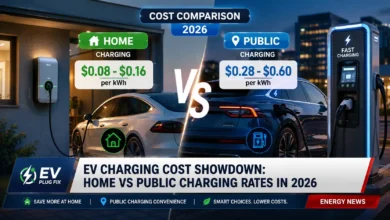
The financial advantages become clear when comparing annual costs across different charging methods. According to recent data, the average American drives approximately 13,500 miles per year. Here’s how the costs stack up:
| Charging Method | Annual Cost | 25-Year Cost | Savings vs. Gas |
|---|---|---|---|
| Solar Charging | $200 – $300 | $5,000 – $7,500 | Up to $70,000 |
| Grid Charging | $600 – $700 | $15,000 – $17,500 | ~$55,000 |
| Public Charging | $1,000+ | $25,000+ | ~$45,000 |
| Gas Vehicle | $2,500 | $62,500 | — |
These figures highlight that charging your EV with solar panels costs less than most people spend on coffee annually. The gap widens dramatically over time, as solar panel owners who charge their EVs escape the endless price escalation of grid energy and gasoline entirely.
According to a SurgePV analysis, even a large EV like the GMC Sierra EV with its 205 kWh Max Range battery can be fully charged for under $30 at home using grid electricity, while solar charging reduces this cost to essentially $0.00. In contrast, the same vehicle would cost $96 to fill with gasoline or $96 at a public fast charger. Understanding your EV Charging Time requirements helps you plan your daily schedule and optimize your solar usage patterns for maximum efficiency.
Studies confirm that the Levelized Cost of Energy (LCOE) for PV-based EV charging ranges from $0.03 to $0.12/kWh in developed economies and $0.05 to $0.37/kWh in developing ones, with payback periods spanning 6-12 years depending on solar potential, policy support, and grid reliability.
Environmental Impact: Beyond Financial Savings
The environmental benefits of solar-powered EV charging are equally compelling. Photovoltaic-based EV charging stations can reduce lifecycle greenhouse gas emissions to 35-110 g CO₂-eq per kWh of electricity delivered to EVs on a well-to-wheel basis.
This represents a 75-90% reduction compared with grid-only charging. Furthermore, local pollutants such as SO₂, NOₓ, and CO decline by up to 80%, underscoring the environmental superiority of PV-based EV infrastructure.
In concrete terms, a solar-powered system achieves an 87.5% reduction in greenhouse gas emissions, emitting only 1,917 kg CO₂/year compared to 15,330 kg CO₂/year for grid-based charging. This significant reduction contributes meaningfully to global sustainability efforts and aligns with Sustainable Development Goals 7 and 13.
The economic benefits extend to grid stability as well. A PV-grid hybrid system offers the lowest LCOE at approximately ₹6.14/kWh (in the Indian context) with a payback period of 7.59 years, while wind integration can reduce emissions by an additional 16.42%.
Bidirectional Charging: The Next Frontier
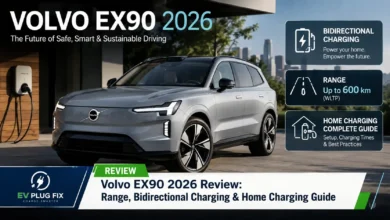
Advanced bidirectional charging technology transforms your EV from a simple energy consumer into a mobile power station. These systems enable vehicle-to-home (V2H) and vehicle-to-grid (V2G) power flow, allowing you to use your EV battery to power your home during outages or peak rate periods. The integration of Bidirectional EV Charging capabilities represents a paradigm shift in how homeowners approach energy independence and backup power planning.
In 2026, eight hardware platforms compete in the bidirectional charger market, with prices ranging from $3,500 to $15,000. Leading options include:
- Wallbox Quasar 2: 11.5 kW charge / 12.48 kW discharge, residential V2H/V2G, $6,440 hardware
- dcbel Ara: 15.2 kW DC, residential all-in-one, $9,999
- Ford Charge Station Pro + Sunrun HIS: 19.2 kW charge / 9.6 kW V2H, F-150 Lightning proprietary, $1,310 + $3,895
- GM Energy PowerShift Charger + PowerVault: 19.2 kW charge / 9.6 kW V2H, $7,099 + $10,599
The typical EV battery stores 50-100 kWh—enough to power a home for 2-5 days. This represents a fundamental shift in how homeowners view their vehicles, transforming them into valuable energy assets that can generate savings and provide backup power when needed most.
A residential rooftop system installed in Sacramento in 2024 cost approximately $14,200 for a 6 kWp system. When combined with a bidirectional EV charger and a compatible EV like the Ford F-150 Lightning, the same homeowner gains approximately 131 kWh of mobile storage—roughly equivalent to 10 Tesla Powerwalls on wheels.
Maximizing Your Return on Investment
To optimize your solar EV charging investment, consider these strategies:
- Right-size your system: A 34 kW photovoltaic array generates approximately 62,294 kWh annually, meeting an EV demand of 38,325 kWh/year and yielding a 31.54% surplus.
- Include battery storage: Battery storage provides 66.4 hours of autonomy, ensuring energy availability during low solar generation periods.
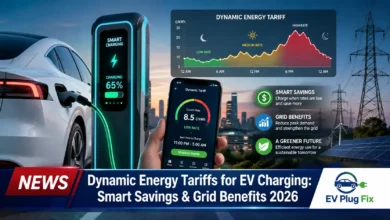
- Time-of-use optimization: Leverage bidirectional charging to store energy when rates are low and discharge during peak periods, maximizing arbitrage opportunities.
- Consider V2H integration: Systems like GM Energy PowerShift enable the GMC Sierra EV to power home loads during peak rates, with home EV grid electricity costing approximately $28 per fill-up compared to $96 for gas.
- Take advantage of incentives: Net metering, feed-in tariffs, and targeted subsidies substantially enhance project viability.
According to a global techno-economic review of 97 studies (2015-2025), supportive mechanisms such as feed-in tariffs, net metering, and targeted subsidies substantially enhance the viability of solar EV charging projects.
A real-world example comes from microgrid expert Jim Reilly, who shares his experience with a complete home electrification setup featuring rooftop solar, a GM Energy home backup battery, and a GMC Sierra EV. Reilly’s calculations show that while gas costs $96 for a full tank and public EV charging also costs $96, home EV charging at grid rates costs $28, and solar EV charging costs $0.00 (locked-in independence).