EV Charging Efficiency 2026: How Power Modules Cut Energy Costs & Improve Uptime
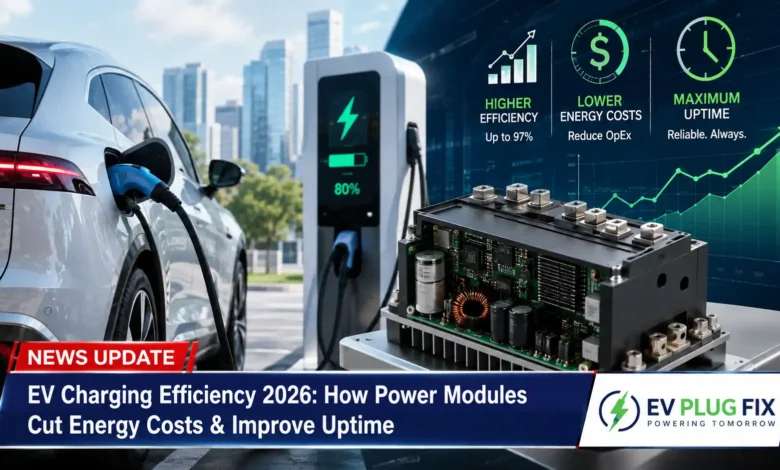
Every year, charging station operators lose thousands of dollars in electricity that never reaches an electric vehicle. It dissipates as heat, consumed by cooling fans, or lost during power conversion, quietly eroding profitability. In 2026, the solution to this persistent drain lies at the heart of the DC fast charger: the power module. These critical components have evolved significantly, with advanced technologies like silicon carbide (SiC) now delivering peak conversion efficiencies exceeding 98.5%, directly lowering operational expenses and improving station reliability.
For Charge Point Operators (CPOs) and fleet managers, the choice of power modules has become a strategic financial decision. Higher-efficiency modules, modular architectures, and intelligent control systems reduce energy losses, improve uptime, and lower operating costs. In 2026, well-designed power modules help stations deliver more usable power while cutting long-term expenses, transforming charging infrastructure from a cost center into a more profitable, efficient asset. I have worked with charge point operators and fleet managers for years as general manager at Parwatt New Energy, where we design and supply power modules and complete DC charging systems. I regularly review station performance data and see the same pattern. Sites that use older or lower-efficiency modules pay more for electricity and cooling while delivering less consistent power to drivers. Our 30kW Power Module and 40kW Power Module are built to raise conversion efficiency and support flexible station designs.
Why Charging Station Efficiency Still Costs Operators More Than They Realize
Energy losses inside the charger convert into heat and higher electricity bills. Cooling systems work harder. Components run hotter and age faster. Stations with lower efficiency deliver less usable power for the same grid input and face higher operating costs over time. Understanding the nuances of AC vs DC Charging is fundamental to grasping why these losses occur and how they impact overall station performance. These effects are easy to overlook until the monthly numbers arrive.
The Real Financial Impact of Inefficiency
Examining operating data from stations running continuous high-power sessions reveals a clear pattern. A difference of only two or three percentage points in conversion efficiency can translate into thousands of dollars per year in extra energy costs at a busy site. The lost energy appears as heat that must then be removed by fans or liquid cooling systems, adding further electricity use and maintenance. For high-utilization sites with annual energy throughput in the megawatt-hours, these small percentage losses become significant absolute costs.
Lower efficiency also affects thermal stress. Power electronics that run hotter experience faster wear. Capacitors, semiconductors, and connectors reach the end of their useful life sooner. Operators then face earlier module replacements and more unplanned downtime. This is especially critical as modules like the ENSD Sirius 40Max with fanless natural cooling are designed to mitigate these issues, offering IP65-rated protection against dust and moisture to enhance long-term reliability in harsh environments.
Station utilization suffers as well. When modules run less efficiently, the system may need to derate power earlier to stay within thermal limits. Drivers receive slower charging during peak periods, and the station delivers fewer successful high-power sessions per day. This derating directly impacts revenue and customer satisfaction. The financial implications are so significant that research shows optimized power factor correction, a key function of modern power modules, can reduce energy losses by over 18% under peak-load conditions, highlighting the direct link between module technology and a station’s bottom line.
| Efficiency Problem | What Happens | Cost or Performance Impact |
|---|---|---|
| Conversion losses | More grid energy turns into heat | Higher electricity bills |
| Extra cooling demand | Fans or pumps run longer and harder | Increased auxiliary energy use |
| Higher component temperatures | Faster aging of power electronics | Earlier module replacement |
| Earlier power derating | Charger reduces output to protect itself | Slower sessions and lower throughput |
| Lower usable power | Less energy reaches the vehicle | Reduced revenue per session |
Public fast-charging hubs and fleet depots feel these costs most strongly. High daily energy throughput turns small percentage losses into large absolute numbers. Stations that ignore module efficiency often discover the true expense only after months of operation. Addressing efficiency at the module level is one of the most direct ways to improve station economics.
Common Misconceptions About Power Modules in DC Fast Chargers
Many operators still view power modules as simple power-building blocks that can be stacked without much thought. They focus on total kilowatts and pay less attention to efficiency curves, redundancy, and thermal behavior. These misconceptions lead to higher long-term costs and less flexible station designs.
Clearing the Main Myths
One frequent myth is that any module of the right power rating will perform the same. In practice, efficiency varies with load. A module that looks good at full power may lose more energy at the partial loads that are common during real charging sessions. Operators who ignore the full efficiency curve pay more than necessary.
Another myth is that redundancy is only a reliability feature. Modular designs that can isolate a failed module also keep the remaining modules operating closer to their efficient range. This dual benefit of uptime and efficiency is often missed. Some buyers focus only on the lowest purchase price per kilowatt. Higher-efficiency modules, especially those using silicon carbide devices, cost more upfront. The difference is frequently recovered through lower energy and cooling costs within a few years at busy sites. For instance, the latest SiC modules from Infineon and Wolfspeed offer significant reductions in RDS(on), leading to lower conduction losses and over 30% higher power density, directly translating to more compact designs and reduced operational costs over the station’s lifetime.
| Misconception | Reality in 2026 | Consequence of the Myth |
|---|---|---|
| Modules are just power blocks | Efficiency and control vary widely | Higher energy losses |
| Only full-load efficiency matters | Partial-load efficiency is critical | Extra losses during typical sessions |
| Redundancy only helps uptime | It also supports efficient operation | Missed energy savings |
| Lowest price per kW is best | Higher efficiency often pays back | Higher lifetime energy costs |
| Cooling is independent | Module design drives heat load | Oversized or stressed cooling |
This table helps operators look beyond the nameplate power rating. At Parwatt, we publish clear performance data for our 30kW Power Module and 40kW Power Module so customers can compare real efficiency, not just peak numbers. You can also explore complete charging systems in our EV Charger Category.
How Modular Power Architecture Actually Raises Charging Efficiency
Modern DC fast chargers use multiple power modules working together. Intelligent control turns modules on or off according to demand, keeps each module near its efficient operating point, and shares power across connectors. New semiconductor technology further reduces conversion losses.
Core Technical Approaches
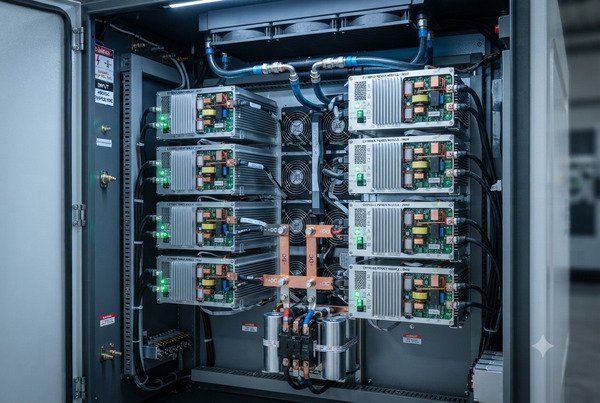
Modules are connected in parallel to reach the total power rating of the charger. A 180 kW charger might use six 30 kW modules. The control system decides how many modules are active based on the power requested by the vehicle and by other connectors. When demand is low, some modules can stay offline. The active modules then operate closer to the load range where their efficiency is highest. This approach avoids the higher losses that occur when a large single converter runs at a small fraction of its capacity. Research confirms that modular architectures with stacked power modules, like the 40kW modules that have become mainstream, provide this flexibility, optimizing station charging capacity while meeting different single-port demands.
Silicon carbide (SiC) devices are at the heart of this efficiency leap. They enable higher switching frequencies and lower conduction losses compared with traditional silicon semiconductors. SiC-based modules deliver better efficiency and higher power density, generating less heat for the same output power. For example, the ENSD Sirius 40Max achieves peak efficiency above 99% and a weighted efficiency up to 98.5%, materially reducing power loss and optimizing station energy costs. Similarly, Tonhe Technology’s 40kW power modules, built with SiC technology, achieve peak efficiency ≥97.5% and are certified to UL 2202 and FCC standards, ensuring compliance with the stringent requirements of the North American market under the NEVI program.
Power factor correction and low harmonic distortion further improve overall system efficiency. Modules that maintain a power factor close to 0.99 reduce the extra current drawn from the grid and can lower the cost of electrical infrastructure. Research shows that advanced control mechanisms in modern chargers can achieve an average power factor of 0.9995 with total harmonic distortion as low as 2.84%, demonstrating the effectiveness of these designs.
| Mechanism | How It Improves Efficiency | Practical Result |
|---|---|---|
| Modular parallel operation | Matches active capacity to demand | Lower partial-load losses |
| Dynamic module on/off control | Keeps modules near peak efficiency | Better average efficiency |
| Silicon carbide devices | Reduces switching and conduction losses | Higher conversion efficiency |
| High power factor | Lowers reactive and harmonic currents | Reduced infrastructure burden |
This table shows how architecture and device technology work together. At Parwatt, our power modules are designed for exactly these operating modes. They support flexible paralleling and efficient performance across a wide load range so stations can maintain high efficiency whether one vehicle or several are charging.
I have reviewed station designs that moved from older fixed converters to modular SiC-based systems. Measured energy losses dropped and the cooling systems ran with less effort. Drivers also experienced more consistent high-power delivery because the thermal margin improved. These gains come directly from the modular approach and the underlying device technology. Dynamic power allocation across multiple connectors adds another layer of efficiency, ensuring better use of the installed hardware and fewer situations where power sits idle.
What High-Efficiency Power Modules Deliver for Station Operators
High-efficiency modular power systems produce clear operational benefits. Energy costs fall. Cooling demand decreases. Uptime improves because individual modules can fail without taking the entire charger offline. Stations can also scale power more easily as demand grows. Implementing EV Charging Load Balancing further optimizes power distribution across multiple vehicles, maximizing the efficiency gains from the modular architecture.
Tangible Benefits at the Station Level
Lower conversion losses mean more of the purchased electricity reaches the vehicle. At high-utilization sites, the annual energy savings become substantial. A typical 2% efficiency improvement saves approximately 2 kW of energy for every 100 kW of charging power, leading directly to lower energy bills and reduced carbon emissions per charger. This same improvement reduces the heat that must be removed, so cooling systems consume less auxiliary power and require less maintenance. The financial impact is clear: a study on IoT-enabled power factor optimization showed that improving power factor from 0.80 to 0.98 can reduce energy losses by up to 18.4% under peak load, translating directly to lower operational expenses.
Modular redundancy keeps the charger partially available when one module fails. Instead of a complete outage, the station can continue serving vehicles at reduced power until the module is replaced. Features like hot-swapping, available on modules like the ENSD Sirius 40Max, allow for replacement without damaging system components, protecting revenue and customer experience.
Scalability becomes simpler. Operators can begin with fewer modules and add more as traffic increases. The same cabinet and grid connection can support higher total power without a complete redesign. This flexibility reduces the risk of over-building at the start of a project. Better power quality eases the burden on the grid connection. High power factor and low harmonics can reduce the need for oversized transformers or additional filtering equipment, lowering the cost of the initial electrical service.
- Reduced energy losses and lower electricity bills
- Lower cooling energy use and longer cooling component life
- Continued partial operation during module failures
- Easier future power upgrades by adding modules
- Improved compatibility with existing grid infrastructure
- More consistent high-power delivery to vehicles
At Parwatt, we see these benefits when operators deploy our modular solutions. The FES-D30 DC EV Charger and higher-power systems built around our modules deliver the combination of efficiency and flexibility that busy sites need. You can also read more about charging system design in our guide on Electric Vehicle Charging.
Ready to Optimize Your Charging Station Efficiency? Here’s the Next Step
Improving station efficiency starts with understanding the performance of the current power modules and calculating the potential savings from an upgrade. Operators who measure real losses and plan modular improvements gain both lower costs and better service quality.
Practical Actions for Operators
Begin by collecting energy input and output data for representative charging sessions. Compare the results with the rated efficiency of the installed modules. Look for larger losses during partial-load operation. Review thermal performance and cooling energy use. Frequent high-temperature alarms or continuously high fan speeds often indicate that conversion losses are higher than necessary.
When planning new stations or upgrades, request full efficiency curves rather than only peak efficiency numbers. Examine how the modules perform across the load range that matches your expected traffic. Consider modular architectures that allow incremental power increases and continued operation during single-module faults. These features protect both capital investment and daily revenue. Calculate the payback period using your actual electricity rates and utilization. Even modest efficiency gains can return the cost difference within a few years at busy sites.
- Measure real energy losses across typical sessions.
- Review cooling energy consumption and thermal alarms.
- Request full efficiency data for any new modules under consideration.
- Prefer modular designs that support redundancy and staged expansion.
- Include energy and maintenance costs in total cost of ownership calculations.
- Plan cabinet and grid capacity with future module additions in mind.
At Parwatt, we help operators select and configure power modules that raise station efficiency. Our 30kW Power Module and 40kW Power Module are designed for high conversion efficiency and flexible paralleling. You can explore complete solutions in the EV Charger Category or learn more about system-level design in our article on AC vs DC EV Charging.
Frequently Asked Questions
What is a power module in an EV charger?
How does silicon carbide (SiC) improve EV charging efficiency?
What are the benefits of a modular power architecture?
Conclusion
Power modules are the core of modern DC fast charging systems. Their efficiency, modularity, and thermal performance directly influence energy costs, uptime, and the overall economics of a charging station. At Parwatt, we design our power modules to deliver high conversion efficiency and flexible operation so operators can reduce losses and scale with confidence. In 2026, advances such as silicon carbide technology and smarter module control are helping stations achieve higher efficiency while lowering infrastructure and operating expenses. Stations that use well-designed modular architectures can scale power more flexibly, maintain service when individual modules fail, and keep energy losses under better control. Don’t treat power modules as simple building blocks. Choosing high-efficiency modules is one of the most practical ways to improve both performance and long-term profitability of your charging network.