EV DC-DC Converter Explained: Function, Types & 2026 Trends
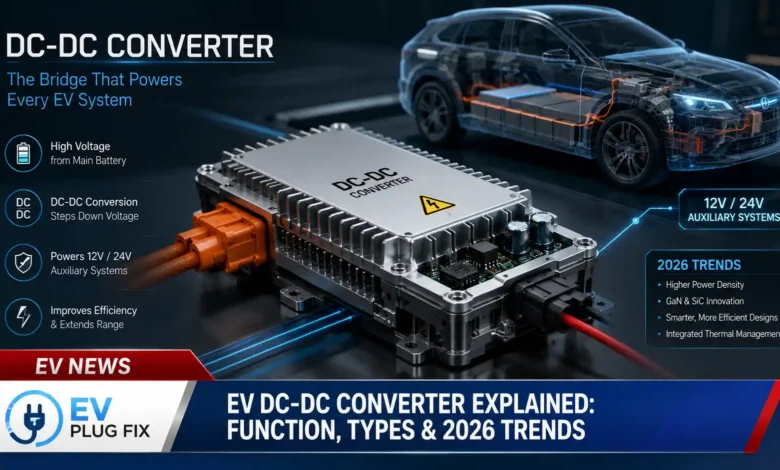
EV DC-DC converters serve as the unsung power brokers of electric vehicles, silently translating high-voltage traction battery energy into the 12V or 24V power that keeps headlights shining, infotainment screens glowing, and critical control modules operating. While the world focuses on battery capacities and motor outputs, this essential power electronics component determines whether your EV’s auxiliary systems function reliably—and it’s undergoing a technological revolution in 2026 that deserves your attention.
What Is an EV DC-DC Converter and Why Does It Matter?
An EV DC-DC converter is a power electronic device that transforms direct current electricity from one voltage level to another—specifically, stepping down the high-voltage DC from your EV’s traction battery (typically 400V to 800V) to the low-voltage DC required by standard automotive electrical systems (12V or 24V). Think of it as a voltage translator that enables your EV’s high-voltage propulsion system to coexist with the conventional electrical architecture found in every vehicle on the road today.
This conversion process isn’t merely convenient—it’s absolutely essential. The lithium-ion traction battery packs powering modern electric vehicles operate at voltages that would instantly destroy traditional 12V components. Without a DC-DC converter, your EV couldn’t power its lights, climate control system, instrument cluster, airbags, sensors, or any of the dozens of electronic control units that manage vehicle functions.
The High-Voltage to Low-Voltage Bridge
Traditional internal combustion vehicles rely on an alternator driven by the engine to generate 12V power and charge the starter battery. Electric vehicles eliminate the engine and alternator entirely, yet they still need reliable low-voltage power for all the same accessories. The DC-DC converter fills this gap by drawing energy from the high-voltage traction battery and delivering stable low-voltage output to both power vehicle systems and maintain the 12V auxiliary battery’s charge.
This arrangement creates a fundamental shift in how vehicle power systems operate. In an EV, the 12V battery serves primarily as a buffer and emergency power source—the DC-DC converter provides continuous power during driving and charging operations. When the vehicle is parked and turned off, the 12V battery handles standby loads like security systems and remote unlocking functions.
| Vehicle Type | Traction Battery Voltage | DC-DC Converter Power Rating | Typical Efficiency |
|---|---|---|---|
| Standard EV (400V system) | 250V – 450V | 1.5 – 3.0 kW | 92% – 94% |
| Premium EV (800V system) | 500V – 900V | 3.0 – 5.0 kW | 94% – 96% |
| Commercial EV / Truck | 400V – 800V | 5.0 – 10.0+ kW | 93% – 95% |
| 48V Hybrid System | 48V – 200V | 1.0 – 2.5 kW | 91% – 93% |
How DC-DC Converters Work: Inside the Power Translation Process
EV DC-DC converters rely on switched-mode power supply technology to achieve voltage conversion with minimal energy loss. The process unfolds through several precisely coordinated stages, each critical to maintaining stable, safe power delivery.
Stage 1: Input Conditioning — The converter receives high-voltage DC power from the traction battery through input filtering circuits that smooth voltage fluctuations and suppress electromagnetic interference. This ensures clean power enters the conversion stage.
Stage 2: High-Frequency Switching — Power semiconductors—typically insulated-gate bipolar transistors (IGBTs) or silicon carbide (SiC) MOSFETs—switch the input voltage on and off at frequencies ranging from tens to hundreds of kilohertz. This rapid switching transforms the steady DC input into a high-frequency pulsed waveform suitable for transformer conversion.
Stage 3: Voltage Transformation and Isolation — The pulsed waveform passes through a high-frequency transformer that performs two essential functions: voltage step-down through its turns ratio, and galvanic isolation that physically separates the high-voltage and low-voltage circuits. This isolation provides critical safety protection, preventing dangerous high voltages from reaching the vehicle’s low-voltage systems.
Stage 4: Rectification and Filtering — The transformer’s output passes through rectification circuits (using diodes or synchronous rectification technology) that convert alternating pulses back to DC power. Filtering components—inductors and capacitors—then smooth this pulsating DC into clean, stable low-voltage output.
Stage 5: Closed-Loop Regulation — A feedback control system continuously monitors output voltage and current, adjusting switching parameters to maintain precise regulation regardless of variations in input voltage or load demand. For a 12V system, this typically means maintaining output at 13.5V to 14.5V to properly charge the auxiliary battery.
Main Types of EV DC-DC Converters
Electric vehicle manufacturers select DC-DC converter types based on power requirements, safety standards, packaging constraints, and cost considerations. The three primary classification methods reveal the diversity of available technologies.
Classification by Isolation Method
Isolated Converters dominate the EV market due to their superior safety profile. By incorporating high-frequency transformers for galvanic isolation, these converters create a physical barrier between high-voltage and low-voltage circuits. This protection proves essential for occupant safety and system reliability.
Non-Isolated Converters omit transformers, offering smaller size and lower cost at the expense of electrical isolation. These find limited application in EVs, typically only in specific scenarios where isolation isn’t required or is provided elsewhere in the system.
Classification by Topology
Common circuit topologies include buck (step-down), boost (step-up), and buck-boost (step-up/down) converters for non-isolated designs. For isolated converters, engineers commonly employ full-bridge, half-bridge, forward, or flyback topologies. Electric vehicles typically favor full-bridge or half-bridge designs because they deliver excellent efficiency and reliability at the high power levels required for automotive applications.
Classification by Power Rating
- Low-power (1-3 kW): Suitable for standard EVs with conventional 12V systems and modest accessory loads
- Medium-power (3-5 kW): Used in premium EVs equipped with extensive electrical features and higher power demands
- High-power (5 kW+): Required for commercial vehicles, trucks, and EVs with 48V auxiliary systems
“The DC-DC converter represents the invisible backbone of EV electrical systems. Its evolution from simple power conversion to intelligent, adaptive energy management mirrors the broader transformation of automotive technology.”
Critical Technical Parameters for DC-DC Converter Selection
When engineers evaluate DC-DC converters for electric vehicle applications, several key parameters determine suitability for the demanding automotive environment.
Input Voltage Range must accommodate the full operating range of the traction battery. For 400V systems, this typically spans 250V to 450V; 800V systems require 500V to 900V capability. The converter must maintain stable output even as battery voltage fluctuates with state of charge and load conditions.
Output Regulation Accuracy determines how precisely the converter maintains target voltage. For 12V systems, output typically requires regulation within 13.5V to 14.5V to properly charge the auxiliary battery while preventing overvoltage damage to sensitive electronics.
Conversion Efficiency directly impacts vehicle range and thermal management. Premium automotive converters achieve 92% to 96% efficiency, meaning only 4% to 8% of input power becomes waste heat. At 3 kW output, 95% efficiency means just 150W of heat requiring dissipation—manageable with proper thermal design.
Power Density measures output capability per unit volume or weight. Higher density enables compact, lightweight designs—critical advantages in EVs where space and weight affect range and performance. Advanced designs using SiC semiconductors achieve significantly higher density than traditional silicon-based converters.
Operating Temperature Range must span -40°C to +85°C or wider to ensure reliable operation across extreme climate conditions. Automotive-grade components undergo rigorous testing to verify performance across this temperature spectrum.
Electromagnetic Compatibility (EMC) presents particular challenges because high-frequency switching generates electromagnetic interference. Converters must comply with strict automotive EMC standards to prevent interference with sensitive electronics, radio reception, and communication systems.
Reliability and Service Life represent non-negotiable requirements. Automotive components must typically survive 15 years or 200,000 kilometers of operation. Manufacturers validate reliability through extensive testing including thermal cycling, vibration, humidity exposure, and electrical stress.
“At 95% efficiency with a 3kW converter, 150W of heat must be dissipated—equivalent to a small space heater operating inside your EV’s power electronics enclosure. This is why thermal management is as critical as electrical design.”
Thermal Management: The Hidden Challenge
Despite impressive conversion efficiencies, EV DC-DC converters generate substantial heat during operation. Managing this thermal load is essential for maintaining efficiency, reliability, and component longevity.
Modern EVs employ sophisticated thermal management strategies for their DC-DC converters. Liquid cooling integrated with the vehicle’s main thermal management system provides the most effective solution for high-power applications. Forced air cooling using dedicated fans offers a simpler, lower-cost alternative for lower-power designs. Advanced heat sink designs with high-efficiency thermal interface materials help dissipate heat in space-constrained installations.
Proper thermal management also prevents semiconductor degradation. Power devices experience accelerated aging at elevated temperatures, potentially shortening converter life and compromising reliability. The thermal design must maintain junction temperatures within specified limits even under maximum load and worst-case ambient conditions.
The 2026 trend toward silicon carbide semiconductors is transforming thermal management. SiC devices can operate at higher temperatures than conventional silicon while delivering better efficiency—enabling smaller, lighter cooling systems and higher power density overall.
Integration with EV Vehicle Architecture
Modern DC-DC converters don’t operate in isolation—they’re deeply integrated into the vehicle’s broader electrical and communication architecture. This integration enables sophisticated power management strategies that optimize overall vehicle efficiency and reliability.
The converter communicates with the Battery Management System (BMS) to monitor high-voltage battery status and coordinate power draw based on state of charge and health. It exchanges data with the Vehicle Control Unit (VCU) to manage power distribution priorities during different driving modes.
During regenerative braking, for example, the DC-DC converter may reduce its output as the motor controller feeds energy back into the high-voltage battery. During rapid acceleration, it ensures low-voltage systems remain stable despite the heavy draw from the high-voltage traction system. These coordinated actions require robust communication protocols—typically CAN (Controller Area Network) or LIN (Local Interconnect Network) buses.
Future Integration Trends
- DC-DC converter integration with onboard chargers (OBC)
- Combined power modules for motor drive and auxiliary power
- Direct integration with 48V mild-hybrid systems
- Software-defined power management via OTA updates
System Benefits
- Reduced cabling and connector complexity
- Lower overall system cost and weight
- Improved reliability through fewer discrete components
- Enhanced thermal management via shared cooling
Safety Features and Protection Mechanisms
Automotive-grade DC-DC converters incorporate multiple layers of protection to ensure safe, reliable operation under all conditions. These protection systems work both independently and in concert to prevent damage and maintain occupant safety.
- Overvoltage Protection (OVP): Prevents damage from voltage spikes on either input or output. If voltage exceeds safe thresholds, the converter either limits output or shuts down.
- Overcurrent Protection (OCP): Limits output current to safe levels during short-circuit conditions or excessive loads, preventing thermal damage and component failure.
- Overtemperature Protection (OTP): Reduces output power or initiates shutdown if internal temperatures exceed safe limits, protecting semiconductors and other temperature-sensitive components.
- Undervoltage Lockout (UVLO): Prevents operation when input voltage falls below minimum thresholds, ensuring the converter doesn’t attempt to operate under conditions that could cause instability or damage.
- Isolation Monitoring: Continuously verifies the integrity of electrical isolation between high-voltage and low-voltage circuits. Any degradation triggers warnings or protective shutdown to prevent potential safety hazards.
These protection mechanisms work together to create a robust, fail-safe system that protects both the vehicle and its occupants. They’re complemented by diagnostic capabilities that enable vehicle systems to monitor converter health and alert drivers to potential issues before failures occur. For more insights on maintaining your EV’s electrical systems, check out our EV Charger Troubleshooting Guide.
2026 Innovations: Bidirectional Power Flow and Silicon Carbide
The EV DC-DC converter is undergoing transformation driven by new technologies and evolving vehicle architectures. Two developments stand out as particularly significant for 2026 and beyond.
Bidirectional Power Flow represents a paradigm shift from traditional unidirectional designs. Conventional converters only transfer energy from high-voltage to low-voltage systems. Bidirectional converters enable power to flow in both directions, opening new capabilities. A 12V auxiliary battery could provide temporary support to the high-voltage system during certain operations. Vehicle-to-load (V2L) functions could draw from the 12V system for emergency power. This bidirectional capability enhances overall vehicle versatility and energy management flexibility.
Silicon Carbide (SiC) Semiconductors are rapidly replacing conventional silicon in premium EV power electronics. SiC devices offer superior characteristics—higher switching frequencies, lower switching losses, and higher temperature operation. These advantages translate directly to smaller, lighter converters with better efficiency. For EV manufacturers, SiC enables higher power density, reduced cooling requirements, and improved overall range. The technology is increasingly cost-competitive, accelerating adoption across vehicle segments. You can learn more about these advancements in our Skoda Elroq SE 50 Review and Fiat Topolino Review, which showcase modern EVs leveraging these technologies.
Cost Considerations and Market Trends for 2026
DC-DC converter costs have steadily declined as production volumes increased and manufacturing processes matured. However, these components still represent a significant portion of an EV’s power electronics budget—typically ranging from several hundred to over a thousand dollars depending on power rating and features.
Manufacturers pursue cost reduction through component standardization across vehicle platforms, increased use of automotive-qualified commercial components, and design optimization that minimizes material usage while maintaining performance. The shift to silicon carbide, while initially more expensive, is reducing overall system costs through smaller cooling systems and simpler packaging.
Market trends point toward continued cost reduction, making EVs more accessible while enabling new features. The integration of DC-DC converters with onboard chargers and motor drives promises to reduce component count and simplify vehicle architecture, delivering cost savings beyond the converter itself. To understand how these efficiencies impact total ownership, explore our analysis on EV Leasing Costs.
Environmental Impact and Sustainability
Beyond their operational role, DC-DC converters contribute to the overall environmental profile of electric vehicles. High-efficiency converters minimize energy waste, extending vehicle range and reducing the environmental impact of electricity generation. Every percentage point of efficiency improvement delivers measurable reductions in energy consumption over the vehicle’s lifetime.
Manufacturers are increasingly considering the full lifecycle environmental impact of these components. The use of recyclable materials in construction, designs that facilitate end-of-life disassembly and material recovery, and the transition to more environmentally friendly materials—such as lead-free solders and recyclable enclosures—reflect broader sustainability initiatives. These design considerations also apply to other components like Copper EV Charging Cables, where material selection plays a key role in efficiency and sustainability.
“Most EV owners never see their DC-DC converter—it’s tucked away under the hood or beneath the vehicle floor, operating silently and efficiently. Yet this humble component is quietly enabling the electric vehicle revolution, one voltage conversion at a time.”
The Path Forward: What to Expect from Future DC-DC Converters
As electric vehicle technology continues its rapid evolution, DC-DC converters are following several clear development trajectories. Understanding these trends helps EV buyers, fleet managers, and industry professionals prepare for the future of automotive power electronics.
Higher Voltage Architectures: The shift from 400V to 800V systems continues, with some manufacturers exploring 1000V+ architectures. Future converters must handle these higher input voltages while maintaining efficiency and reliability.
Increased Integration: DC-DC converters will increasingly combine with onboard chargers, inverters, and other power electronics into unified modules. This integration reduces weight, cost, and packaging complexity while enabling enhanced thermal management.
Intelligent Energy Management: Software-defined power management will enable converters to adapt their behavior based on driving conditions, battery status, and user preferences. Over-the-air updates could optimize converter performance throughout the vehicle’s life.
Predictive Maintenance: Advanced diagnostic capabilities will allow vehicle systems to predict converter issues before they cause failures, reducing downtime and improving reliability.
Enhanced Connectivity: Future converters will communicate with cloud-based systems, enabling fleet operators to monitor converter health across vehicles and optimize maintenance schedules.
Conclusion: The Essential Bridge in EV Power Architecture
While the DC-DC converter may never achieve the name recognition of batteries, motors, or charging systems, its role in electric vehicle power architecture is absolutely essential. It quietly bridges the high-voltage traction system and the low-voltage auxiliary system, ensuring that every electrical device in the vehicle receives stable, reliable power. Understanding its working principles and importance provides a more complete picture of EV technology architecture and supports better decisions when purchasing, maintaining, or operating electric vehicles.
As electric vehicle technology continues to mature and the market expands, DC-DC converter technology will advance in parallel—delivering more efficient, reliable, and intelligent power solutions. The developments in bidirectional capability, silicon carbide semiconductors, and system integration represent the next wave of innovation in this critical automotive component.
The DC-DC converter exemplifies how seemingly simple components play vital roles in complex systems. Its evolution from basic power conversion to sophisticated, intelligent energy management reflects the broader transformation of the automotive industry toward an electrified, connected, and sustainable future. For more information on EV charging and power systems, explore our guides on EV Charging Time and EV Charging Levels Guide.