EV Charging Adapters Explained: Standards, Speeds & Global Compatibility 2026
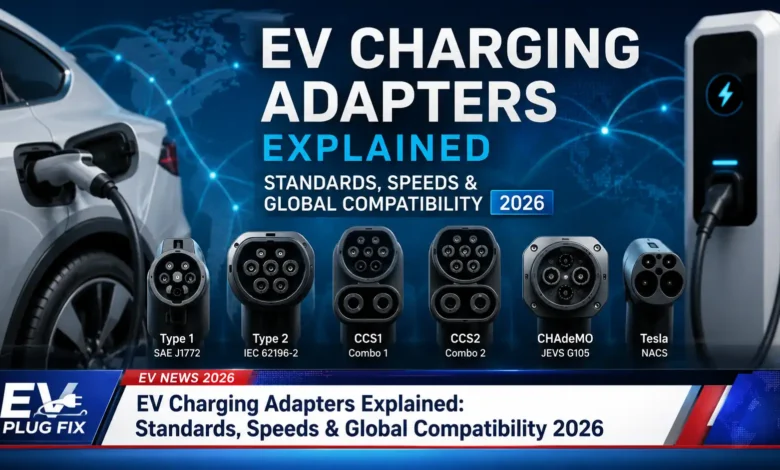
EV charging adapters form the critical bridge between your electric vehicle and the diverse world of public charging stations, yet their technical specifications and regional variations often confuse even seasoned EV owners. As the global electric vehicle fleet expands rapidly, understanding the nuances of connector types like CCS1, CCS2, NACS, and CHAdeMO has become as essential as knowing your car’s range. This journalistic deep-dive cuts through the complexity, offering a comprehensive technical examination of each major standard, their real-world charging speeds, and practical advice for seamless travel across continents in 2026.
The AC vs DC Charging Foundation: Why It Matters for Adapters
Before dissecting specific connector types, we need to establish the fundamental electrical principles governing all EV charging. The electricity flowing from your wall outlet or public charger arrives as Alternating Current (AC), but your vehicle’s battery pack stores energy as Direct Current (DC). This distinction shapes everything about your charging experience and dictates the role of your vehicle’s onboard hardware. Understanding the AC to DC Conversion process is essential for grasping why adapter types matter in different charging scenarios.
Alternating Current (AC) Charging: The Daily Workhorse
When you plug into a standard home outlet or a workplace Level 2 charger, you’re using AC power. The vehicle’s built-in onboard charger converts this incoming AC to DC before safely storing it in the battery. This conversion process inherently limits the power flow, which is why AC charging is slower but also more economical and gentle on battery cells. Typical AC power levels range from 3.7 kW up to 22 kW, translating to roughly 15-50 miles of range added per hour of charging. For a standard 60 kWh battery pack, a full charge typically requires between 4 to 10 hours, making AC the undisputed champion for overnight Home EV Charger Guide setups and workplace top-ups.
Direct Current (DC) Charging: The Road Trip Essential
DC fast charging fundamentally changes the game by moving the AC-to-DC conversion process from your car to the charging station itself. This allows the station to deliver high-power DC directly to the battery, bypassing the vehicle’s onboard charger limitations. Modern DC fast chargers output anywhere from 50 kW to a staggering 350 kW, capable of adding 60-200 miles of range in just 20-30 minutes. However, smart battery management systems automatically reduce charging speeds as the battery approaches 80% capacity to preserve long-term health. This makes DC fast charging ideal for quick en-route replenishment during long journeys, while AC remains the preferred choice for everyday use.
North American Charging Standards: J1772, CCS1, and the NACS Shift
The North American charging landscape is undergoing its most significant transformation since the EV era began, driven largely by Tesla’s decision to open its proprietary connector technology. Understanding this evolving ecosystem is crucial for any EV driver in the United States and Canada.
SAE J1772 (Type 1): The AC Foundation
The SAE J1772 connector, often called Type 1, has been the default AC charging standard for non-Tesla EVs in North America and Japan since the early 2000s. Featuring a five-pin design supporting single-phase power, this connector incorporates control pilot communication—a safety system that ensures a secure connection before allowing current flow, preventing electrical hazards. Nearly every non-Tesla EV sold in North America, including models like the Nissan Leaf, Chevrolet Bolt, and Ford Mustang Mach-E, features a J1772 port. Charging speeds vary significantly based on voltage: Level 1 (120V) can take 40-50 hours for a full charge, while Level 2 (240V) typically completes the job in 4-10 hours.
CCS1 (Combined Charging System Type 1): The Fast-Charging Standard
CCS1 extends the J1772 base by adding two dedicated high-speed DC pins below the connector, creating a combined unit that supports both AC and DC charging through a single vehicle port. This elegant design eliminates the need for separate charging sockets and has made CCS1 the dominant DC fast-charging standard across North America. Maximum power output reaches 360 kW, though stations delivering over 200 amperes require liquid-cooled cables to maintain safe operating temperatures. Most new non-Tesla EVs come equipped with CCS1 ports, making it the most accessible fast-charging option for road trips.
NACS (North American Charging Standard): Tesla’s Connector Goes Mainstream
Tesla’s proprietary connector, now officially designated as NACS, represents a pivotal moment for North American charging standardization. Its compact design supports both AC and DC charging at all power levels, and its widespread deployment through the Tesla Supercharger network has proven its reliability. The seismic shift came when major automakers including Ford, GM, Hyundai, Rivian, and Volvo announced plans to equip new models with NACS ports starting in 2025. This unprecedented industry alignment signals North America’s journey toward a single, unified connector standard, dramatically simplifying the charging experience for future EV owners.
“The move toward NACS standardization across North America is accelerating faster than anyone predicted. By 2026, you’ll likely see more NACS-equipped vehicles on the road than any other connector type.” — EVPlugFix Charging Infrastructure Report
European Charging Standards: Type 2 and CCS2 Dominance
Europe has taken a different path to standardization, favoring the technologically superior Type 2 connector and its fast-charging derivative, CCS2. This unified approach has created one of the most seamless charging experiences globally.
Type 2 (Mennekes): The European AC Standard
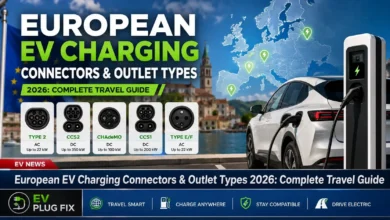
The Type 2 connector, commonly called the Mennekes plug, is Europe’s mandatory AC charging standard since 2014. Its automatic locking mechanism, built according to the IEC 62196 specification, physically secures the connector to the vehicle during charging—a crucial safety feature preventing unauthorized disconnection. Unlike the North American J1772, Type 2 supports both single-phase and three-phase charging, allowing for significantly faster AC speeds. Using a 7 kW home charger, a 40 kWh battery typically requires 4-6 hours for a full charge, while a 22 kW public AC unit can achieve full charge in just 1-2 hours. The overwhelming majority of European EVs and charging stations use Type 2 connectors.
CCS2 (Combined Charging System Type 2): The European Fast-Charging Solution
CCS2 combines the Type 2 standard with two dedicated DC pins, creating a versatile single-port solution for all charging scenarios. This is currently the most widely deployed DC fast-charging standard across Europe, supported by every major automaker including Audi, BMW, Daimler, Ford, GM, Porsche, and Volkswagen. While the European Parliament’s attempt to mandate CCS2 as the exclusive standard wasn’t fully realized, the connector nevertheless dominates the continental fast-charging landscape, providing EV drivers with exceptional interoperability across borders. For advanced charger management in European deployments, solutions like the go-e Portal Review demonstrate how software platforms enhance the charging experience.
Asian Charging Standards: CHAdeMO, GB/T, and Emerging Technologies
Asia presents the most diverse and complex charging ecosystem, with Japan championing CHAdeMO, China developing its own GB/T standard, and both markets gradually shifting toward global compatibility.
CHAdeMO: Japan’s DC Fast-Charging Pioneer
Developed by five Japanese automakers including Nissan and Mitsubishi, CHAdeMO (originally meaning “the charging time is as short as a tea break”) was the first global DC fast-charging standard to achieve widespread deployment. Despite efforts to promote it internationally, CHAdeMO’s adoption remains concentrated in Japan and select markets. The standard requires vehicles to maintain separate AC and DC ports, increasing design complexity compared to CCS solutions. From 2015 to 2019, global CHAdeMO stations grew from 10,000 to 25,600 units, with 9,200 in Europe and 7,600 in Japan. While vehicles like the Nissan Leaf and Mitsubishi Outlander PHEV continue to support CHAdeMO, Japanese automakers are progressively transitioning to CCS for their North American and European models.
GB/T: China’s Domestic Standard
China has developed its own comprehensive charging standard system known as GB/T (Guobiao), encompassing both AC and DC connectors. This standard is fully adapted to China’s domestic industrial requirements and supports an extensive nationwide charging network. The GB/T standard uses different communication protocols than CCS or CHAdeMO, making cross-standard interoperability challenging without specialized adapters. Chinese EV manufacturers including XPeng and Geely equip their vehicles with GB/T ports for the domestic market. Notably, GB/T is collaborating with CHAdeMO on the development of the third-generation ChaoJi connector, targeting an extraordinary 900 kW power output.
| Connector Standard | Primary Region | AC Power Range | DC Power Range | Vehicle Examples |
|---|---|---|---|---|
| J1772 (Type 1) | North America, Japan | 3.7 – 22 kW | N/A | Nissan Leaf, Chevrolet Bolt |
| CCS1 | North America | 3.7 – 22 kW | Up to 360 kW | Ford Mustang Mach-E, Hyundai Ioniq 5 |
| NACS | North America | Up to 19.2 kW | Up to 350 kW | Tesla Models, Ford, GM (2025+) |
| Type 2 (Mennekes) | Europe | 3.7 – 43 kW | N/A | BMW i3, Renault Zoe |
| CCS2 | Europe | 3.7 – 43 kW | Up to 350 kW | VW ID.4, Audi e-tron, Porsche Taycan |
| CHAdeMO | Japan, select global | N/A | Up to 100 kW | Nissan Leaf (older), Mitsubishi Outlander PHEV |
| GB/T | China | 7 – 44 kW | Up to 250 kW | XPeng, Geely, BYD |
Charging Adapter Compatibility: Connecting the Dots
With multiple standards coexisting globally, charging adapters serve as essential tools for cross-compatibility. However, several critical limitations determine whether an adapter will actually work for your specific charging scenario.
Understanding Adapter Limitations
While adapters physically connect different plug types, they cannot override your vehicle’s inherent hardware capabilities. If your EV has a maximum AC acceptance of 7 kW, connecting to a 22 kW station via an adapter won’t magically increase charging speed—the car simply won’t draw more power than its onboard charger permits.
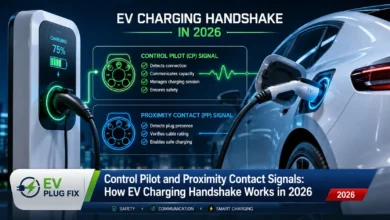
Communication protocol compatibility presents another significant hurdle. Many adapters convert physical plug shapes but fail to translate the digital handshake between vehicle and charger. The EV and the charging station must “speak the same language” through protocols like ISO 15118 Guide to initiate and maintain charging. Always verify protocol compatibility before purchasing an adapter.
Safety Certification Requirements
The safety implications of using uncertified adapters cannot be overstated. Only use adapters explicitly recommended by your vehicle manufacturer or certified by recognized regional authorities. Poorly manufactured adapters risk electrical shorts, overheating, or even damage to your vehicle’s charging port. The proliferation of cheap, uncertified adapters online represents a genuine safety hazard that EV owners should actively avoid.
Factors That Influence Real-World Charging Speeds
Beyond the connector type itself, a range of variables determine the actual charging speed you’ll experience at the plug. Understanding these factors helps you manage expectations and plan charging stops effectively. Learning about Constant Current EV Charging protocols can help you understand how your vehicle manages power intake during different stages of the charge cycle.
Vehicle Hardware and Battery Chemistry
Entry-level EVs often have maximum charge acceptance rates as low as 50 kW, meaning they cannot utilize the full power of high-output stations. Premium vehicles with advanced battery architectures support speeds up to 350 kW, drastically reducing stop times. Battery chemistry also plays a role—some cells accept higher C-rates than others, directly affecting how quickly energy can be safely stored.
Thermal Management and Battery Temperature
Battery electrochemistry functions optimally within a specific temperature range. In cold weather, chemical reactions slow down, reducing charging efficiency. Conversely, excessive heat can trigger thermal throttling to protect battery cells. Many modern EVs feature battery preconditioning systems that heat or cool the battery to ideal temperatures before arriving at a charger, maximizing speed. Planning your route with this in mind can significantly improve charging times during winter months.
State of Charge and Charging Curves
Every EV follows a charging curve that reduces power as the battery fills. The most dramatic slowdown occurs beyond 80% state of charge, where charging speeds can drop to as low as 20% of maximum. This is why the “charge to 80%” rule remains the most efficient strategy for DC fast charging—beyond that point, the extra time yields diminishing returns. For home and workplace charging, where time is less critical, carrying the charge to 100% is perfectly fine and actually beneficial for range calculation.
Looking ahead: The next generation of battery technology promises to flatten these charging curves, allowing higher speeds closer to full capacity.
Future Developments: Standardization, XFC, and ChaoJi Technology
The charging industry is evolving rapidly, with three major trends poised to reshape the EV experience by 2030 and beyond.
Industry Standardization Underway
North America is moving toward NACS unification, Europe continues reinforcing CCS2 dominance, and China strengthens its GB/T ecosystem. This consolidation will dramatically simplify the charging process for future EV owners, reducing adapter dependency and improving interoperability across charging networks.
Extreme Fast Charging (XFC) Technology
XFC stations use liquid-cooled connectors to manage the immense heat generated at 350 kW plus power levels. These advanced chargers remain backward compatible with older EVs, ensuring both new and legacy vehicles can benefit from the expanding high-power infrastructure. As XFC deployment accelerates, long-distance EV travel will become increasingly comparable to fossil fuel refueling in terms of time efficiency.
ChaoJi: The 900 kW Future
The collaborative ChaoJi project between CHAdeMO and GB/T representatives aims to deliver an astonishing 900 kW power output through a next-generation connector design. This technology would slash charging times to under 10 minutes for most passenger EVs, potentially eliminating range anxiety as a consumer concern. While still in development, ChaoJi represents the visionary direction of ultra-fast charging technology and highlights the importance of global cooperation in advancing EV infrastructure.
“The move from 350 kW to 900 kW charging represents more than just a speed increase—it fundamentally changes how we think about EV ownership, making fast charging essentially equivalent to the fuel station experience.” — EVPlugFix Technology Analysis
Practical Charging Recommendations for Every EV Owner
Armed with this knowledge, here’s our expert advice for optimizing your EV charging strategy in 2026:
- Know your vehicle’s limits: Check your owner’s manual or manufacturer website to confirm supported connector types, maximum AC and DC acceptance rates, and recommended charging practices.
- Carry certified adapters: Based on your typical travel routes and preferred charging networks, keep necessary adapters in your vehicle. Ensure they carry official certifications and are not cheap knockoffs. For those using multiple charger types, the EV Charging Cable Guide offers additional insights on cable management and compatibility.
- Strategically use AC vs. DC: Reserve AC charging for daily, overnight, and workplace charging to protect battery longevity. Use DC fast charging for road trips and time-sensitive situations where speed is paramount.
- Optimize for 80% on road trips: For DC fast charging, plan to stop between 10-80% state of charge for the most efficient use of time. The slow-down beyond 80% makes pushing to full rarely worthwhile on long journeys.
- Plan ahead: Before long-distance travel, map charging stations along your route using apps like PlugShare or ABRP. Verify connector compatibility and consider backup options in case of station outages.