EV Charger Circuit Breaker Guide 2026: Sizing, Safety, and Code Rules
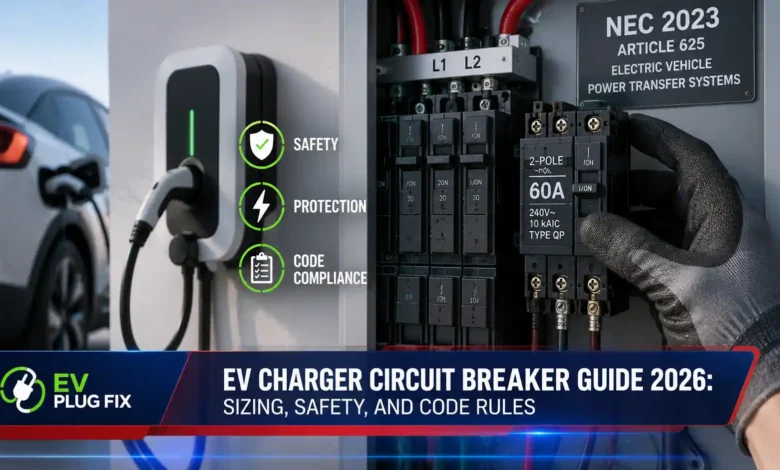
An EV charger circuit breaker is the unsung hero of your home electric vehicle charging setup, acting as the critical safety mechanism that protects your home’s electrical system from overloads and potential fires. With the electric vehicle market booming—the U.S. saw battery electric vehicles nearly double from 1.1 million in 2020 to 2.1 million in 2022 —understanding the nuances of electrical protection for your charging station has never been more essential. For a comprehensive overview of charging options, explore our EV Charging Levels Guide to see how different charging speeds impact your electrical setup requirements.
But circuit breakers for EV charging aren’t one-size-fits-all. From understanding the 125% continuous load rule to differentiating between GFCI breakers and hardwired setups, there’s a lot to unpack. This guide cuts through the confusion, providing the expert insights you need for a safe, code-compliant installation in 2026.
What Is an EV Charger Circuit Breaker?
A circuit breaker is an automatically operated electrical switch designed to protect an electrical circuit from damage caused by overcurrent, overload, or short circuit. Its basic function is to interrupt current flow after a fault is detected. For EV charging, this is crucial because charging stations draw high current for extended periods, making them what the National Electrical Code (NEC) classifies as a continuous load .
Unlike a fuse, which must be replaced after it blows, a circuit breaker can be reset to restore power. Think of it as a vigilant guardian for your home’s wiring and your EV, preventing overheating and potential electrical fires.
Why EV Chargers Need Special Breaker Considerations
EVs place unique demands on electrical systems. A standard home outlet isn’t designed for the high amperage draw of an EV charger over several hours. This is why dedicated circuits and correctly sized circuit breakers are non-negotiable. Furthermore, the interactions between an EV and the EV supply equipment (EVSE) can create electrical faults, including overtemperature events that can result in fires, often initiated by localized heating of connectors or high-impedance fault current paths. Understanding expected charge times can help you plan your installation—check our detailed analysis on EV Charging Time to match your breaker size with your daily driving needs.
The 125% rule isn’t a suggestion; it’s a critical safety standard. A 40-amp EV charger must be protected by a minimum 50-amp circuit breaker to handle the sustained electrical load without risking a fire or nuisance tripping.
Circuit Breaker Sizing and Electrical Code Requirements for 2026
Properly sizing your circuit breaker is the most critical step in any EV charger installation. The NEC, specifically Article 625.41, mandates that EV charging equipment must be considered a continuous load. The circuit breaker must be rated at 125% of the charger’s maximum amperage .
This means if you have a popular 40-amp Level 2 charger, you need a circuit breaker rated for at least 50 amps (40 amps x 1.25). A 48-amp charger would require a 60-amp breaker. This rule prevents nuisance tripping and ensures the breaker can handle the heat generated by hours of continuous current flow.
| Charger Amperage | Minimum Breaker Size (125% Rule) | Typical Power Output (kW) | Estimated Range Added Per Hour |
|---|---|---|---|
| 16A | 20A | 3.8 kW | ~12-15 miles |
| 32A | 40A | 7.7 kW | ~20-25 miles |
| 40A | 50A | 9.6 kW | ~25-30 miles |
| 48A | 60A | 11.5 kW | ~35-40 miles |
| 80A | 100A | 19.2 kW | ~60-65 miles |
It’s also important to consider your home’s total electrical capacity. A 50-amp or 60-amp breaker consumes a significant portion of a typical 100-amp or 200-amp panel. An electrician will perform a load calculation to determine if your panel can support a new EV charger without requiring an expensive service upgrade .
GFCI Breakers vs. Hardwired Chargers: What’s the Safer Choice?
One of the most common and frustrating issues homeowners face is “nuisance tripping.” This often stems from the interaction between a GFCI (Ground Fault Circuit Interrupter) breaker and the EV charger’s internal safety systems. If you’re experiencing persistent tripping issues, our comprehensive EV Charger Troubleshooting Guide offers step-by-step solutions to diagnose and resolve common installation problems.
NEMA 14-50 and GFCI Requirements
If you’re using a NEMA 14-50 plug-in outlet for your EV charger, the current NEC requires GFCI protection. This is due to NEC 210.8(A), which requires GFCI for all 125- through 250-volt receptacles in garages, and NEC 625.54, which specifically requires GFCI for receptacles installed for EV charging .
However, most modern EV chargers already have built-in GFCI protection. When an external GFCI breaker is added to the circuit, these two systems can conflict, leading to nuisance tripping that halts charging and requires a manual reset.
The Hardwired Solution
Hardwiring your EV charger is often the superior, more reliable, and safer choice. A hardwired connection eliminates the plug and receptacle, removing a common point of failure and potential heat risk. Crucially, hardwired chargers are not subject to the same NEC GFCI receptacle requirements, dramatically reducing the chance of nuisance tripping .
Hardwired installations offer a cleaner look, fewer failure points, and the ability to support higher amperages (up to 80A) for the fastest possible Level 2 charging speeds .
NEMA 14-50 (Plug-in)
- ✓ Portable and easy to move
- ✗ Requires GFCI breaker (in most cases)
- ✗ Higher risk of nuisance tripping
- ✗ Receptacle can be a wear or heat failure point
- ✗ Max charge rate up to 40A (~9.6 kW)
Hardwired Installation
- ✓ Most reliable, secure connection
- ✓ GFCI breaker typically not required
- ✓ No nuisance tripping from external GFCI
- ✓ Supports up to 48-80A (11.5+ kW)
- ✓ Professional installation often cheaper overall
Types of Circuit Breakers for EV Charging
While the term “circuit breaker” is often used generically, several specific types are relevant to EV charging, each with distinct functions and applications.
Miniature Circuit Breakers (MCB)
MCBs are designed to protect against overloads and short circuits in low-voltage circuits. They are the standard for residential and commercial applications. A typical MCB for an EV circuit might support currents up to 100A, with a short-circuit capacity of around 10 kA, making them suitable for most home installations .
However, it’s crucial to use breakers designed for DC circuits if you’re dealing with DC charging components. Ordinary AC breakers are not designed for DC conditions and may fail to safely interrupt a DC fault. Specialized UL489 DC MCBs can handle up to 1000VDC, with breaking capacities of 10kA, making them suitable for solar, ESS, and EV charging modules . The quality of conductors used throughout your system also matters—learn why with our guide on Copper EV Charging Cables and their superior conductivity for high-current applications.
Residual Current Breaker with Overcurrent (RCBO)
An RCBO is a device that combines the functions of a Residual Current Device (RCD) and an MCB. It provides protection against both earth leakage currents (which can cause electric shocks) and overcurrents (overloads and short circuits). This is a space-saving solution that ensures comprehensive protection, making it popular for EV charger installations where the panel doesn’t already have a separate RCD .
High-Breaking Capacity and Future Standards
As charging power increases, especially with the advent of megawatt-scale DC fast charging for heavy-duty EVs, protection technology must evolve. Research is underway on ultra-fast hybrid DC circuit breakers capable of interrupting high DC fault currents in less than 500 microseconds .
For future-proofing, consider the breaking capacity (kA rating) of your breaker. This is the maximum fault current a device can safely interrupt without failing. For EV charging in commercial sites, the prospective short-circuit current (PSCC) can be high, requiring breakers with a higher kA rating than those used in most residential settings .
FAQs About EV Charger Circuit Breakers
What size breaker do I need for a 40 amp EV charger?
You need a minimum 50-amp circuit breaker. This is because the NEC requires that EV chargers, as continuous loads, be protected by a breaker rated at 125% of the charger’s maximum current draw (40A x 1.25 = 50A) .
Why does my EV charger keep tripping the breaker?
This could be due to several factors. Most commonly, it’s nuisance tripping from a GFCI breaker when using a plug-in charger that also has internal GFCI protection. Other causes include a breaker that is too small, a short circuit, or a ground fault. A hardwired installation typically resolves GFCI-related nuisance tripping .
Should I hardwire my EV charger?
Yes, hardwiring is generally the recommended, safer, and more reliable option. It eliminates the plug and receptacle, reduces the risk of heat-related failures, avoids GFCI nuisance tripping, and often supports faster charging speeds .
Can I use a standard NEMA 14-50 outlet for EV charging?
Yes, but you must ensure the outlet is installed with a GFCI breaker to meet current NEC code requirements. Be aware that this may lead to nuisance tripping. An industrial-grade receptacle is also recommended to handle the wear and tear of continuous use .
Choosing the right circuit breaker for your EV charger is a balance of safety, compliance, and convenience. Hardwiring your charger and consulting a licensed electrician are the two most impactful steps you can take to ensure a safe, fast, and frustration-free home charging experience.