EV Charger Amp Rating: How Many Amps Do You Really Need in 2026?
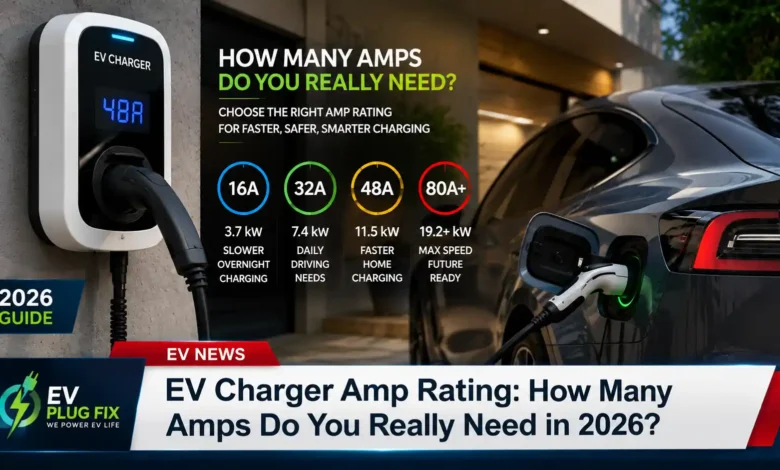
EV charger amp rating is the single most important specification for determining your home charging speed, but bigger isn’t always better for your electric vehicle’s battery health and your wallet. While many new EV owners assume that buying the highest-amperage charger is the best choice, the reality is more nuanced.
In this deep dive, EVPlugFix investigates how amp ratings from 16A to 48A translate to real-world range recovery, what the National Electrical Code (NEC) requires for safe installation, and how to choose the perfect charger for your 2026 driving habits without overspending on unnecessary electrical upgrades. For those considering a more permanent setup, exploring Wall-Mounted EV Chargers versus pedestal options can provide additional context for your home installation.
Key Takeaway: EV charger amperage directly scales with charging speed, but your vehicle’s onboard charger limit and home electrical panel capacity often dictate the practical maximum.
Understanding EV Charger Amp Rating: Speed vs. Heat
An EV charger amp rating specifies the maximum continuous electrical current it can deliver to your vehicle. At a given voltage (like the 240V of a Level 2 charger), higher amperage means more power — measured in kilowatts (kW) — flowing to your EV’s battery every second . This power directly translates to miles of range added per hour.
However, the charging equation has a critical trade-off often overlooked: heat. Higher amperage generates more heat, which can accelerate battery degradation if used habitually for daily top-ups rather than occasional fast charging needs. For routine charging, a mid-range amperage often provides the optimal balance between speed and long-term battery care . Understanding Tesla Battery Lifespan and similar metrics for other EVs can help you make informed decisions about charging habits.
⚡ Expert Analysis: The relationship is simple math: Power (kW) = Voltage (V) × Amperage (A) ÷ 1,000. At 240V, a 16A charger delivers 3.84 kW, while a 48A unit delivers a whopping 11.52 kW — three times the power .
How Amp Ratings Impact Charging Speed in 2026
Charging speed scales linearly with amperage at a given voltage. Using an average EV efficiency of 3.5 miles per kWh — a realistic benchmark based on EPA estimates for popular models like the Tesla Model 3, Hyundai Ioniq 5, and Chevrolet Equinox EV — here’s how each amp rating breaks down .
| Amp Rating | Voltage | Power Output | Range Per Hour | Required Breaker (NEC) |
|---|---|---|---|---|
| 16A | 240V | 3.84 kW | ~14 miles | 20A |
| 32A | 240V | 7.68 kW | ~28 miles | 40A |
| 40A | 240V | 9.6 kW | ~36 miles | 50A |
| 48A | 240V | 11.52 kW | ~42 miles | 60A |
The difference between a 16A and a 48A charger means the difference between adding roughly 110 miles and 336 miles of range during an 8-hour overnight session. For the average American driver covering 37 miles daily according to the U.S. Department of Transportation Federal Highway Administration, even a 16A Level 1 charger on a standard 120V outlet can fully recover daily range in about 5 hours .
16A vs 32A vs 40A vs 48A: Which Amp Rating Fits Your Life?
Selecting the right amp rating depends on your daily driving distance, available charging window, and home electrical infrastructure. Here’s a breakdown of each tier.
16A – The Zero-Installation Champion
For drivers covering under 40 miles daily, a 16A charger — often portable and plugging into a standard 120V NEMA 5-20P outlet — provides a no-installation, no-electrician solution. At ~14 miles of range per hour on 240V, it recovers a full day’s driving in about 3 hours. This tier is ideal for apartment dwellers, renters, or anyone wanting a travel-friendly backup .
32A – The Versatile Sweet Spot
At 32A and 7.68 kW, this tier adds roughly 28 miles of range per hour — enough to recover 200 miles in about 7 hours. It requires a 40A dedicated circuit and 8-gauge wiring. With support for both 120V and 240V, dual-voltage 32A chargers offer flexibility for home and portable use. For most EV owners, the 32A charger represents the sweet spot between speed and installation cost . A comprehensive Level 2 EV Installation guide can help you understand the full scope of what’s involved.
40A – The High-Speed Home Solution
Delivering 9.6 kW and ~36 miles per hour, a 40A charger recovers a full 300-mile battery from 20% to 100% in roughly 6.7 hours. This requires a 50A circuit breaker and 6-gauge wiring. Models like the Grizzl-E Classic and JuiceBox 40 are popular plug-in options compatible with NEMA 14-50 outlets, making installation simpler than hardwired alternatives .
48A – The Future-Proof Maximum
The highest residential tier pushes 11.52 kW and adds ~42 miles per hour. At this speed, even large-battery electric trucks and SUVs recover full capacity overnight. Per the NEC 80% rule, a 48A charger mandates a 60A breaker and dedicated 6-gauge wiring. Models like the Emporia 48A and Battery Tender eCharge 48A deliver maximum speed for high-mileage drivers and multi-EV households . If you have multiple EVs, exploring Smart EV Energy Management solutions can help optimize charging across your fleet.
🔌 Critical Installation Notice: Never install a 48A charger on a 50A breaker. The NEC 80% rule requires a 60A circuit for continuous loads of 48A. Ignoring this creates a fire hazard.
The Vehicle Onboard Charger Limit: Why More Amps Won’t Always Help
Every EV contains an onboard charger (OBC) that converts AC power from the wall unit into DC power for the battery. The OBC has a maximum input rating — typically 7.2 kW, 9.6 kW, or 11.5 kW depending on the model. A 48A wall charger delivering 11.52 kW will not charge faster than 7.2 kW if the vehicle’s OBC is rated at 7.2 kW (approximately 30A at 240V) .
Entry-level EVs and compact models often feature 7.2 kW OBCs. Mid-range and premium EVs increasingly include 11.5 kW OBCs, making 48A home chargers a useful future-proofing investment. Always check your vehicle’s specifications before selecting a charger .
Vehicles with 7.2 kW OBC
- Chevrolet Bolt EV/EUV
- Nissan Leaf Plus
- Some standard-range models
Match with: 32A charger (max usable)
Vehicles with 11.5 kW OBC
- Tesla Model 3/Y (some trims)
- Hyundai Ioniq 5/6
- Kia EV6/EV9
- Ford F-150 Lightning
Match with: 48A charger (optimal)
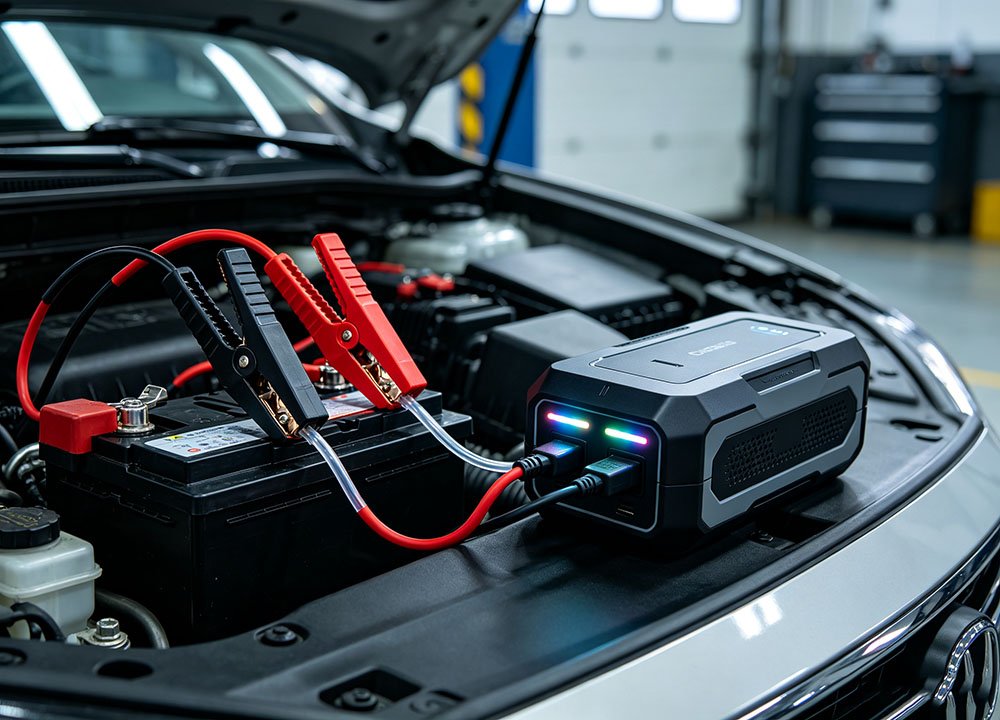
A 48A EV charger requires a dedicated 60A circuit breaker, per the NEC 80% continuous-load rule.
NEC Circuit Requirements for Each Amp Rating
The National Electrical Code (NEC Article 625) classifies EV charging as a continuous load — defined as any load expected to operate for 3 hours or more. Under NEC Section 210.20, the circuit breaker must be rated at 125% of the continuous load current, commonly known as the 80% rule .
This means a 40A charger requires a 50A breaker (40 ÷ 0.80 = 50), and a 48A charger requires a 60A breaker (48 ÷ 0.80 = 60). Wire gauge must match the breaker size — typically 6 AWG copper for a 50A circuit and 6 AWG or 4 AWG copper for a 60A circuit, depending on run length . Understanding Level 2 Charger Installation Cost can help you budget for these necessary electrical upgrades.
NEC 80% Rule Summary:
- 16A charger → 20A breaker
- 32A charger → 40A breaker
- 40A charger → 50A breaker
- 48A charger → 60A breaker
Hardwired vs. Plug-In: Which Installation Works for You?
The choice between a hardwired and plug-in charger often correlates with amp rating. Here’s a breakdown of the trade-offs.
Plug-In EV Chargers (NEMA 14-50)
Plug-in chargers connect to a common NEMA 14-50 outlet — the same as an electric oven or RV hookup. They offer easier, lower-cost installation and flexibility to move or replace the unit. Most 40A chargers are available in plug-in configurations .
Hardwired EV Chargers
Hardwired chargers connect directly to the breaker box. This permits higher amperage support (48A+), creates a more secure connection, and reduces the risk of loose plugs or outlet failure. Hardwired installation typically costs more but provides a cleaner appearance and supports maximum speed .
Real-World Charging Times: 40A vs. 48A Example
To illustrate the practical difference, let’s examine a popular EV: the Ford Mustang Mach-E with an extended-range 88 kWh battery .
| Charger | Estimated 10%–80% Charging Time |
|---|---|
| 40A charger (9.6 kW) | ~7–8 hours |
| 48A charger (11.5 kW) | ~6–7 hours |
The faster charger saves about one hour of charging time. For overnight charging, most drivers will wake up to a fully charged vehicle regardless of which charger they choose. For daytime top-ups or quick turnarounds, that hour could matter .
The Verdict: Which EV Charger Amp Rating is Right for You in 2026?
Choosing the right EV charger amp rating boils down to three factors.
- Daily Mileage: Under 40 miles/day → 16A or 32A is plenty. Over 60 miles/day → 40A or 48A makes sense.
- Electrical Capacity: Do you have a 200A panel? A 60A circuit for a 48A charger may be feasible. Older 100A homes may be limited to 32A or 40A without a costly panel upgrade .
- Future-Proofing: Installing a 60A circuit now costs the same labor as a 50A circuit, but allows upgrading from 40A to 48A charging without rewiring .
For most EV owners, a 32A or 40A Level 2 charger provides the ideal balance of speed, installation cost, and battery care. High-mileage drivers, multi-EV households, and those with large-battery trucks will benefit from the maximum speed of a 48A setup. For households with multiple EVs, implementing Condo EV Charging Billing strategies can help manage electricity costs effectively.
Remember: Your vehicle’s onboard charger limit sets the ceiling. Consult your EV’s specifications before purchasing, and always hire a licensed electrician to perform a load calculation and install the circuit per NEC requirements.