MID Wallbox Austria Requirements for Company Cars in 2026: Do You Need One?
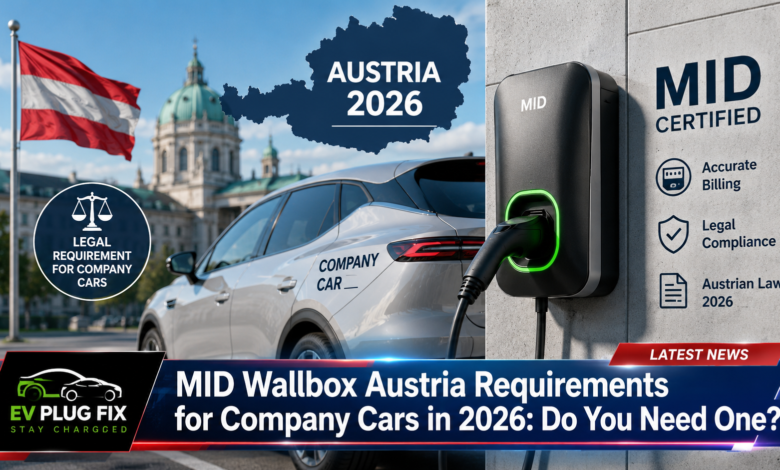
Determining whether you need an MID wallbox in Austria for your company car in 2026 is the first critical step for employees managing home charging. For most employees living in a single-family home and charging only their company vehicle, a simple meter with RFID functionality is sufficient for now, unless your employer has specific requirements. However, the landscape is shifting with new Austrian technical regulations taking effect, and understanding the distinction between “needed” and “mandatory” is key to compliance and cost savings.
Do I Need an MID Wallbox in Austria? The Basic Rules for 2026
Unlike in Germany, where strict measurement and calibration laws (MessEG and Eichrecht) necessitate a certified meter from the outset, Austrian law offers more flexibility for private home charging. For drivers comparing regional standards, understanding the European EV Connectors Guide can help ensure your wallbox is compatible with your vehicle’s inlet. Here’s the breakdown for 2026 based on your living situation and usage patterns:
- Single-Family Home, Sole User: An MID wallbox is not legally required. A standard wallbox that can measure consumption via a simple internal meter and authenticate users via RFID is considered adequate for billing your employer. Many providers, like Salzburg AG, emphasize that “the easiest and most accurate method is digital billing, where the actual power consumed (kWh) is measured and invoiced at the end of the month” . This can be achieved without an MID-certified energy meter for the employer’s reimbursement process.
- Single-Family Home, Shared Use: If you share the wallbox for company car charging with others, such as your partner charging their own vehicle, a simple meter with RFID remains currently sufficient in Austria. The key is the technical capability to assign specific charging sessions to the correct vehicle or person. An RFID reader is essential for this, as it enables precise allocation of charging events .
- When is an MID Wallbox Mandatory? Your employer may require you to charge your company car at home with an MID-compliant wallbox for their own accounting purposes. Some companies have internal policies that mandate a certified meter to comply with their internal auditing procedures. If this is the case, you have no choice but to buy an MID wallbox.
- The Public Charging Aspect: Even with an MID-certified meter, your home wallbox generally cannot be operated as a public, fee-based charging point. As one provider notes, the MID meter “cannot be used as a basis for commercial settlement of public charging sessions since it does not comply with local calibration law (e.g., in Germany and Austria)” .
The need for an MID wallbox in Austria is not a blanket legal requirement for home charging, but rather a case-specific decision driven by your employer’s policy and your specific usage scenario.
The Employer Factor: Can They Force You to Buy an MID Wallbox?
Yes, your employer can require you to install an MID wallbox. While Austrian law does not mandate it for most home settings, your company’s policy on cost allocation and reimbursement might. They may need the legal certainty that an MID-certified meter provides, ensuring the measured kilowatt-hours are legally sound for tax and auditing purposes.
Companies like KEBA, a leading Austrian wallbox manufacturer, offer solutions like the KeContact P30 company car wallbox which features an integrated and certified (MID) energy meter specifically designed for correct billing and automated email reports of charging sessions . This simplifies the process for the employee and provides the employer with verifiable data. For drivers experiencing setup issues, consulting an EV Charger Troubleshooting Guide can help resolve common configuration problems.
What is an MID Wallbox and Why Does It Matter?
MID stands for Measuring Instruments Directive, a European Union directive that sets out the standards for calibration and accuracy of measurement instruments . An MID wallbox is equipped with a certified energy meter that provides a tamper-proof, legally compliant measurement of electricity consumption. This is crucial when the electricity is being resold or reimbursed.
As one industry expert notes, “The most important thing is an MID-capable wallbox. As soon as you want to pass on electricity costs, for example with tenants or your employer, the measurement must be MID-compliant, comparable to a heat meter or water meter” .
MID vs. “Eichrecht” (ME) in Austria and Germany
Understanding the distinction between MID and “Eichrecht” (ME) is vital, especially if you are comparing products for the Austrian market. In Germany, additional calibration law (MessEG and Eichrecht) applies. For company cars in Austria, an MID-compliant meter is generally sufficient. However, if you also charge a private vehicle at the same wallbox, some providers suggest that a calibration-law-compliant (Eichrecht) solution may be necessary to accurately separate the two uses for tax purposes.
The KEBA product comparison reveals this nuance: they offer models that are “MID-certified” or “Compliant to German calibration law (ME),” distinguishing the two standards .
Technical Requirements: OVE Guideline R37 and 2026 Compliance
A more significant development for 2026 concerns the technical standards of the charging station itself, not just the meter. Since 1 June 2025, new technical requirements for charging stations in Austria have been in force under the OVE Guideline R37 . This defines a comprehensive testing concept to ensure grid-friendly behaviour, covering aspects like frequency maintenance, system protection, and controllability. When selecting equipment, checking the EV Charger IP Ratings is also crucial for ensuring your wallbox can withstand Austria’s varying weather conditions.
Important Update: From 1 June 2026, an accredited test report in accordance with OVE Guideline R37 will be mandatory for the initial installation of any new charging station in Austria . The test report must be issued by a testing laboratory accredited under ÖVE/ÖNORM EN ISO/IEC 17025 . While this doesn’t mandate an MID meter, it does require all new wallboxes to meet stringent grid-stability standards.
This means that while you might not need an MID meter to charge your company car, you will need a wallbox that is OVE R37 compliant for any new installation from June 2026 onwards. TÜV AUSTRIA has noted that failure to meet these requirements risks “delays in approvals, additional costs, and the exclusion from the grid connection of new charging infrastructure” .
Tax Benefits of Charging a Company Car at Home in 2026
Charging your company car at home comes with significant tax advantages for both employees and employers in Austria. According to the Lohnsteuerrichtlinien (Income Tax Guidelines), the reimbursement of electricity costs for a company car charged at home is not taxable income for the employee, provided a few conditions are met .
- Cost Reimbursement: If the employer reimburses the employee for the electricity costs, there is no taxable benefit if the “traceable allocation of the charging quantity to this motor vehicle is ensured” . This is where the wallbox’s metering and RFID functionality becomes essential. The E-Control sets reference prices for fair reimbursement.
- Charging Equipment: If the employer reimburses the employee for the wallbox or provides one, up to €2,000 is tax-free. Only the value exceeding €2,000 is considered a taxable benefit . This provides a clear financial incentive for the employer to support home charging setup.
| Requirement | Single-Family Home – Sole User | Single-Family Home – Shared Use | Employer Policy |
|---|---|---|---|
| MID Wallbox Mandatory? | ❌ Not required (unless employer demands it) | ❌ Not required (unless employer demands it) | ✅ Yes, if your employer requires it for their accounting |
| RFID Card Required? | ✅ Recommended for session allocation | ✅ Yes, essential for separate billing | ✅ Often required for tracking |
| OVE R37 Mandatory? | ✅ Yes, for new installations from 1 June 2026 | ✅ Yes, for new installations from 1 June 2026 | ✅ Yes, for new installations from 1 June 2026 |
| Tax Benefit for Wallbox | ✅ Up to €2,000 tax-free from employer | ✅ Up to €2,000 tax-free from employer | ✅ Up to €2,000 tax-free from employer |
Choosing the Right Wallbox for Your Company Car
When selecting a wallbox for your company car, consider these factors beyond just the MID certification:
- RFID Authentication: Essential for assigning charging sessions. Many wallboxes, like the Fronius Wattpilot, come with built-in RFID readers, allowing you to use standard ID cards to authorize charging and automatically log the session .
- Communication Capabilities: For the employer to receive reports, the wallbox should have communication interfaces. KEBA’s KeContact P30, for example, offers the option of automated email reports of charging sessions .
- Smart Home Integration: If you have a photovoltaic system, look for a wallbox with PV surplus charging capabilities for optimized electricity usage and cost savings. Exploring a go-e Smart Home Setup can provide valuable insights into integrating your charger with existing home automation systems.
- Future-Proofing: With OVE R37 coming into effect, ensure any wallbox you buy meets the new technical requirements. Many leading manufacturers, such as KEBA and go-e, offer products compliant with these standards .
What About Other EV Charging Developments in Austria?
For company car drivers who also need to charge on the road, the public charging infrastructure in Austria is expanding rapidly. VERBUND recently launched the V-Go charging app, providing access to Austria’s largest fast-charging network with transparent tariffs for public charging . This is a great complement to your home charging setup. Understanding your vehicle’s range capabilities through resources like WLTP EV Range Explained can help you plan longer journeys efficiently.
Furthermore, the government is working on legislation to meet the EU’s Alternative Fuels Infrastructure Regulation (AFIR), aiming to install charging stations at an average distance of 25 km on major roads, with a maximum gap of 50 km . This signals a strong commitment to expanding the national charging network, making EV company cars even more practical.
Final Verdict for 2026
The decision on whether you need an MID wallbox in Austria for your company car in 2026 depends on your employer, your living situation, and your budget. For many employees in single-family homes, a smart wallbox with RFID and a standard meter is all you need to comply with tax regulations and secure cost reimbursement. However, if your employer demands MID certification, or if you are installing a new charger after June 2026, you must prioritize OVE R37 compliance. Always consult with your employer and a qualified electrician to ensure your setup meets all legal, technical, and company requirements. As the charging landscape evolves, staying informed about these regulations ensures you benefit from all the tax advantages and technological innovations coming to Austria’s EV ecosystem.