Electric Car Battery Lifespan in 2026: What Real-World Data Reveals About Longevity
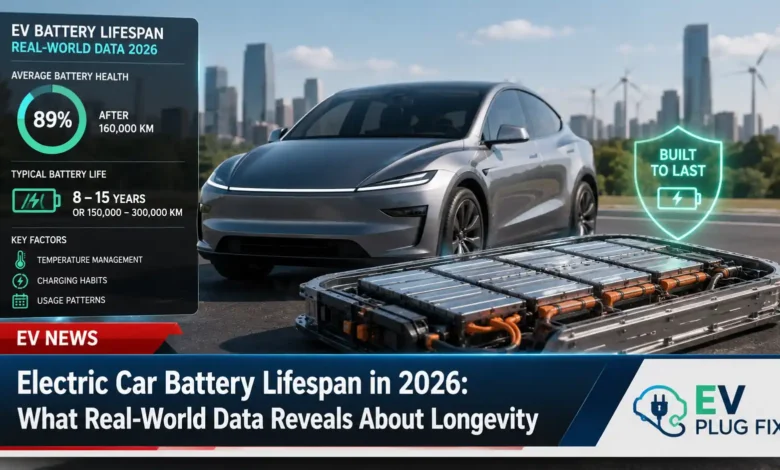
Electric car battery lifespan remains the single biggest question for prospective EV buyers in 2026, but a wave of new real-world data suggests that modern batteries are significantly outlasting the vehicles they power. A landmark Swedish study analyzing nearly 10,000 battery tests has revealed that top-performing electric vehicles retain over 95% of their original capacity even after 100,000 kilometres of driving .
The analysis, conducted by used EV retailer Carla using diagnostics from Austrian battery specialist AVILOO, showed that the Kia e-Niro with a 64 kWh battery leads the pack with an average battery health score of 97.25% . This was followed closely by the Hyundai Kona Electric at 97.18%, and the Kia EV6 at 95.95% . The findings are part of one of the largest collections of battery health data from the Swedish used EV market, covering tests performed between 2022 and 2026 .
The Real-World Data on EV Battery Degradation
While the 2.3% average annual degradation rate reported in multiple 2026 studies suggests a battery will retain about 75% of its capacity after 12 years, this is a conservative average . The data shows that the picture is far more nuanced and generally more positive. For instance, the Geotab 2026 EV Battery Health report, which analyzed over 22,700 vehicles, found that at an average degradation rate of 2.3% per year, a typical pack would retain about 81.6% of its original capacity after eight years .
Furthermore, an independent field study by P3 and Aviloo, examining more than 7,000 EVs including those with up to 186,000 miles, found that most measured batteries remained above 80% health after 124,000 miles . The decline was steepest during the first 18,600 miles before stabilizing, suggesting that initial degradation is not indicative of a battery’s long-term future . Understanding the broader EV Charging Speed Factors can help you better interpret how battery health impacts overall charging performance.
How Battery Chemistry Impacts Lifespan
One of the most striking findings from the Carla study is the significant influence of battery chemistry and cell supplier on long-term health . In a head-to-head comparison of Tesla Model 3 variants, vehicles equipped with CATL’s Lithium Iron Phosphate (LFP) batteries retained an average of 93.3% capacity after 100,000km . This outperformed versions using LG Chem cells (91.5%) and Panasonic batteries (89.8% and 88.2%, depending on the pack) . This data suggests that choosing a vehicle with certain battery chemistries, like LFP, can be a strategic decision for maximizing long-term range retention. For a deeper understanding of battery efficiency in everyday use, explore our guide on EV Charging Efficiency.
| EV Model | Battery Capacity | Average Health (%) |
|---|---|---|
| Kia e-Niro | 64 kWh | 97.25% |
| Hyundai Kona Electric | 64 kWh | 97.18% |
| Kia EV6 | 77.4 kWh | 95.95% |
| Volvo XC40 Recharge | 69 kWh CATL | 94.70% |
| Polestar 2 | 78 kWh CATL | 94.35% |
| BMW i3 | 120 Ah | 93.77% |
| Tesla Model 3 (CATL LFP) | 60.5 kWh | 93.34% |
Understanding EV Battery Warranties and Replacement Costs
Federal law mandates that EV batteries in the U.S. be warranted for at least 8 years or 100,000 miles, with California going further from the 2026 model year, requiring batteries to retain at least 70% of their range for 10 years or 150,000 miles . These warranties typically cover repair or replacement if the battery’s capacity drops below 70% to 75% of its original level . When evaluating different EV models and their long-term value, understanding Choose the Right EV Charger for your specific battery type and usage pattern is essential.
“A typical EV battery warranty is 8 years or 100,000 miles. But in practice, many EVs retain over 90% of their original battery capacity after years on the road.”
— Cox Automotive Insight Team
Despite this robust coverage, many drivers are concerned about out-of-warranty costs. The electric car battery replacement cost can range from $5,000 to $20,000, depending on the vehicle and battery size . For context, a replacement for a Tesla Model 3 pack can cost as much as $18,000, while a Nissan Leaf battery could be around $4,500 . With the average lifespan of a vehicle being around 15 years, and many modern EV batteries projected to last 20 years or more, a replacement may simply not be a factor for most original owners .
How to Maximize Your EV Battery Lifespan
While the data is overwhelmingly positive, how you treat your battery can influence its long-term health. Here are key factors that can affect battery degradation:
- Charging Habits: Frequent DC fast charging can shorten battery life by approximately 10% compared to slower Level 2 charging . It’s best to use fast charging sparingly. Compare AC vs DC Charging to understand which method is gentler on your battery for daily use.
- Avoid Extreme States of Charge: While modern battery management systems (BMS) are sophisticated, regularly letting the battery drop to 0% or keeping it at 100% for prolonged periods can accelerate degradation. It’s recommended to keep the charge between 20% and 80% for daily use.
- Temperature Management: EVs in hotter climates can experience slightly higher degradation rates, highlighting the importance of effective battery cooling systems . Parking in the shade or in a garage can help. Advanced High-Power EV Thermal Management systems play a crucial role in protecting battery health during charging sessions.
- Warranty Pitfalls: It’s crucial to read your EV’s warranty fine print. Factors like tampering, improper charging practices, and physical damage can void the battery warranty .
Will My EV Battery Outlast the Car?
Multiple studies and expert analyses now point to a clear conclusion: the electric vehicle battery lifespan is likely to outlast the vehicle itself. According to a 2026 study, EV batteries in modern vehicles are expected to comfortably outlast the usable life of the car and will likely not need to be replaced . The Geotab research shows that at current degradation rates of 1.8% per year (for newer models), EV batteries could last 20 years or more . Given that the average vehicle lifespan is about 15 years, the vast majority of EV batteries will continue to perform well long after the car’s body and interior have reached the end of their useful life. For those concerned about long-term charging infrastructure compatibility, reviewing European EV Charging Standards can provide peace of mind about future-proofing your EV experience.