EV Charger EMC Testing & Electromagnetic Compatibility Standards 2026
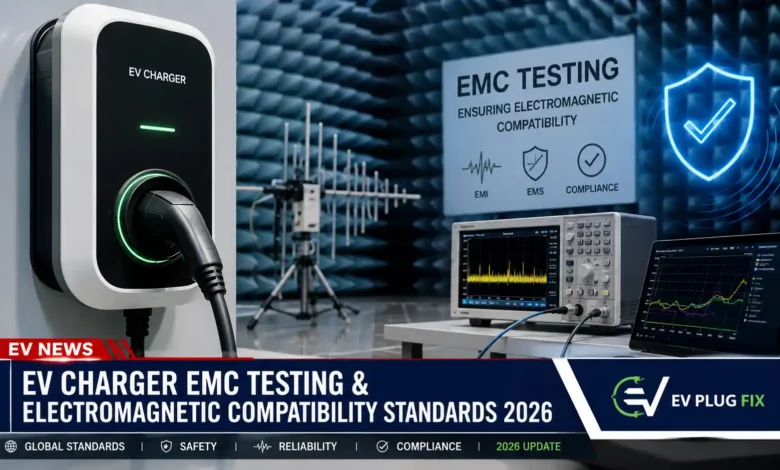
Electromagnetic compatibility (EMC) testing for EV chargers is a critical, non-negotiable process ensuring these powerful devices operate reliably without disrupting the world around them. Whether it’s a compact Level 2 home unit or a gargantuan 360 kW DC fast charger, every charger is a sophisticated source of electromagnetic noise. This testing verifies that a charger won’t interfere with a vehicle’s sensitive electronics, pollute the electrical grid, or be disrupted by external electromagnetic disturbances.
⚡ Key Takeaways: EV Charger EMC Testing
- Dual Pillars of EMC: Requires balancing low electromagnetic emissions (radiated & conducted) with high immunity against external electrical surges (ESD/EFT).
- High-Frequency EMI Risks: Next-gen SiC and GaN semiconductors operate in MHz switching ranges, creating significant high-frequency noise that requires specialized EMI filtering.
- 2026 Regulatory Update: IEC 61851-21-1 mandates extended emissions testing up to 6 GHz and new provisions for bidirectional V2G power flow.
- Design-First Compliance: Integrating EMI input filters, proper PCB ground planes, and metal shielding prevents costly testing failures.
The Core Principles of EMC: Emissions and Immunity
The concept of EMC rests on two complementary pillars, much like a well-functioning society where everyone respects their neighbors’ space.
- Emissions: This is the unwanted electromagnetic energy a charger radiates outward, either through the air (radiated emissions) or back through the power lines (conducted emissions). Without proper filtering, these emissions can cause “grid pollution” and interfere with communication systems.
- Immunity (or Susceptibility): This measures how well a charger can tolerate external electromagnetic disturbances without malfunctioning. A charger that stops working every time a nearby mobile phone transmits is a safety hazard and a reliability nightmare. Common disturbances include electrostatic discharge (ESD) and electrical fast transients (EFT).
Why EV Chargers Are Prime EMI Generators
Modern EV chargers are built on switched-mode power supplies (SMPS) and high-frequency switching circuits, which are the primary culprits behind EMI generation. The physics is straightforward: every time a switch turns on or off, it creates an abrupt change in voltage and current, generating a ripple of electromagnetic waves. For homeowners considering installation, understanding these technical aspects is essential when consulting a Home EV Charger Guide to ensure proper setup and performance.
- High-Frequency Switching: Power converters often use IGBTs, SiC MOSFETs, and GaN transistors operating at frequencies from 20 kHz to several MHz, creating a broad spectrum of EMI.
- Conducted vs. Radiated EMI: Conducted EMI flows along power cables and back into the grid, while radiated EMI travels through the air like radio waves. Both types require distinct measurement and mitigation strategies.
- Harmonic Distortion: EV chargers draw current in a non-sinusoidal fashion, introducing harmonic distortion that can overheat transformers and cause voltage fluctuations.
The Regulatory Framework: Key Standards for 2026
Navigating the complex web of EMC standards is a prerequisite for selling EV chargers in major global markets. Compliance isn’t just about passing a test; it’s about ensuring long-term reliability and safety.
| Standard | Scope & Application for EV Chargers | Key Focus |
|---|---|---|
| IEC 61851-21-1 (2026 Update) | EMC requirements for on-board and off-board conductive charging systems. A major update for 2026 adds bidirectional charging modes and extends testing up to 6 GHz. | Emissions & Immunity |
| IEC 61000 Series | A foundational set of standards defining electromagnetic environments and test methods, including immunity tests like ESD and surges. | Immunity, Environment |
| CISPR 11 / EN 55011 | Limits for radiated and conducted emissions from industrial, scientific, and medical (ISM) equipment, broadly applied to EV chargers. | Emissions Limits |
| FCC Part 15 | US regulation for unintentional radiators, setting emission limits that EV charging equipment must meet. | Emissions (USA) |
| UL 2202 / UL 2251 | North American safety standards for EV charging equipment, which also incorporate EMC and EMI requirements. | Safety & EMC (NA) |
| IS 17017 (Part 24) | Indian standard for digital communication in DC charging, recently updated to reflect the latest EMC requirements. | Communication & EMC |
“EMC compliance is not just a checkbox—it directly affects uptime, safety, and interoperability in real-world installations.” — Industry Expert Analysis
Inside the EMC Test Lab: Practical Testing Procedures
Passing EMC testing requires a deep understanding of what happens in the lab. The “star of the show” is the anechoic chamber, a specially shielded room that prevents external interference from corrupting test results.
- Radiated Emissions: The charger is placed in the chamber, and antennas scan for electromagnetic field strength across a range of frequencies.
- Conducted Emissions: A Line Impedance Stabilization Network (LISN) is used to measure the noise traveling back through the power cable into the electrical network.
- Immunity Testing: The charger is subjected to standardized disturbances like ESD, EFT bursts, and surges to ensure it remains operational.
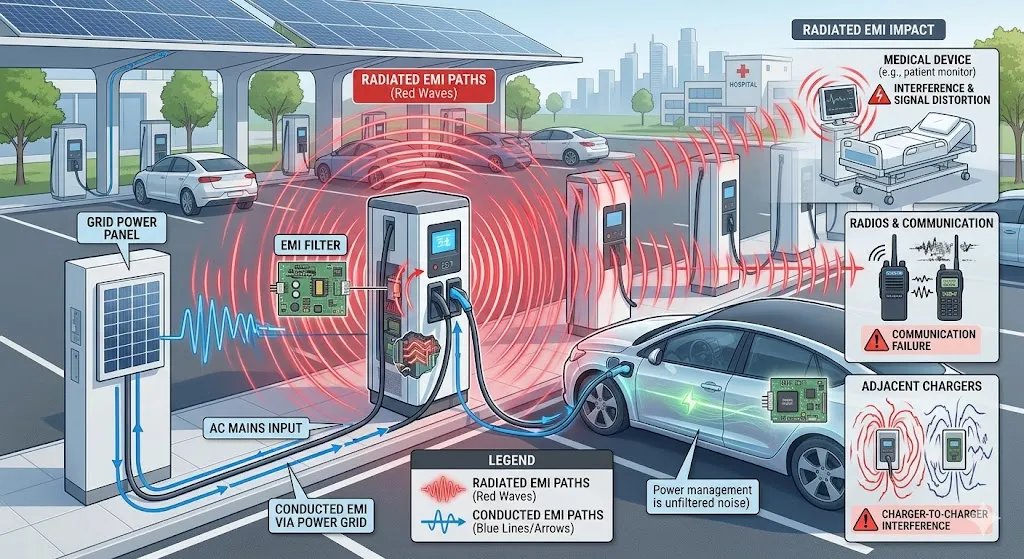
A well-designed EMI filter, featuring common-mode chokes and capacitors, is the first line of defense against conducted emissions.
Designing for EMC: Building It In from the Start
Experts strongly advocate for a strategy of ‘designing EMC in’ rather than trying to fix problems after a failed test. Here are the critical strategies for successful EMC design. Property owners and landlords should also consider these factors when selecting equipment; the Best Rental Property EV Charger options often feature robust EMC design to ensure reliable operation in multi-tenant environments.
- EMI Filters: This is the primary defense. A well-designed filter at the power input, combining common-mode chokes and capacitors, can effectively suppress conducted noise by up to 43.40 dBμV/m.
- PCB Layout Discipline: Careful placement of components, routing of high-current loops, and proper grounding are fundamental to reducing EMI generation.
- Shielding: Metal enclosures and shielded cables contain radiated emissions. Even small seams or openings can act as antennas if not managed properly.
- Spread Spectrum Techniques: Deliberately modulating the switching frequency spreads the emission energy across a wider range, reducing peak emissions at any given frequency.
Frequently Asked Questions About EV Charger EMC Testing
What is the difference between conducted and radiated EMI in EV chargers?
Conducted EMI travels through physical wiring and power cables back into the electrical grid. Radiated EMI travels as airborne electromagnetic waves that can interfere with wireless communications and nearby electronic equipment.
Why is IEC 61851-21-1 crucial for EV charger compliance?
IEC 61851-21-1 defines the core electromagnetic compatibility requirements for electric vehicle conductive charging systems, establishing strict limits for electromagnetic emissions and immunity for both AC and DC chargers.
How do EMI filters work in EV charging stations?
EMI filters use common-mode chokes and specialized X/Y capacitors placed at the power input stage to suppress unwanted high-frequency electrical noise before it can travel into the power grid.
The Future of EMC: V2G, Wireless, and Mega-Hubs
As EV adoption accelerates, EMC is evolving from a device-level concern to a systemic infrastructure challenge. The launch of 720 kW mega-charging hubs demonstrates the scale of the challenge, where multiple chargers operate simultaneously in close proximity. The growing interest in bidirectional charging adds another layer of complexity; exploring EV Backup Power solutions requires careful attention to EMC compliance to ensure seamless home energy integration.
- Vehicle-to-Grid (V2G): Bidirectional power flow creates bidirectional EMI pathways, and standards are being updated to address this complexity.
- Wireless Charging: Inductive power transfer is designed to radiate energy, making the challenge of balancing power transfer efficiency with strict emission control a key frontier.
- Systemic Infrastructure: EMC in multi-charger sites is critical for reliable communication, billing, and the overall stability of the grid. Understanding long-term equipment durability is also vital; data on EV Battery Degradation shows that consistent, clean power delivery through EMC-compliant chargers can extend battery life significantly.