EV Charger Types and Battery Health 2026: How Fast Charging Impacts Degradation Rates
Electric vehicle chargers have become a critical factor in battery health, with new 2026 data revealing that frequent high-power DC fast charging above 100 kW can nearly double annual battery degradation rates. A comprehensive real-world analysis of over 22,700 EVs shows that while the average battery loses about 2.3% capacity per year, vehicles heavily reliant on ultra-fast charging experience degradation rates up to 3.0% annually—compared to just 1.5% for those primarily using Level 2 or lower-power DC charging . For EV owners and fleet operators, this means understanding charger types and adopting smarter charging habits has never been more crucial. EV Off-Peak Charging at home can be a cornerstone of this smarter approach.
Understanding EV Charger Types and Their Impact on Batteries
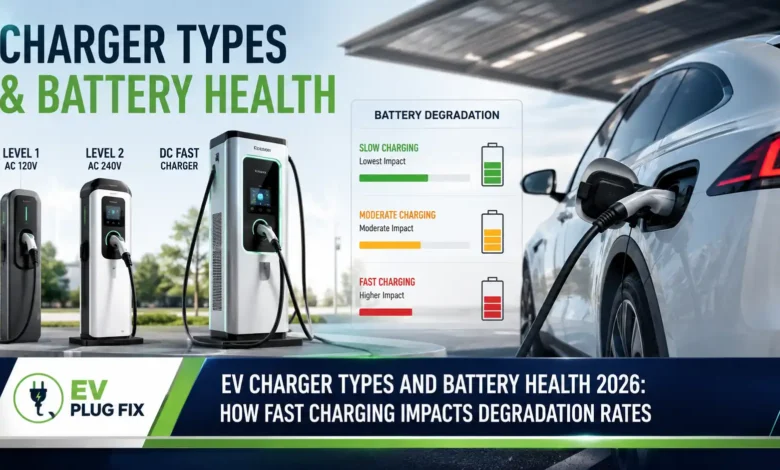
Before diving into battery health, it’s essential to understand the three main EV charger types. Each delivers power differently, and that variance directly affects battery longevity.
Level 1 Chargers (120V)
The slowest option, adding just 2-5 miles of range per hour. While gentle on batteries, a full charge for a 60 kWh battery can take 40-50 hours . Best suited for overnight top-ups or low-mileage drivers. Many owners also use an EV Granny Charger as a portable alternative for similar slow, battery-friendly top-ups.
Level 2 Chargers (240V)
Delivering 10-20 miles of range per hour, these chargers fully recharge most EVs in 4-10 hours . Found at homes, workplaces, and public stations, Level 2 represents the sweet spot for daily charging without stressing the battery. Installing a dedicated home unit through EV Wallbox Installation ensures you have this optimal charging method available daily.
DC Fast Chargers (Level 3)
Ranging from 50 kW to 350 kW, these can add 180-240 miles of range per hour . While convenient, they generate significant heat and stress, making them the primary concern for battery longevity. The threshold for accelerated degradation appears to be around 100 kW . For those relying on these stations, understanding Public EV Fast Charging station specifications can help you choose lower-power options when available.
“Charging power is the strongest operational influence on EV battery health. Using the lowest charging power that still meets operational needs can make a measurable difference to long-term battery health.” — Charlotte Argue, Senior Manager, Sustainable Mobility at Geotab
DC Fast Charging: The Convenience vs. Longevity Trade-off
DC fast charging represents the most significant convenience factor in EV ownership, enabling quick recharges during road trips. However, this convenience comes with an electrochemical price.
When charging at powers above 100 kW, the battery experiences a phenomenon called lithium plating. During rapid charging, lithium ions can deposit as metallic lithium on the anode surface rather than properly intercalating into the electrode structure. Over time, this permanently reduces the number of lithium ions available for energy storage, effectively shrinking battery capacity .
New research from Carnegie Mellon University confirms that the degradation cost of frequent fast charging varies considerably across battery chemistries. In extreme scenarios where more than 90% of charging sessions use fast charging, pack replacement costs could reach $27,000 for NMC batteries, while LFP batteries showed essentially no increased degradation even under the same demanding conditions . NMC Battery Analysis reveals these packs require more careful charging management to avoid costly replacements.
| Charging Behavior | Annual Degradation Rate | Impact Level |
|---|---|---|
| Primarily Level 2 or low-power DC (<100 kW) | ~1.5% | Low |
| Average across all EV users | ~2.3% | Moderate |
| Frequent DCFC use (>12% of sessions) | ~2.5% | High |
| High-power DCFC (above 100 kW) dominance | Up to 3.0% | Very High |
How Battery Chemistry Determines Fast Charging Tolerance
Not all batteries react to fast charging the same way. The two dominant chemistries in today’s EVs—NMC (Nickel Manganese Cobalt) and LFP (Lithium Iron Phosphate)—show dramatically different resilience to high-power charging.
LFP Batteries: The Fast Charging Champions
LFP batteries, used in many standard-range Teslas and BYD vehicles, demonstrate remarkable tolerance to frequent fast charging. Research shows LFP packs can handle more than 90% fast charging without significantly increased degradation . This chemistry offers lower energy density but exceptional thermal stability and cycle life, making it ideal for drivers who rely heavily on public fast chargers.
NMC and NCA Batteries: More Sensitive to High Power
NMC batteries, common across most EV manufacturers, show clear degradation acceleration when frequently fast-charged beyond 90% of sessions . NCA batteries (used in long-range Teslas) prove the most vulnerable, with degradation scaling exponentially with increased fast charging frequency. The EV Battery Charging Methods employed by different manufacturers also influence how well each chemistry handles repeated fast charging sessions.
Expert Insight: If you’re considering an EV purchase and expect to rely heavily on public fast charging, LFP battery models may offer better long-term value. Conversely, if you primarily charge at home with Level 2 equipment, the higher energy density of NMC batteries provides greater range without longevity concerns.
The Critical Role of Battery Management Systems
Modern EVs incorporate sophisticated Battery Management Systems (BMS) that actively protect battery health during charging. These systems monitor temperature, voltage, and current in real-time, adjusting charging rates to prevent overheating and overcharging .
Advanced BMS technologies are now embracing degradation-aware strategies that proactively mitigate battery aging through optimized charging profiles and thermal management. Recent innovations using deep reinforcement learning and multi-physics modeling can adapt charging strategies in real-time, balancing speed against battery stress and thermal safety .
These smart systems typically slow charging rates as the battery approaches higher states of charge, particularly above 80%, which explains why the last 20% of a fast-charging session takes disproportionately longer . Understanding the EV Charging Handshake between your vehicle and the charger also plays a role in how these protective measures are communicated and implemented.
Optimal Charging Habits for Extended Battery Life
Daily charging behavior significantly influences battery longevity. Following these evidence-based practices can protect your battery investment:
- Maintain the 20-80% charging window: For daily driving, keep your battery between 20% and 80% state of charge. Full charges should be reserved for long trips or when recommended by your manufacturer .
- Limit fast charging to essential use: Reserve DC fast charging for travel or emergencies. The data clearly shows that frequent fast charging accelerates degradation, particularly for NMC and NCA battery types .
- Charge in moderate temperatures: High ambient heat increases battery stress. Park in shade or garages when possible, especially during charging. Thermal management systems work best when not fighting extreme conditions .
- Use Level 2 as your primary method: Home Level 2 charging provides the ideal balance of convenience and battery-friendly power delivery .
- For LFP batteries, follow manufacturer guidance: Some LFP-equipped vehicles recommend regular 100% charges for BMS calibration, so consult your owner’s manual .
Important Note: A 2026 study on rural EV users found that adaptive charging strategies considering Depth of Discharge (DoD) could increase average driving range by 49% while improving battery health . This highlights the importance of smart, informed charging habits.
Thermal Management: Keeping Cool Under Pressure
Battery temperature plays a pivotal role in degradation during fast charging. Heat accelerates chemical reactions inside cells, breaking down electrolytes and weakening battery structure. The latest thermal management innovations, including direct refrigerant cooling (DRC), can maintain battery temperature uniformity within 3°C even under heat loads up to 500W .
Advanced cooling technologies like immersion cooling show even greater promise, with simulations demonstrating maximum module temperatures of just 37.5°C under 250 kW fast charging—4°C cooler than conventional indirect cooling systems. These improvements translate directly to slower degradation rates and longer battery life .
Comparing the Real-World Costs: Degradation and Replacement
Understanding the financial implications of charging habits makes the data tangible. Research quantifying degradation costs across battery chemistries reveals striking differences:
- For NMC batteries in an extreme fast-charging scenario (more than 90% fast charging), replacement costs averaged $27,000 over 150,000 miles .
- The same conditions for NCA batteries would cost an estimated $210,000 due to multiple replacements .
- Restricting fast charging to the 20-80% state of charge window reduced NMC pack replacement costs to $0 .
- LFP batteries showed $0 replacement costs even under extreme fast charging scenarios .
“From a consumer perspective, if I know I can fully fast-charge in 18 minutes, maybe I would go for 15 instead. We found that if you did a fast charge, but not for the entire capacity of the battery, it was less degrading.” — Jay Whitacre, Trustee Professor at Carnegie Mellon University
Looking Ahead: Smart Charging and EV Battery Longevity
The trajectory of EV charging technology points toward ever-smarter solutions. Stress-Aware Adaptive Power Electronic Charging Techniques (SA-APECT) can now adjust charging profiles dynamically based on real-time battery impedance and thermal states, minimizing lithium plating during high-rate charging .
Additionally, multi-physics-informed charging strategies using artificial intelligence are achieving 11.4% faster charging without accelerating degradation, solving the traditional speed-versus-longevity dilemma . As these technologies reach the market, the gap between fast charging convenience and battery health protection will continue to narrow.
For today’s EV owners, the message is clear: your daily charging habits are the most powerful tool for controlling battery degradation. By understanding your vehicle’s battery chemistry and making conscious choices about when and how you charge, you can significantly extend your battery’s usable life and maintain optimal range for years to come.