EU EV Charging Infrastructure 2026: Network Outpaces Sales as AFIR Targets Reshape Europe’s E-Mobility Landscape
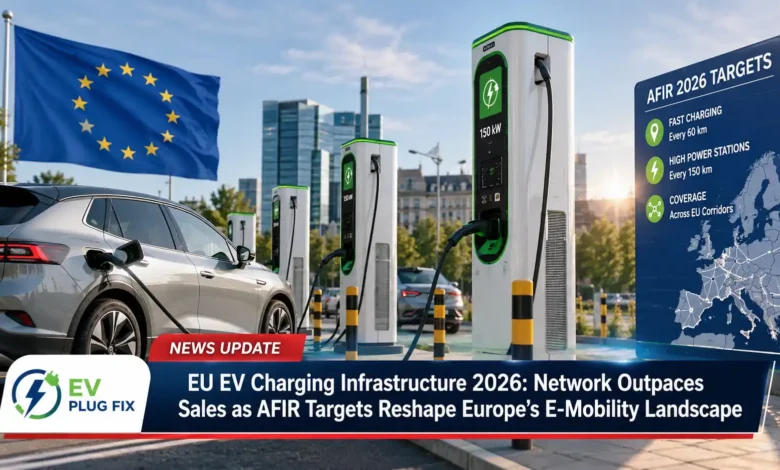
European EV charging infrastructure has officially outpaced electric vehicle sales across the continent, with new data revealing that 26 out of 27 EU member states now meet the bloc’s stringent public charging requirements linked to their national EV fleets. This milestone, confirmed by advocacy group Transport & Environment (T&E) in July 2026, challenges persistent narratives from some automakers that inadequate charging networks justify a slower transition away from internal combustion engines . Instead, the evidence suggests Europe’s charging capacity is growing faster than its battery-electric vehicle fleet, fundamentally reshaping the e-mobility landscape.
By the end of 2025, the European Union’s public charging network reached 1.1 million points—a fivefold increase from 2020 levels . This dramatic expansion has been driven largely by the Alternative Fuels Infrastructure Regulation (AFIR), part of the EU’s broader ‘Fit for 55’ climate package, which mandates member states to provide at least 1.3 kW of publicly accessible charging capacity for every battery electric vehicle (BEV) registered in their national fleet . When aggregated across all member states, the EU as a whole exceeds this fleet-based target by an impressive 180% . For EV owners looking to maximize their home charging efficiency alongside public infrastructure growth, understanding Smart EV Charging Benefits can help optimize energy usage and reduce costs.
However, the picture is not uniformly rosy. While most nations have met their fleet-based obligations, geographical disparities persist. Tesla, ChargePoint, and other major charging network operators continue to concentrate their investments in Western European markets, leaving gaps in Eastern and Southern Europe that require urgent attention. Malta remains the sole EU member state yet to meet AFIR’s fleet-based targets—a stark reminder that the transition to e-mobility remains uneven .
Nevertheless, the overall momentum is undeniable. The charging targets are working as intended and have enabled huge growth in the EV market, according to Lucien Mathieu, Cars Director at T&E. However, significant challenges remain in charging ease of use and price transparency—factors that will prove crucial to make EVs more attractive for all drivers, especially those living in apartment buildings who rely primarily on public charging . Regular Home EV Charger Maintenance is equally important for homeowners to ensure their private charging equipment remains safe and efficient over time.
Distance-Based AFIR Targets: Fast Chargers Along Europe’s Highways
Beyond fleet-based requirements, AFIR also mandates the installation of DC fast-charging stations with a minimum output of 150 kW every 60 kilometers along the EU’s primary transport corridors—specifically the Trans-European Transport Network (TEN-T) Core and Comprehensive networks . By June 2026, T&E’s analysis reveals that 79% of the Core network—predominantly national motorways—had met this 2025 deadline .
Western Europe leads the charge with compliance exceeding 99%, while remaining gaps are concentrated primarily in Spain and several Central and Eastern European countries . Yet these very nations are recording some of the fastest growth rates for ultra-fast charging infrastructure, suggesting that investment is increasingly shifting toward regions with the greatest need for additional capacity . For commercial fleet operators, implementing EV Peak Shaving strategies can help manage energy demand and reduce operational costs during high-usage periods.
Poland exemplifies this catch-up dynamic. Within less than two years, the country’s compliance with TEN-T Core requirements skyrocketed from 20% at the end of 2024 to 59% by June 2026 . For the wider TEN-T Comprehensive network—covering regional motorways and primary roads—20 out of 27 EU member states have already achieved their 2027 AFIR targets, a full 18 months ahead of schedule . Across the EU, the collective 2027 target has already been achieved, with 64% of the charging infrastructure required for the 2030 milestone already in place .
The T&E report further highlights that targeted upgrades could dramatically improve compliance. Installing or upgrading just 70 strategically located charging hubs would increase compliance with the 2025 motorway target to around 90%—22 in Spain, 11 in Poland, and seven in Romania . Many of these identified sites already have some charging infrastructure and would only require upgrades to meet AFIR requirements.
Regional Leaders and Infrastructure Disparities
A closer examination of Europe reveals stark contrasts in EV infrastructure deployment. Mercedes-Benz, BMW, and other premium automakers have invested heavily in markets where charging networks are robust, but coverage remains uneven across the continent. Germany, France, and the Netherlands—though covering only 20% of the EU’s surface area—account for an impressive 61% of all public charging points . In contrast, the other 24 EU member states, covering around 80% of the land area, collectively host just 39% of charging points.
The European Alternative Fuels Observatory (EAFO) identifies diverse regional strategies. Western European countries excel with extensive, well-funded networks boasting significant high-power chargers, though their average charging power per point is lower than some other nations. Southern European countries like Italy, Spain, and Greece are advancing but with generally lower power outputs. The Nordic region shows steady growth with moderate charging power. For Tesla owners specifically, understanding Tesla Model 3 Charging Time can help optimize home charging schedules alongside public network usage.
Central and Eastern European countries such as Bulgaria, Estonia, Latvia, Slovakia, Croatia, and the Czech Republic offer higher charging power per station but suffer from smaller overall network sizes, reflecting lower EV adoption rates . This “chicken-and-egg” challenge—low consumer demand discouraging infrastructure investment while inadequate charging deters consumers—remains a significant barrier in these regions.
Regional disparities in EV charging coverage persist, but Southern and Eastern Europe are closing the gap at record speed.
Competition Heats Up in the European EV Charging Market
Operating an integrated charging network across Europe comes with its own set of challenges—including navigating differing energy regulations, multiple currencies, and adjusting to recently implemented AFIR requirements . The European public charging market now comprises nearly 2,000 Charge Point Operators (CPOs) providing AC charging, over 1,000 supplying DC charging, and approximately 240 Mobility Service Providers (MSPs) .
Unlike North America—where pure players dominate—Europe’s foremost CPOs are primarily sector-leaping entities, notably oil and gas corporations and electric utilities, which possess competitive advantages over pure players . Major players such as Shell, TotalEnergies, bp, and E.ON leverage existing brownfield assets and grid capabilities to capture market share . Substantial capital flows from both private equity and public instruments, such as the EU’s Alternative Fuels Infrastructure Facility, fueling intense competition for prime real estate along TEN-T corridors . For property owners and businesses considering installation, understanding Wallbox Installation Costs is essential for budgeting and planning new charging infrastructure projects.
Competition among charger manufacturers and CPOs is intensifying, with newcomers like feyree entering the market with flexible, customizable AC public chargers designed for ease of installation. This influx of innovation benefits consumers but also raises questions about market concentration and pricing transparency. A parliamentary question submitted to the European Commission in May 2025 highlighted concerns that integrated companies—those operating as both CPOs and MSPs—might serve their own end-users at significantly lower prices than roaming partners, potentially restricting competition . The Commission is expected to conduct market analyses ahead of the AFIR evaluation set for late 2026.
EU EV Charging Infrastructure at a Glance: Key 2026 Statistics
| Metric | Statistic | Status |
|---|---|---|
| Total public charging points (end-2025) | 1.1 million | 5× 2020 level |
| EU member states meeting AFIR fleet target | 26 of 27 (all except Malta) | As of March 2026 |
| EU overall AFIR fleet target attainment | 180% above minimum | As of May 2026 |
| TEN-T Core network compliance (150 kW+ chargers) | 79% | As of June 2026 |
| TEN-T Comprehensive network compliance | 20 of 27 states (18 months ahead) | 2027 target achieved early |
| Chargers needed to reach 90% Core compliance | 70 strategically placed hubs | 22 in Spain, 11 in Poland, 7 in Romania |
| 2030 EU charging point target | 3.5 million | 64% already in place |
Expert Analysis: Why Price Transparency Matters
While infrastructure targets are being met, T&E’s Lucien Mathieu emphasizes that ease of use and price transparency remain critical challenges. For EV adoption to continue accelerating, especially among apartment dwellers who lack home charging, seamless payment systems, interoperable infrastructure, and transparent pricing must become priorities. Expanding smart and bidirectional charging capabilities will also be essential to support further EV adoption as the number of electric vehicles continues to grow across Europe . Innovative solutions like go-e PV Surplus Charging are already demonstrating how solar energy integration can make EV charging more sustainable and cost-effective for homeowners.
“Today EV drivers do not have far to go for a public charger. The charging targets are working as intended and have enabled huge growth in the EV market. However, there are still challenges to be overcome in charging’s ease of use, and a lack of price transparency.” — Lucien Mathieu, Cars Director, Transport & Environment
Frequently Asked Questions
What is the AFIR regulation and how does it impact EV charging in Europe?
The Alternative Fuels Infrastructure Regulation (AFIR) is a key component of the EU’s ‘Fit for 55’ climate package, mandating member states to deploy publicly accessible charging stations commensurate with electric vehicle adoption rates. Under AFIR, each BEV registered must be supported by 1.3 kW of public charging capacity, and fast-charging stations (150 kW+) must be installed every 60 km along major transport corridors. By March 2026, all EU states except Malta had met these fleet-based requirements, demonstrating the regulation’s effectiveness in enabling the EV transition .
How many public charging points does Europe have in 2026?
By the end of 2025, Europe had 1.1 million public charging points across the EU—five times the number available in 2020. This represents significant progress toward the EU’s 2030 target of 3.5 million charging points. However, achieving this goal requires installing roughly 2.6 million additional chargers over the next five years, meaning an average of nearly 520,000 new chargers annually—a steep climb from the 153,027 new chargers added in 2023 .
Which European countries lead in EV charging infrastructure?
Germany, France, and the Netherlands—though covering only 20% of the EU’s surface area—account for 61% of all public charging points . Western European countries generally excel with extensive, well-funded networks boasting significant high-power chargers. Southern European countries like Italy, Spain, and Greece are advancing but with lower power outputs, while Central and Eastern European nations like Bulgaria, Estonia, and Slovakia offer higher charging power per station but suffer from smaller network sizes due to lower EV adoption rates .
What challenges remain for Europe’s EV charging network in 2026?
Despite meeting fleet-based targets, significant challenges persist. Only 79% of the TEN-T Core network complies with the 2025 fast-charging requirement, with gaps concentrated in Spain and Eastern European countries. Price transparency and ease of use remain critical issues, particularly for drivers without home charging. The market also faces questions about fair competition between integrated CPO-MSP operators and independent providers. Additionally, rural and underserved communities continue to lag behind urban areas in charging access .
Is the EU’s EV charging network growing fast enough to support EV adoption?
Current data suggests yes—charging infrastructure is actually outpacing EV sales in all but one EU country. According to T&E’s 2026 analysis, the public charging network expanded ahead of strong electric car sales growth in 2025 and 2026, demonstrating that charging targets are enabling the EV transition as intended. However, maintaining this pace requires continued investment, with the EU needing to install approximately 2.6 million additional chargers by 2030 to meet its 3.5 million-point target .