Level 2 EV Charger Location: Indoor vs Outdoor Installation for 2026
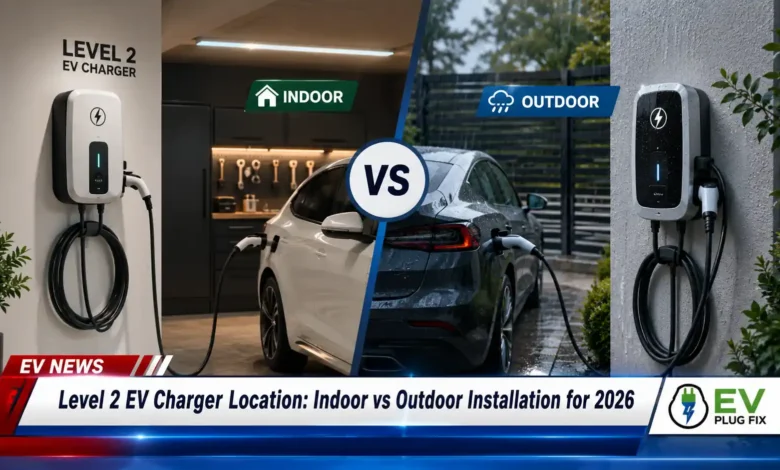
Selecting the optimal location for your Level 2 EV charging station is one of the most critical decisions you’ll make as an electric vehicle owner. The choice between indoor and outdoor installation, combined with your specific residential situation and geographic location, directly impacts your charging experience, safety, costs, and long-term satisfaction. This investigation explores the key considerations across different housing types and regions, helping you make an informed decision that aligns with your needs and circumstances for 2026 and beyond.
Understanding Level 2 Charging Fundamentals
Level 2 chargers operate on 240-volt circuits and typically draw between 30 and 50 amps, delivering a full charge in 4 to 8 hours depending on your vehicle’s battery capacity. A 40-amp Level 2 charger delivers approximately 9.6 kilowatts of power, adding 25 to 35 miles of range for every hour the vehicle is plugged in . Unlike Level 1 chargers that use standard household outlets, Level 2 chargers require dedicated electrical circuits and professional installation. The location you choose fundamentally affects installation costs, charging reliability, equipment longevity, and your daily convenience.
⚡ Expert Insight: Most new EV owners begin with a Level 1 trickle charger, but for anyone driving more than 30 to 40 miles per day, upgrading to Level 2 is essential. The speed difference is dramatic—Level 2 charging is five to eight times faster than standard outlets .
Indoor Installation: Garages and Enclosed Spaces
Advantages of Garage Installation
Installing your Level 2 charger inside a garage offers substantial benefits, particularly regarding equipment protection and longevity. The controlled environment shields your charger from rain, snow, UV radiation, and temperature extremes, significantly extending the equipment’s lifespan . Additionally, garage installations provide enhanced security—your charger and vehicle are protected from weather damage and potential vandalism.
For homeowners with vehicle connector locations positioned conveniently near the garage wall, this setup minimizes cable length and eliminates tripping hazards. The covered environment also protects you from harsh weather while plugging in your vehicle, a notable advantage during heavy rain or snow. Garage-mounted chargers also tend to have shorter wire runs from the electrical panel, which often reduces installation costs .
Garage Installation Considerations
Before committing to a garage installation, assess several critical factors. Your garage must be positioned reasonably close to your home’s electrical panel; distances exceeding 75 feet can dramatically increase installation costs due to required conduit work and wiring. Ensure adequate ventilation to accommodate charger heat generation, and verify that your garage receives sufficient Wi-Fi signal if your charger offers smart features like scheduling and remote monitoring.
Space constraints represent another consideration. While most modern garages accommodate wall-mounted chargers without significant obstruction, verify that your parking arrangement allows convenient cable access from the charging location. The industry standard mounting height is 48 to 54 inches from the floor—high enough to keep the cable clear of the ground, low enough for easy connector handling .
Outdoor Installation: Driveways, Carports, and Exterior Walls
Benefits of Outdoor Placement
Outdoor installations eliminate space constraints and provide greater flexibility for future modifications. Driveways and carports offer practical charging locations without requiring interior garage space, making them ideal for homeowners with workshop areas, storage needs, or multi-vehicle situations. Outdoor mounting also simplifies installation if your electrical panel is located on the exterior of your home.
For properties without covered parking, a weatherproof outdoor charger delivers reliable charging regardless of garage availability. Outdoor installations also allow you to serve different parking spots more easily, which is valuable for households with multiple vehicles or frequent guests .
Technical Requirements for Outdoor Chargers
Outdoor installations demand specific weatherproofing standards that add to your investment. All outdoor chargers must meet rigorous environmental protection ratings; industry standards recommend NEMA 4 ratings or higher to resist rain, dust, and moisture ingress . The National Electrical Code (NEC) requires that outdoor chargers be mounted at appropriate heights to protect against standing water and flooding.
Outdoor electrical cables must be specifically rated for wet environments, and weatherproof outlet box hoods must be listed as “extra duty” grade. These specifications ensure safety and compliance, but they typically add $200–$500 to installation costs compared to standard indoor installations . GFCI protection is required for all outdoor EV charging circuits, which can be provided through a GFCI circuit breaker at the panel .
| Installation Type | Weather Protection | Typical Cost Premium | Key Considerations |
|---|---|---|---|
| Indoor (Garage) | Full protection from elements | Baseline cost | Shorter wire runs, enhanced security, temperature-controlled environment |
| Outdoor (Driveway) | Requires NEMA 4+ rated equipment | +$200 to $500 | Weatherproof conduit, GFCI protection, proper mounting height |
| Outdoor (Carport) | Partial protection; still requires weatherproof rating | +$200 to $500 | UV exposure consideration, structural mounting assessment |
Housing Type Considerations for EV Charger Installation
Single-Family Homes
Single-family homeowners typically enjoy the most flexibility in charger placement. Whether you choose a garage, covered carport, or exterior wall location depends primarily on your home’s layout and electrical infrastructure. Most single-family homes built after the 1980s have 200-amp electrical service panels with sufficient capacity for Level 2 chargers, simplifying the installation process .
Single-family homes in suburban areas often benefit from garage or driveway installations, with typical installation costs ranging from $700 to $2,500 including electrical upgrades and permits . The national average for a standard installation is approximately $1,700 .
Apartments and Condominiums
Apartment and condominium dwellers face the most complex charging installation landscape. Historically, homeowners associations and building management frequently denied charger installation requests, creating a barrier to EV adoption for multifamily residents. However, recent legislative changes have transformed this situation significantly.
The European Union’s Energy Performance Building Directive (EPBD) now mandates that building owners and managers approve charging installation requests from residents—what’s known as the “right to plug” regulation [citation:original_content]. This groundbreaking policy recognizes that apartment residents deserve equal access to home charging solutions.
In the United States, a growing number of states have enacted “right-to-charge” laws protecting condo residents’ charging rights. As of 2025, 15 states including California, New York, Massachusetts, and Florida have passed such legislation, though each maintains slightly different requirements [citation:original_content]. These laws prevent HOAs and building management from unreasonably denying charger installations, provided residents cover all costs.
For apartment dwellers without dedicated parking spaces, emerging curbside charging solutions offer promising alternatives. Innovative companies now provide Level 2 curbside chargers that connect to building electrical infrastructure, delivering convenient neighborhood charging without requiring extensive utility infrastructure upgrades .
Rural Properties
Rural homeowners often face distinct challenges related to electrical infrastructure and grid capacity. Many rural areas rely on outdated electrical grids that weren’t designed to support modern charging demands, potentially requiring significant utility upgrades before installation can proceed. These infrastructure improvements can add substantial costs and extend timelines significantly.
However, rural properties typically offer abundant space for flexible charger placement, whether in a barn, garage, or covered outdoor structure. Homeowners should consult with local utilities early in the planning process to understand grid capacity and any required upgrades.
Regional Differences: Europe and the United States
European Regulatory Framework
Europe’s approach to residential EV charging emphasizes standardization and consumer protection through comprehensive regulatory frameworks. The EPBD establishes minimum infrastructure requirements: new residential buildings with more than three parking spaces must include pre-cabling for at least 50% of spots and install a minimum of one operational charging point [citation:original_content].
European countries maintain varying implementation timelines and incentive structures. Nordic countries lead in adoption incentives; Sweden offers subsidies covering up to 50% of residential charger installation costs, while Norway prioritizes heavy-duty vehicle charging infrastructure development [citation:original_content].
United States Regulatory Landscape
The American approach to residential EV charging emphasizes local jurisdiction authority, resulting in significant variations between states. Unlike Europe’s unified regulations, individual states, cities, and municipalities maintain distinct permitting requirements, safety codes, and incentive structures.
Most U.S. jurisdictions require electrical permits for Level 2 installations, with permit costs ranging from $50 to $200 . Inspection requirements are universal, ensuring that installations comply with the National Electrical Code. However, permit processing times vary dramatically; some jurisdictions approve permits within days, while others require weeks. The permit fee itself is typically a minor expense relative to the total project cost .
The U.S. federal government offers substantial incentives to offset installation costs. While the 30% federal tax credit for home EV charger installation expired on June 30th, 2026, many states and utilities currently offer rebates and incentives for Level 2 chargers .
Climate and Weather Considerations
Geographic location and climate profoundly influence charger location decisions. Regions experiencing heavy snow, ice, or extreme cold require particular attention to installation details.
Cold weather reduces EV charging efficiency; data indicates that some models experience up to 35% range reduction under freezing conditions. In Northern climates, outdoor charger locations should include weather protection—whether through garage placement, carport coverage, or dedicated weatherproof enclosures—to optimize winter charging performance [citation:original_content].
Outdoor chargers in cold climates must be mounted at proper heights to prevent snow accumulation and ensure water drainage. High-rainfall areas demand superior weatherproofing; outdoor installations in these regions benefit from additional protective measures beyond standard NEMA 4 ratings. For open driveway installations, NEMA 4 or higher rated equipment is recommended to withstand direct precipitation and splashing .
Conversely, regions with intense sun exposure should consider outdoor chargers’ heat dissipation requirements. Mounting on a south- or west-facing wall in hot climates means sustained UV and thermal exposure—minimizing direct solar loading on the unit through natural shading or a small equipment shade where practical will extend the service life of any electronic device .
Electrical Panel and Infrastructure Requirements
Your home’s electrical infrastructure fundamentally constrains charging location options. Level 2 chargers require dedicated circuits with breakers sized at 125% of the charger’s maximum current draw. A 40-amp charger, for example, requires a 50-amp circuit breaker .
Most modern homes with 200-amp service panels accommodate Level 2 chargers without upgrades. However, older homes with 100-amp panels often require service panel upgrades costing $500–$2,000 before charger installation can proceed . The electrical panel’s location typically dictates optimal charger placement; positioning your charger close to the panel minimizes wiring distances and reduces installation costs substantially.
A poorly positioned charger creates daily frustration. Taking time upfront to pick the right spot, factoring in accessibility, wiring distance, and weather exposure, saves a lot of trouble down the road .
Future-Proofing Your Installation
When selecting charger location, consider your long-term needs. Installing a charger with sufficient amperage capacity—32 to 48 amps rather than the minimum 16–20 amps—prepares your home for higher-power chargers as technology advances. Some experts recommend equipping new homes with 200-amp panels specifically to accommodate future charger upgrades and potential additions for multiple electric vehicles [citation:original_content].
Choosing a location that permits future expansion—whether adding a second charger or upgrading to higher capacity—protects your investment against technological advancement and changing household needs. For garages, installing near the garage door with a cable long enough to reach vehicles parked either inside or just outside offers maximum flexibility .
Making Your Decision
The ideal charger location balances multiple factors: your home’s physical layout, electrical infrastructure capacity, climate considerations, local regulations, and long-term intentions. Homeowners with garages in moderate climates enjoy straightforward indoor installations. Apartment dwellers should leverage new “right-to-charge” protections and emerging curbside solutions. Rural property owners must verify grid capacity early and plan accordingly.
Regardless of your circumstances, consult with a licensed electrician before committing to a location. Professional assessment of your electrical panel, proposed charger placement, and local code requirements ensures safety, compliance, and optimal long-term performance. A licensed electrician will handle the permitting process and ensure your installation complies with the National Electrical Code and local building regulations—unpermitted work can complicate selling your home later or even void your homeowner’s insurance policy .
⚠️ Important: Installing a Level 2 EV charger is not a DIY project. It involves high-voltage electrical work that directly impacts your home’s safety and your vehicle’s battery health. Mishandling 240-volt circuits can lead to severe electrical shock, arc flashes, or home electrical fires .
Your Level 2 charger location decision shapes your EV ownership experience for years to come. By carefully evaluating your specific residential situation, regional regulations, climate factors, and electrical infrastructure, you can select a location that maximizes convenience, minimizes costs, and provides reliable charging for your electric vehicle.