OCPP Protocol Standard 2026: EV Charging Interoperability & Smart Grid Integration
The Open Charge Point Protocol (OCPP) is the de facto communication standard that powers the global EV charging ecosystem, ensuring that any charging station can talk to any central management system. By 2026, OCPP has evolved far beyond its original purpose of preventing vendor lock-in. It is now the foundational technology enabling smart charging, vehicle-to-grid (V2G) integration, and the seamless incorporation of renewable energy sources into the grid .
Developed and maintained by the Open Charge Alliance (OCA), this royalty-free protocol operates in over 137 countries. Its primary mission is to provide a uniform method of communication, preventing coordination problems and benefiting the entire electric vehicle market . For charge point operators (CPOs), e-mobility service providers (EMSPs), and fleet managers, understanding OCPP is no longer optional—it is a competitive and regulatory imperative.
What is the OCPP Protocol and Why is it Crucial?
At its core, the Open Charge Point Protocol (OCPP) is an application protocol that enables two-way communication between EV charging stations and a central management system. It acts like a universal translator, allowing hardware from different manufacturers to work with software from different providers . This interoperability is the key to avoiding vendor lock-in, where a network operator is stuck with a single provider and cannot switch without ripping out and replacing expensive hardware. For homeowners, selecting Best Home EV Wallbox Chargers that support OCPP ensures compatibility with future energy management systems.
The protocol operates on a client-server architecture using WebSocket with JSON message bodies. It supports a wide range of functions that are critical for modern infrastructure management:
- Authentication & Authorization: Securely verifying user credentials to prevent unauthorized access.
- Transaction Management: Handling the complete lifecycle of a charging session, from start to billing.
- Smart Charging: Enabling load management and dynamic power allocation to prevent grid peaks .
- Remote Management: Allowing operators to monitor status, update firmware, and diagnose issues without a physical visit.
A key advancement in OCPP 2.0.1 resolved a major flaw in earlier versions regarding network disruptions. By shifting the generation of transaction IDs to the charging station itself, it streamlined the reconciliation process when connectivity was restored, eliminating previous reconciliation challenges .
OCPP Version Evolution: From 1.6 to 2.1 in 2026
The OCPP protocol has matured significantly, with each version adding critical features to meet the demands of a rapidly growing market. As of 2026, the landscape is defined by three main versions: the widely deployed OCPP 1.6, the security-focused OCPP 2.0.1, and the new, energy-market-centric OCPP 2.1.
| Feature / Capability | OCPP 1.6 (2015) | OCPP 2.0.1 (2020) | OCPP 2.1 (2025) |
|---|---|---|---|
| Primary Focus | Basic interoperability & vendor lock-in prevention | Advanced security & device management | Energy markets, V2X, & DER integration |
| Security | Basic authentication | Strictly defined profiles, TLS 1.3, client-side certificates | Builds on 2.0.1 with enhanced profile management |
| Smart Charging | Basic SetChargingProfile |
Central, Local, and External smart charging variants | Advanced tools for optimized energy distribution |
| ISO 15118 Integration | No native support | Native support for Plug & Charge | Full support for ISO 15118-20 & bidirectional power transfer |
| Bidirectional Power (V2G/V2H) | Workarounds only | Not natively supported | Native support via new functional block |
| DER Control | Not included | Limited capabilities | Dedicated functional block for renewable integration |
| Transaction & Billing | Standard energy-based billing | Improved transaction handling | Fixed cost, energy, or time-based billing; session resumption |
OCPP 1.6 remains the most widely deployed version globally, handling basic smart charging tasks adequately for many residential and public charging setups. However, it is now considered outdated for new, large-scale infrastructure projects .
OCPP 2.0.1, which was approved as an IEC standard (IEC 63584) in 2024, marked a generational leap in security and functionality. It introduced a device management framework, enhanced security profiles, and native support for ISO 15118, enabling Plug & Charge for seamless user experiences . This version is now mandated for federally funded projects in the US, with compliance requirements similar to Home EV Charger Permits needed for residential installations.
OCPP 2.1, released in early 2025, is the latest standard designed for a smarter, more efficient future . It builds on 2.0.1 while ensuring backward compatibility for existing application logic.
OCPP 2.1: The Breakthrough Features of 2026
The release of OCPP 2.1 represents a significant shift in how EV charging infrastructure interacts with the broader energy ecosystem. Here are the standout features that are defining 2026 :
- Native V2X and Bidirectional Charging: A new functional block manages bidirectional energy flows, allowing EVs to send power back to the grid (V2G), a home (V2H), or a building (V2B). This is the hardware-agnostic software backbone for monetizing the battery capacity of EVs. Understanding Bidirectional EV Charging Benefits is essential for homeowners considering this technology.
- Distributed Energy Resource (DER) Control: A dedicated functional block allows charging stations to communicate directly with renewable sources like solar and wind. This enables charging to be automatically prioritized during peak solar production, dramatically improving the economics of home solar systems .
- Enhanced Smart Charging: The new smart charging tools offer more granular control over energy distribution, allowing for real-time optimization across multiple stations and vehicles.
- Flexible Payment and Authorization: OCPP 2.1 introduces support for prepaid charge cards, ad hoc payment via credit/debit card terminals, and secure dynamic QR codes, catering to a wider range of use cases and improving user accessibility.
- Extended Transaction Options: Operators can now offer fixed-cost, energy-based, or time-based billing models. A critical feature is the ability to resume a transaction after an unexpected reboot, ensuring uninterrupted service and improving user experience.
OCPP and the Rise of Smart Charging & Solar Integration
The economic case for OCPP in 2026 is heavily tied to smart charging, particularly for renewable energy integration. For homeowners, the gap between the feed-in tariff for solar and the retail price of electricity makes self-consumption highly valuable. The EV is the largest controllable load in a home, and OCPP is the tool that allows a Home Energy Management System (HEMS) to control it. Pairing OCPP with EV Time-of-Use Plans can further optimize charging costs by scheduling sessions during off-peak hours.
Using the SetChargingProfile message, a HEMS can dynamically adjust the charging rate of the EV based on real-time solar surplus. In a practical scenario, the system calculates the surplus solar power every 10-30 seconds and translates that into a charging limit for the EV. This ensures that the car charges almost entirely on free, green energy, bypassing grid import entirely .
“On a 6 kWp German rooftop with a Volkswagen ID.3 charging 40 kWh per session three times a week, OCPP-controlled solar-only charging shifts roughly 5,800 kWh per year from grid import… The OCPP integration pays for itself in under 6 months.”
This logic scales seamlessly to workplaces and commercial sites with multiple chargers, where local smart charging algorithms can distribute available solar power among dozens of vehicles based on their state of charge and departure times. Without OCPP, this would require complex, vendor-specific wiring; with OCPP, it is solved in software .
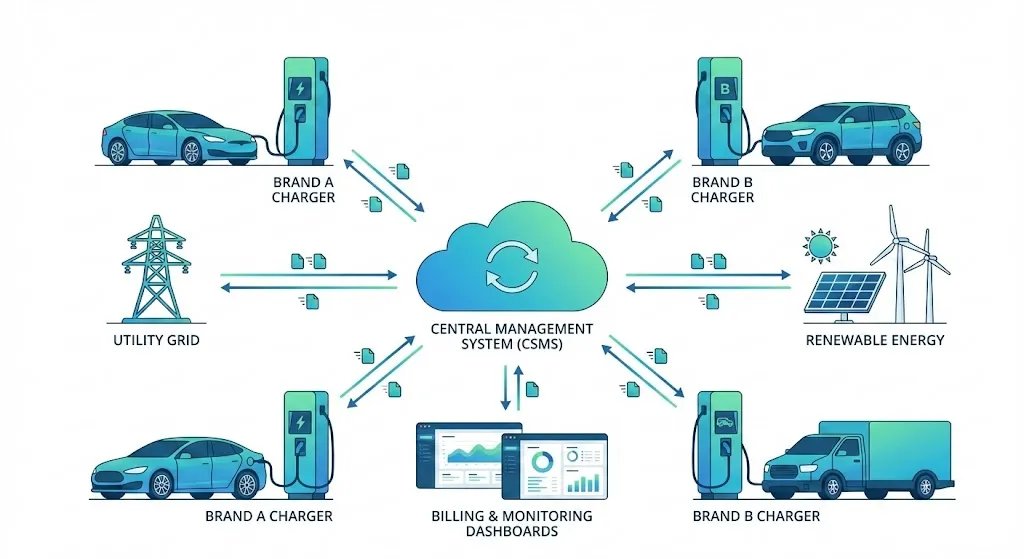
Optimized energy distribution using OCPP smart charging algorithms across multiple EV chargers.
OCPP 2026: The Interoperability Stack
To understand the role of OCPP, it’s essential to see how it fits within the broader communication stack of modern EV charging. It works in harmony with other standards rather than replacing them :
- ISO 15118 (Vehicle-to-Charger): Governs the digital communication between the EV and the charging station. It enables Plug & Charge and smart charging negotiation over the charging cable. OCPP 2.0.1 and 2.1 transport this information to the backend.
- OCPP (Charger-to-Backend): Handles the communication between the charging station and the Charging Station Management System (CSMS). It is the management and monitoring layer.
- OCPI (Backend-to-Backend): Handles roaming between different charging networks, allowing EV drivers to use charging stations from different providers with a single app or card.
Together, these three protocols form a complete communication stack that ensures a seamless, secure, and interoperable charging ecosystem from the vehicle to the grid operator.
Global Adoption and Mandates in 2026
Regional adoption of OCPP varies significantly, driven by different regulatory environments and market maturity. Europe is the leader, with approximately 85% of charging stations using OCPP. The EU’s Alternative Fuels Infrastructure Regulation (AFIR) now mandates interoperability and explicitly references OCPP compliance for public chargers .
In North America, adoption is accelerating due to the $5 billion National Electric Vehicle Infrastructure (NEVI) program, which mandates OCPP 2.0.1 compliance for all federally funded charging stations. California and other leading states also require OCPP for public projects to prevent vendor lock-in. For residential installations, ensuring your charger meets these standards is as important as understanding Level 2 EV Installation requirements.
In the Asia-Pacific region, adoption is heterogeneous, with South Korea mandating OCPP certification and countries like Japan and China increasingly adopting it for international market compatibility. Emerging markets in South America, Africa, and the Middle East are beginning to integrate OCPP into their smart city and infrastructure modernization plans.
Conclusion: OCPP as the Backbone of the Energy Transition
In 2026, the Open Charge Point Protocol is far more than a tool for basic interoperability. It is the foundational layer upon which the future of flexible energy management is being built. By enabling intelligent communication between EVs, charging stations, and the grid, OCPP is transforming electric vehicles from passive loads into active, distributed energy resources.
From enabling solar-powered charging that pays for itself in months to unlocking the immense potential of V2G for grid stability, OCPP is the protocol that powers it all. For operators and consumers alike, understanding and leveraging OCPP’s latest capabilities—particularly OCPP 2.1—is the key to unlocking the full economic and environmental benefits of the EV revolution.