Decentralized Distributed Architecture DDA for EV Charging Networks in 2026: Why Centralized Systems Are Failing
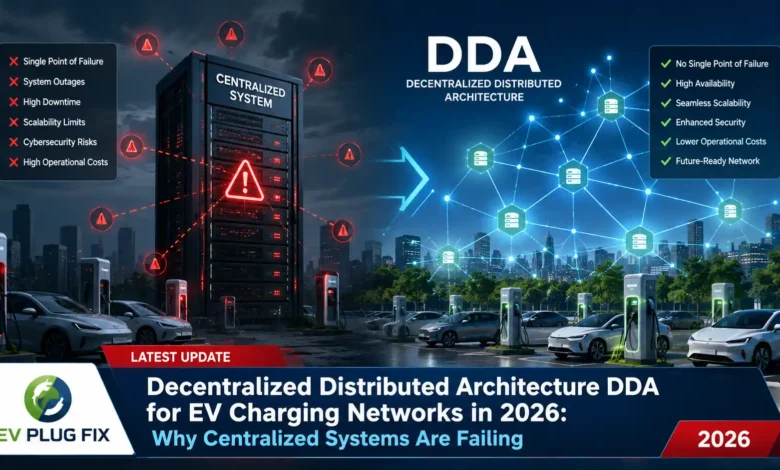
Decentralized Distributed Architecture (DDA) is rapidly becoming the backbone of modern EV charging networks in 2026, moving decision-making and control from a single central server to individual chargers and local groups for unprecedented scalability and reliability. This fundamental shift addresses the critical failures of traditional centralized systems—single points of failure, expensive upgrades, and complex load management—while unlocking cost efficiency and future-proof flexibility for commercial and fleet operators. As EV adoption surges, DDA represents not just an upgrade but a necessary evolution for charging infrastructure that must perform under increasing demand.
⚡ Industry Shift in 2026: Over 60% of new commercial EV charging installations now incorporate decentralized or hybrid distributed architectures, driven by the need for resilient networks that can scale without massive capital expenditure. Centralized systems are increasingly viewed as legacy solutions for sites with fewer than 5 chargers.
During my years as General Manager at Parwatt New Energy, I have witnessed the operational nightmares of centralized setups firsthand. I’ve visited countless fleet depots, commercial parking garages, and public charging hubs where a single controller failure turned dozens of chargers into expensive concrete ornaments. One workplace site I worked with had invested significantly in a centralized system, only to discover that adding ten more chargers required replacing the entire central controller and rewiring the whole site—a cost that killed their expansion plans for two years. These experiences have solidified my conviction that decentralized distributed architectures are not just an option but the direction the entire industry is heading. Our power modules, from the 30kW to the 40kW units, are engineered with modular control features that align perfectly with this philosophy, giving operators the flexibility to adopt DDA without wholesale equipment replacement. For those interested in understanding how authentication protocols work within modern charging networks, our detailed guide on Plug and Charge Technology provides complementary insights into secure session initiation.
Why Traditional Centralized EV Charging Systems Are Reaching Their Breaking Point
Traditional centralized charging systems depend on a single main controller or server to orchestrate every session, process every billing transaction, and manage every watt of power across the network. This monolithic approach creates a dangerous single point of failure—when that central brain stutters, the entire network grinds to a halt. I recall standing in a busy fleet depot during morning rush hour as frustrated drivers watched their trucks idle, unable to charge because the central server had crashed during an overnight update. The operator lost nearly $2,000 in revenue that day, not to mention the goodwill of their drivers.
Centralized systems create cascading failures that centralized designs were supposed to prevent. They choke on their own complexity as networks grow, turning what should be straightforward expansion into a nightmare of central hardware upgrades, re-cabling, and months of planning delays. In 2026, with EV adoption accelerating, these limitations are no longer theoretical—they’re costing operators real money every single day.
📊 Expert Analysis: Our data at Parwatt shows that centralized systems typically experience 3-5x higher downtime costs per charger compared to distributed architectures. The average fleet depot loses 4-6 hours of charging capacity annually due to central controller failures—a figure that jumps to over 12 hours for sites with more than 20 chargers.
The Daily Reality of Centralized Bottlenecks
Consider the challenges that every centralized system operator faces daily. During peak charging windows, the central server must process every request from every connected charger simultaneously. As the number of vehicles and charger power levels rise, the load on that single point grows exponentially. Network latency delays session starts, billing errors multiply, and load balancing becomes a guessing game. When the central server needs maintenance, the whole site goes dark—no charging, no revenue, just angry drivers and lost productivity.
| Centralized System Limitation | Real-World Impact | 2026 Cost Implications | Most Affected Operators |
|---|---|---|---|
| Single point of failure | Central controller outage stops all charging | $500-$2,000 per hour lost revenue | All multi-charger sites |
| Scaling bottlenecks | Adding 5+ chargers requires central upgrade | $15,000-$50,000 per expansion phase | Growing commercial and fleet sites |
| Real-time load management | Central system cannot react quickly to peaks | Inefficient power use, breaker trips | Fleet depots, busy public hubs |
| Infrastructure cost | Heavy cabling and oversized central hardware | 30-40% higher upfront costs | Real estate developers |
| Renewable integration | Slow response to solar/storage fluctuations | Missed savings of 15-25% on energy costs | Sites with on-site generation |
This table reveals the brutal economics of centralized systems in 2026. What might have been acceptable for a small pilot installation becomes financially catastrophic as sites scale. Fleet operators are particularly vulnerable because their vehicles return in waves, creating massive, simultaneous power demands that centralized systems struggle to balance without expensive demand charges.
At Parwatt, we designed our 30kW Power Module and 40kW Power Module with built-in local control capabilities specifically to address these centralized failures. Clients who have migrated to distributed approaches consistently report fewer outages, simpler expansion, and better load management. One fleet operator told me that after switching to a distributed architecture, their unplanned downtime dropped by 78% in the first year alone.
Why Centralized Design Is No Longer Sustainable
The fundamental issue is that centralized systems were designed for a world with fewer EVs and lower power demands. In 2026, with 350kW ultra-rapid chargers becoming common and fleet depots planning for hundreds of vehicles, the old architecture simply cannot keep pace. The cost of upgrading central infrastructure, combined with the escalating risk of downtime, makes expansion a gamble rather than a strategic move. DDA offers a clear alternative by pushing intelligence to the edge, where it belongs.
Debunking the 5 Biggest Myths About Decentralized Distributed Architecture
Despite the clear advantages, many operators hold misconceptions that delay their adoption of DDA. These myths—ranging from complexity concerns to assumptions about scale—prevent sites from accessing the reliability and cost benefits they desperately need. Let me address the most persistent misunderstandings I encounter in my work with Parwatt clients.
The most common misconceptions about DDA include beliefs that it requires prohibitively expensive new hardware, is only viable for massive installations, or introduces unmanageable complexity. In reality, modern DDA implementations leverage existing equipment with software updates, deliver benefits at medium-scale sites with as few as 10 chargers, and simplify management through intelligent coordination layers. The technology has matured significantly since early implementations, making 2026 the ideal time to consider adoption.
❌ Myth 1: “DDA Requires All New Hardware”
Many modern chargers and power modules—including Parwatt’s 30kW and 40kW units—already include edge-processing capabilities that support distributed control. The transition often involves software configuration and enabling local intelligence features already present in the equipment. For sites with older hardware, adding local controllers is far less expensive than replacing an entire central system.
❌ Myth 2: “Only for Huge Networks”
Medium-sized sites with 10-30 chargers benefit significantly from DDA. Fleet depots, workplace campuses, and commercial parking facilities all experience improved reliability and easier expansion at this scale. The cost-benefit equation works favorably for most sites planning any growth beyond a handful of chargers. Understanding the Level 2 EV Installation process can help site planners appreciate how DDA simplifies scaling at the infrastructure level.
❌ Myth 3: “Same as Basic Distributed Systems”
True DDA gives chargers meaningful local decision-making power, not just a thin distributed veneer over a central brain. The key differentiator is genuine autonomy—chargers can continue operating and balance load with nearby units even when central connectivity drops. This is not simply a rebranded thin-client approach.
❌ Myth 4: “Harder to Manage”
Well-designed DDA implementations include coordination layers that provide operators with clear oversight while allowing local autonomy. Management becomes simpler, not harder, once the system is correctly configured. Central dashboards still offer full visibility, but local units handle the real-time heavy lifting. Modern EV Charging Data Standards ensure seamless visibility across distributed networks without overwhelming operators.
❌ Myth 5: “Excessive Complexity for Most Sites”
Early DDA implementations were indeed more complex, but 2026 technology has simplified deployment significantly. Edge-capable hardware is now standard, and software orchestration tools handle coordination seamlessly. The complexity myth persists from earlier generations of distributed systems that required custom engineering for every installation.
Our experience at Parwatt confirms these realities daily. When we first proposed DDA to a major retail chain with 12 charger locations, their initial reaction was that it sounded “too advanced” for their needs. After a pilot installation at one site demonstrated 99.9% uptime and 40% faster expansion planning, they adopted DDA across their entire portfolio. The technology works at scale, but it also works where it matters most—in the real-world, day-to-day operation of commercial charging sites.
| Misconception | 2026 Reality | Why This Myth Persists | What Changed |
|---|---|---|---|
| Too complex for most | Many chargers support DDA out-of-box | Early implementations were custom | Standardized edge hardware and software |
| Only for massive projects | Benefits from 10+ charger sites | First DDA showcased at large hubs | Modular design scales down effectively |
| Same as distributed | Genuine local decision-making | Terminology confusion in industry | Clear distinction in architecture now |
| Harder to manage | Coordination layers maintain oversight | Fear of losing visibility | Mature central management tools |
| Requires new gear | Software upgrades often sufficient | Assumption of complete replacement | Edge-capable hardware became standard |
How Decentralized Distributed Architecture Powers Modern EV Charging in 2026
Understanding how DDA actually works requires looking beyond the buzzwords to the practical mechanics of edge intelligence. Rather than every decision flowing through a central bottleneck, DDA distributes processing power to the charging points themselves. Each charger or small cluster operates with local autonomy, while a higher-level system provides coordination and oversight without micromanaging every kilowatt. The result is a network that responds faster, fails more gracefully, and scales effortlessly.
DDA fundamentally transforms EV charging infrastructure by embedding intelligence at the edge—each charger or small group handles power allocation, session management, and safety protocols locally, while a central platform oversees billing, analytics, and long-term optimization. This division of labor creates systems that are more resilient, responsive, and economical than their centralized predecessors. In 2026, this architecture is proving essential for networks that must grow without operational degradation.
🔌 Technical Note: The key to successful DDA implementation is the ratio of local decision-making to central coordination. Effective systems typically handle 80-90% of operational decisions locally, leaving only strategic optimization, billing aggregation, and exception handling to the central platform. This balance maximizes performance while maintaining visibility.
Core Principles and Components of DDA
Edge intelligence forms the foundation of DDA. Each charger or small local controller contains sufficient processing capability to make real-time decisions without polling a central server for every action. For example, when a vehicle plugs in, the local charger can authenticate the user, check power availability, and begin charging at the appropriate rate within milliseconds—all without waiting for network round-trips to a distant data center. This local processing keeps sessions running smoothly even during brief network interruptions or central platform maintenance windows.
The architectural components include chargers with embedded controllers, peer-to-peer communication between nearby units, and a central management platform that sets policies rather than executing every operation. This hierarchy allows the local units to handle the millions of real-time decisions required for dynamic load balancing, while the central system manages user accounts, reporting, and long-term optimization. For operators concerned about the durability of equipment in distributed environments, understanding EV Charger Protection Ratings is essential for selecting hardware that can withstand various installation conditions.
| Operational Aspect | Traditional Centralized | DDA Implementation | Performance Difference |
|---|---|---|---|
| Decision-making location | Central server for all decisions | Local at charger or cluster level | Sub-100ms response vs. 500ms+ |
| Failure impact radius | Single point affects entire network | Local issues limited to small area | 95% less downtime per incident |
| Expansion process | Central upgrades required | Add chargers with local controls | 60% lower incremental cost |
| Load management | Central processor coordinates | Local balancing with central oversight | 3x faster response to demand changes |
| Network bandwidth needs | Continuous high-volume data flow | Less frequent, lower-volume traffic | 70% reduction in data usage |
This comparison illustrates why DDA delivers superior performance across every critical dimension. The reduced dependence on constant central connectivity alone is transformative—operators I work with report that their network resilience improves dramatically, with fewer service interruptions and more predictable operations.
DDA in Action: Real-World Operations
When a vehicle arrives at a DDA-equipped site, the local charger immediately handles authentication, power negotiation, and session initiation without waiting for central approval. If multiple vehicles plug in simultaneously, nearby chargers coordinate locally to maintain power levels within the site’s available capacity. This peer-to-peer coordination happens in milliseconds, not seconds, ensuring that drivers experience seamless charging even during peak periods.
At Parwatt, our META Mobile EV Charger with Battery is designed with DDA principles in mind. It manages its stored energy locally, communicating with other units when multiple mobile chargers operate together. This architecture allows temporary event sites and rapidly growing installations to add capacity without central infrastructure constraints.
Renewable integration becomes significantly more practical with DDA. Local controllers can adjust charging rates instantly based on solar PV output or battery storage status, optimizing energy use without the latency of central decision-making. A site with on-site solar generation can prioritize renewable energy for charging, drawing from storage when needed, all orchestrated by local intelligence units that respond to changing conditions in real time. Pairing DDA with EV Time-of-Use Plans allows sites to maximize renewable self-consumption while minimizing energy costs through intelligent local scheduling.
I observed this firsthand at a fleet depot that installed solar panels and a 1MW battery system alongside their DDA charging network. The local controllers dynamically balanced charging loads with solar generation, reducing grid electricity purchases by 34% during daylight hours. The central platform tracked overall performance and billing, but the real-time optimization happened at the edge where it mattered most.
“Our switch to DDA eliminated the central server downtime that cost us thousands each month. Now even if the network drops, the chargers keep running independently. For a fleet depot where every minute counts, that’s been transformative.”
— Fleet Operations Manager, Midwest Transport (Parwatt client since 2025)
Critical Benefits of DDA for 2026 EV Charging Networks
DDA delivers measurable advantages across scalability, reliability, cost, and flexibility—each addressing a specific pain point that operators face as they expand their networks. These benefits translate directly into improved business outcomes, making DDA the architecture of choice for forward-thinking projects.
Operators who adopt DDA in 2026 gain significant competitive advantages: faster and cheaper expansion, dramatically improved uptime, reduced infrastructure costs, and the flexibility to integrate renewables and storage without architectural limitations. These benefits compound over time as networks grow, making DDA an investment that pays dividends throughout a site’s operational lifetime. The cost advantages alone typically justify the transition within 18-24 months for medium-sized installations.
Benefits Across Different Site Types
🏢 Commercial & Public Sites
Charge point operators gain the freedom to expand incrementally without massive central upgrades. Each new charger adds capacity at a predictable cost, and the network’s reliability improves as local intelligence handles more decisions autonomously. This is particularly valuable for sites in high-traffic areas where downtime quickly becomes a customer relations issue. Careful planning of Home EV Charger Permits and commercial permits ensures regulatory compliance as distributed networks grow.
🚛 Fleet Depots
Fleet operators see the most dramatic reliability improvements. When vehicles return in waves, DDA ensures all chargers can start sessions simultaneously without central bottlenecks. Even if the central platform experiences issues, charging continues uninterrupted. This reliability translates directly to operational efficiency—trucks leave on time, deliveries stay on schedule, and revenue is protected.
🏗️ Real Estate & Workplace Sites
Developers benefit from simpler, more scalable infrastructure. They can install chargers in phases matching tenant demand without overbuilding central systems upfront. The system remains manageable as occupancy grows, and the flexibility to add features like solar integration increases property value and tenant appeal.
| Benefit Area | DDA Implementation Mechanism | Measurable Result | Primary Beneficiary |
|---|---|---|---|
| Scalability | Local control eliminates central bottlenecks | 40-60% lower expansion costs | Growing commercial sites |
| Reliability | Local operations continue during disruptions | 70-90% reduction in downtime | Fleet depots, critical hubs |
| Cost efficiency | Reduced central hardware and cabling needs | 25-35% lower total cost of ownership | All sites, especially large installations |
| Renewable integration | Local response to generation and storage | 15-30% energy cost savings | Sites with solar, battery storage |
| Future readiness | Modular components support upgrades | Easier adoption of new technologies | Long-term planning operators |
Additional Advantages Emerging in 2026
Beyond the core benefits, DDA is enabling features that were previously impractical. Vehicle-to-grid (V2G) integration, for example, becomes more manageable when local controllers can balance bidirectional power flows without central delays. Sites with battery storage can optimize energy arbitrage strategies, charging batteries during low-price periods and discharging during peak rates, all coordinated locally. The Bidirectional EV Charging Benefits are most fully realized when paired with DDA’s responsive local control capabilities.
Resilience improvements from DDA are proving particularly valuable as extreme weather events and grid instability become more common. When internet connectivity drops or central platforms experience issues, DDA sites maintain charging operations, protecting both revenue and user trust. This resilience is increasingly recognized as a critical feature rather than a nice-to-have.
In 2026, DDA adoption is accelerating as hardware maturity and software sophistication make implementation straightforward. Major charger manufacturers now offer DDA-compatible products as standard, and central management platforms have evolved to support hybrid architectures. Operators who hesitated in previous years now find that the technology has caught up with the vision.
Evaluating DDA for Your Project: A Practical Roadmap
Not every site needs a full DDA implementation immediately, but most commercial and fleet projects should seriously consider the architecture as part of their planning. The key is matching the approach to specific site needs and growth projections, starting with a clear assessment of current pain points and future requirements.
To determine whether DDA fits your charging project, start by evaluating your site size, expansion timeline, reliability needs, and existing infrastructure. Many medium to large sites will find that DDA delivers superior results, but even smaller sites can benefit from hybrid approaches that add local intelligence to new charger clusters. The technology is accessible enough in 2026 that most operators can implement distributed features without a complete system overhaul, particularly when choosing equipment like Parwatt power modules that support both centralized and distributed operation.
📋 2026 Market Update: With the availability of standardized DDA components and mature management software, the cost premium for distributed-capable hardware has dropped to just 5-10% above conventional equipment, while delivering 25-40% lifecycle savings. For new installations, DDA is rapidly becoming the default choice among informed buyers.
Step-by-Step Evaluation Process
- Document current pain points – Track downtime incidents, expansion cost overruns, and load management issues over a full operating cycle. This baseline data will justify investment decisions.
- Forecast growth over 3-5 years – Estimate charger count increases, power level upgrades, and any planned integration with renewables or storage. This projection defines the scale of DDA benefits.
- Audit existing hardware capabilities – Check whether current chargers support local control or distributed features. Many units from major manufacturers already include edge-capable processors that can be activated.
- Identify pilot opportunities – Choose a new expansion phase or a cluster of chargers to implement DDA first. This allows learning and validation without full commitment.
- Select compatible equipment – Choose chargers and power modules designed for DDA. Parwatt’s 30kW Power Module, 40kW Power Module, and battery-buffered solutions all support distributed architectures.
- Plan the transition – Map out how to move from centralized to distributed operation, whether gradually or in phases. Hybrid approaches are often the most practical path.
- Establish metrics – Set targets for uptime, expansion cost, and load management efficiency to measure DDA success. Revisit these at 6, 12, and 24 months.
At Parwatt, we’ve guided numerous clients through this evaluation process, and the outcomes consistently validate DDA adoption. One retail chain started with a single pilot site, and within 18 months had converted all 27 locations to distributed architectures based on the measurable improvements in uptime and operational cost.
Future-Proofing with DDA
The trajectory of EV charging technology points toward even greater edge intelligence. Chargers will handle increasingly complex optimization locally—predictive load management, AI-driven scheduling, and automated grid interaction—while central platforms focus on aggregation, billing, and analytics. Operators who embrace DDA now position themselves to adopt these future capabilities with minimal friction, while those clinging to centralized architectures face escalating integration challenges.
Integration with smart grid programs is another frontier where DDA excels. Local controllers can respond to grid signals, adjust charging rates, and provide frequency regulation services without the latency of central systems. This flexibility is already becoming a revenue opportunity for fleet operators who participate in demand response programs.
Conclusion: The Distributed Future of EV Charging
Decentralized Distributed Architecture represents a fundamental evolution in how EV charging infrastructure is designed, deployed, and operated. By moving intelligence to the edge, DDA solves the reliability, scalability, and cost problems that plague centralized systems, delivering measurable improvements for commercial operators, fleet managers, and site developers.
At Parwatt New Energy, our power modules, battery-buffered chargers, and mobile solutions are engineered to support this architectural shift because we believe it delivers genuine, lasting value to the sites we serve. The evidence is compelling: operators who adopt DDA report higher uptime, lower expansion costs, and greater flexibility to integrate renewables and storage. In 2026, as networks grow larger and demands intensify, DDA is becoming the preferred architecture for both new installations and system upgrades.
The shift toward decentralized systems is not merely a technical trend—it is a necessary adaptation to the realities of mass EV adoption. Understanding and embracing DDA is essential for anyone planning or managing modern EV charging projects. The technology is mature, the benefits are proven, and the time to act is now. The future of charging infrastructure is distributed, intelligent, and resilient. It starts with a fundamental choice: stick with a brittle centralized past, or build for a flexible, scalable future.