Solid-State EV Battery Timeline 2026: When Will They Actually Arrive?
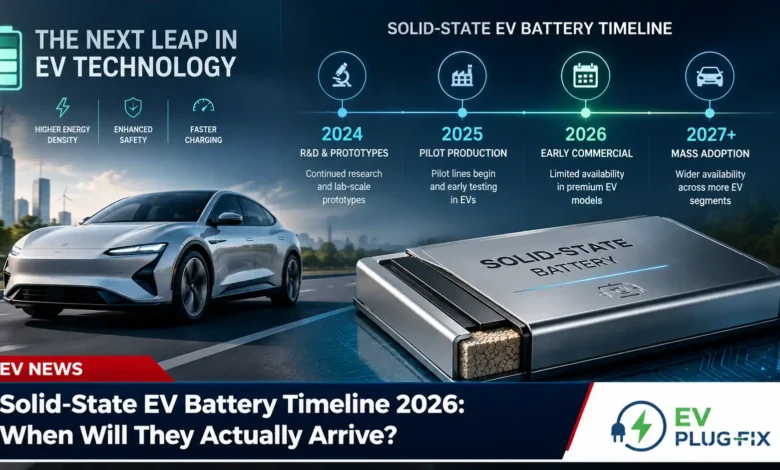
Solid-state EV battery technology represents the single most anticipated advancement in electric vehicle development since the invention of the lithium-ion cell itself. For decades, researchers have chased the promise of batteries that charge in minutes, deliver 500-mile ranges, and eliminate fire risks entirely. Now in 2026, that vision stands on the precipice of commercial reality, with major automakers and battery manufacturers racing to bring solid-state cells to production vehicles within the next 12 to 36 months.
The journey from laboratory curiosity to automotive showroom has been anything but straightforward. When physicist John B. Goodenough and his team first demonstrated lithium cobalt oxide as a viable cathode material in the early 1980s, they defied conventional wisdom about achievable battery voltages. “We didn’t know that you weren’t supposed to be able to get such a big voltage out of it,” Goodenough later reflected. “But because I didn’t know that, we went ahead and did it. And it was stable.” This spirit of scientific audacity now drives the solid-state revolution, as researchers tackle challenges that once seemed insurmountable.
Why Solid-State Batteries Represent a Quantum Leap Forward
Understanding the solid-state advantage requires examining what’s currently inside your EV battery pack. Traditional lithium-ion batteries use liquid electrolytes to shuttle ions between electrodes during charging and discharging. While this chemistry has proven remarkably successful, it comes with inherent limitations: fire risks from thermal runaway, gradual degradation that reduces range over time, and fundamental energy density constraints. For a deeper look at how battery health affects your EV’s long-term performance, check out our analysis on EV Battery Degradation.
Solid-state batteries replace the flammable liquid electrolyte with a solid material, typically ceramics or advanced polymers. This simple substitution unlocks extraordinary benefits:
- Energy density improvements of 50-100% enable 500+ mile ranges on a single charge
- Charging times under 15 minutes approach the convenience of gasoline refueling
- Elimination of thermal runaway risks creates inherently safer battery packs
- Extended cycle life with up to 80% capacity retention after 1,000+ charge cycles
- Lower operating costs through reduced cooling requirements and simplified pack design
“The potential for solid-state technology to transform the EV industry cannot be overstated,” explains Dr. Sarah Chen, a battery researcher at the University of Cambridge. “We’re not just incrementally improving lithium-ion chemistry—we’re fundamentally reimagining what battery technology can achieve.”
Current Solid-State Battery Development Status in 2026
Despite decades of research, bringing solid-state batteries from laboratory to production line has proven remarkably challenging. Manufacturing complexities, interfacial resistance between solid materials, and formidable cost barriers have delayed commercialization timelines repeatedly. However, 2026 marks the turning point where several major players are finally transitioning from prototype to pilot production.
| Manufacturer | Projected Production Start | Target Energy Density | Expected Range | Cost Premium |
|---|---|---|---|---|
| Toyota | Late 2026 | 500 Wh/kg | 600+ miles | 20-30% above Li-ion |
| Volkswagen | 2027 | 400 Wh/kg | 500+ miles | 15-25% above Li-ion |
| QuantumScape | 2027 | 450 Wh/kg | 450+ miles | 25-35% above Li-ion |
| CATL | 2028 | 380 Wh/kg | 400+ miles | 10-20% above Li-ion |
| Solid Power | 2027 | 390 Wh/kg | 420+ miles | 20-30% above Li-ion |
This timeline represents a significant acceleration from earlier projections. Toyota’s ambitious target, announced at their 2025 technology briefing, positions the Japanese automaker as the first to integrate solid-state cells into volume production vehicles. Meanwhile, Volkswagen’s strategic investment in QuantumScape has yielded promising results, with the startup achieving impressive cycle stability in recent testing.
The Technology Behind the Solid-State Revolution
Several distinct solid-state approaches are competing for commercial dominance, each with unique advantages and challenges:
Sulfide-Based Electrolytes
Japanese manufacturers, particularly Toyota and Panasonic, have invested heavily in sulfide-based solid electrolytes. These materials offer excellent ionic conductivity comparable to liquid electrolytes but present manufacturing challenges due to moisture sensitivity and complex processing requirements. The payoff, however, is exceptional energy density potential reaching 500 Wh/kg or higher.
Oxide-Based Electrolytes
Companies like QuantumScape have pioneered oxide-based approaches that offer superior stability and simplified manufacturing. While ionic conductivity is slightly lower than sulfide alternatives, the reduced production complexity and enhanced safety profile make oxide-based systems attractive for early commercialization efforts.
Polymer-Based Solutions
European manufacturers, including Volkswagen and BMW, have explored polymer-based solid electrolytes that balance performance with manufacturability. Though energy density is generally lower than ceramic alternatives, polymer systems can leverage existing manufacturing infrastructure, potentially accelerating time to market. Understanding the electrical fundamentals behind these systems is crucial, and our AC to DC Conversion guide explains the power electronics that enable efficient energy transfer.
“The technology is proven. The challenge isn’t whether solid-state batteries work—it’s whether we can manufacture them economically at scale.”
— Dr. Michael Stein, Battery Research Director, Fraunhofer Institute
Automaker Commercialization Strategies for 2026
Different manufacturers have adopted varying strategies for introducing solid-state batteries to their vehicle lines. Toyota plans to initially deploy the technology in hybrid vehicles, gradually scaling to pure EVs as production capacity grows. Volkswagen’s roadmap positions solid-state cells for premium vehicle segments first, with expansion to mass-market models as costs decline.
Chinese battery manufacturers, led by CATL and BYD, are pursuing aggressive expansion strategies that could disrupt Western competitors. Their massive manufacturing investments and government support create potential cost advantages that could accelerate solid-state adoption in the world’s largest EV market.
Luxury automakers are focusing on performance applications where solid-state advantages—extended range, rapid charging, and weight reduction—deliver the clearest benefits. These high-margin vehicles provide the perfect proving ground for new technology before it filters down to mainstream models. For property owners considering EV charging installations, our Best Rental Property EV Charger guide offers valuable insights on future-proofing your investment.
🔋 Tesla’s Solid-State Position
While Tesla has been conspicuously quiet about solid-state plans, industry analysts expect the company to incorporate external suppliers rather than developing proprietary technology. Elon Musk has publicly noted that solid-state remains interesting but requires significant manufacturing advances. Tesla’s 4680 battery developments may bridge the gap until solid-state becomes commercially viable.
⚡ Charging Infrastructure Impact
Solid-state batteries capable of ultra-fast charging will require substantial grid upgrades and higher-power charging stations. Industry experts estimate that supporting a fleet of 5-minute-charge vehicles will demand 600kW+ charging infrastructure, pushing the boundaries of current installation capabilities. Learn about advanced solutions in our Networked EV Chargers article to understand how smart charging systems can help manage this increased demand.
Challenges That Could Delay Solid-State Adoption
Despite remarkable progress, significant obstacles remain before solid-state batteries reach mainstream production:
- Manufacturing scale: Current production capacity remains a fraction of the volume required for automotive applications. Scaling from pilot to mass production has historically proven challenging for next-generation battery technologies.
- Cost reduction: Solid-state battery costs remain 2-3 times higher than conventional lithium-ion cells. Achieving cost parity requires both manufacturing improvements and economies of scale.
- Material sourcing: Lithium demand is already straining global supply chains. Solid-state batteries require additional materials, including specific rare elements for electrolyte formulations.
- Durability testing: Automotive applications require 10-15 years of reliable operation. Accelerated testing shows promise, but real-world validation takes time.
- Manufacturing equipment: Current battery production lines cannot simply be retooled for solid-state technology. New manufacturing processes and equipment represent massive capital investments.
What Solid-State Batteries Mean for Consumers
For everyday EV buyers, solid-state technology promises to address the three most common barriers to EV adoption:
Range anxiety effectively disappears with 500+ mile capabilities, making even long-distance travel stress-free. Charging time transforms from a 30-60 minute inconvenience into a 10-15 minute pit stop. Battery degradation becomes significantly less concerning, as solid-state cells maintain capacity better over extended use. However, pairing this advanced battery technology with the right home setup is essential—our Home EV Charger Guide covers everything you need to prepare your garage for next-generation vehicles.
However, consumers should temper expectations around initial availability and pricing. The first solid-state EV models will command premium prices, likely $5,000-$10,000 above comparable lithium-ion vehicles. As production scales through the late 2020s and early 2030s, these costs should decline substantially.
Investment and Market Implications
The solid-state battery race has significant implications beyond automotive applications. Energy storage systems, consumer electronics, and aerospace sectors all stand to benefit from the technology. The global solid-state battery market is projected to reach $8 billion by 2028, with compound annual growth rates exceeding 40%.
Traditional battery manufacturers face strategic decisions about when to transition production lines to solid-state technology. Those who invest too early risk financial strain from pre-commercial facilities; those who wait too long risk losing market share to more agile competitors.
Government policies increasingly support solid-state development, with the US Department of Energy allocating $3.2 billion for advanced battery research in 2025. The European Union’s Battery Innovation Program similarly prioritizes solid-state technology, recognizing its strategic importance for automotive competitiveness. The ability to leverage bidirectional power flow adds another dimension to this technology—explore the possibilities with our Bidirectional EV Charging guide to see how your future solid-state EV could power your home during outages.
“The transition to solid-state batteries represents the most significant technological shift in automotive energy storage since the introduction of lithium-ion packs. This transformation will reshape the global EV landscape over the next decade.”
— International Energy Agency, Battery Technology Report 2026
Final Verdict: When Will Solid-State EV Batteries Actually Arrive?
The evidence suggests that consumers will see the first solid-state powered production vehicles by late 2026, with Toyota likely leading the charge. However, these early vehicles will be limited production runs or premium models, not mass-market offerings. The real inflection point for widespread adoption comes between 2028-2030, when multiple manufacturers achieve manufacturing scale and cost reductions.
Investors, automakers, and consumers should prepare for a gradual transition rather than a sudden revolution. Early adopters will pay a premium for the technology’s benefits, while mainstream consumers will likely see solid-state options in mid-range vehicles by 2028 or 2029. By 2035, industry analysts predict solid-state batteries could capture 25-30% of the automotive battery market.
The legacy of John B. Goodenough’s scientific courage continues to inspire researchers tackling today’s challenges. Just as he questioned what was supposedly impossible with lithium-ion technology, today’s battery pioneers push boundaries to deliver the next generation of energy storage. The solid-state revolution is coming—and now we know exactly when it will arrive.