AC to DC Conversion 2026: How Car Chargers & EVs Convert Power
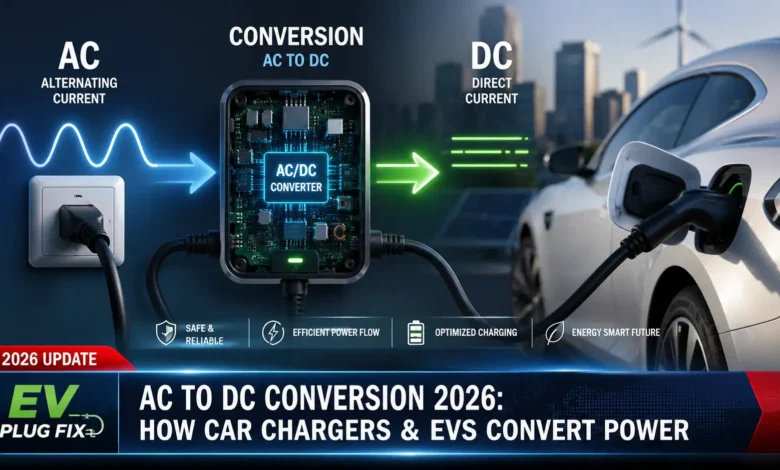
AC to DC conversion stands as one of the most critical yet invisible processes powering the electric vehicle revolution and our entire digital ecosystem. Every time you plug in your electric car, charge your smartphone, or power up a laptop, this essential electrical transformation occurs behind the scenes. The journey from alternating current (AC) delivered by the power grid to the direct current (DC) required by batteries and electronics involves a sophisticated four-stage process that engineers have perfected over decades.
Understanding AC to DC conversion isn’t just academic knowledge—it’s essential knowledge for EV owners, tech enthusiasts, and anyone curious about the electrical backbone of modern life. In 2026, as electric vehicles dominate new car sales and charging infrastructure expands globally, the importance of efficient power conversion has never been greater. For a comprehensive overview of residential charging options, check out our Home EV Charger Guide to see how this technology applies to your garage setup.
Understanding AC vs DC: The Foundation of Power Conversion
Electricity travels in two fundamentally different forms: Alternating Current (AC) and Direct Current (DC). The global power grid delivers AC because it’s ideal for long-distance transmission—voltage can be easily stepped up or down using transformers, significantly reducing energy loss over transmission lines.
In the United States, AC current reverses direction 60 times per second (60 Hz), while Europe and Asia operate at 50 Hz. This constant reversal makes AC efficient for distribution but completely unsuitable for powering modern electronics.
Direct current, however, flows in only one direction at constant voltage. Batteries, solar panels, fuel cells, and virtually all electronic circuits operate on DC. Smartphones, laptops, LED televisions, and most importantly, electric vehicles require stable, unidirectional current to function reliably.
The fundamental incompatibility between AC power delivery and DC-powered devices makes AC to DC conversion not just useful—it’s absolutely essential. Without this conversion, the modern electronic ecosystem and the entire EV industry simply couldn’t exist.
The Four Critical Stages of AC to DC Conversion
Converting AC to DC isn’t a single-step process. It involves a carefully engineered sequence of four stages, each designed to transform raw alternating current into clean, stable direct current suitable for sensitive electronics and battery charging.
Stage 1: Transformation – Getting the Voltage Right
The first stage adjusts incoming AC voltage to appropriate levels using a transformer—a device that employs electromagnetic induction to transfer electrical energy between circuits. A standard wall outlet provides 120V in North America or 230V in Europe, but most devices require much lower voltages.
Transformers consist of primary and secondary coils wound around a shared iron core. The ratio of turns between coils determines whether voltage steps up or down. For most consumer electronics and EV chargers, the transformer steps down voltage to safer, more manageable levels. A typical laptop charger might reduce 120V AC to around 19V AC before further processing.
Transformers also provide critical electrical isolation between input and output circuits—an essential safety feature protecting both devices and users from dangerous high-voltage exposure.
Stage 2: Rectification – Converting Waveforms
Once voltage reaches appropriate levels, rectification begins—converting the alternating waveform into unidirectional current. This stage uses diodes, semiconductor components that allow current flow in only one direction.
Two primary rectification methods exist:
- Half-wave rectification uses a single diode, allowing only one half of the AC wave to pass through. While simple and cheap, it discards half the available power, making it inefficient.
- Full-wave rectification employs a bridge rectifier—four diodes arranged in a diamond pattern—utilizing both positive and negative AC halves. When the AC swings negative, diodes reroute current to maintain consistent direction through the load. This is far more efficient and represents the standard method used in virtually all modern power supplies.
The output from a full-wave rectifier is pulsating DC—current flowing consistently in one direction but varying in magnitude. Engineers sometimes call this “bumpy DC,” and it’s not yet suitable for sensitive electronics.
| Rectification Type | Diodes Used | Efficiency | Common Applications |
|---|---|---|---|
| Half-Wave | 1 | ~40% | Simple battery chargers, low-power devices |
| Full-Wave Bridge | 4 | ~80-85% | EV chargers, power supplies, appliances |
| Synchronous Rectification | MOSFETs | ~90-95% | High-efficiency power supplies, modern EV chargers |
Stage 3: Filtering – Smoothing the Pulsating DC
Pulsating DC causes instability, noise, and potential damage to sensitive components. The filtering stage smooths these variations, producing stable DC output.
Large electrolytic capacitors placed parallel to the rectifier output form the backbone of filtering. During pulsating DC peaks, capacitors charge up; during troughs, they discharge stored energy to maintain output voltage. The result is nearly constant DC voltage with only minor residual ripples.
Advanced designs incorporate inductors combined with capacitors to form LC filters, providing even smoother DC output. The quality of filtering directly impacts device performance—inadequate filtering produces audible hum in audio equipment or visible flicker in lighting systems.
Stage 4: Voltage Regulation – Maintaining Precision
The final stage ensures output voltage remains precisely constant despite variations in input AC voltage or changes in load conditions. Two primary regulation approaches exist:
- Linear regulators like the classic 7805 chip dissipate excess voltage as heat to maintain stable output. Simple and producing very clean DC, they’re inefficient when input-output voltage differences are large.
- Switching regulators (Switch-Mode Power Supplies or SMPS) use high-frequency switching transistors to convert excess energy into stored magnetic or electric energy, releasing it as needed. SMPS designs achieve 85-95% efficiency and dominate modern chargers, computers, and appliances. The trade-off involves greater circuit complexity and potential electromagnetic interference.
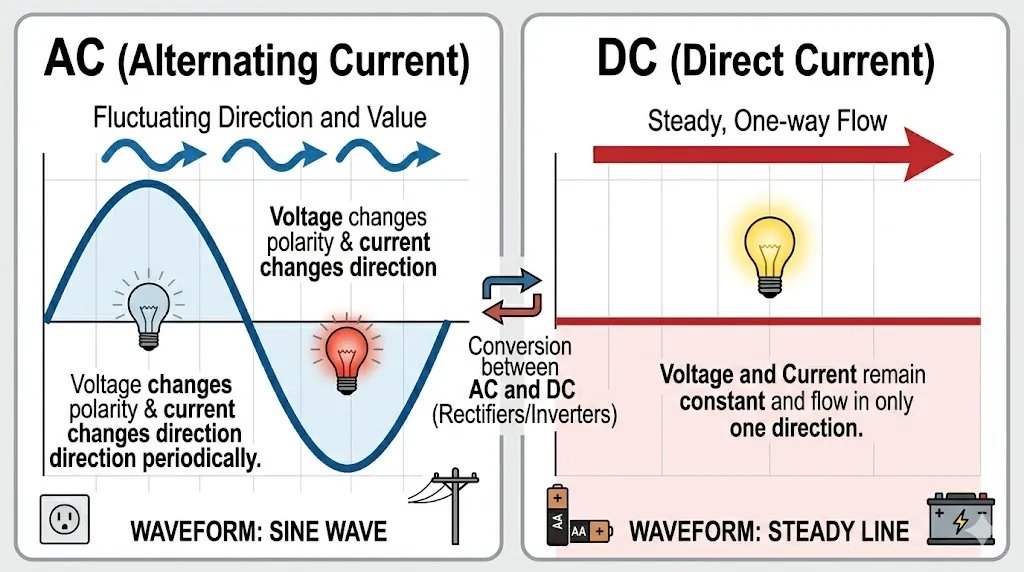
How your EV’s on-board charger converts grid AC power to battery-ready DC current
AC to DC Conversion in Electric Vehicle Charging
Electric vehicle charging represents the most demanding and sophisticated application of AC to DC conversion in consumer technology. When you charge an EV from a household outlet or Level 2 station, the grid delivers AC power, but your vehicle’s battery stores DC power. The conversion must happen somewhere, and EV manufacturers have developed two distinct approaches:
On-Board Chargers: Built-in Conversion
The on-board charger (OBC) lives inside your electric vehicle, accepting AC from the charging cable and performing the full conversion sequence. Typical OBCs range from 3.3 kW to 22 kW, with newer models pushing toward 22 kW for faster home charging.
Your EV’s OBC is essentially a highly sophisticated version of the four-stage AC to DC conversion process—transforming 240V AC grid power, rectifying it with high-power bridge rectifiers using MOSFETs or IGBTs, filtering through large capacitors and inductors, and regulating final voltage to match battery state of charge.
DC Fast Charging: External Conversion
DC fast charging stations handle AC to DC conversion externally, delivering DC directly to the vehicle’s battery pack at much higher power levels—50 kW, 150 kW, or even 350 kW in ultra-fast chargers. This approach bypasses the vehicle’s on-board charger limitations, enabling significantly faster charging speeds.
The vehicle’s Battery Management System communicates with the external charger to control voltage and current for safe, efficient charging. This external conversion also reduces heat generation inside the vehicle, extending component life and improving overall charging efficiency. Many modern DC fast chargers also incorporate Bidirectional EV Charging capabilities, allowing energy to flow both ways for vehicle-to-home applications.
Everyday Devices Powered by AC to DC Conversion
AC to DC conversion is embedded in virtually every aspect of modern life. Beyond EV charging, this technology powers countless everyday devices:
Smartphone Chargers
Compact SMPS units convert 120/230V AC to 5V–20V DC for charging lithium-ion batteries. Modern fast chargers incorporate sophisticated power delivery protocols.
Laptop Power Adapters
Step down and rectify AC to provide 19V–20V DC for laptop internal circuitry and battery charging systems, often reaching 85-90% efficiency.
LED Lighting Systems
LED drivers convert AC mains voltage to low-voltage DC (typically 12V or 24V) required by LED arrays. Poor conversion quality causes flickering and reduced lifespan.
Desktop Computer PSUs
Power supply units convert 120V/230V AC into multiple DC rails: +12V for CPU and GPU, +5V for drives, +3.3V for logic circuits.
Medical Equipment
Hospital devices require ultra-stable, isolated DC power, making high-quality AC to DC conversion a critical patient safety factor.
Why AC to DC Conversion Matters Now More Than Ever
As electric vehicles become mainstream and renewable energy systems proliferate, efficient AC to DC conversion has never been more critical:
Grid Compatibility
Our global power infrastructure was built around AC for economic reasons, but virtually all modern technology requires DC. AC to DC converters remain the essential bridge between these two worlds.
Safety Protection
High-voltage AC is dangerous when in direct contact with electronic components. Proper conversion reduces voltages to safe levels and provides electrical isolation, protecting both devices and users. This is particularly important when selecting the right EV Charging Cable Guide to ensure compatibility and safety with your vehicle’s conversion system.
Energy Efficiency
Modern switch-mode power supplies achieve efficiencies above 90%, dramatically reducing energy waste compared to older linear regulators. This efficiency matters enormously as EV adoption scales globally.
Precision Power Delivery
Sensitive electronics require stable, noise-free power supplies. Voltage regulation ensures input AC fluctuations don’t affect device performance or longevity—why your laptop continues operating normally even when grid voltage varies. For EV owners, understanding this principle helps protect against EV Battery Degradation by ensuring your charging system delivers consistent, regulated power over time.
“The future of transportation depends on efficient AC to DC conversion. Every improvement in conversion efficiency translates directly to faster charging, longer range, and reduced energy costs for EV owners.”
Making Smart Charging Decisions
For EV owners in 2026, understanding AC to DC conversion helps make better charging choices:
- Home charging relies on your vehicle’s on-board charger. Higher-capacity OBCs (11-22 kW) significantly reduce charging time at home.
- Public charging with Level 2 stations still uses your vehicle’s OBC, so your car’s charging speed capabilities matter.
- DC fast charging bypasses your OBC limitations, making it the fastest option for long-distance travel.
- Battery health depends on high-quality conversion. Poor regulation can cause premature battery degradation. To fully optimize your charging setup, consider exploring Networked EV Chargers that provide advanced monitoring and control features.
AC to DC conversion powers our electric future. Whether you’re charging your EV, powering your smartphone, or running sophisticated medical equipment, this invisible technology makes modern life possible. As conversion efficiency continues improving, expect faster charging, longer range, and more sustainable energy use across every sector.