EV Charger IP & IK Ratings Explained 2026: Choose the Right Protection for Your Installation
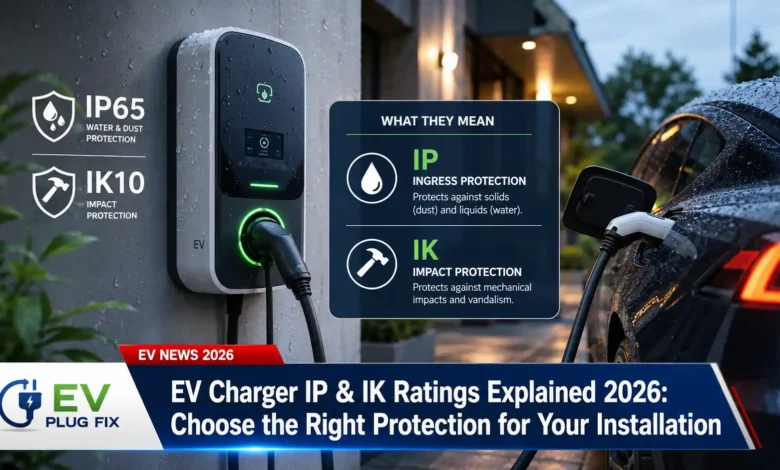
EV charger IP and IK ratings determine whether your charging station survives weather, dust, impacts, and daily wear in 2026. These alphanumeric codes appear on every charger specification sheet, but many buyers either ignore them or misunderstand what they actually mean for real-world performance. The consequence? You either overpay for protection you don’t need or end up with a damaged charger that fails prematurely.
IP ratings protect against dust and water ingress while IK ratings measure resistance to mechanical impacts. For most home installations in 2026, IP65 and IK08 offer an ideal balance. Public outdoor stations demand higher levels like IP67 and IK10 to withstand harsh weather and potential vandalism. The right combination saves you money, extends equipment life, and ensures your EV charges reliably whenever you plug in. When selecting your charger, consider reviewing our comprehensive Choose the Right EV Charger guide to understand all factors beyond just protection ratings.
What Happens When You Choose the Wrong IP or IK Rating for Your EV Charger
The technical specifications create confusion. People see a high number and assume it’s automatically superior, but the reality is more nuanced. This misunderstanding leads to two equally frustrating outcomes: insufficient protection that leaves your charger vulnerable, or unnecessary expense on ruggedized equipment you simply don’t require.
Take the homeowner who purchased a budget charger with minimal sealing for outdoor wall mounting. Within months, moisture penetrated the housing, corroded internal components, and the unit needed complete replacement at a cost exceeding $400. Another buyer went the opposite direction, spending an extra $300 on industrial-grade protection for a sheltered garage installation that only needed basic dust resistance.
Common Rating Mistakes and Their Real Costs
| Mistake | Result | Added Cost Example |
|---|---|---|
| Too Low Rating | Water or dust damage leads to early failure | Replacement $400+ |
| Too High Rating | Unnecessary expense on over-engineered unit | Extra $200-$500 |
| Ignoring Location Factors | Poor performance in specific environments | Frequent maintenance calls |
| Price-Only Focus | Early failure from inadequate protection | Downtime and replacement costs |
Beyond the direct financial impact, wrong ratings create safety hazards. Water ingress can cause electrical shorts. Impact damage may expose live components. Vandalism in public installations becomes more likely without adequate mechanical protection. These risks affect not only the charger owner but also anyone in proximity to the equipment. Understanding EV Charging Efficiency can help you maximize performance while maintaining proper protection.
- Match ratings precisely to your installation environment – garage, outdoor wall, or public parking area all have different requirements
- Consider year-round weather patterns – temperature extremes, humidity, and precipitation levels matter
- Factor in physical contact risks – foot traffic, vehicle proximity, and cleaning methods affect impact needs
- Calculate total ownership costs – purchase price plus maintenance and replacement over the charger’s lifespan
EV Charger IP and IK Rating Misconceptions That Lead to Bad Purchases
Marketing claims and online forums spread inaccurate information about protection ratings. These misconceptions persist because the technical standards aren’t widely understood by the average EV owner. Let’s address the most common ones directly.
Higher Numbers Always Mean Better for EV Chargers
This is the most widespread myth. While higher IP and IK ratings do offer more protection, they come with trade-offs. A charger rated IP69K might survive high-pressure washing, but it also costs significantly more, weighs more, and may run hotter due to thicker sealing. For a covered garage installation, that level of protection is wasted money.
IP and IK Ratings Provide the Same Type of Protection
These ratings measure completely different things. IP (Ingress Protection) covers solids and liquids – dust, dirt, rain, splashes, and submersion. IK (Impact Protection) measures resistance to mechanical shock from objects, falls, or deliberate tampering. You need both, but for different reasons. A charger with excellent IP protection but weak IK ratings could stop working after a minor bump.
Numbers Alone Tell You Everything About Charger Durability
Laboratory testing provides a baseline, but real-world conditions vary. Installation quality, seal integrity, temperature fluctuations, and UV exposure all affect long-term durability. The rating is a starting point, not the complete story. For installations in apartment buildings, review our Austria Wallbox Installation guide which addresses specific environmental challenges in multi-tenant settings.
| Misconception | Fact | Purchase Risk |
|---|---|---|
| Higher always better | Balance protection with actual needs | Overspending on unnecessary features |
| IP and IK are the same | Different protections for different threats | Incomplete coverage leaves vulnerabilities |
| Numbers tell the full story | Environment and installation matter equally | Wrong selection despite good numbers |
| All units with same rating are equal | Quality and design vary by manufacturer | Reliability issues despite correct rating |
“The most common regret I hear from EV owners is buying a charger with protection ratings that don’t match their actual installation environment. They either paid too much or got too little.” – Industry installation specialist
Before purchasing, evaluate your specific environment honestly. Consider climate conditions, exposure risks, and how the charger will be used daily. Then compare multiple models that meet those requirements rather than fixating on maximum numbers.
IP and IK Ratings Breakdown: What Each Number Actually Means
The IP rating system uses two digits. The first digit, ranging from 0 to 6, indicates protection against solid objects and dust. A rating of 6 means the enclosure is dust-tight – no particles can penetrate. The second digit, from 0 to 9, covers protection against moisture. IP65 withstands water jets from any direction, while IP67 handles temporary immersion in water up to 1 meter deep.
IK ratings operate on a different scale, measuring impact energy in joules. The scale runs from IK00 to IK10. IK08 withstands 5 joules of impact energy – roughly equivalent to a 1.7kg mass dropped from 300mm. IK10 handles 20 joules, suitable for public environments where vandalism or accidental vehicle contact is possible. Proper protection becomes especially important when considering High-Power EV Thermal Management systems that generate additional heat and require robust enclosures.
Common IP Ratings for EV Chargers
- IP54 – Dust protected, splash water resistant. Suitable for indoor garage installations.
- IP65 – Dust tight, protected against water jets. Standard for outdoor wall-mounted home chargers.
- IP66 – Dust tight, protected against powerful water jets. For areas with heavy rain or pressure washing.
- IP67 – Dust tight, protected against temporary immersion. For flood-prone or coastal locations.
Common IK Ratings for EV Chargers
- IK07 – 2 joules impact resistance. Suitable for low-traffic home installations.
- IK08 – 5 joules impact resistance. Good balance for most outdoor home chargers.
- IK09 – 10 joules impact resistance. For areas with moderate traffic or risk.
- IK10 – 20 joules impact resistance. Essential for public stations and high-risk areas.
Most EV charger manufacturers recommend specific combinations for different applications. IP65 with IK08 serves as the sweet spot for residential outdoor installations. Public charging networks typically specify IP66 or IP67 combined with IK10 to minimize downtime and maintenance costs.
The testing methods for these ratings are standardized internationally. IP tests involve controlled exposure to dust and water under specific conditions. IK tests use calibrated pendulum hammers or drop weights to ensure consistency. Manufacturers who claim these ratings must demonstrate compliance through accredited laboratory testing.
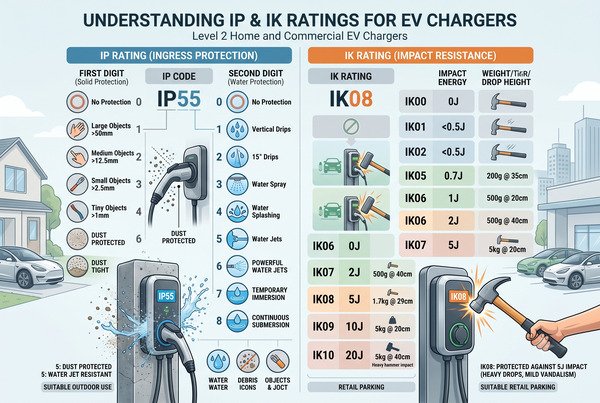
Outdoor wall-mounted EV chargers need strong weather and impact protection to ensure reliable performance year-round.
How to Select the Right EV Charger Protection for Your Installation in 2026
Choosing the correct IP and IK rating follows a straightforward process based on your specific location and usage patterns. Here’s how to evaluate your needs systematically.
Assess Your Installation Location and Exposure
Indoor garage installations in dry climates typically require minimal protection. IP54 offers sufficient dust and splash resistance for these environments. The charger stays protected from direct weather, and impact risk is limited to occasional bumps from stored items or vehicle doors.
Outdoor residential installations demand stronger weather protection. IP65 handles rain, snow, and hose cleaning effectively. Choose IK08 for impact resistance – it withstands the occasional accidental contact with garden tools or bike handles without damage.
Public and commercial charging stations require the highest protection levels. IP66 or IP67 ensures reliable operation in all weather conditions. IK10 protects against vandalism, vehicle collisions, and heavy use in high-traffic locations. For multi-vehicle setups, explore Multi-EV Home Charging solutions that often feature enhanced durability for shared environments.
Factor in Local Climate Conditions
Coastal areas with salt air need corrosion-resistant enclosures with strong sealing. High humidity and salt spray can penetrate inadequate IP ratings quickly. Inland areas with heavy dust or pollen also benefit from higher IP ratings to prevent particle ingress.
Cold climate installations face freeze-thaw cycles that can stress seals. High IP ratings with proper drainage prevent water from entering and freezing inside the housing. Hot climates with intense UV exposure require enclosures that won’t degrade under direct sunlight, regardless of the IP rating.
| Installation Location | Recommended IP Rating | Recommended IK Rating | Primary Protection Need |
|---|---|---|---|
| Indoor Garage (Residential) | IP54 | IK07 | Dust and basic splash resistance |
| Outdoor Wall (Residential) | IP65 | IK08 | Weather and light impact protection |
| Public Parking Station | IP66 or IP67 | IK10 | Heavy use and vandalism resistance |
| Flood-Prone or Coastal Area | IP67 | IK09 or IK10 | Water immersion and corrosion protection |
Consider Long-Term Maintenance and Replacement Costs
Higher-rated chargers typically cost more upfront but may save money over time through reduced maintenance and longer service life. Calculate the total cost of ownership over five to ten years. Factor in installation costs, potential repair expenses, and the risk of premature failure with insufficient protection.
Consult Professional Installers
Local electricians who work with EV chargers understand regional conditions and common installation challenges. Their experience can help you avoid expensive mistakes. Many reputable manufacturers provide technical support to help match products to specific applications. When planning your installation, don’t forget to check local permit requirements with our Home EV Charger Permits guide which covers compliance and safety standards.
Taking Action: Your EV Charger Protection Checklist
Armed with this knowledge, you’re ready to select the right charger. Follow these steps to ensure your installation stays reliable for years to come.
- Document your installation location – note whether it’s indoor, outdoor, covered, or exposed
- Assess weather exposure – consider rain, snow, humidity, temperature extremes, and salt air
- Evaluate impact risks – identify foot traffic, vehicle proximity, and potential vandalism concerns
- Review manufacturer specifications – look for official IP and IK ratings with supporting test data
- Compare multiple products – evaluate features, warranty coverage, and protection ratings together
- Get professional input – consult with certified installers about local requirements
FAQ: Common Questions About EV Charger Protection Ratings
What do IP and IK ratings actually mean for EV chargers?
IP ratings measure protection against dust and water ingress. IK ratings measure resistance to mechanical impacts. Both are essential for reliable outdoor charger performance.
What IP rating should an outdoor EV charger have?
IP65 is the recommended minimum for most outdoor residential installations. For public or exposed locations, IP66 or IP67 offers enhanced protection.
What’s the difference between IP65 and IP67?
IP65 protects against water jets from any direction. IP67 protects against temporary immersion in water up to 1 meter deep for 30 minutes.
Do higher IK ratings cost more?
Yes, chargers with IK10 rating typically cost more than IK08 or IK07 units due to stronger enclosures and more robust construction materials.
Is IP54 enough for a garage EV charger?
IP54 provides adequate protection for most covered garage installations, resisting dust and splashes effectively.
Can I install an IP-rated charger on my own?
Follow manufacturer instructions and local electrical codes. Professional installation is recommended for safety and warranty compliance.
Selecting the right IP and IK rating for your EV charger is a critical decision that affects performance, safety, and cost over the life of your charging station. In 2026, with more chargers installed outdoors and exposed to increasingly unpredictable weather, proper protection has never been more important.
Don’t guess your charger’s protection needs. Evaluate your specific installation environment, understand what each rating actually provides, and choose a product that balances durability with value. The right charger protects your investment and delivers worry-free charging for years to come.